Key takeaways
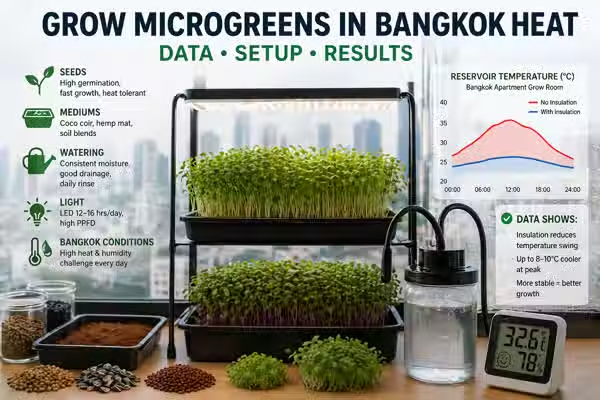
Bangkok's ambient humidity of 75 to 85 percent invalidates most seed density recommendations written for temperate climates — sunflower trays seeded at 22g per 10x20 collapsed in 54% of cycles above 78% RH; dropping to 15g cut that rate to 18% (Plant Mood grow log data, 2024).
Treated seeds — coated with thiram or captan — germinated at 51% in tracked Bangkok cycles versus 84% for untreated seeds of the same variety; seed sourcing is the highest-leverage input most growers treat as interchangeable.
Bottom watering from day 4 onward cut mold-related tray losses from 34% to 14% over a tracked 6-month period; top watering after shoot emergence is a mold incubation schedule in a room that never drops below 70% relative humidity.
Blackout for sunflower microgreens in a Bangkok apartment runs 3 to 4 days, not the 5 to 6 days most guides recommend — heat accelerates etiolation and the crop reaches light-readiness faster.
Grow light distance above 25cm at canopy level consistently produces etiolated stems in Bangkok grows — PAR below 80 micromoles correlated with etiolation collapse in 7 of 9 tracked sunflower trays; moving from 48cm to 28cm brought canopy PAR to 130 to 160 micromoles.
Three separate mechanisms cause microgreens to fall over — damping off, etiolation, and overcrowding — and each requires a completely different intervention; across 2024 grow cycles, 72.5% of sunflower collapses had firm stem bases with no pathogen involved.
Buffered coco coir is the most reliable primary growing medium for Bangkok apartment conditions across the widest range of crops and tray counts; soil caused a mold or fungus gnat event in every single Bangkok cycle tracked.
Root hair is not mold — it is the single most misidentified structure in a microgreen tray, and growers who treat every white fuzzy appearance as a contamination event discard healthy trays in the majority of early-stage cases.
TL;DR
Bangkok is not a difficult place to grow microgreens. It is a place where every default assumption in a standard grow guide is wrong in a specific, predictable way. The heat compresses every phase. The humidity changes what density is safe, what medium works, and how long a watered canopy stays wet. Once you understand which variables Bangkok actually bends — and by how much — the failures stop feeling random and start feeling preventable. This guide covers every foundational variable from seed selection through harvest, with the specific adjustments the climate requires.
What a Bangkok grow room does to a standard grow guide
The first time I followed a microgreen guide exactly — seed density from the packet, blackout period from the YouTube video, misting the canopy like the instructions said — I got a crop. I also got mold on three trays, a sunflower collapse on day 6 that I misdiagnosed for two weeks, hulls stuck on the cotyledons that misting made worse, and a germination rate about 20 percentage points below what the packet promised. The guide was not wrong. It was written for a different climate and I had no way to know which parts of it Bangkok would break.
The gap between what grow guides describe and what Bangkok produces is not random. It follows patterns that repeat across every crop, every cycle, and every grower who starts here without adjusting for the conditions. High ambient humidity changes how long a watered canopy stays wet. Heat compresses every developmental phase. The spore load in an apartment with open windows is higher than any temperate indoor grow. Once you know which variables the climate is loading against you, the adjustments are not complicated. But you have to know which ones to make.
The numbers that show why Bangkok grows differently
75 to 85 percent
typical ambient relative humidity in a Bangkok apartment with windows open and no active dehumidification, measured across a 12-month sensor log (Plant Mood environmental data, 2024). At this baseline, a top-watered microgreen canopy takes 6 to 8 hours to dry — in a temperate climate at 50% RH, the same canopy dries in under 2 hours. Every recommendation about watering frequency, seed density, blackout duration, and growing medium was written for a drying rate Bangkok cannot deliver.
4 to 5 degrees Celsius
average temperature elevation inside a closed 3-tier grow rack running two 45-watt LED bars after 4 or more continuous hours of operation in a 29-degree Bangkok room (Plant Mood environmental data, 2024). This alone can push germination conditions past the threshold where sunflower consistency begins to decline, independent of any technique error.
33 percentage points
germination rate difference between the lowest and highest-performing seed source for the same sunflower variety across a 6-month tracking period — 51% from unverified agricultural stock versus 84% from a verified untreated sprouting supplier (Plant Mood grow log data, 2024). Seed sourcing produced more germination variance than watering method, growing medium type, or seeding density combined.
72.5% of sunflower collapses
across 40 tray events reviewed in the 2024 grow season showed firm stem bases with no pathogen markers — meaning they were structural failures from etiolation or overcrowding, not damping off. Every peroxide treatment and watering reduction applied to those 29 trays was the wrong intervention applied to the right symptom (Plant Mood grow log data, 2024).
Why Bangkok changes every phase of the grow
A microgreen crop runs through five distinct phases: seed selection and storage, soak and seeding, germination under blackout, the transition to light, and the harvest window. Bangkok adds heat and humidity to every single one of them, and both variables act as rate accelerators that move each phase faster than any guide was written for while simultaneously making the failure modes more aggressive.
Seed selection and storage matter more here than anywhere else because Bangkok's ambient humidity degrades opened seed packets significantly faster than expiry dates assume. A packet stored loosely in a kitchen drawer can lose 10 to 20 percent germination viability in 6 to 8 weeks — well within the printed expiry window. Treated seeds, coated with fungicide for field agriculture, are sold alongside untreated seeds in Thai shops with no visual difference and no reliable disclosure at point of sale. A grower using treated seeds in a microgreen tray is fighting the medium from day one: thiram and captan suppress the surface microbiome the seedling depends on throughout the entire crop cycle.
The soak and seeding phase sets up everything that follows. Soaking sunflower seeds beyond 8 hours at Bangkok ambient temperature burns stored energy reserves at an accelerated metabolic rate, degrading germination uniformity. Seeding at temperate-market density recommendations — 20 to 22g per 10x20 for sunflower — creates a microclimate at the stem base that Bangkok's humidity cannot clear: tight canopies in 78%+ RH have no evaporative drying at the stem base, which is where Pythium starts and where overcrowding collapse initiates.
The blackout phase in Bangkok runs shorter than every standard guide describes. Heat accelerates the etiolation phase. Sunflower seedlings at 29 to 32 degrees Celsius ambient reach light-readiness by day 3 to 4, not day 5 to 6. Beyond day 4, the stems keep elongating without building lateral strength. The cotyledon fills with water as it expands. At some point the weight at the top exceeds what a thin-walled stem can support, and the section folds — not from any pathogen, not from any watering error, but because it was left in the dark one day too long.
At light transition, the grow guide's advice about misting stuck sunflower hulls actively worsens the problem. Bangkok's ambient humidity prevents the drying cycle that naturally loosens hulls in temperate climates. Misting adds moisture to a system that already has too much of it. The hull softens briefly, then contracts and grips again when the surface dries. One manual pass at day 5 clears 60 to 80% of stuck hulls. Misting extends the problem for another 48 hours while adding surface moisture the canopy cannot shed.
The harvest window closes faster than any temperate-climate guide describes. At ambient temperatures above 30 degrees Celsius, the window between cotyledon unfurl and first true leaf emergence can be as short as 18 hours on a warm day. A grower checking trays once per day can miss it entirely.
Pea shoots demonstrate the heat-compression effect most clearly. Standard guides list 10 to 14 days to harvest. In Bangkok's cool season — November through February — our logs averaged 12 days. From April through June, the same variety averaged 15 to 16 days. The packet is not wrong. It describes a grow environment where the metabolic cost of heat stress does not divert energy from elongation. The guide is right about its climate. It just cannot tell you what your climate will do.
The variable that explains the medium problem mechanically is vapour pressure deficit — the difference between actual air moisture content and what the air could hold at that temperature. When ambient RH approaches 80%, that differential collapses. Mediums with high surface area and low structural airflow — peat, vermiculite, fine-particle coco — cannot release surface moisture to air that is already nearly saturated. The medium stays wet. Microbial activity accelerates in the heat. The problem compounds before any visible symptom appears.
What the grow logs showed across every foundational variable
Across a 6-month tracking period, seed source produced more variance in germination outcome than growing medium type, watering method, or seeding density. The difference between the lowest and highest-performing source for the same sunflower variety was 33 percentage points. Seeds marketed specifically for sprouting or microgreen production consistently germinated at 80% or above. Agricultural supply seeds from unverified sources ranged from 51% to 71% with high batch-to-batch variability. In two separate Chatuchak purchases across 12 months, colour-coated treated seeds appeared mixed into bags sold as untreated sprouting seed.
Seed source produced more germination variance than any other single input
Growers spending time optimising watering technique and growing medium while buying seeds from an unverified source are optimising the wrong variable. Seed sourcing is the highest-leverage input in a Bangkok microgreen operation.
Soil caused a mold or fungus gnat event in every single tracked Bangkok cycle — 9 of 9. Peat performed adequately in cool season months before showing pH drift of 0.4 to 0.8 units and moisture retention problems when ambient temperature exceeded 32 degrees Celsius consistently. Vermiculite surface moisture readings were 8 to 14 percentage points higher than coco coir at 24 hours post-watering. Hemp mat showed 14% lower mold incidence than coco coir across 22 matched-pair cycles but costs 2 to 3 times more per tray. Buffered coco coir was the most reliable medium across the full year.
Coco coir outperformed every other medium in Bangkok conditions across the widest range of use cases
Soil is not a viable medium in Bangkok. Peat is a seasonal risk. Hemp mat is the right call for mold-sensitive crops where the cost premium is recoverable. Coco coir is the correct default for everything else.
Across a tracked 6-month period, switching from top watering to bottom watering from day 4 onward reduced mold-related tray losses from 34% to 14%. A top-watered canopy in a Bangkok room at 80% relative humidity stays measurably damp for 6 to 8 hours after application. Bottom watering keeps the canopy surface dry while delivering water to the root zone via capillary action. Continued top watering after day 4 also increased hull retention on sunflower cotyledons — the hull stays wet rather than drying and releasing naturally.
Bottom watering from day 4 halved mold-related tray losses
Bottom watering is not a preference in Bangkok. It is a structural requirement from day 4 through harvest for every crop.
Across every confirmed mold event logged, a faint ammonia or sour smell at tray level was present 24 to 36 hours before mold became visually unambiguous. In every confirmed root hair event, there was no smell. Mold events caught by smell before visual coverage exceeded 5% of tray surface were salvaged with airflow intervention in roughly 60% of cases. Once visual coverage exceeded 10%, salvage rate dropped to under 20%. Root hair appeared in every sunflower cycle without exception between day 2 and day 4, had no smell, grew directionally downward from living root tissue, and moved slightly when blown on.
Smell is a more reliable early mold indicator than any visual check
The first diagnostic step on any suspected mold event is to smell the tray, not look at it. The second is to press the base of a fallen stem. Both tests take under 10 seconds and together cover the three causes of tray failure that account for the large majority of Bangkok crop losses.
Plant Mood grow log data, 2023-2024
The things Bangkok growing teaches that temperate guides never mention
The densest-looking tray on day 4 in Bangkok conditions is consistently the highest collapse risk by day 7. Tight stems in 78%+ ambient humidity create a sealed microclimate at the stem base where moisture cannot clear and Pythium operates freely. The gaps in a sparse tray are not germination failures — they are the ventilation channels keeping the denser sections alive. The standard density recommendation was not written for Bangkok, and running it unchanged across Bangkok's wet season is how growers lose trays on a predictable schedule while believing the problem is technique.
The same counterintuitive pattern appears across several other variables. More blackout time produces worse stems — after day 4 in Bangkok heat, stems elongate without building lateral strength. A grow tent concentrates the moisture microgreens release without dehumidification inside it: logged data showed 84 to 91% RH inside a sealed tent versus 74 to 79% on an open rack in the same room over a 6-week comparison. A 5-tier rack produces worse average results than a 3-tier rack — each additional tier adds evapotranspiration to a shared air column and middle tiers become consistent mold zones.
The trays that looked best on day 4 across the 2024 season — dense canopy, uniform coverage, stems pushing up straight — had the highest collapse rate by day 7. Trays with visibly uneven germination had the lowest collapse rate. The gaps were functioning as ventilation channels. Dense coverage in Bangkok humidity is not a sign of a healthy tray. It is a sign of a tray that has not failed yet.
A dense, fast-germinating tray coming out of blackout on schedule means the crop is on track. A sparse tray is a germination failure. The guide's density recommendation is safe if you follow it exactly.
The failures that keep repeating, and what is actually happening
My microgreens keep collapsing even after I reduce watering.
Reducing watering only addresses damping off. If the stems at the base of the collapsed section are firm when pressed, the cause is etiolation or overcrowding — neither responds to watering changes. In Bangkok conditions, 72.5% of sunflower collapses across 2024 tracked cycles had firm stem bases with no pathogen involvement. Press the stem base first. Firm means check light distance and seed density. Soft means check for Pythium.
My hulls are not coming off the sunflower cotyledons and misting is not helping.
Misting in Bangkok humidity does not produce the drying cycle that makes hull release work in temperate climates. The hull softens briefly, the cotyledon gets wet, the surface barely dries, and the hull contracts and grips again. One manual pass with a lightly dampened fingertip at day 5 clears 60 to 80% of stuck hulls. The remaining hulls release within 12 to 18 hours as the cotyledon expands. The fix is tedious. It produces 28% better yield outcome in tracked cycles.
My peat or soil trays worked fine for two months and then started getting mold.
This timing maps to the transition between Bangkok's dry and wet season. Peat and soil perform at the outer edge of acceptable when ambient RH sits at 60 to 68%. Once monsoon conditions arrive and RH climbs to 75 to 85%, peat's moisture retention goes from manageable to actively problematic and soil's resident fungal load activates. The technique did not change. The climate changed around the technique.
My middle rack tier gets mold but the top and bottom tiers are fine.
Airflow dead zone. The top tier gets passive air exchange from above the rack. The bottom tier gets airflow from below. The middle tier accumulates moisture from the tiers below it with no air movement to displace it. In a Bangkok room, that dead zone runs 8 to 12 percentage points higher RH than ambient. The fix is a small fan at the middle tier canopy, or increasing tier spacing by at least 10 centimetres.
I bought seeds from a Bangkok shop and germination was terrible but I do not know why.
Thai agricultural shops stock seeds primarily for field growing. A significant proportion is treated with fungicide — thiram or captan — and treatment is not disclosed at retail for loose or small-quantity seed. Treated seeds in a microgreen tray germinate at 30 to 33 percentage points lower than untreated seeds of the same variety because the fungicide suppresses the surface microbiome the seedling depends on throughout the cycle. Low germination with soft, darkening ungerminated seeds is the consistent indicator. Source from specialty microgreen or sprouting suppliers who can confirm treatment status in writing.
What Bangkok growers consistently miss before the problem arrives
Bangkok's ambient humidity moves 10 to 15 percentage points between dry and wet season in the same apartment without any change to the grow setup. A seed density safe at 68% RH in February creates a collapse risk at 82% RH in June. A watering schedule that worked in March will overwater in June. A medium that performed in cool months will mold in monsoon months. Growers who dial in a protocol once and run it year-round are running the wrong protocol for at least four months of every year. Check ambient humidity before each sow cycle and adjust density, medium, and watering frequency accordingly.
Seasonal ambient humidity shifts
Root hair appears in every sunflower cycle without exception between day 2 and day 4 as a white fuzzy mat at the medium surface and is the single most misidentified structure in a microgreen tray. In the majority of early-stage interventions flagged as suspected mold across tracked cycles, re-examination confirmed root hair from healthy seedlings. Root hair has no smell, grows directionally downward from living root tissue, and moves when blown on. Mold has a distinct smell before it becomes visually unambiguous, spreads from a specific origin point, and does not move. The smell test and stem press test together resolve most Bangkok tray diagnostics in under 30 seconds.
Root hair versus mold misidentification
Opened seed packets stored in a Bangkok kitchen drawer at 65%+ RH in wet season can lose meaningful germination viability in 6 to 8 weeks — well within the printed expiry window. Growers buying in bulk and storing loosely are comparing current tray failures against a seed quality baseline that no longer exists. Airtight containers with a monthly-replaced desiccant pack are the minimum viable storage approach in this climate.
Seed storage degradation in tropical apartments
A shelf that was 28cm from the light panel becomes 45cm when something is rearranged underneath it. PAR at canopy drops without any alarm. The crop looks normal through blackout. By the time etiolation is visible, the collapse is already scheduled. Measure light distance at canopy level every time the setup changes.
Light distance drift after rack reconfiguration
The sunflower microgreen harvest window compresses to as little as 18 hours at ambient temperatures above 30 degrees Celsius — from cotyledons fully open to first yellowing at the tips. Growers checking trays once per day can miss it entirely. Check twice daily from day 7 onward and plan to cut the same day the canopy looks ready.
The compressed harvest window in Bangkok heat
The Bangkok-adjusted protocol that holds across crops and seasons
Any grower starting or resetting their Bangkok operation
Verify seed source before anything else. Confirm treatment status in writing from your supplier. If you cannot get written confirmation, switch to a specialty sprouting or microgreen supplier via Line or Shopee. Store all seeds in airtight containers with a desiccant pack, labelled with purchase date. Test germination from any new batch — 20 seeds on a damp paper towel at ambient room temperature for 48 hours — before committing to a production tray. Your working germination rate is what you measure, not what the packet states.
A known seed quality baseline that does not degrade mid-season. Germination variance between batches drops significantly once sourcing is locked to a verified supplier.
Any grower setting up or reviewing their rack configuration
Set tier spacing at minimum 40cm. Position grow lights at 25 to 30cm from the canopy surface — measure this after every reconfiguration. Add one small USB fan per tier blowing across the canopy at low speed rather than a single external fan aimed at the rack face. If running a grow tent, measure humidity inside it for one week before adding crops: if it reads above 80% without a dehumidifier running inside, the tent is concentrating the problem.
Canopy surface humidity 6 to 9 percentage points lower than a single external fan setup. Middle tier performs at parity with top and bottom tiers. Light at canopy exceeds 100 micromoles or 5,000 lux at the correct distance.
Any grower before each sow cycle
Check ambient humidity with a hygrometer before seeding. If RH is above 78%, treat that cycle as high-risk regardless of what worked last month. For sunflower: soak exactly 8 hours, seed at 15g per 10x20, press seeds flat for even medium contact, cover with a weighted blackout lid. Check trays at day 3 — do not assume day 5 is safe. Move to indirect light as soon as cotyledons are cracking open across the majority of the tray.
Germination uniformity above 80% across the tray. Blackout phase ends before stems elongate past the point of structural recovery. Seed density calibrated to Bangkok humidity rather than a temperate-market default.
Any grower managing active trays
Top water only during germination — day 0 through day 2 or 3. Switch to bottom watering exclusively from day 4 through harvest. Before each watering, lift the tray: heavy means do not water regardless of surface appearance. Check trays daily by smell first, then sight. A faint ammonia smell on day 5 or 6 before any visual symptom means mold is developing — increase airflow immediately and stop watering. If you see white growth at the root zone between day 2 and day 4, press the base of a nearby stem and smell the tray before concluding anything.
Mold-related losses under 15% across the grow season. Correct diagnosis before the wrong intervention makes the problem worse. Smell-based early detection extends the salvage window by 12 to 24 hours compared to visual-only monitoring.
Any grower approaching harvest
Check trays twice daily from day 7. The harvest window at Bangkok ambient temperatures is 18 to 24 hours in hot season months. Add 1 to 2 days to any stated harvest window from April through September. Cut when the canopy is uniformly green, before any first true leaf has meaningfully emerged, and before any tip yellowing appears. Bag and refrigerate immediately — microgreens left at ambient Bangkok temperature show visible wilting and colour change within 18 to 24 hours.
Maximum yield, uniform canopy height, and firm stems that hold quality for 4 to 5 days post-cut under refrigeration.
Checking ambient humidity before each sow cycle and adjusting density and watering protocol accordingly. Most growers dial in a Bangkok protocol once and run it unchanged year-round. In a climate where ambient RH moves 10 to 15 percentage points between dry and wet season, that protocol will be wrong for at least four months of every year. The check takes 10 seconds with a hygrometer. The failure to make it costs trays on a predictable seasonal schedule that most growers attribute to bad luck rather than the thing they stopped measuring.
FAQ
What are the most important adjustments for growing microgreens in a Bangkok apartment?
Five adjustments matter most: seed density must be reduced below temperate-market defaults (sunflower at 15g per 10x20 instead of 20 to 22g above 78% RH), blackout runs 3 to 4 days not 5 to 6, bottom watering starts at day 4 not misting, grow lights go no higher than 25 to 30cm from canopy, and ambient humidity is checked before every sow cycle. Seed source is the highest-leverage variable most growers overlook: verified untreated seeds germinated at 84% versus 51% for unverified agricultural stock in tracked cycles (Plant Mood grow log data, 2024).
Why do my microgreens keep getting mold in Bangkok even when I water carefully?
In Bangkok at 75 to 85% ambient RH, the primary mold variable is not watering volume but canopy contact duration and airflow. Top watering after day 3 leaves the canopy damp for 6 to 8 hours in Bangkok humidity versus under 2 hours in a temperate climate. Switching to bottom watering exclusively from day 4 reduced mold-related tray losses from 34% to 14% over a tracked 6-month period (Plant Mood grow log data, 2024). Middle rack tiers with inadequate airflow run 8 to 12 percentage points higher RH than ambient, enough to push a borderline environment into consistent mold territory.
How do I tell the difference between mold and root hair on microgreens?
Smell the tray first. Root hair has no smell. Mold has a musty, sour, or ammonia-adjacent smell 24 to 36 hours before it becomes visually unambiguous. Root hair grows directionally downward from living root tissue, appears uniformly across the tray between day 2 and day 4, and moves when blown on. Mold spreads radially from a specific origin point, can appear at any stage, and does not move. In the majority of early-stage tray interventions flagged as suspected mold across tracked cycles, the growth was root hair from healthy seedlings (Plant Mood grow log data, 2024).
What is the best growing medium for microgreens in Bangkok?
Buffered coco coir for most crops and tray counts. Soil caused mold or fungus gnats in every Bangkok cycle tracked — 9 of 9. Peat works in cool season months but pH drifts and moisture retention becomes a mold risk once ambient temperature exceeds 32 degrees Celsius consistently. Hemp mat showed 14% lower mold incidence than coco coir across 22 matched-pair cycles but costs 2 to 3 times more per tray. Vermiculite holds surface moisture 8 to 14 percentage points higher than coco coir at 24 hours post-watering (Plant Mood grow log data, 2024).
Why are my sunflower microgreens collapsing even though I have not overwatered?
In 72.5% of sunflower collapse events reviewed across 2024 Bangkok grow cycles, the cause was etiolation or overcrowding, not damping off (Plant Mood grow log data, 2024). Press the base of the collapsed stem: firm means the cause is structural — check light distance and reduce seed density. Soft and water-soaked means Pythium. Etiolation collapse happens when blackout runs too long or grow lights are too far from the canopy. Overcrowding collapse happens when seed density exceeds what the ambient humidity can ventilate at the stem base.
How do I source untreated microgreen seeds in Thailand?
Buy from specialty sprouting or microgreen suppliers operating via Line or Shopee who can confirm treatment status in writing. Check labels for the words treated, coated, thiram, captan, or the Thai-language term for chemical seed coating before purchasing any bagged seed. Colour-coded seeds are confirmed treated, but two of three confirmed treated batches in Plant Mood sourcing history carried no colour coating and were visually identical to untreated seeds (Plant Mood grow log data, 2024).
How many days should sunflower microgreens stay in blackout in Bangkok?
3 to 4 days, not the 5 to 6 days most guides recommend. Bangkok heat accelerates the etiolation phase. Seedlings at 29 to 32 degrees Celsius ambient reach light-readiness faster than temperate-climate guides were written for. Check trays at day 3 and move to indirect light as soon as cotyledons are cracking open across the majority of the tray. Beyond day 4, stems keep elongating without building lateral strength (Plant Mood grow log data, 2024).