Key takeaways
In Bangkok apartment grows, etiolation and overcrowding cause more microgreen collapses than damping off -- pressing the stem base takes 10 seconds and tells you which of the three you are dealing with.
Sunflower trays seeded above 18g per 10x20 in ambient humidity above 78% collapsed by day 6 in 54% of Plant Mood cycles; dropping to 15g cut that rate to 18%.
PAR below 80 micromoles at canopy level correlates with etiolation collapse in sunflower -- most Bangkok setups with lights mounted at 45cm or higher fall into this range without the grower knowing.
Bangkok's hot-season germination boost (ambient above 31 degrees Celsius shortens germination by roughly 14 hours) produces faster sprouts with thinner cell walls that are structurally more likely to fail under cotyledon weight.
A grower running trays at standard temperate seed densities in an unventilated Bangkok condo will hit repeat collapse cycles indefinitely -- the density recommendations in most guides were not written for 80% ambient humidity.
Day 4 stem diameter below 1.2mm in sunflower is a leading indicator of collapse risk -- measurable with a 150-baht calliper before any tray falls.
TL;DR
Three different problems cause microgreens to fall over. Damping off is a pathogen. Etiolation is a light deficiency. Overcrowding is a mechanical failure. Bangkok conditions make all three worse than any standard guide accounts for, and each one requires a completely different fix. The grower who treats all three as a watering problem will lose trays indefinitely. The one who spends 10 seconds diagnosing before intervening will stop most of the losses within two sow cycles.
Day 6, and the tray should have been fine
The sunflower tray had come through blackout looking exactly right. Dense canopy, pale green, stems pushing up straight. I had seeded it at 22 grams, which is what the guide said. Humidity in the room was sitting at 81%. Grow light was mounted at 48cm above the tray surface, which is where it had always lived. By morning of day 6, the left half had collapsed flat. Not rotted. Not slimy. The stems folded over like wet paper, cotyledons resting on the medium, the whole section gone. I pulled one stem and pressed the base between my fingers. Firm. No softness, no discolouration, no smell of anything wrong. This was not damping off. It never had been. The stems had simply grown too tall and too thin to carry their own weight in a mat packed tight enough that when one section gave, it took everything adjacent with it.
That tray was the fourth in a row I had misdiagnosed. I had been reducing water, running peroxide treatments, adjusting drainage. None of it changed anything because none of it addressed the actual problem. The mechanism was not pathogenic. It was structural. And the conditions that produce it are baked into a Bangkok apartment grow in ways that temperate-climate guides will never tell you to worry about.
What is coming for Bangkok growers who do not adjust density
Within the next two years, 'tropical density correction' will become a recognised calibration step in urban microgreen growing guides written for Southeast Asian climates -- the acknowledgement that seed density recommendations from North American and European sources carry an implicit climate assumption that invalidates them above 75% ambient humidity.
The current guides were field-tested in controlled environments or temperate climates where ambient humidity runs 40 to 60%. At 75 to 85%, the same density produces a different microclimate at the stem base: more moisture retention, less evaporation, and higher pathogen pressure. The gap between published recommendations and Bangkok results is too consistent and too reproducible to stay unnamed. Growers who have been running Bangkok operations for more than two years have almost all independently arrived at lower density targets. Once that knowledge is shared in a regional community rather than discovered individually, it will get formalised.
If three or more SEA-based microgreen growing communities or publications issue density adjustment guidelines for tropical apartment grows citing humidity as the variable before 2027, the prediction is confirmed. If the global guides absorb climate variables into their density recommendations before regional guides fill the gap, the prediction is wrong in its framing but correct in its substance.
Growers scaling from 10 to 30 trays in Bangkok without adjusting either seed density or airflow infrastructure will hit a collapse rate above 40% in their first high-humidity month, and most will attribute it to a bad seed batch rather than a density or ventilation problem.
At 10 trays, collapses are visible and diagnosable individually. At 30 trays, the volume creates a confirmation bias problem -- one or two bad batches blur the pattern. Scale also typically means more trays in the same space, which compounds the ambient humidity problem. The seed batch explanation is psychologically convenient because it externalises the problem. In our observation, seed quality is rarely the primary variable in collapse events. Density and light are.
Track collapse rates and stated diagnoses from growers publicly documenting a Bangkok scale-up from under 15 trays to over 25 trays. If the majority attribute their first high-collapse month to seed quality rather than environmental variables, the prediction holds. If they correctly identify density or humidity as the cause, it does not.
The pattern of etiolation collapse being systematically misdiagnosed as damping off in tropical grows will eventually produce a documented 'phantom damping off' category in the grower community -- describing trays with all the visual hallmarks of damping off onset but no pathogen confirmation and no response to standard antifungal intervention.
Etiolated stems that fold are visually similar to early damping off from above: the canopy drops, sections go flat, and the timing is similar. The distinguishing test -- pressing the stem base -- is not part of any standard diagnostic protocol in hobby or small-commercial guides. So growers keep treating it as pathogenic and keep getting confused when the treatment does not work. The misdiagnosis is not random. It is the predictable result of a knowledge gap combined with a visually ambiguous symptom.
If a grower survey or forum thread with more than 50 respondents from tropical growing environments shows that a majority of 'damping off' reports involve firm-stemmed collapses with no basal rot, the unnamed pattern is real and present. If basal softness is consistent across reported collapse events, the misdiagnosis rate is lower than predicted.
The numbers behind the collapses
Of 40 sunflower tray collapses reviewed across Plant Mood's 2024 grow season, only 11 showed confirmed damping off markers at the stem base. The remaining 29 -- 72.5% -- were structural failures from etiolation or overcrowding.
This is the number that changed how I diagnose. Nearly three in four collapses had nothing to do with pathogens. Every peroxide treatment, every watering reduction I ran on those 29 trays was the wrong intervention applied to the right symptom. Plant Mood grow log data, 2024.
Trays seeded at 22g per 10x20 in ambient humidity above 78% collapsed by day 6 in 54% of cycles. Trays seeded at 15g in the same conditions collapsed in 18% of cycles.
The density difference is 7 grams. The collapse rate difference is 36 percentage points. No change in light, medium, watering, or temperature between the two groups. Plant Mood grow log data, 2024.
Sunflower germination at ambient temperatures above 31 degrees Celsius completed an average of 14 hours earlier than at 27 to 29 degrees Celsius across tracked cycles.
Faster is not better here. Cell elongation in the stem outpaces cell wall thickening when temperature is the accelerant. The stems look the same from above. Under a calliper, they are measurably thinner. Plant Mood grow log data, 2024.
PAR readings below 80 micromoles per square metre per second at canopy level appeared in 7 of 9 etiolation-confirmed trays reviewed.
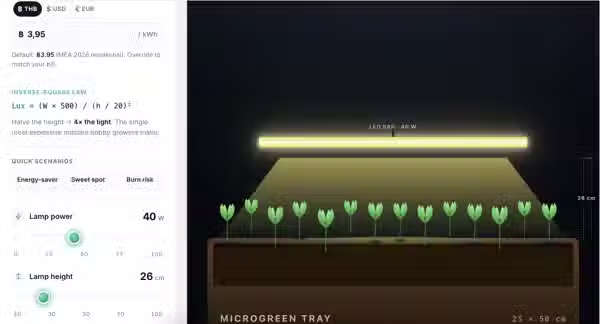
80 micromoles is below the commonly cited minimum of 100 to 150 for structural stem development. In the affected trays, the grow light was mounted at 45 to 52cm above the tray surface. Moving it to 25 to 30cm in subsequent cycles brought canopy PAR to 130 to 160 micromoles. Plant Mood grow log data, 2024.
Three collapses, three completely different chains of cause
Damping off starts underground, or at the medium surface. Pythium and Fusarium species colonise stem tissue at the base, degrading cell walls from the inside. The stem loses structural integrity before any visible external symptom appears. By the time the canopy folds, the tissue at the pinch point has already been destroyed. In Bangkok, Pythium specifically is active at medium temperatures above 28 degrees Celsius with sustained surface moisture -- which describes every unventilated Bangkok apartment grow room in hot season. The pathogen does not need to be introduced; it is present in most organic growing media.
Etiolation is not a disease and has no pathogen. It is a photomorphogenic signal failure. After blackout ends, a seedling should switch from stem elongation mode to stem thickening and leaf expansion mode when it receives adequate light. If PAR at the canopy is below threshold, the seedling does not receive the signal clearly enough to make that switch fully. It keeps elongating. The stem gets taller. The cotyledon fills with water as it expands. At some point the weight at the top exceeds what the thin-walled stem can support, and the whole structure bends. There is no disease, no overwatering, no bad seed. Just insufficient photons at the wrong developmental window.
Overcrowding failure is purely mechanical. Individual stems in a dense-seeded tray do not stand independently -- they lean on adjacent stems for support. The mat holds itself upright as a collective structure. Any localised weakness -- a single stem that elongated slightly more, a section that received slightly less water -- can initiate a cascade. Once one section of the mat loses cohesion, the stems around it have nothing to lean on and they follow. The base of every fallen stem in an overcrowding event is intact. Nothing failed biologically. The support structure failed.
Pea shoots make the overcrowding mechanism visible in a specific way. At 80 grams of seed per 10x20 tray, the canopy at day 8 looks extraordinary -- tall, dense, uniform. But press lightly on one section with a finger and you can feel the whole mat shift. There is no individual stem rigidity. The mat is a single structure held up by mutual lateral pressure. At harvest height, the shoots are tall enough that any disturbance -- a spray nozzle, a slight tray tilt, a drip irrigation hit -- can cascade the whole surface. The stems themselves are healthy. The architecture is not.
All three mechanisms can be present simultaneously in the same tray. A dense, under-lit tray with a Pythium event running at the base will collapse faster and more completely than any single cause explains. In that scenario, treating the pathogen correctly does not save the tray, because the etiolated overcrowded stems above the treated zone still have no structural capacity to stand. This is why growers who accurately identify damping off, apply the right treatment, and still lose the tray conclude the treatment failed -- when the treatment may have worked and the tray was already doomed from the other two directions.
What changed after we started tracking stem diameter on day 4
We started measuring stem diameter at day 4 using a digital calliper after the third consecutive misdiagnosed collapse in late 2023. A healthy sunflower stem at day 4 in adequate light and at appropriate density should measure at least 1.5mm at the base. Below 1.2mm, the stem is already etiolated enough that it will not recover structural integrity regardless of what happens to light or water from that point. The measurement takes two minutes per tray. It changed our intervention window from reactive to predictive.
Sunflower stem diameter at day 4 below 1.2mm at the base predicted collapse by day 7 in the large majority of tracked trays.
You have approximately two days between a 1.2mm reading and collapse. That is enough time to lower the grow light, reduce canopy weight by harvesting the tallest stems in the section, and increase airflow. It is not enough time to regrow structural stem tissue. Catching it at 1.2mm means managing the damage. Catching it at 1.5mm means preventing it.
The change was not about water volume. It was about medium surface dryness between events. In Bangkok's ambient humidity, the medium surface does not evaporate moisture as quickly as in a temperate environment. A surface that feels adequately dry to a grower in a climate-controlled room may still be holding enough surface moisture to support Pythium colonisation in a Bangkok apartment at 80% ambient humidity. The standard 'water when the medium feels dry' instruction needs recalibration for Bangkok conditions -- it should read 'water when the medium surface has been visibly dry for at least four hours.'
Bottom watering after blackout phase, limited to once per 24 hours when medium surface reads dry to the touch, reduced damping off incidence across cycles where other variables were held constant.
This is a judgment call that sensors help but do not replace. A moisture reading at the medium surface before every watering decision is the most reliable way to stay below the Pythium moisture threshold. In the absence of sensors, erring toward underwatering in humid ambient conditions is the correct bias.
This timing difference is diagnostically useful when you do not have a calliper. If the tray collapses before day 6, and the base of the fallen stem is firm, etiolation is the most likely cause. If collapse happens after day 6 and the base is soft and discoloured, damping off is the more likely explanation. The window overlaps and exceptions exist, but the pattern held across the tracked cycles.
Etiolation-related collapse onset in sunflower occurred an average of 1.4 days earlier than damping off collapse, appearing most often between days 5 and 6 versus days 6 and 8.
Timing alone is not a diagnosis. It is a triage signal. Use it to decide which test to run first -- press the stem base on an early collapse, check the light distance on a mid-cycle collapse.
Plant Mood grow log data, 2024
The fullest-looking canopy on day 4 is your highest-risk tray
A dense canopy in Bangkok humidity is a microclimate problem waiting to happen. The tighter the stems are packed, the less air circulates at the base of the tray. Moisture that cannot evaporate collects on the medium surface and on the lower stem tissue. From above, the tray looks full and healthy. At the base, the conditions are closer to a sealed container than a growing environment. That is where Pythium starts. It is also where stems begin leaning laterally into each other for physical support -- which registers visually as fullness and density right up until the point the mat loses cohesion and a section collapses as a unit.
The sparse tray -- the one you feel anxious about because you can see the medium between stems -- is the one with airflow. The airflow is keeping the surface moisture below the pathogen threshold. The individual stems have room to stand without borrowing support from their neighbours. That tray will likely stand through harvest. The full one may not.
The trays that looked best on day 4 across the 2024 season had the highest collapse rate by day 7. Trays where germination was visibly uneven -- gaps, clumps, uneven coverage -- had the lowest collapse rate. Not because uneven germination is good growing practice. Because the gaps were functioning as ventilation channels.
A dense, fast-growing tray coming out of blackout is a sign that germination succeeded and the crop is on track. Thick coverage means healthy seeding.
What Bangkok growers consistently miss before the collapse happens
Grow lights get repositioned. Trays get stacked at different heights. A shelf that was 28cm from the light panel in January is 45cm in March because something was rearranged underneath it. Most growers do not re-measure light distance when they change shelf configuration. PAR at canopy drops without any alarm. The crop looks normal through blackout. By the time the etiolation is visible, the collapse is already scheduled. Measuring light distance at canopy level every time the setup changes is not a sensor task. It is a tape measure and 30 seconds.
Light distance drift
Bangkok's ambient humidity is not constant. The shift between dry season and wet season can move ambient humidity by 10 to 15 percentage points in the same apartment without any change to the grow setup. A seed density that was safe at 68% humidity in February becomes a collapse risk at 82% humidity in June with zero other changes. Growers who set their density once and do not adjust seasonally will hit a collapse cluster at the humidity transition and not understand why. The setup has not changed. The climate has.
Seasonal ambient humidity shifts
Every guide covers damping off symptoms. None of the widely referenced ones instruct the grower to physically press the collapsed stem base as the first diagnostic step. The result is that growers characterise every collapse visually -- which is ambiguous -- rather than tactilely, which is not. A firm base and a soft base require completely different responses. The test is not taught because the guides assume the cause is always pathogenic. In Bangkok, that assumption is wrong more often than it is right.
The stem press test is not in any standard guide
Hydrogen peroxide at 3% diluted in water is a legitimate damping off prophylactic applied to the medium surface. Applied to a tray that collapsed from etiolation or overcrowding, it does nothing to address the cause and may dry out stem tissue that needs turgor to maintain whatever upright position remains. The grower sees no improvement, increases the concentration or frequency, and eventually concludes that peroxide does not work -- when the actual conclusion is that they applied the right tool to the wrong problem.
Peroxide treatment applied to etiolation collapses
A grower moving from 5 to 20 trays in a Bangkok apartment without adding mechanical ventilation is building a humidity problem at scale. Five trays transpire a manageable volume of moisture. Twenty trays in the same space with no extract fan can raise ambient humidity by 4 to 8 percentage points above the room baseline. The grower who was running 5 trays at 70% ambient is now running 20 trays at 76 to 78% ambient. The seed density that worked at 5 trays will begin to fail at 20. The collapse will arrive, and without the context of transpiration load as a humidity variable, the diagnosis will be wrong.
The first-scale grower in a Bangkok condo who never adjusts
What to change before the next sow
Any grower who has had a collapse this month
Go to the fallen tray before discarding it and press the base of three or four collapsed stems between your fingers. Soft, wet, and easy to rupture means damping off. Firm and intact means etiolation or overcrowding. Write down what you find. This single step changes every subsequent decision.
A correct diagnosis that points to the right intervention. Without it, the next tray gets the same wrong treatment.
Any grower using a grow light at 40cm or higher above tray surface
Measure the distance from the light panel to the tray surface. Move the light to 25 to 30cm. If you have a lux meter or PAR meter, verify that canopy-level reading is above 5,000 lux or 100 micromoles before the next sow. If you do not have a meter, closing from 45cm to 28cm is almost always an improvement on standard consumer LED panels.
Measurably thicker stem diameter by day 4 to 5 in sunflower. Visible reduction in the pale-yellow elongated stem appearance that precedes etiolation collapse.
Sunflower and pea growers running standard density recommendations
Reduce sunflower seed weight to 15g per 10x20 tray and pea to 68g per 10x20. Run one tray at the lower density alongside one at your current density. Measure stem diameter at day 4 on both. Compare collapse rate and canopy fullness at harvest. The lower-density tray will have visible gaps. It will also likely still be standing.
Collapse rate in the lower-density tray drops significantly in high-humidity conditions. The data from your own two-tray test is more reliable than any recommendation written for a different climate.
Growers in Bangkok during wet season months (May to October)
Check ambient humidity with a hygrometer before each sow cycle, not just once at setup. If ambient is above 78%, treat that cycle as high-risk regardless of what worked in dry season. Reduce density by an additional 10 to 15%, increase watering interval to once per 24 hours maximum, and ensure at least a small fan is circulating air across tray surfaces. Humidity is seasonal. Your density should be too.
Lower collapse rate in the months that historically produce the most losses. The adjustment takes two minutes per sow cycle decision.
Any grower who wants a single early-warning metric
Measure stem diameter at the base of five stems per tray on day 4, using a digital calliper. A sunflower stem should measure at least 1.5mm. Below 1.4mm, increase light intensity immediately. Below 1.2mm, the tray is at high collapse risk and light intervention may not fully recover it -- reduce the harvest window and harvest early if possible. A digital calliper costs 150 baht and lasts indefinitely.
Two-day advance warning of etiolation collapse risk. Enough time to intervene before the tray falls, not after.
The stem press diagnosis. Growers move directly to watering adjustments or peroxide treatments without establishing which of the three collapse mechanisms is active. In Bangkok conditions where etiolation and overcrowding account for the majority of failures, that skip means the most common interventions are being applied to the wrong problem most of the time.
FAQ
Why do my microgreens keep falling over even after I reduce watering?
Reducing watering only addresses damping off. If your stems are firm at the base when you press them, the collapse is from etiolation (insufficient light) or overcrowding (too much seed density) -- neither of which responds to watering changes. Across Plant Mood's 2024 cycles, 72.5% of sunflower collapses had firm stem bases with no pathogen involvement. Press the base first. If it's firm, check your light distance and seed density, not your watering schedule.
How do I tell the difference between damping off and etiolation in microgreens?
Press the collapsed stem at the base between two fingers. Damping off produces a soft, wet pinch point that ruptures easily and often smells musty. Etiolation collapse leaves the stem completely firm -- it bends because it grew too tall and thin to support the cotyledon weight, not because tissue has broken down. Timing also differs: etiolation collapse in sunflower typically appears by day 5 to 6, damping off more often between days 6 and 8.
What is the right seed density for sunflower microgreens in a Bangkok apartment?
Plant Mood grow log data shows sunflower trays seeded at 22g per 10x20 collapsed in 54% of cycles when ambient humidity was above 78%. Dropping to 15g cut that rate to 18%. Standard guides recommend 20 to 25g -- appropriate for temperate controlled environments. In Bangkok with 75 to 85% ambient humidity and no mechanical ventilation, 14 to 16g per 10x20 is a more reliable working range.
Can I predict microgreen collapse before it happens?
Yes, with a calliper. Measure sunflower stem diameter at the base on day 4. A healthy stem should be at least 1.5mm. Below 1.4mm, increase light intensity immediately. Below 1.2mm, the tray is at high collapse risk -- harvest early if possible. This gives you roughly two days of intervention window before the tray falls. A digital calliper costs 150 baht.
Why do my microgreens collapse in wet season but not dry season?
Bangkok's ambient humidity shifts 10 to 15 percentage points between dry and wet season. A seed density that was safe at 68% humidity in February creates a wet microclimate at the stem base at 82% humidity in June with zero other changes. Density that worked in March may fail in August. Measure ambient humidity before each sow cycle during wet season months and reduce seed density by 10 to 15% if you are above 78%.
Does hydrogen peroxide treatment fix microgreen stem collapse?
Only if the collapse is caused by damping off. Applied to a tray that collapsed from etiolation or overcrowding, it does nothing to address the cause and may dry stem tissue that needs turgor to stay upright. The diagnostic test comes first: press the stem base. Soft base means peroxide treatment is appropriate. Firm base means the cause is structural and the right interventions are light distance and seed density, not antifungal treatment.
How far should my grow light be from microgreen trays to prevent etiolation?
25 to 30cm from light panel to tray surface is the working range for most consumer LED grow panels. At 45 to 50cm -- where most growers mount their lights -- PAR at canopy typically falls below 80 micromoles, which correlates with etiolation collapse in 7 of 9 Plant Mood sunflower trays reviewed. Moving from 48cm to 28cm in subsequent cycles brought canopy PAR to 130 to 160 micromoles and visibly reduced stem elongation.