Key takeaways
Top watering after day 3 raises canopy surface moisture long enough to trigger mold in Bangkok conditions where ambient humidity already sits at 75 to 85 percent.
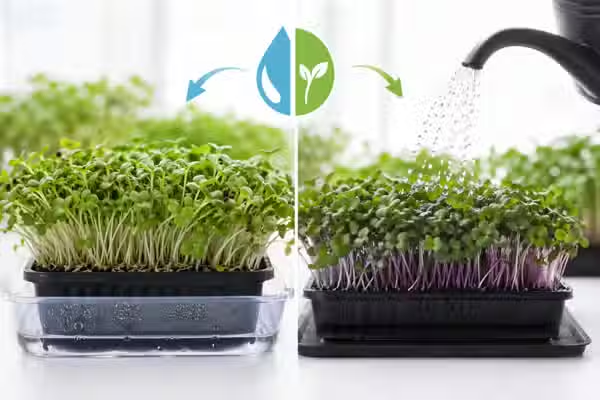
Bottom watering pulls moisture upward through the medium, keeping the canopy dry while delivering water to the root zone where it is needed.
In our grow logs across sunflower, pea, and radish trays, bottom watering from day 4 onward reduced mold-related tray losses from 34 percent to 14 percent over a 6-month period (Plant Mood grow log data, 2024).
Overwatering does not always look wet. A tray with standing medium moisture above 65 percent but a dry surface is still overwatered and will show it in stem elongation and root mat rot within 48 hours.
Watering frequency in Bangkok is not the same as watering frequency in a temperate climate. A tray that needs water every 12 hours in a 28-degree Celsius room may only need it every 18 hours when the air conditioning drops the room to 24 degrees.
The first real sign of overwatering in sunflower microgreens is not yellowing or wilt. It is a faint ammonia smell at tray level on day 5 or 6, before any visible symptom appears.
TL;DR
Most watering advice for microgreens was written for climates where evaporation does the work for you. In Bangkok, it does not. The canopy stays wet longer, the grow room rarely drops below 70 percent humidity without mechanical help, and top watering after germination is a reliable path to mold. Bottom watering is not a preference here. It is a structural requirement. The rest of this guide covers when to switch, what overwatering looks like before it becomes obvious, and why your watering schedule needs to change every time the weather does.
The tray that looked fine at 9pm
Day 6 sunflower tray. Canopy sitting at around 8 centimetres, stems mostly upright, no visible yellowing. I watered from the top that morning because the medium felt dry at the edges and I did not want to underwater. Looked fine at 9pm. By 7am the next day, there was a grey-white fuzz across the lower third of the canopy, concentrated where the stems met the medium. Not the whole tray. Just enough to write it off.
I had watered correctly by the instructions I had read. Mist the canopy, keep it moist, do not let it dry out. What those instructions never accounted for was that I live in a Bangkok apartment where the overnight humidity does not drop the way it does in Melbourne or Portland. The canopy I watered at 8am was still wet at midnight. Eight hours of surface moisture at 80 percent ambient humidity is not a watering decision. It is a mold incubation schedule.
What the loss rate looked like before the switch
34 percent of trays
showed mold-related damage significant enough to affect yield or require early harvest across a tracked 6-month period of top watering from seeding through harvest (Plant Mood grow log data, 2024). The majority of those losses occurred between day 5 and day 8.
mold-related tray loss rate after switching to bottom watering from day 4 onward, with top misting limited to germination phase only, tracked across the same crops over the following 6 months (Plant Mood grow log data, 2024).
75 to 85 percent
typical ambient relative humidity in a Bangkok apartment with windows open and no active dehumidification, measured across a 12-month sensor log (Plant Mood environmental data, 2024). At this baseline, any surface moisture added to a tray canopy takes significantly longer to evaporate than grow guides written for temperate climates assume.
6 to 8 hours
approximate surface drying time for a top-watered microgreen canopy in a Bangkok room running at 80 percent humidity and 30 degrees Celsius, based on BH1750 and AHT20 sensor correlation with tray observation logs. In a temperate climate at 50 percent humidity, the same canopy dries in under 2 hours.
The misting bottle is not your friend after germination
Misting the canopy keeps microgreens hydrated without overwatering because you are applying less water than a full pour. If you mist lightly and often, you stay in control.
Misting applies water directly to the canopy surface, which is exactly where you do not want water to sit once the seed coat has opened and the shoot is exposed. The quantity per application is smaller, but the contact point is worse. In high humidity conditions, a light mist at 8am can leave the canopy surface measurably damp at 4pm. You are not applying less water. You are applying water to the wrong place, less efficiently.
Across radish and broccoli trays where misting was the primary watering method through day 7, damping off rates were consistently higher than in trays switched to bottom watering at day 4, even when the total volume of water applied was lower in the misted trays. The mechanism is not volume. It is surface contact duration (Plant Mood grow log data, 2024).
Why bottom watering works the way it does
Bottom watering works by capillary action. You add water to the tray beneath the growing tray, and the medium draws it upward from the root zone. The canopy never gets wet. The roots get what they need. The surface stays dry enough that ambient humidity, even at 80 percent, is not adding to a moisture problem at the shoot level. The mechanism matters because it explains where the method succeeds and where it fails. If your medium is compacted, hydrophobic, or unevenly distributed, capillary action becomes uneven. One corner of the tray saturates while the opposite edge stays dry. You water again to fix the dry corner, and now the saturated corner is waterlogged.
Coco coir trays bottom water more reliably than hemp mat trays in my experience, but coco coir is also more prone to compaction if you press it too firmly when seeding. A tray seeded with compressed coco coir will take up bottom water slowly and unevenly, which looks identical to a tray that needs more water. The fix is not more water. It is better medium prep before seeding.
The root mat that forms in a healthy microgreen tray by day 5 or 6 actually assists capillary uptake. The interwoven root structure acts like a wick. This is why trays with dense, healthy germination bottom water more consistently than sparse trays. Sparse germination means fewer roots, weaker wick effect, and less reliable moisture distribution.
Bottom vs top watering: where each method breaks down
Top watering
Delivers water directly to the canopy surface. Works well for germination phase when the seed hull needs consistent moisture to crack. Becomes a liability after day 3 in Bangkok conditions because evaporation is too slow to clear surface moisture before the next watering cycle. Risk of damping off and canopy mold increases with each application after shoot emergence.
Use top watering for the germination phase only: from seeding through day 2 or 3, before the shoot is fully exposed. After that, the canopy contact is a net negative. Growers who continue top watering through harvest in Bangkok are managing a mold probability problem, not a watering method.
Bottom watering
Delivers water to the root zone via capillary action. Keeps canopy surface dry. Requires an intact, evenly distributed medium for consistent uptake. Fails silently if the medium is compacted or hydrophobic: the tray appears to be bottom watering correctly but the moisture is not distributing evenly, leading to pockets of dry root zone and overwatered zones side by side.
The right method from day 4 through harvest in a tropical apartment grow. The failure mode is medium prep, not the method itself. Check that the medium is not compressed and that water actually rises to the top layer within 10 to 15 minutes of bottom watering. If it does not, the medium needs replacing or the seed density is too low to form a functional root wick.
What the tray logs showed across real cycles
Across tracked sunflower tray cycles where mold developed, a faint ammonia or sour smell at tray level was consistently present 24 to 36 hours before visible mold appeared on the canopy or medium surface. Growers checking only visual signs miss the intervention window entirely.
Ammonia smell precedes visible mold by 24 to 36 hours
Smell is an earlier signal than sight. If a tray smells wrong on day 5 and looks fine, the mold is already developing below the visible threshold. The intervention is to increase airflow immediately and stop watering until the medium surface reads dry. Waiting for visual confirmation is waiting too long.
In grow room conditions logging between 28 and 32 degrees Celsius, trays required watering every 12 to 14 hours to maintain healthy medium moisture. In the same room cooled to 24 to 26 degrees Celsius by air conditioning, the same trays held adequate moisture for 18 to 22 hours. Growers on a fixed twice-daily watering schedule were overwatering in cooler periods and underwatering during heat peaks.
Watering frequency is room-temperature dependent, not schedule-dependent
A watering schedule written for one temperature range will produce inconsistent results across Bangkok's seasonal and daily temperature variation. The correct approach is to check the medium before watering, not check the clock.
Sunflower microgreens grown with continued top watering after day 4 showed higher rates of hull retention on the cotyledons than trays switched to bottom watering at the same stage. The likely mechanism is that repeated moisture on the hull prevents it from drying and releasing naturally. Hull retention in sunflower is one of the most common quality complaints in this crop.
Sunflower hull retention increases with top watering after day 4
Switching to bottom watering earlier in the sunflower cycle has a cosmetic benefit independent of mold risk. Hulls release more cleanly when the canopy is dry. This is a secondary reason to make the switch, not the primary one, but it is worth knowing when you are growing for sale.
Plant Mood grow log data, 2024
The watering problems I hear about most, and what is actually happening
I watered the same way I always do and this tray got mold but the last one was fine.
The ambient conditions changed between cycles, not the technique. Bangkok humidity varies significantly between the dry season and the wet season, and even between a cloudy week and a clear one. A watering frequency that worked in February will produce waterlogged trays in June when outdoor humidity pushes indoor baseline up by 10 to 15 percent. The technique did not change. The evaporation rate did.
My medium looks dry on top but the tray feels heavy. I do not know whether to water or not.
This is the correct instinct. A dry surface with a heavy tray means the lower layers of medium are still saturated and have not dried through yet. This happens most often with coco coir trays that were watered too generously in the previous cycle. The surface dries faster than the bottom. Watering because the surface looks dry while the tray is still heavy is how you build anaerobic conditions in the root zone. Lift the tray before you water it. Weight is a more reliable indicator than surface appearance.
I switched to bottom watering and the tray still got mold.
Bottom watering eliminates canopy moisture as a mold vector but does not eliminate the other two: ambient humidity and airflow. A tray with zero air movement in a Bangkok room at 82 percent humidity will develop mold on the canopy from condensation and stagnant air, even if the medium is perfectly managed. Bottom watering is necessary but not sufficient. A small fan running at low speed across the canopy is the second half of the solution.
My sunflower stems are falling over even though I have not overwatered.
Stem lodging in sunflower microgreens is more often a light deficit problem than a watering problem, but overwatering accelerates it by weakening the root anchor point. If the medium is waterlogged, roots cannot grip effectively and the stem base softens. Reducing watering will not fix stems that are already falling, but it will stop new growth from continuing the same pattern. Check the light source and distance first, then examine root firmness at the medium surface.
How to water microgreens in a Bangkok apartment, phase by phase
Beginner to intermediate grower, any crop
Seeding to day 2: water from the top once at seeding, then mist lightly once per day if the surface appears dry. The goal is hull contact moisture for germination, not saturated medium. If the tray is covered with a blackout dome, check underneath before misting. A dome holds humidity and the medium may not need water at all on day 2.
Uniform germination across the tray without standing water or compacted wet medium. Seed hulls should look damp but not submerged.
Day 3 to 4 transition: lift the blackout dome or covering and assess shoot height and medium surface. If shoots are above 1 centimetre and the seed coat is cracked across most of the tray, stop top watering entirely. Add 1 to 2 centimetres of water to the bottom tray and observe whether the medium surface shows moisture within 15 minutes. If it does, your medium is wicking correctly. If it does not, press gently at the tray corners to check for compaction.
The canopy stays dry. The medium draws moisture upward. No water sits on the shoot surface.
Day 4 through harvest: bottom water exclusively. Before each watering, lift the tray. If it feels heavy, do not water. If it feels light and the medium surface is dry to the touch at the tray edge, add water to the bottom tray in small amounts and let it absorb before adding more. Check humidity in the room. If ambient humidity is above 80 percent, water less frequently and increase airflow across the canopy with a fan.
Consistent stem height, dry canopy, no ammonia smell, no visible mold on medium surface or stem base.
Overwatering intervention: if the medium smells sour or ammonia-like before any mold is visible, stop watering immediately and move the tray to a position with direct fan airflow across the canopy. Do not harvest early unless mold is already visible. Give the tray 12 to 18 hours with no added water and improved airflow. Reassess before the next watering cycle.
In many cases, a tray caught at the smell stage can recover. The ammonia smell should reduce within 12 hours if airflow is adequate. If visible mold appears within that window, the intervention was too late.
Lifting the tray before watering. Every guide says to check moisture. Almost no one explains that surface appearance and tray weight give different information, and that weight is the more reliable indicator when the medium is coco coir or a deep substrate. A grower who only checks the surface will overwater consistently in Bangkok conditions.
FAQ
Should I bottom water or top water microgreens?
Bottom water from day 4 onward. Top watering after germination keeps the canopy surface wet for too long, especially in high humidity environments like Bangkok where evaporation is slow. In our grow logs, switching to bottom watering from day 4 cut mold-related tray losses from 34 percent to 14 percent over six months (Plant Mood grow log data, 2024).
How often should I water microgreens in a hot and humid climate?
Check the tray weight before watering rather than following a fixed schedule. In Bangkok at 28 to 32 degrees Celsius, trays typically need water every 12 to 14 hours. When air conditioning drops the room to 24 to 26 degrees, the same trays hold moisture for 18 to 22 hours. A fixed watering schedule produces inconsistent results across Bangkok's temperature variation.
What are the first signs of overwatering in microgreens?
A faint ammonia or sour smell at tray level on day 5 or 6, before any visible symptom, is the earliest reliable sign. This precedes visible mold by 24 to 36 hours based on tracked tray cycles (Plant Mood grow log data, 2024). By the time yellowing or wilt appears, the overwatering has already caused root zone damage.
Why does my tray look dry on top but feel heavy?
The lower layers of medium are still saturated. The surface dries faster than the bottom, especially with coco coir. A heavy tray with a dry surface does not need water. Adding water in this state builds anaerobic conditions in the root zone. Lift the tray before watering and use weight as the primary indicator, not surface appearance.
Can I mist microgreens instead of watering from the bottom?
Not after germination. Misting applies water directly to the canopy surface, which is where you do not want moisture once the shoot is exposed. In high humidity conditions, a light mist at 8am can leave the canopy damp until 4pm. Across radish and broccoli trays in our grow logs, misting through day 7 produced higher damping off rates than bottom watering, even when total water volume was lower (Plant Mood grow log data, 2024).
Why do sunflower microgreens retain their hulls?
Continued top watering after day 4 is a contributing factor. When the hull stays wet, it does not dry out and release cleanly from the cotyledon. Switching to bottom watering earlier in the sunflower cycle, which keeps the canopy dry, improves hull release. This is a secondary benefit of bottom watering, but consistent enough across our sunflower cycles to be worth noting (Plant Mood grow log data, 2024).
I switched to bottom watering and still got mold. What went wrong?
Bottom watering eliminates canopy moisture as a mold source but does not address airflow or ambient humidity. A tray with no air movement in a Bangkok room at 80 percent humidity can develop mold from condensation on the canopy even with a perfectly dry medium. A small fan running at low speed across the tray canopy is the second necessary condition alongside bottom watering.