Key takeaways
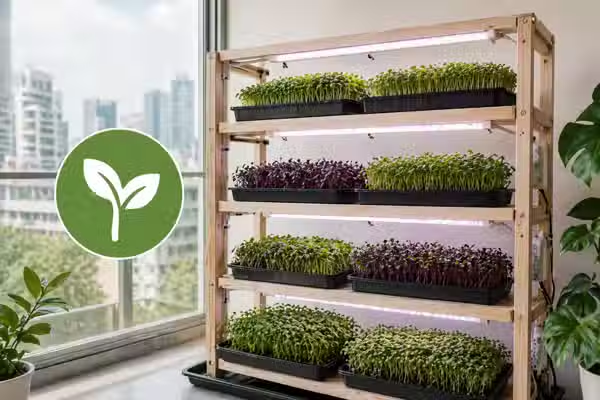
A functional 3-tier microgreen rack in a Bangkok apartment can be built for under 2,000 baht using a chrome wire shelving unit from Lazada, grow lights sourced from JJ Mall or local electronics shops, and a small USB fan per tier.
Shelf spacing below 35 centimetres between tiers creates a measurable humidity trap in Bangkok conditions: sensor logs showed relative humidity 8 to 12 percent higher inside a tight rack than in the ambient room (Plant Mood environmental data, 2024).
Grow light placement above 25 centimetres from the canopy in a Bangkok apartment with ambient temperatures above 30 degrees Celsius consistently produced etiolated stems in sunflower and pea microgreens across tracked cycles.
A single oscillating fan pointed at the rack is less effective than one small fan per tier blowing across the canopy at low speed. Per-tier airflow kept canopy surface humidity 6 to 9 percent lower than a single external fan at the same total wattage (Plant Mood environmental data, 2024).
The rack material that fails fastest in Bangkok is powder-coated steel shelving. Salt air and humidity cause surface rust within 4 to 6 months in apartments without consistent air conditioning. Chrome-plated wire or stainless alternatives last significantly longer.
Light timer discipline matters more than light wattage in a small rack. Running lights 16 hours on, 8 hours off in a Bangkok apartment with no temperature control adds 2 to 4 degrees Celsius of heat accumulation inside the rack that does not dissipate before the next light cycle.
TL;DR
Most low-cost microgreen rack guides treat the rack as furniture. In a Bangkok apartment, it is an environment. The ambient conditions outside the rack are already marginal for growing: high humidity, inconsistent temperature, and limited air exchange. A badly designed rack makes all three worse by concentrating them in a small enclosed space. The decisions that matter are shelf spacing, fan placement, and light distance. The decisions that feel like they matter but mostly do not are brand of grow light and number of tiers.
What the sensor logs showed across rack configurations
Across two rack configurations tested in the same room over 8 weeks, a rack with 30-centimetre tier spacing logged average relative humidity of 83 to 88 percent inside the middle tier during active grow cycles. The same room measured 74 to 78 percent at desk height with no rack obstruction. Increasing tier spacing to 40 centimetres brought the middle-tier humidity reading to within 3 percent of ambient. The trays had not changed. The spacing had.
Tight shelf spacing traps humidity independent of room conditions
In a temperate climate, 30-centimetre shelf spacing is a minor inconvenience. In Bangkok, it is a mold incubation geometry. The rack itself becomes a humidity amplifier when tiers are too close together, and no amount of fan placement fully compensates for inadequate vertical clearance.
With two 45-watt LED grow light bars running inside a 3-tier rack in a room held at 29 degrees Celsius, the temperature inside the rack at the middle tier rose to 33 to 34 degrees Celsius after 4 hours of continuous light. At 16 hours of continuous light, the rack interior was consistently 4 to 5 degrees above ambient. The 8-hour dark period brought it back to within 1 degree of ambient just before the next light cycle started.
Heat accumulation inside the rack is additive across the light cycle
Germination rates for sunflower dropped noticeably above 33 degrees Celsius in tracked cycles. A rack running 16-hour light cycles in a Bangkok room without air conditioning will breach that threshold regularly, not because the room is too hot but because the rack geometry concentrates the heat the lights produce. Shorter light cycles or passive ventilation gaps between tiers change this materially.
A single 20-watt oscillating fan positioned 60 centimetres from the rack face reduced canopy surface humidity on the front-facing trays but had negligible effect on trays at the back of the middle and lower tiers. Replacing it with one 2-watt USB fan per tier, positioned to blow across the canopy parallel to the tray surface, produced more even humidity reduction across all tray positions and lower peak canopy moisture readings in grow log data over a 4-week comparison period.
Per-tier fans outperform single external fans on canopy moisture
The total power draw of three 2-watt USB fans is 6 watts. The single oscillating fan drew 20 watts. The per-tier setup used less electricity and produced better results on every metric the sensors tracked. The single-fan approach is not wrong in principle. It is wrong for a closed rack geometry where airflow does not reach the back of the tiers.
Plant Mood environmental data, 2024
The rack that worked perfectly for six days
First rack I built in this apartment was a 4-tier chrome wire unit from Lazada, 150 centimetres tall, 60 centimetres wide. Looked exactly like every setup photo in every microgreen guide online. Lights zip-tied to the underside of each shelf. One fan on the floor blowing at the front face. Trays loaded in on a Monday. By Sunday, the middle two tiers had mold on four of six trays. The top and bottom tiers were fine.
The top tier had airflow from above. The bottom tier had airflow from the floor fan. The middle two tiers had neither. I had built a rack with good ventilation at the extremes and a dead zone in the centre, which happened to be the most humid part of the apartment because it was furthest from the window and closest to the wall. The mold was not random. It was a geometry problem.
The numbers behind a rack that looks identical but performs differently
8 to 12 percent
higher relative humidity measured inside the middle tier of a 3-tier rack with 30-centimetre shelf spacing compared to ambient room humidity, logged continuously across 8 weeks in a Bangkok apartment without active dehumidification (Plant Mood environmental data, 2024). This is the difference between a grow environment at 76 percent relative humidity and one at 88 percent, from the same room, using the same equipment.
4 to 5 degrees Celsius
average temperature elevation inside a closed 3-tier rack running two 45-watt LED bars after 4 or more continuous hours of light in a 29-degree Celsius Bangkok room, measured at the middle tier (Plant Mood environmental data, 2024). This elevation is enough to push germination conditions past the threshold where sunflower germination consistency begins to decline.
Under 2,000 baht
total build cost for a functional 3-tier microgreen rack using a chrome wire shelving unit from Lazada (approximately 800 to 1,100 baht), two full-spectrum LED grow light bars from JJ Mall or similar (approximately 300 to 500 baht each), and three USB fans (approximately 80 to 150 baht each). Pricing based on Bangkok market rates as of 2024.
More tiers is not more output in a Bangkok apartment
In a controlled environment with mechanical climate management, this is approximately true. In a Bangkok apartment with ambient humidity and no dehumidifier, it is not. Each additional tier adds more evapotranspiration to a shared air column. A 5-tier rack with tightly spaced shelves and no per-tier airflow produces a humidity gradient from bottom to top that makes the middle three tiers consistently worse growing conditions than a standalone 3-tier rack with adequate spacing. You are not adding capacity. You are adding trays to a deteriorating environment.
In a side-by-side comparison tracked over 6 grow cycles, a 3-tier rack with 40-centimetre spacing and per-tier fans averaged lower mold incidence and more consistent stem height across all tray positions than a 5-tier rack in the same room with 25-centimetre spacing and a single external fan. The 5-tier rack held 10 trays. The 3-tier rack held 6. Net usable yield per cycle was within 15 percent of each other once mold losses on the 5-tier rack were subtracted (Plant Mood grow log data, 2024).
A 5-tier rack produces more than a 3-tier rack because it holds more trays. The growth is linear: more shelf space, more yield.
Why rack geometry determines grow performance in a tropical apartment
Microgreens release moisture into the air continuously through transpiration, and the growing medium releases additional moisture through evaporation. In a rack with tight tier spacing and limited airflow, this moisture accumulates in the air column between shelves. It has nowhere to go. The tier above traps it. The tier below adds to it. The canopy of every tray in that column sits in progressively more humid air than the room around it. This is not a watering problem or a light problem. It is a rack design problem that no amount of grow technique adjustment will fix.
The middle tier in a 4-tier rack is the worst position in a Bangkok apartment. It is furthest from natural airflow at the top and bottom, most exposed to the accumulated moisture from the tiers below it, and most affected by heat rising from lower grow lights. A grower who seeds identical trays on all four tiers on the same day and harvests identical technique across all four will consistently see worse results from the middle two tiers. If they do not track it by position, they will assume the problem is random.
Vapour pressure deficit (VPD) is the variable that explains this mechanically. VPD describes the difference between the moisture content of the air and the maximum moisture it could hold at that temperature. Low VPD means the air is close to saturation and the plant cannot transpire efficiently. In a tight rack interior in Bangkok, VPD can drop low enough that transpiration slows, the canopy stays wet longer, and mold risk increases even when the grower has done nothing wrong at the tray level.
The rack problems I see most often and what is underneath them
My top tier grows fine but the middle tier keeps getting mold on the same trays.
Airflow dead zone. The top tier gets passive air exchange from above the rack. The middle tier gets the accumulated moisture from tiers below it and no meaningful air movement to displace it. The fix is not a different watering schedule or a different grow medium. It is a small fan positioned to move air specifically across the middle tier canopy. If the rack has no space for per-tier fans, increasing tier spacing by 10 centimetres will reduce the effect.
I followed a build guide exactly and my lights are too hot.
The build guide was written for a room at 20 to 22 degrees Celsius. In Bangkok at 30 degrees Celsius, the same LED bar that runs at a comfortable temperature in a European apartment adds heat to an environment that is already marginal. LED grow lights marketed as low heat still emit some heat, and in a closed rack interior that heat has no easy exit path. The solution is to create passive ventilation gaps in the rack by not filling every tier with trays, which allows convective airflow to carry heat upward and out.
I bought a more powerful grow light and yields did not improve.
The limiting factor was not light. In most Bangkok apartment grows with a functional LED bar at the right distance, light is adequate. The limits are temperature, humidity, and airflow. Increasing light intensity without addressing the thermal load it adds to the rack interior often makes things worse, not better. Before upgrading light wattage, measure the temperature inside the rack at canopy level during peak light hours.
My rack started rusting within a few months.
Powder-coated steel shelving degrades quickly in high humidity with frequent water contact. Bangkok apartments without consistent air conditioning run at humidity levels that accelerate surface oxidation on any shelving with imperfect coating. Chrome-plated wire shelving from reputable Lazada suppliers is significantly more resistant. Stainless steel is the most durable option but costs more. Inspect coating integrity before purchasing: any scratched or thin-looking powder coat on steel will rust within one growing season.
You do not need a grow tent to control humidity in a Bangkok apartment
A grow tent is the only way to manage humidity and temperature in a tropical apartment. Without one, you cannot control the environment well enough to grow consistently.
A grow tent solves temperature and light control problems. It does not solve humidity problems. Sealing a grow environment in Bangkok without active dehumidification inside the tent produces higher humidity than an open rack, not lower. A tent concentrates the moisture that microgreens and their medium release, and unless you are running a dehumidifier and an exhaust fan inside the tent, you are paying more for a worse humidity situation.
Grow logs from a sealed 60 x 60 x 140 centimetre tent in the same Bangkok apartment versus an open chrome wire rack with per-tier fans showed consistently higher average relative humidity inside the tent: 84 to 91 percent versus 74 to 79 percent in the open rack over a 6-week comparison. Mold incidence was higher in the tent across every crop type tested during that period (Plant Mood environmental data, 2024). A grow tent makes sense for light spectrum control or pest exclusion. For humidity in a Bangkok apartment, it is the wrong tool.
What the next generation of Bangkok apartment growers will figure out
Per-tier environmental monitoring will become a standard expectation for serious apartment growers within 3 years, not a technical enthusiast feature.
The cost of ESP32-based sensor nodes with temperature, humidity, and lux sensing has dropped below 300 baht per unit in Bangkok component markets. Growers who have invested in even basic per-tier logging consistently outperform those who manage by observation, because the problems are invisible until they are not. As more growers enter the space and face the same rack geometry failures, the ones who survive will be those who can see what is happening at each tier independently.
If per-tier sensor logging is not a common topic in Bangkok urban farming communities and online groups by 2027, and most apartment growers are still managing by visual inspection only, the prediction is wrong.
The optimal Bangkok apartment microgreen rack will converge on 2 tiers rather than 3 or more, as growers optimise for yield per tray rather than total tray count.
Once growers start tracking yield by position and accounting for mold losses, the economics of a tight multi-tier rack in a high humidity environment look different. Two tiers with adequate spacing, per-tier fans, and no humidity dead zone consistently outperform three or four tiers with marginal conditions. The constraint in a Bangkok apartment grow is not shelf space. It is the ability to maintain growing conditions across all positions simultaneously. Two tiers is easier to manage and more likely to produce consistent results across the whole operation.
If the dominant rack configuration in Bangkok apartment grow communities in 3 years is still 4 or 5 tiers with tight spacing, and growers are reporting acceptable mold rates without per-tier airflow, the prediction does not hold.
FAQ
How much does it cost to build a microgreen rack in Bangkok?
Under 2,000 baht for a functional 3-tier setup: a chrome wire shelving unit from Lazada runs 800 to 1,100 baht, full-spectrum LED grow light bars from JJ Mall cost 300 to 500 baht each, and USB fans run 80 to 150 baht per unit. Avoid powder-coated steel shelving, which rusts within 4 to 6 months in Bangkok humidity.
What shelf spacing should I use for a microgreen rack in Bangkok?
Minimum 40 centimetres between tiers. Sensor logs showed 8 to 12 percent higher relative humidity inside the middle tier of a rack with 30-centimetre spacing compared to ambient room conditions (Plant Mood environmental data, 2024). In Bangkok, tight shelf spacing turns the rack into a humidity trap that no fan placement fully compensates for.
Should I use a grow tent for microgreens in a Bangkok apartment?
Not for humidity management. A sealed grow tent in a Bangkok apartment without an internal dehumidifier and exhaust fan produces higher humidity than an open rack with per-tier fans. Grow logs from a 6-week comparison showed 84 to 91 percent relative humidity inside a tent versus 74 to 79 percent on an open rack in the same room (Plant Mood environmental data, 2024).
How many tiers should a Bangkok apartment microgreen rack have?
Three tiers with 40-centimetre spacing outperforms five tiers with 25-centimetre spacing in a Bangkok apartment environment. In tracked cycles, a 3-tier rack with per-tier fans averaged lower mold incidence and more consistent stem height than a 5-tier rack in the same room, with net usable yield within 15 percent of each other once mold losses were subtracted (Plant Mood grow log data, 2024).
Where should I position the fan for a microgreen rack?
One small fan per tier, blowing across the canopy parallel to the tray surface, outperforms a single external oscillating fan on every metric. Per-tier 2-watt USB fans kept canopy surface humidity 6 to 9 percent lower than a single 20-watt oscillating fan at the same position, while using less than a third of the electricity (Plant Mood environmental data, 2024).
Why is my middle rack tier getting mold but the top and bottom are fine?
Airflow dead zone. The top tier gets passive air exchange from above the rack, the bottom tier gets airflow from below, and the middle tier accumulates moisture from tiers below it with no air movement to displace it. Add a small fan positioned specifically at the middle tier canopy, or increase tier spacing by at least 10 centimetres.
How far should grow lights be from microgreen trays in a Bangkok apartment?
No further than 25 centimetres from the canopy. Beyond that distance in a Bangkok room above 30 degrees Celsius, etiolated stems appeared consistently across sunflower and pea microgreen cycles in tracked grow logs (Plant Mood grow log data, 2024). Also account for heat accumulation: two 45-watt LED bars raised rack interior temperature 4 to 5 degrees Celsius above ambient after 4 continuous hours of operation.