Key takeaways
Sunflower microgreens deliver the most reliable sales volume in Bangkok because buyers recognise them on sight, the flavour is approachable, and the format works for both retail and restaurant supply.
Broccoli microgreens carry the highest margin per tray of the five crops ranked here, but sell slowly in Bangkok because most buyers do not know what they are or why they cost more.
Wheatgrass has the worst margin of the five: input costs are low but yield per tray is inconsistent, harvest windows are short, and the buyer pool in Bangkok is thin outside of juice bars that already have established suppliers.
Radish microgreens have the fastest crop cycle of the five at 6 to 8 days to harvest, which compresses margin per day rather than expanding it when priced at the same per-tray rate as slower crops.
Pea shoots are the easiest sell to first-time buyers in Bangkok because they taste like food rather than health product, but the tray weight and volume make them one of the most expensive crops to ship or deliver without losing margin.
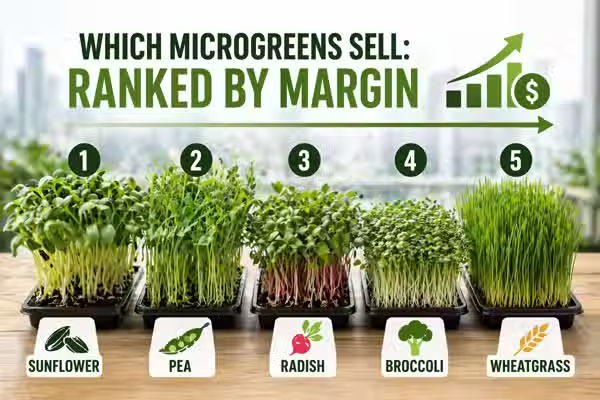
Margin ranking from highest to lowest based on Plant Mood production cost and sales data: broccoli, sunflower, pea, radish, wheatgrass (Plant Mood grow log and sales data, 2024).
TL;DR
Every beginner grows wheatgrass because it looks serious and photographs well. Almost no one can sell it at a margin worth the tray space in Bangkok. The crops that actually pay are sunflower for volume, broccoli for margin, and pea for first-time buyer conversion. Radish and wheatgrass have real use cases but not the ones most growers assume when they start. This ranking is built from real production costs and real Bangkok sales, not from what the grow guides recommend.
The market bag that taught me how to rank crops
First time I took product to a weekend market in Bangkok I brought six crop types. Wheatgrass in cups, radish in clamshells, sunflower in bags, pea shoots loose, broccoli in small bundles, and a few trays of something experimental I will not name. I had priced everything by gut feel and growth effort. The wheatgrass was priced highest because it took the most attention. The radish was priced lowest because it grew fastest.
By the end of the market, I had sold out of sunflower, moved most of the pea shoots, sold two broccoli bundles to one person who clearly already knew what broccoli microgreens were, sold one wheatgrass cup, and brought the radish almost entirely home. The pricing I had built around effort had nothing to do with what the market valued or how quickly each crop moved. I went home and rebuilt the whole thing from the buyer side instead of the grow side.
Why margin on a microgreen crop is not what the per-tray price suggests
Margin is what remains after you subtract every input that the crop consumed: seed cost, medium cost, water, electricity for lights and fans, the time spent on that specific tray from seeding to delivery, and the proportion of trays in that crop type that were lost or downgraded before sale. Most growers calculate margin by subtracting seed and medium cost from sale price. That calculation produces a number that has nothing to do with actual profitability. It ignores the crops that did not make it to sale, the time spent managing difficult germination, and the delivery cost difference between a heavy pea shoot bag and a light broccoli bundle.
Wheatgrass looks cheap to grow because the seed is inexpensive and the medium requirement is modest. But wheatgrass has a narrow harvest window of 2 to 3 days before quality degrades, a lower tolerance for the temperature variability common in Bangkok apartments, and a buyer pool that largely already has a supplier. A tray that misses its harvest window by one day in Bangkok heat is a tray that sells at a discount or does not sell at all. When you account for the loss rate and the harvest timing pressure, the per-tray margin shrinks faster than any other crop in this ranking.
Crop cycle speed works against margin when priced by the tray rather than by the day. Radish reaches harvest in 6 to 8 days. Sunflower takes 10 to 12 days. If both are priced at 180 baht per tray, sunflower produces 15 baht per tray per day and radish produces 22 to 30 baht per tray per day. But radish trays do not sell as reliably or at as high a price point as sunflower in the Bangkok market, so the theoretical advantage of cycle speed does not convert to actual margin without a reliable buyer at the right price.
The numbers behind the ranking
Broccoli: 61 percent gross margin per tray
based on seed cost of approximately 28 baht per tray, medium and input cost of approximately 18 baht per tray, and average sale price of 240 baht per tray to Bangkok health food buyers and restaurants. Loss rate across tracked cycles was 9 percent, which is the lowest of the five crops ranked here (Plant Mood grow log and sales data, 2024).
Sunflower: 48 percent gross margin per tray
seed cost approximately 22 baht, medium and inputs approximately 20 baht, average sale price 180 baht, loss rate 14 percent across tracked cycles. Highest sales volume of the five crops. Most repeat buyers. Most consistent tray quality across Bangkok temperature variation (Plant Mood grow log and sales data, 2024).
Pea shoots: 41 percent gross margin per tray
seed cost approximately 18 baht, medium and inputs approximately 22 baht, average sale price 160 baht, loss rate 11 percent. Margin compressed by delivery weight: pea shoots are the heaviest crop per tray and add meaningful cost to any delivery-based sales model (Plant Mood grow log and sales data, 2024).
Radish: 38 percent gross margin per tray
seed cost approximately 14 baht, medium and inputs approximately 16 baht, average sale price 140 baht, loss rate 17 percent. Fast cycle but inconsistent buyer demand in Bangkok retail. Best suited to restaurant supply where spice and visual contrast drive the purchase decision (Plant Mood grow log and sales data, 2024).
Wheatgrass: 22 percent gross margin per tray
seed cost approximately 12 baht, medium and inputs approximately 18 baht, average sale price 120 baht per tray equivalent, loss rate 26 percent due to narrow harvest window and heat sensitivity. Lowest margin and highest loss rate of the five crops (Plant Mood grow log and sales data, 2024).
What the sales logs showed that the grow guides never mentioned
Across tracked sales cycles, broccoli microgreen buyers returned for a second purchase at more than twice the rate of sunflower buyers and four times the rate of radish buyers. The buyer pool is small but highly loyal. A single restaurant account or health-focused household buying broccoli microgreens weekly produces more reliable revenue than three occasional sunflower buyers at a similar per-unit price.
Broccoli buyers are repeat buyers at a rate no other crop matches
Broccoli is worth growing at low volume for the right buyers even though it moves slowly at a market stall. The sales strategy is different from sunflower. You are not trying to move trays on the day. You are finding three to five accounts who will take a fixed quantity every week and building the grow schedule around them.
Pea shoots lose visual quality faster than any other crop in this ranking when exposed to Bangkok outdoor temperatures. At a weekend market in direct or indirect sun above 34 degrees Celsius, pea shoot presentation degraded visibly within 90 minutes: wilting, colour loss, and moisture accumulation in packaging. Sunflower and radish held presentable condition for 3 to 4 hours under the same conditions.
Pea shoot sales collapse above 34 degrees Celsius at point of sale
Pea shoots are a poor choice for outdoor market sales in Bangkok from March through June. The crop margin calculation changes when you factor in the proportion of pea shoot product that arrives at point of sale in degraded condition. Pea shoots are best sold through direct delivery or indoor venues with climate control, not outdoor weekend markets.
Radish microgreen sales at market stalls with a tasting sample available were 3.4 times higher than stalls where radish was displayed without sampling, based on tracked market sessions across two 3-month periods. Without tasting, buyers consistently chose sunflower or pea over radish when selecting unfamiliar microgreens. With tasting, roughly half of radish samplers purchased on the day.
Radish sells best when the buyer can taste it before purchasing
Radish is not a crop you can sell on appearance or description in Bangkok. The peppery flavour is the entire sales argument, and most Bangkok buyers do not know to expect it. If you are selling at a venue where sampling is not possible, radish will underperform its production cost. It is a tasting-table crop, not a display crop.
Plant Mood grow log and sales data, 2024
What growers get wrong about crop selection before they have sold anything
Wheatgrass and radish both produce images that perform well on social media. Dense green grass and vivid pink-stemmed radish shoots are visually distinctive. Neither of those facts translates to Bangkok sales volume. Growers who build their initial crop mix around Instagram aesthetics end up with product that attracts follows but not buyers. Sunflower photographs less dramatically but sells every time.
Growing what photographs well instead of what sells
Wheatgrass is genuinely harder to grow consistently in Bangkok conditions than sunflower. That difficulty does not make it worth more to a buyer. A buyer at a Bangkok health food market does not know or care that the wheatgrass required more intervention than the sunflower next to it. Pricing built around grow effort produces margins that feel fair to the grower and make no sense to the buyer.
Pricing by grow difficulty rather than by buyer value
A Bangkok restaurant chef buying microgreens as a plating garnish has completely different purchase criteria than a Thai household buying microgreens for smoothies or salads. Broccoli sells to the chef because of the visual and the sulforaphane story. It does not sell to the household buyer without a 2-minute explanation most market vendors do not have time to give. Crop selection without a defined buyer type is a guess that usually lands on sunflower by accident.
Treating all buyers as interchangeable
A grower who tracks gross margin without accounting for the trays that did not sell, were harvested early due to mold, or were downgraded in price is operating on a fictional number. Wheatgrass at a 26 percent loss rate looks completely different on a real margin calculation than on a seed-cost-subtracted estimate. Track every tray outcome, not just the ones that sold at full price.
Ignoring tray loss rate when calculating margin
The fastest-growing crop is not the most profitable crop
This is true in a model where every tray sells at the target price and no trays are lost. In practice in Bangkok, radish has the second-highest loss rate of the five crops ranked here and the smallest buyer pool willing to pay a price that makes the cycle speed advantage worth anything. Running three radish cycles per month at a 38 percent margin and a 17 percent loss rate does not outperform one sunflower cycle per month at 48 percent margin and a 14 percent loss rate when you account for the selling time, packaging, and delivery each cycle requires.
In a tracked 3-month period where radish and sunflower were grown simultaneously with equal tray allocation and equal sales effort, sunflower produced 34 percent more net revenue per rack tier per month than radish, despite radish completing more cycles in the same period. The cycle speed advantage was real. It just did not outweigh the margin and volume difference at the buyer end (Plant Mood grow log and sales data, 2024).
Radish microgreens are the smart choice for a small operation because the cycle is so short. You can run more cycles per month than any other crop, which means more revenue per square metre of rack space.
How to build a crop mix that actually generates margin in Bangkok
Start with one crop only: sunflower
A repeatable sunflower grow cycle with consistent germination, predictable harvest timing, and at least two confirmed buyers before you expand to a second crop.
Sunflower is the most forgiving crop at the grow level and the most reliable seller in Bangkok across buyer types. Starting with one crop lets you focus on yield consistency and build a sales habit before adding complexity.
Add broccoli as your second crop only after you have a restaurant or health food account
One confirmed weekly broccoli account taking a fixed quantity. Build the grow schedule around the delivery date, not the other way around.
Broccoli's margin only materialises with the right buyer at the right price. Growing broccoli before you have a confirmed account means holding inventory that is difficult to move at market and pricing it down to shift it. The account comes first, then the crop.
Add pea shoots only if you have an indoor or delivery-based sales channel
Pea shoot trays harvested to order rather than held in inventory. If a tray is not pre-sold before harvest, the margin is already at risk.
Pea shoots degrade too quickly at outdoor Bangkok temperatures to be a reliable market crop. If your sales are via direct delivery to restaurants, households, or indoor market venues with climate control, pea shoots convert well because buyers respond immediately to the flavour and the familiar appearance.
Test radish only with a sampling setup at a specific venue
A clear answer on whether your specific venue allows and supports product sampling. If yes, test one radish batch. If no, direct that tray space to sunflower.
Radish does not sell without tasting. If you cannot offer samples at your sales venue, skip radish until you can. The tray loss rate at venues without sampling is too high to make radish worth the grow space.
Grow wheatgrass only on order, never on speculation
Wheatgrass enters the grow schedule only when a buyer has confirmed a quantity and a pickup date. Every tray of wheatgrass should have a name attached to it before it is seeded.
The harvest window, loss rate, and thin buyer pool in Bangkok make speculative wheatgrass production a reliable way to lose money. Wheatgrass has a buyer base, but it is concentrated in juice bars that mostly have suppliers. If you do not have a confirmed wheatgrass account, do not fill trays.
Running a crop mix that stays profitable in Bangkok conditions
Grower selling at Bangkok markets or via direct delivery
Track every tray outcome in a simple log: crop type, seeding date, harvest date, sale price, quantity sold, quantity lost or downgraded. Do this from the first tray. A month of this data will tell you more about which crops to grow than any ranking including this one.
A real margin number per crop type that accounts for loss rate, not just a seed-cost subtraction.
Grower building a restaurant supply relationship
Lead with sunflower and broccoli in your first sample delivery to a restaurant. Sunflower because the chef knows it and it works on a plate without explanation. Broccoli because the margin justifies the conversation about sulforaphane and micronutrient density that chefs at health-focused venues are willing to have.
A standing order for at least one crop type within two to three sample deliveries. If neither sunflower nor broccoli lands a repeat order, the venue is not the right fit, not the crop.
Grower managing rack space across multiple crop types
Allocate rack tiers by confirmed demand, not by grow interest. Sunflower and broccoli get the most tier space because they have the highest margin and the most reliable buyers. Experimental or low-volume crops like wheatgrass occupy one tier maximum and only when pre-sold.
A grow schedule where the majority of production is pre-sold before the tray is seeded, reducing end-of-cycle inventory risk.
Grower pricing for the first time
Price by buyer value and crop scarcity, not by grow effort. Broccoli microgreens are not widely available in Bangkok and carry a documented health benefit story that justifies 220 to 260 baht per tray to informed buyers. Sunflower at 160 to 200 baht per tray is competitive at Bangkok market rates and leaves margin at realistic volume. Do not price wheatgrass higher than sunflower because it was harder to grow.
Prices that reflect what Bangkok buyers will actually pay rather than what the grow difficulty suggests is fair. Review pricing every 3 months against actual sales conversion rate.
Tracking tray loss rate separately from tray yield. Most growers log what sold. Almost none log what did not sell and why. The loss rate is where the margin actually disappears, and without tracking it by crop type you will keep growing the crop that loses the most trays while believing it is profitable because the trays that did sell looked fine.
FAQ
Which microgreen has the best profit margin in Bangkok?
Broccoli microgreens carry the highest gross margin per tray at approximately 61 percent, based on a seed cost of around 28 baht, medium and input cost of 18 baht, and an average sale price of 240 baht to Bangkok health food buyers and restaurants. The loss rate across tracked cycles was 9 percent, the lowest of the five crops ranked (Plant Mood grow log and sales data, 2024). The limitation is a narrow buyer pool that requires a confirmed account before growing at volume.
Are sunflower microgreens worth growing to sell in Bangkok?
Yes. Sunflower delivers the most reliable sales volume of the five crops ranked here at a 48 percent gross margin per tray and the highest repeat buyer rate across Bangkok market and direct delivery channels. It is the most forgiving crop to grow in Bangkok conditions and the easiest sell to buyers who have not bought microgreens before (Plant Mood grow log and sales data, 2024).
Is wheatgrass profitable to grow in Bangkok?
Rarely. Wheatgrass carries the lowest gross margin of the five crops at approximately 22 percent, the highest loss rate at 26 percent due to narrow harvest windows and heat sensitivity, and a thin buyer pool in Bangkok outside of juice bars that mostly have established suppliers. Grow wheatgrass only on a confirmed order with a named buyer and a pickup date (Plant Mood grow log and sales data, 2024).
How should I price microgreens for the Bangkok market?
Price by buyer value and crop scarcity, not grow effort. Broccoli microgreens support 220 to 260 baht per tray with informed buyers because of limited availability and a clear health benefit story. Sunflower at 160 to 200 baht is competitive at Bangkok market rates. Do not price wheatgrass higher than sunflower on the basis that it was harder to grow. Buyers do not factor your grow difficulty into their purchase decision.
Why do radish microgreens not sell well at Bangkok markets?
Radish does not sell on appearance or description alone. The peppery flavour is the entire sales argument, and most Bangkok buyers do not know to expect it. Across tracked market sessions, radish sales at stalls with tasting samples were 3.4 times higher than at stalls without sampling (Plant Mood grow log and sales data, 2024). If your venue does not support product sampling, radish will consistently underperform its production cost.
Can I sell pea shoot microgreens at outdoor Bangkok markets?
Not reliably from March through June. Pea shoots lose visual quality faster than any other crop in this ranking when exposed to Bangkok outdoor temperatures above 34 degrees Celsius, wilting and losing colour within 90 minutes of display. Pea shoots are best sold through direct delivery or indoor venues with climate control, not outdoor weekend markets where heat degrades presentation before buyers arrive.
How do I know which microgreens to grow first for a Bangkok small business?
Start with sunflower only, get two confirmed buyers, then build from there. Add broccoli only after you have a restaurant or health food account willing to pay a price that justifies the slower sales pace. Add pea shoots only if you have a delivery-based or indoor sales channel. Test radish only if you can offer samples. Grow wheatgrass only on confirmed pre-orders. This sequence is built from sales conversion data, not grow preference (Plant Mood grow log and sales data, 2024).