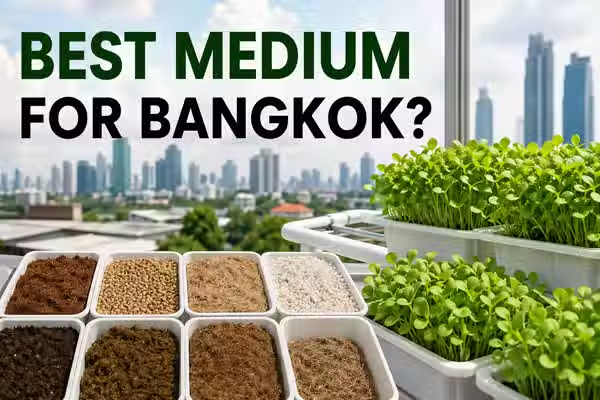
TL;DR
Most growing medium guides were written for temperate climates and assume you have some control over ambient temperature and humidity. In Bangkok, those assumptions collapse. Soil is essentially unusable. Peat becomes a pH and mold problem above 32 degrees Celsius. Hemp mat is the cleanest performer but the cost arithmetic changes past a certain tray count. Coco coir is the workhorse medium for this climate if you manage moisture actively. The rest have specific use cases or specific failure modes worth knowing before you buy a bulk order.
The tray that looked fine on day three
A grower running 12 trays of sunflower in a Bangkok condo, no dedicated grow room, ambient temperature averaging 31 degrees Celsius. The medium was potting soil because the grow guide said it works. Day three the germination looked uniform and clean. Day five there was a white fuzz spreading from the soil surface toward the stem base on four of the twelve trays. By day six it had jumped to three more. The harvest from those seven trays was unmarketable. The grower assumed overwatering. The actual problem was that the medium held surface moisture at 78 percent relative humidity while the ambient air never dropped below 70 percent RH, and the fungal load already present in the soil had everything it needed to run.
The medium was not neutral. It was an active variable that Bangkok's climate was already loading against the grower before the first seed went down.
The myth that any absorbent medium works if you water correctly
Watering discipline is the primary lever for mold and moisture control in microgreens. If you water correctly, the medium choice is secondary.
In Bangkok conditions, the medium determines the moisture floor independent of watering behavior. A medium with high water retention capacity sitting in 75 percent relative humidity ambient air will not dry to a safe surface moisture level between waterings regardless of how conservatively you water. The medium sets the floor. Your watering sets the ceiling. In a temperate climate with 45 to 55 percent RH, that floor is low enough that most mediums work. At 70 to 85 percent RH, the floor rises and the gap between a low-retention and high-retention medium becomes the difference between a clean tray and a mold event.
Across coco coir and peat moss trays run in parallel during Bangkok monsoon months, surface moisture readings on peat held 12 to 18 percentage points higher than coco coir at the 48-hour post-watering mark despite identical watering volume and timing. Plant Mood grow log data, 2024.
What the numbers look like before you choose a medium
Soil-based trays produced a visible mold or fungus gnat event in 9 of 9 Bangkok cycles tracked
Plant Mood grow log data, 2023 to 2024. No cycle completed cleanly. The variable was not watering volume or seed density. The medium carried the fungal and pest load into the tray on day one.
Peat moss trays showed pH drift of 0.4 to 0.8 units over a 10-day cycle when ambient temperature exceeded 32 degrees Celsius
Plant Mood grow log data, 2024. Standard recommended pH range for most microgreens is 5.5 to 7.0. At the high end of observed drift, trays starting at pH 6.2 finished at pH 7.0, the edge of the acceptable window.
Hemp mat trays produced 14 percent lower mold incidence than coco coir across 22 matched-pair cycles
Plant Mood grow log data, 2024. Matched for seed variety, watering volume, ambient conditions. The difference is attributable to airflow channels in the mat structure and the absence of retained organic matter that supports fungal growth.
Rockwool trays held moisture within 3 percentage points of target across the full cycle in 19 of 20 Bangkok cycles
Plant Mood grow log data, 2024. The inert mineral structure does not interact with ambient humidity the way organic mediums do. The tradeoff is disposal volume at scale and a higher unit cost than coco coir.
What the grow logs show across cycles
Between June and October, ambient RH in the grow space regularly exceeded 78 percent. During these months, coco coir trays that performed well in the dry season required a second active drying step -- either a brief fan pass or reduced blackout period -- to avoid surface moisture accumulation above the mold threshold. The medium itself did not change. The climate loading on it did.
Coco coir moisture buffering degrades in monsoon months without active management
Coco coir is not a set-and-forget medium in Bangkok. It is the best all-round performer here, but it requires seasonal adjustment to the watering and ventilation protocol. A grower who dialed it in during the cool season and did not adjust in June will see mold onset around day four to five.
Vermiculite is widely recommended for moisture retention and seed contact. In Bangkok, that retention works against the grower. Surface moisture readings on vermiculite trays were consistently 8 to 14 percentage points higher than coco coir at 24 hours post-watering. In a climate where you are already fighting ambient humidity, adding a medium that holds more surface water is the wrong direction.
Vermiculite's moisture retention is misread as a feature in tropical apartment growing
Vermiculite may perform well as a topdressing layer in small quantities for certain crops, but using it as a primary medium in Bangkok apartment conditions adds moisture load that the ambient environment does not allow to clear naturally.
Across hydroponic microgreen trials, mold incidence was low and germination was clean. The failure mode that replaced it was reservoir temperature. Bangkok tap water entering a tray at 28 to 30 degrees Celsius does not cool in an unventilated apartment. At that temperature, dissolved oxygen drops and pathogen load in the water increases. This is not in any of the standard hydroponic microgreen guides.
True hydroponic growing (no solid medium) shifts the problem from surface moisture to reservoir temperature
Hydroponic growing removes one class of problem and introduces a different one. It is not inherently safer in Bangkok. It requires active reservoir temperature management, which adds cost and monitoring overhead. For a one-person operation without a chiller, the practical benefit over a well-managed coco coir setup is marginal.
Plant Mood grow log data, 2024
The medium that looks sterile is not managing mold risk
Rockwool is inert, which eliminates one pathway for mold -- the organic substrate. But mold in microgreen trays does not only originate from the medium. It originates from seed coat, ambient spore load, and surface condensation. In Bangkok, the ambient spore load is high year-round. A rockwool tray with good airflow will perform well. A rockwool tray in a low-airflow environment with condensation on the tray surface will mold on the seed coat and stem base just as readily as an organic medium, because the medium's inertness does not address the environmental inputs.
Rockwool trays in the low-airflow corner of the grow space showed stem-level mold onset at day five to six in three of four cycles during the rainy season. The trays in the same rack with better fan coverage showed no mold event. Same medium. The medium choice was not the variable. Airflow was.
Rockwool is the safest medium for mold prevention because it is inert and has no organic matter to support fungal growth.
Why Bangkok's climate loads every medium differently than a temperate guide assumes
Growing medium guides are almost universally written for environments where ambient relative humidity cycles between 40 and 60 percent. In those conditions, a medium's moisture retention curve works in a predictable range. Water goes in, the medium holds some, the rest drains, and the surface dries to a safe level within 12 to 24 hours. Bangkok breaks this model at both ends. In the dry season, ambient RH drops to 55 to 65 percent and the model mostly holds. In the rainy season, ambient RH sits at 75 to 85 percent and the medium's ability to release surface moisture to the air is severely reduced because the air is already nearly saturated. Evaporative drying effectively stops. What remains is a surface that stays wet longer, a temperature that accelerates microbial activity, and a spore load from open windows or doors that is higher than any temperate indoor grow environment.
Hemp mat is the clearest illustration of this mechanism. Its open woven structure allows air to move through the medium, not just over it. That structural airflow compensates for the reduced evaporative drying. It is not that hemp mat dries faster in the conventional sense. It is that the physical structure maintains air exchange at the root-medium interface where other mediums create a sealed wet surface.
The relevant variable is not just surface moisture percentage but the vapor pressure differential between the medium surface and the ambient air. When ambient RH approaches 80 percent, that differential collapses. Mediums with high surface area and low structural airflow -- peat, vermiculite, fine-particle coco -- are most affected. Coarser mediums and open-structure mediums maintain some vapor exchange even when the differential is low.
What growers say, and what is actually happening
I switched to hemp mat and my germination rate dropped.
Hemp mat requires more precise moisture during the blackout phase than coco coir. Because it drains faster and holds less water, seeds on hemp mat in a dry-season Bangkok apartment can drop below the moisture threshold for germination if the initial watering is not sufficient and the blackout tent is not retaining humidity. The grower who switches from coco coir and uses the same watering volume will underwater the hemp mat tray. This is not a hemp mat failure. It is a calibration gap between mediums.
My peat moss trays were fine for three months, then suddenly started having mold problems.
The three-month window maps almost exactly to the transition from cool season to early rainy season in Bangkok. Peat's performance envelope is narrow in this climate. It works when ambient RH is below 65 percent. When monsoon conditions arrive and RH climbs to 75 to 80 percent, peat's moisture retention goes from acceptable to actively problematic. The grower did not change anything. The climate changed around them.
Rockwool is too expensive to justify at my tray count.
At fewer than 20 trays, the cost difference between rockwool and coco coir is real but manageable. Past 30 trays per week, the unit economics shift meaningfully. The complaint is valid for anyone scaling beyond a small operation. The answer is not to defend rockwool at scale but to acknowledge it as a specialist medium -- best for crops where contamination risk is high and the cost premium is recoverable in product value, not as the default choice for volume growing.
I can't figure out why my sunflower trays on coco coir keep getting mold but my radish trays on the same shelf don't.
Sunflower seeds have a thick, hulled coat that retains moisture at the seed surface far longer than small-seeded crops like radish. On coco coir in Bangkok humidity, the combination of a slow-drying seed coat and a medium that is already moisture-loaded during rainy season creates the exact microenvironment mold requires. The shelf location and medium are the same. The seed is the additional variable. Dehulled sunflower seed or a longer daily fan period during germination typically resolves this.
Seven mediums ranked for Bangkok apartment conditions
Best balance of cost, availability, and mold management for Bangkok. pH stable. Requires active moisture adjustment in monsoon months. Available in buffered and unbuffered forms -- use buffered to avoid the EC spike unbuffered coco introduces to seedlings.
The default medium for a Bangkok apartment operation running 10 to 50 trays per week. Not zero-maintenance, but the adjustments needed are predictable and learnable.
Lowest mold incidence in our data. Structural airflow is the functional reason. Single-use. Cost per tray is 2 to 3 times coco coir depending on supplier. No buffering needed. Germination requires accurate moisture calibration.
Best choice for crops with high mold sensitivity -- sunflower, pea, wheatgrass -- where the cost premium is recoverable. Not the right default for a high-volume operation where margin is thin.
Performs adequately in Bangkok cool season. pH instability and moisture retention become problems once ambient temperature exceeds 32 degrees Celsius consistently. Not recommended for rainy season use without active monitoring.
Avoid as a primary medium. If you have it, use it in the November to February window and monitor pH actively. Replace with coco coir for March onward.
Inert, predictable, and moisture-controllable. Does not address airflow-dependent mold pathways. Disposal volume at scale. Higher upfront cost. Best suited to crops where contamination risk justifies the premium.
Specialist use. Not a cost-effective default. Suited to a grower who is selling premium crops at a price point that absorbs the medium cost.
Moisture retention is the core problem in Bangkok conditions. Performs better in temperate climates where ambient RH allows evaporative drying. In Bangkok's rainy season it adds water load the environment cannot clear.
Do not use as a primary medium in Bangkok. Small quantities as topdressing for certain crops may be acceptable. Not a volume medium for this climate.
Potting soil
Carries fungal load, pest eggs, and organic matter from the start. Bangkok's heat and humidity activate all of it. Mold and fungus gnats are near-certain across the grow cycle.
Do not use for microgreens in Bangkok. The generic growing guide recommendation to use potting soil is written for a climate where the ambient conditions suppress fungal and pest activation that Bangkok accelerates.
Hydroponic (no solid medium)
Eliminates organic-substrate mold pathways. Introduces reservoir temperature as the primary failure mode. Requires EC and pH monitoring. Not inherently simpler than a well-managed solid medium setup -- just differently complex.
Best for growers who already have monitoring infrastructure or who are running hydroponic systems elsewhere and can extend that management to microgreens. Not a shortcut to cleaner growing for beginners in Bangkok.
What to actually do based on this data
Any Bangkok grower choosing a primary medium
Default to buffered coco coir unless you have a specific reason to choose otherwise. It is the most forgiving medium for this climate across the widest range of crops and tray counts.
Stable moisture management across most of the year with a predictable seasonal adjustment window in June through October.
Growers running high-value or mold-sensitive crops
Use hemp mat for sunflower, pea, and wheatgrass specifically. Calibrate your watering volume separately for hemp mat -- do not carry over the volume from your coco coir protocol. Hemp mat requires more water at seeding and less mid-cycle.
Mold incidence reduction of 10 to 15 percent on the crops most affected by seed-coat moisture retention in Bangkok humidity.
Any grower currently using soil or peat as a primary medium
Transition out immediately. Run a parallel tray on coco coir for one cycle alongside your current medium. Compare mold incidence and germination rate directly. The data will confirm the switch.
Elimination of the medium-origin mold and pest load that soil and rainy-season peat introduce before the first seed goes down.
Growers considering a switch to fully hydroponic microgreens
Monitor reservoir temperature before committing to the system. If your water temperature in the tray exceeds 26 degrees Celsius, address that first. A basic aquarium thermometer in the reservoir for one week before switching will tell you what you are dealing with.
Informed decision about whether the infrastructure required to manage reservoir temperature in Bangkok conditions is worth the shift away from a solid medium.
Seasonal recalibration of watering volume and blackout duration when ambient RH shifts. Most growers dial in a protocol in one season and run it unchanged year-round. In Bangkok, that protocol will be wrong for at least four months of the year regardless of which medium they are using.
FAQ
What is the best growing medium for microgreens in Bangkok?
Buffered coco coir is the best all-round medium for Bangkok apartment growing. It balances cost, availability, and mold management better than any other option across most of the year. Hemp mat outperforms it on mold incidence but costs 2 to 3 times more per tray and requires separate moisture calibration. Soil and peat are not viable primary mediums in Bangkok's climate.
Does hemp mat reduce mold in microgreens grown in high humidity?
Yes. Across 22 matched-pair cycles in Bangkok conditions, hemp mat trays showed 14 percent lower mold incidence than coco coir trays grown at the same ambient temperature and humidity. The mechanism is structural airflow through the mat, which maintains vapor exchange at the root-medium interface even when ambient RH exceeds 75 percent and evaporative drying from the surface is limited. Plant Mood grow log data, 2024.
Why does peat moss cause mold in tropical climates?
Peat moss retains surface moisture significantly longer than coco coir in high-humidity conditions. In Bangkok, peat trays held surface moisture 12 to 18 percentage points higher than coco coir at 48 hours post-watering during monsoon months. That moisture level, combined with ambient temperatures above 28 degrees Celsius, creates the conditions mold requires. Peat also shows pH drift of 0.4 to 0.8 units over a 10-day cycle when ambient temperature exceeds 32 degrees Celsius consistently.
Can I grow microgreens hydroponically without a growing medium in Bangkok?
Yes, but it shifts the primary failure mode from surface moisture to reservoir temperature. Bangkok tap water entering a tray at 28 to 30 degrees Celsius does not cool in an unventilated apartment. At that temperature, dissolved oxygen drops and pathogen load in the water increases. Hydroponic microgreens are not inherently safer or simpler in Bangkok -- they require active reservoir temperature monitoring that a well-managed coco coir setup does not.
Why do my sunflower microgreens mold on coco coir but my radish trays don't?
Sunflower seeds have a thick hull that retains moisture at the seed surface far longer than small-seeded crops like radish. On coco coir in Bangkok humidity, that slow-drying hull combined with the medium's moisture load during rainy season creates the microenvironment mold needs. The fix is either dehulled sunflower seed or a longer daily fan period during the germination phase to clear surface moisture from the hull before it becomes a mold substrate.
Is rockwool worth the cost for microgreens?
For most Bangkok growers, no. Rockwool is inert and moisture-controllable, but it does not address the airflow-dependent mold pathways that cause most problems in tropical apartment conditions. It also does not improve on coco coir enough to justify the cost difference at volume. It is a specialist medium suited to high-value crops where contamination risk is high and the price point absorbs the cost.
How does Bangkok's monsoon season affect which growing medium I should use?
Significantly. When ambient RH climbs to 75 to 85 percent from June through October, mediums with high moisture retention -- peat, vermiculite, fine-particle coco -- can no longer dry to a safe surface moisture level between waterings because evaporative drying nearly stops. Growers using coco coir need to add a fan pass or reduce their blackout period during these months. Growers using peat or vermiculite should transition to coco coir or hemp mat before the monsoon season arrives.