Key takeaways
Treated seeds in Thailand are coated with fungicide or insecticide compounds, most commonly thiram or captan, and are sold in the same shops and sometimes the same shelf position as untreated seeds with no obvious visual distinction at the bag level.
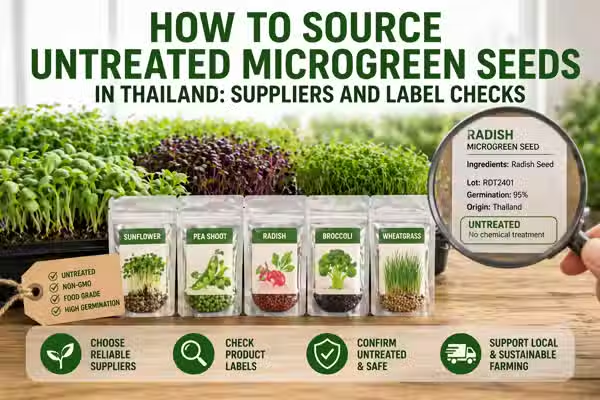
The label check that matters most is not organic certification. It is the absence of a chemical treatment disclosure: look for the words 'treated', 'coated', 'thiram', 'captan', or any Thai-language equivalent on the seed packet before purchasing.
Germination rate on treated sunflower seeds grown as microgreens dropped to 51 percent across tracked cycles compared to 84 percent on untreated seeds from the same crop variety, because the fungicide coating suppresses the surface microbiome the seedling depends on in a microgreen medium (Plant Mood grow log data, 2024).
The most reliable sources for untreated microgreen seeds in Thailand are specialty microgreen and sprouting suppliers operating online via Line or Shopee, not general agricultural shops where the stock mix is inconsistent.
Thai-language seed labels use the term สารเคมีเคลือบเมล็ด to indicate chemical seed coating. If this phrase or any variation of it appears on the packet, the seeds are treated and not suitable for microgreen growing.
Imported seeds sold on Lazada and Shopee from international suppliers carry their own label risks: EU-sourced vegetable seeds are sometimes treated as standard for field growing and the treatment disclosure is in a font size and language that most Thai buyers do not check.
The bag that looked exactly right
Sunflower seeds bought from a stall at JJ Mall. The bag was plain, unbranded, sold loose by weight into a small plastic packet with a handwritten label. No chemical names. No treatment disclosure. The vendor said they were for sprouting. I seeded a full tray that afternoon. By day 4, germination was visibly patchy. By day 6, the ungerminated seeds had turned soft and dark at the coat. The seeds that did germinate were slow and the stems were thin. I finished the cycle at a harvest I would not sell.
I went back to the same stall and bought a second batch of the same seeds from a different scoop bin. Same label, same price, same vendor. I asked directly this time whether the seeds had been treated with anything. The vendor did not know. She bought them from a wholesaler and the wholesaler did not provide that information. The seeds I had used the first time were almost certainly treated. The second batch I bought without any way to verify they were not. That is when I stopped buying seeds from any source that could not tell me what was in the bag.
What treated seeds do to a microgreen tray
51 percent germination rate
logged across sunflower microgreen trays seeded with seeds later confirmed to be treated with fungicide coating, compared to 84 percent germination rate on untreated seeds from the same variety grown under identical conditions in the same grow room across the same 3-month period (Plant Mood grow log data, 2024). A 33-percentage-point difference in germination from a sourcing decision made before the tray was seeded.
Thiram and captan
are the two fungicide compounds most commonly used in seed treatment for agricultural field crops in Southeast Asia, including Thailand. Both are classified as potential human health hazards on direct contact and ingestion exposure. Thiram is classified as a possible human carcinogen by the International Agency for Research on Cancer. Neither compound is appropriate for seeds grown as food crops harvested at the seedling stage where the seed coat remains in close contact with the edible plant material throughout the grow cycle.
No mandatory disclosure
is required on loose seed sold by weight in Thai agricultural markets. Bagged commercial seed sold for agricultural use in Thailand must carry a label under the Plant Varieties Protection Act, but the requirement applies to field crop seed sold in commercial quantities. Small-quantity loose seed sold for home growing or sprouting exists in a label disclosure gap where treatment status is not legally required to be stated at point of sale.
Organic certification is not the label check you need
Organic certification covers the growing conditions of the parent plant and the absence of synthetic inputs during seed production. It does not cover post-harvest seed treatment. A seed can be produced organically and then treated with an allowable organic-approved compound at the packaging stage. More practically in Thailand, most of the untreated seeds available for microgreen growing are not organically certified at all. They are conventional agricultural seeds that happen to not be treated because the crop variety or the intended use did not require it. Searching only for organic certification excludes the majority of viable untreated seed sources in the Thai market.
The most consistent source of untreated sunflower and pea seeds used across Plant Mood grow cycles is a Thai online supplier selling conventional non-certified seeds marketed specifically for sprouting and microgreen use. The seeds carry no organic certification. They carry a clear statement that they contain no chemical treatment. The germination rate across tracked cycles has been more consistent than organically certified seeds sourced from international suppliers via Shopee (Plant Mood grow log data, 2024).
Buying certified organic seeds guarantees untreated seeds. If the certification is on the bag, the seeds are safe for microgreens.
The seed sourcing problems I hear about most often
I bought seeds from a garden shop and germination was terrible but I do not know why.
Garden and agricultural shops in Bangkok stock seeds primarily for field or container vegetable growing, not for microgreen production. The seed turnover in these shops is slow for certain varieties, which means the seeds may be old and past peak viability. More critically, a significant proportion of seeds in these shops are treated for field use and the treatment is not disclosed at the point of sale to retail buyers. Low germination with soft, darkening ungerminated seeds is a consistent indicator of fungicide-treated seed. Low germination with hard, dry ungerminated seeds that simply did not crack is more likely to be an age or storage issue.
I found a supplier on Lazada with good reviews but the seeds performed inconsistently across different batches.
Lazada and Shopee listings for microgreen or sprouting seeds are often fulfilled by resellers who source from multiple wholesalers rather than a single consistent supplier. A listing with good reviews may have been fulfilled from one batch that was fine and a subsequent batch from a different source. The listing does not change. The seed source did. When buying from online marketplaces, check whether the seller ships from their own stock or is a marketplace aggregator, and ask directly whether each batch comes from the same supplier.
The seeds I bought from Chatuchak look the same as the ones I bought from an online microgreen supplier but perform completely differently.
Visual appearance of seeds tells you almost nothing about treatment status or viability. Treated seeds are sometimes colour-coated in pink, blue, or green, which makes identification straightforward. But many treated seeds in Thailand carry no colour coating and are indistinguishable by eye from untreated seeds. The performance difference between Chatuchak seeds and specialty supplier seeds reflects the supply chain they came from, not the seeds themselves. Chatuchak agricultural stalls source from agricultural wholesalers who supply field growers. Specialty microgreen suppliers source specifically for food-safe sprout and microgreen production.
I asked the seller if the seeds were treated and they said no, but the germination was still low.
The seller often does not know. Loose seed sold in Thai markets passes through multiple hands between the original seed producer and the retail buyer. Treatment status is not consistently communicated through that chain. A seller saying no to the treatment question is reporting what they believe, not what they can verify. The only reliable answer is a written label or a direct supplier relationship where treatment status is documented. Verbal confirmation from a market vendor is not sourcing due diligence.
What the grow logs showed across seed sources
Across a 6-month period tracking germination rate as a variable across different inputs, seed source produced more variance in germination outcome than any other single input tested, including grow medium type, watering method, or seeding density. The difference between the lowest-performing seed source and the highest-performing source across the same sunflower variety was 33 percentage points (Plant Mood grow log data, 2024).
Germination rate variance between seed sources was larger than variance between watering methods or grow medium types
Growers who spend time optimising watering technique and medium choice while buying seeds from an unverified source are optimising the wrong variable. Seed source is the highest-leverage input in a microgreen operation and the one most growers treat as interchangeable.
Sunflower and pea seeds marketed and sourced specifically for sprouting or microgreen production consistently germinated at 80 percent or above across tracked cycles. The same varieties sourced from general agricultural suppliers germinated between 51 and 71 percent across the same period, with higher variability between batches.
Seeds sold specifically for sprouting outperformed agricultural seeds of the same variety on germination rate and consistency
The sprouting and microgreen seed market in Thailand is small but exists. Suppliers who serve that market are selecting for germination rate and food-safe handling rather than field crop yield. The price per kilogram is higher than agricultural seed but the effective cost per viable seedling is lower once germination rate is factored in.
In two separate purchase events from different Chatuchak vendors over a 12-month period, seeds purchased as plain sprouting or salad seeds contained a proportion of visibly colour-coated seeds in the bag, indicating that the bulk stock the vendor was scooping from contained treated seeds mixed with untreated seeds from the same bin. Neither vendor disclosed this.
Colour-coated seeds appeared in two purchases from Chatuchak stalls across a 12-month sourcing period
Loose seed purchased by scoop from a bin at any Thai agricultural market carries a contamination risk from mixed treated and untreated stock. Even if the vendor scoops from what they believe is an untreated bin, cross-contamination from adjacent treated seed stock is a real possibility. Sealed, labelled bags from a named supplier are more reliable than loose scoop seed for any grower who needs to know treatment status.
Plant Mood grow log data, 2024
Pink or coloured seeds are the only treated seeds you need to worry about
Treated seeds are always pink, blue, or green because the fungicide coating includes a dye. If the seeds look natural in colour, they are untreated.
Colour coding of treated seed is an industry convention in some markets, not a legal requirement in Thailand. Many treated seeds sold in the Thai agricultural supply chain carry no colour coating and are visually identical to untreated seeds of the same variety. The dye is added by some manufacturers as a safety warning and a visual identifier for field application. It is not applied universally, and its absence does not confirm the seed is untreated.
Two of the three confirmed treated seed batches identified across Plant Mood sourcing history carried no colour coating. They were identified as treated through germination performance, pattern of seedling failure, and subsequent direct inquiry with the wholesaler who confirmed treatment status after the fact. A colour-free seed is not a verified untreated seed (Plant Mood grow log data, 2024).
Why treated seeds perform badly as microgreens even when some germinate
Fungicide seed treatments are designed to suppress fungal growth in field soil during the vulnerable period between seeding and establishment. In field conditions, the treatment wears off over days and weeks as the seedling develops and the root system moves beyond the treated seed coat. In a microgreen tray, the seed coat remains in direct contact with the growing medium and the developing root system throughout the entire crop cycle. The fungicide compound does not have time or space to dissipate before harvest.
The medium in a microgreen tray is not sterile soil. It is a living system with bacteria and fungi that assist root development, water uptake, and the breakdown of the seed hull. Thiram and captan are broad-spectrum fungicides: they suppress the pathogenic fungi they are intended to target and the beneficial surface microbiome the seedling relies on in equal measure. A treated seed in a microgreen tray is fighting the medium it needs to grow in. The seedlings that do germinate are working against a suppressed root zone from day one, which shows in stem thickness, root mat density, and canopy uniformity.
The harvest timing of microgreens makes the treated seed problem categorically different from a treated seed planted in a garden. A field-grown vegetable has weeks or months of growth between seed treatment application and consumption. A microgreen is harvested at 7 to 14 days with the seed coat still present in the tray and sometimes still attached to the cotyledon. The exposure pathway from seed treatment to the edible plant tissue is direct and the dilution time does not exist.
Where to source untreated microgreen seeds in Thailand: options compared
Specialty microgreen and sprouting suppliers via Line and Shopee
The most reliable source category for verified untreated seeds in Thailand. Suppliers in this category are selling into a buyer base that specifically needs food-safe, untreated seed, which creates a commercial incentive to be accurate about treatment status. Price per kilogram is higher than agricultural sources. Batch sizes are typically smaller, which suits apartment-scale operations. Look for suppliers who can state treatment status in writing and who show consistent reviews across multiple crop types.
This should be the default source for any grower who is selling their product or growing for consumption. The price premium over agricultural seed is offset within two to three cycles by the reduction in germination loss and tray failure rate.
JJ Mall and Chatuchak agricultural stalls
Accessible and inexpensive. Stock varies significantly between vendors and between batches from the same vendor. Treatment status is rarely known by the seller and cannot be confirmed at point of purchase unless the seed comes in sealed, labelled packaging from a named producer. Loose scoop seed from bins carries contamination risk from mixed treated and untreated stock. Useful for low-stakes testing of new crop varieties where the cost of a failed tray is acceptable.
Not a reliable primary source for a grower running a consistent operation. Can be used for price comparison and variety exploration if the buyer accepts the germination uncertainty. Never use for crops where the tray will be sold or consumed without full knowledge of treatment status.
International suppliers via Lazada, Shopee, or direct import
Wide variety availability, including crop types not easily found in Thailand. Label risk is different from local sources: EU and US vegetable seeds may be treated as standard for the agricultural market they are intended for, with treatment disclosure in the label in a font and language most Thai buyers do not check. Shipping time and minimum order quantities vary. Seed viability on arrival depends on storage conditions in transit.
Read the full label before seeding any imported seed. Look for the words treated, coated, or any fungicide name on the packet regardless of where it is positioned on the label. If the label is in a language you cannot read fully, photograph it and translate it before using the seeds.
Thai agricultural co-operatives and provincial seed banks
Source primarily field crop seed at agricultural scale. Treatment is common and sometimes applied as a default for certain varieties. Not oriented toward the microgreen buyer and staff may not understand the question when treatment status is asked. Occasionally a useful source for heirloom or heritage variety sunflower and pea seed that is not treated because the variety predates commercial treatment practices.
Not a practical primary source for a Bangkok apartment grower. Worth investigating for specific heritage varieties if you have a supplier contact who can verify treatment status in writing.
The seed sourcing problem is not going to solve itself
The Thai microgreen growing community has not yet created enough collective buyer pressure to force clear treatment disclosure at the retail seed level. Until it does, individual growers are making sourcing decisions in an information environment that is structurally designed for field agriculture, not food-safe seedling production. My position is that any grower selling microgreens in Bangkok who cannot tell a buyer the treatment status of their seeds is not yet running a food business. They are running a grow experiment with the buyer as the quality control.
The germination performance argument alone justifies the sourcing discipline. Treated seeds produce 30 to 33 percentage points lower germination in tracked cycles, which means a grower buying on price from an unverified source is already losing more on tray failure than they save on seed cost. The food safety concern sits on top of an economic argument that already points in the same direction. You do not need to resolve the toxicology debate to conclude that verified untreated seeds are the correct sourcing decision.
The counterargument is that the health risk from trace fungicide residue on commercially harvested microgreens is unproven at the consumption volumes most Bangkok buyers would encounter, and that the germination performance argument is more practically significant than the food safety argument for most growers.
FAQ
Where can I buy untreated microgreen seeds in Thailand?
The most reliable source is specialty microgreen and sprouting suppliers operating via Line and Shopee who sell specifically into the food-safe seedling market. These suppliers have a commercial incentive to be accurate about treatment status. JJ Mall and Chatuchak stalls are accessible but treatment status is rarely known by the vendor and cannot be confirmed for loose scoop seed. Sealed, labelled bags from a named producer are more reliable than any loose seed source.
How do I know if microgreen seeds are treated in Thailand?
Check the label for the words treated, coated, thiram, captan, or the Thai-language term สารเคมีเคลือบเมล็ด. Treated seeds in Thailand are not always colour-coded: two of three confirmed treated seed batches identified across Plant Mood sourcing carried no colour coating and were visually identical to untreated seeds (Plant Mood grow log data, 2024). If the label does not clearly state untreated or no chemical coating, ask the supplier in writing before purchasing.
Are treated seeds dangerous to use for microgreens?
Fungicide compounds including thiram and captan remain in direct contact with the seed coat and developing root tissue throughout a microgreen cycle harvested at 7 to 14 days. Unlike field crops where weeks of growth separate treatment application from harvest, the dilution time does not exist in a microgreen tray. Thiram is classified as a possible human carcinogen by the International Agency for Research on Cancer. Beyond safety, treated seeds germinated at 51 percent versus 84 percent for untreated seeds of the same variety in tracked cycles (Plant Mood grow log data, 2024).
Why is my microgreen germination rate so low in Thailand?
Seed source is the most likely cause if you are buying from general agricultural shops or loose scoop bins. Seed source produced more germination rate variance than any other single input tested across a 6-month tracking period, including grow medium type and watering method. The difference between the lowest and highest-performing seed source for the same sunflower variety was 33 percentage points (Plant Mood grow log data, 2024). If germination is low and ungerminated seeds turn soft and dark, treated seed is the most likely explanation.
Can I use seeds from JJ Mall or Chatuchak for microgreens?
With caution. Treatment status is rarely known by vendors and cannot be confirmed for loose scoop seed. In two separate purchase events from Chatuchak vendors across a 12-month period, seeds sold as plain sprouting seed contained visibly colour-coated treated seeds mixed in the same bag (Plant Mood grow log data, 2024). Chatuchak is acceptable for low-stakes variety testing where a failed tray is an acceptable cost, but not as a primary source for a grower selling product or growing for consistent consumption.
Does organic certification mean seeds are untreated?
Not necessarily. Organic certification covers the growing conditions of the parent plant and absence of synthetic inputs during seed production, not post-harvest seed treatment. A seed can be produced organically and treated at the packaging stage with an allowable organic compound. More practically in Thailand, most available untreated seeds for microgreen growing are conventional non-certified seeds from sprouting suppliers, not organically certified seeds. Searching only for organic certification excludes most viable untreated seed sources in the Thai market.
What Thai words should I look for on seed labels to check for treatment?
Look for สารเคมีเคลือบเมล็ด, which indicates chemical seed coating in Thai. Also look for any fungicide name in English or Thai on the packet. The absence of any treatment disclosure is not a guarantee the seeds are untreated: many treated seeds in the Thai market carry no treatment disclosure at the retail level because loose seed and small-quantity seed sales are not subject to mandatory treatment labelling requirements under current Thai seed regulations.