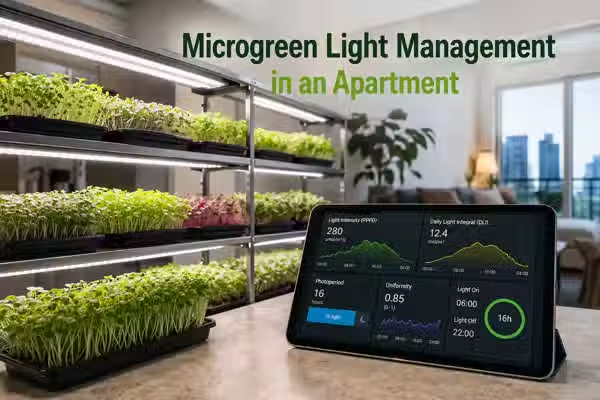
Key takeaways
Bangkok window light drops from 9,400 lux in January to 2,900 lux in April at the same east-facing window and the same hour, due to sun angle shift and hot season haze. Sunflower cotyledons need 4,000 to 6,000 lux to green in under 6 hours. Below that threshold, they take 18 to 26 hours and stems develop visible phototropic lean before colour changes. (Plant Mood grow log data, 2023 to 2024)
Corner tray positions on a grow rack receive 40 to 55% less light than the centre position under the same LED strip. At a 16-hour photoperiod, the DLI gap between a rack centre and a corner can exceed the difference between a 12-hour and 18-hour photoperiod schedule entirely. Tray-to-tray inconsistency blamed on seeds or watering is a light distribution problem in most cases. (Plant Mood grow log data, 2024)
A BH1750 lux sensor weighted to human vision cannot measure photosynthetic photon delivery. Two light sources at identical lux readings can differ by up to 50% in PPFD depending on spectrum. The sensor is reliable as a consistency tool. It is not reliable for determining whether a crop is receiving sufficient photosynthetic input when light sources change.
Sunflower microgreen yield difference between 14-hour and 18-hour photoperiods was under 8% in Plant Mood trial data, while electricity cost for the light circuit increased 29%. In Bangkok without air conditioning, running lights past 21:00 raises tray-level temperature 1.4 to 2.1 degrees Celsius overnight and measurably reduces germination rate in the critical day 2 to 3 window.
Blackout mold incidence in sunflower trays tripled between 3-day and 5-day blackout cycles across 47 logged cycles in Bangkok conditions. The single strongest predictor of mold outcome was substrate moisture at stack time, not blackout day count. Trays entering blackout above 42% moisture showed mold in over half of affected cycles regardless of how many days they ran. (Plant Mood grow log data, 2024)
Raising an LED strip mounting height from 12 cm to 18 cm above tray surface improved corner-to-centre lux ratio from 0.54 to 0.68 in rack mapping data. This is a free adjustment that produces the largest single improvement in within-shelf consistency available without additional hardware.
TL;DR
Microgreen light management in Bangkok is not one problem. It is five problems that interact. The season changes what your window delivers. The position on the rack changes what each tray receives. The sensor on your bench is not measuring what the plant is using. The number of hours on the timer costs more past 14 hours than it returns. And the darkness before the light matters as much as the light itself. Growers who solve one of these without knowing the others exist will keep getting inconsistent trays and looking in the wrong place for the reason.
Five problems that look like one
April. I have six sunflower trays on the rack. Three on the middle shelf, three on the top. They came out of blackout the same morning, same seed batch, same coir depth, same soak time. By day 8, the three top-shelf trays look correct. The three middle-shelf trays look like they had two fewer days of light. Stems stretched, cotyledons pale, one tray leaning noticeably toward the window. I have seen this pattern before and I have blamed it on the wrong thing before: seed variability, watering inconsistency, a draft from the aircon. None of those explanations survived the data.
The middle shelf LED strip had shifted 4 centimetres off centre when someone pushed a tray in hard the previous week. Corner positions on that shelf were reading under 5,500 lux. The top shelf was running over 9,000. The difference was not visible without a meter. It was visible in the tray.
That was one problem. But in April there was a second one underneath it: even the top shelf was delivering 3,200 lux through the east-facing window in the post-blackout light phase, down from 9,400 in January. The artificial light was adequate. The window light supplementing it was not what it had been four months earlier. Two things were wrong at once, and fixing only the strip position would have caught one of them.
The pattern across five years of growing in this apartment is that light problems rarely arrive alone. Bangkok's season changes what comes through the window. The rack geometry shapes what each tray gets from the artificial source. The sensor reports something adjacent to but not identical to what the plant is measuring. The timer controls duration but not the heat cost of running lights too long in an uncooled room. And the blackout stack creates its own light-free microclimate where humidity and temperature compound over time in ways that have nothing to do with the light waiting on the other side. Understanding any one of these in isolation is less useful than understanding how they layer.
What plant science adds to what tray observation shows
Bantis, F. et al. (2018). Current status and recent achievements in the field of horticulture with the use of light-emitting diodes. Scientia Horticulturae 235: 437-451.
Microgreens show crop-specific responses to light spectrum composition that PPFD alone does not predict. Red-to-blue ratio, far-red fraction, and photoperiod interact to affect hypocotyl length, cotyledon size, and anthocyanin accumulation. Pea and sunflower microgreens showed different optimal red-to-blue ratios in controlled trials.
A lux sensor cannot see spectrum. A PAR sensor gives photon quantity but not quality. The tray itself is the most complete diagnostic instrument available to a small grower. When stem behaviour and colour diverge from what the meter suggests, the meter is usually measuring the wrong thing, not reporting a broken crop.
Morrow, R.C. (2008). LED lighting in horticulture. HortScience 43(7): 1947-1950.
The relationship between lux and plant-usable light is spectrum-dependent and cannot be approximated by a single conversion factor across different light source types. Red-blue LED arrays deliver significantly more photosynthetic output per lux unit than white broad-spectrum sources.
Any grow guide that gives a lux target without naming the light source type is giving half an instruction. A grower switching from a white LED strip to a red-heavy panel at the same lux reading may be delivering 40 to 50% more PPFD to the tray while the sensor shows a drop. The tray will tell them before the number does.
Taulavuori, K. et al. (2016). Species-specific differences in synthesis of flavonoids and phenolic acids under increasing periods of enhanced blue light. Environmental and Experimental Botany 121: 145-150.
Blue light fraction in the grow spectrum drives flavonoid and phenolic compound synthesis in leafy crops at fractions as low as 10 to 15% of total photon output. These compounds contribute to flavour intensity and nutritional density beyond what growth metrics capture.
Two white LED panels at the same lux, with different blue fractions, produce different flavour profiles in the crop. A grower selling on taste is managing a variable their sensor cannot detect. Consistency in flavour across cycles requires consistency in the light source spectrum, not just consistency in the lux reading.
The numbers that change how you read your grow space
3,200 lux in April versus 9,400 lux in January
BH1750 readings taken at tray level on the same east-facing Bangkok apartment windowsill at the same hour across monthly measurements. Same window. Same time of day. A 66% reduction in delivered light that most growers attribute to a failing crop before they point a meter at the glass. Sunflower cotyledons need 4,000 to 6,000 lux for normal post-blackout greening. The April reading sits below threshold for 8 months of the year. (Plant Mood grow log data, 2023 to 2024)
0.45 to 0.68
Corner-to-centre lux ratio range across six shelves on the Plant Mood Bangkok grow rack, measured at nine grid positions per shelf. A ratio of 0.45 means the corner tray receives 45% of what the centre tray receives from the same fixture. The DLI gap between those two positions at a 16-hour photoperiod exceeds the difference between a 12-hour and 18-hour timer schedule. Growers rotating trays front-to-back are addressing the smaller gradient. The dominant gradient on a linear LED strip runs left-to-right. (Plant Mood grow log data, 2024)
Mold incidence tripled between 3-day and 5-day blackout
Across 47 logged sunflower cycles in Bangkok conditions, 3-day blackout produced 11% mold incidence. The same substrate and seed source under 5-day blackout produced 34% mold incidence. The tipping variable was not the day count alone but the interaction of blackout duration with substrate moisture at stack time and ambient humidity above 78%. The 5-day recommendation in most guides was established in lower-humidity environments where that compounding does not occur at the same rate. (Plant Mood grow log data, 2024)
Under 8% yield difference between 14-hour and 18-hour photoperiod
Averaged across three consecutive grow cycles per condition in structured photoperiod trials on sunflower microgreens. The 4-hour increase in daily light duration produced a yield improvement within the margin of normal tray-to-tray variability, while electricity cost for the light circuit increased 29%. In Bangkok ambient conditions without air conditioning, the 18-hour schedule also raised tray-level temperature 1.4 to 2.1 degrees Celsius overnight. (Plant Mood grow log data, 2024)
Potential PPFD difference between two light sources reading identical lux on a BH1750, depending on spectrum composition. A blurple LED and a warm white LED at the same lux reading can deliver PPFD values that differ by nearly half. Growers comparing grow lights by lux are comparing how bright the light looks to a sensor calibrated to human vision, not to a plant.
How the five light variables interact in a Bangkok apartment
Each of the five light variables in a Bangkok microgreen operation operates through a distinct mechanism. They are independent enough that fixing one does not fix the others. They are connected enough that when two or three are wrong simultaneously, the crop outcome looks like a single, bigger failure instead of a stack of smaller ones.
The seasonal window variable runs through the sun's angle and the atmospheric condition of the sky. In cool season, Bangkok's sun rises further south and lower. An east-facing window receives near-direct morning incidence through December and January. As the season turns toward March and April, the sun rises further north and climbs steeper. By 8am in April it has already passed above the window frame angle. What the tray receives after that is diffuse sky light filtered through pre-monsoon haze, not the same sky it saw in January. The tray is receiving photons, not the same photons.
The rack distribution variable runs through geometry. Light from a linear LED strip follows the inverse square law in the vertical direction and a beam-spread function laterally. Corner positions on a shelf are at maximum distance from the strip in both directions simultaneously -- the double-penalty zone. Raising the strip spreads the beam more evenly but reduces peak intensity. The tradeoff is almost always worth making if the crop minimum is still cleared after raising.
The lux-versus-PPFD variable runs through spectral mismatch. The BH1750 is calibrated to peak around 555 nanometres -- the green-yellow range that human eyes favour and that leaves reflect. Red wavelengths around 660 to 680 nanometres, which chlorophyll uses most efficiently, are underweighted by the sensor. A light source rich in red delivers more to the plant per lux unit than the meter suggests. Switching light types without understanding this produces unexplained crop differences at identical lux readings.
The photoperiod variable runs through daily light integral and its thermal side effect. More hours deliver more photons up to the point where the crop's photosynthetic machinery is saturated for that growth stage. In Bangkok without mechanical cooling, the hours past 21:00 also maintain elevated tray-level temperature during the window that would otherwise allow the room to cool. Germination rate on sunflower drops measurably above 32 degrees Celsius sustained for more than 6 hours during the day 2 to 3 window. The photon gain from extended hours and the temperature cost of the same hours are not the same sign in Bangkok conditions.
The blackout variable runs through moisture and microbial growth rate. Darkness is the trigger for hypocotyl elongation through auxin redistribution. But darkness also means no evaporation, no air exchange, and a sealed microclimate where the temperature runs 1.8 to 2.4 degrees Celsius above ambient inside a 6-tray stack. Fungal spores present on any coco coir substrate -- and they are always present -- have time to germinate and establish when substrate moisture is above 42% and the environment stays warm and sealed past day 3. The elongation benefit of each additional blackout day diminishes as seed energy depletes. The mold risk does not diminish. It compounds.
A grower running a standard Bangkok apartment setup -- east-facing window for post-blackout light, four-shelf rack with one LED strip per shelf, BH1750 monitoring, 18-hour timer, 5-day blackout -- may be running four separate light problems without knowing any of them. The window drops below 3,000 lux in April without any change in setup. The rack corners are receiving half the centre lux without any malfunction. The lux meter is reporting a white-LED number that would be incorrect applied to the blurple strip they switched to last month. The 18-hour timer is adding overnight heat that is raising the germination risk in their blackout stack. None of these produce a single catastrophic failure. They produce a grower who gets good results in January and cannot reliably reproduce them in August, and has a different hypothesis each time for why.
Daily light integral -- DLI in mol/m2/day -- is the unit that connects the photoperiod and lux variables. DLI equals PPFD in micromoles multiplied by photoperiod in seconds, divided by one million. At 120 estimated PPFD and 14 hours: 120 times 3,600 times 14 divided by 1,000,000 equals 6.05 mol/m2/day. Target DLI for sunflower microgreens at cotyledon stage based on Plant Mood trial data sits between 5.5 and 7.5 mol/m2/day. Below 5.5, etiolation accumulates. Above 7.5, incremental yield response becomes difficult to measure.
Window-only versus artificial-only versus hybrid: what each actually delivers in Bangkok
Window light only, post-blackout greening
Free. Spectrally complete. Delivers 8,000 to 12,000 lux in cool season on an unobstructed east-facing Bangkok window. Drops to 2,900 to 3,500 lux in hot season on the same window due to sun angle and atmospheric haze. Not controllable. Does not compensate for overcast days. Creates phototropic stem lean when tray centre receives significantly less incidence than the window edge, requiring rotation every 4 to 5 hours. Completely season-dependent in performance. A grower who sets up their window light position in January and does not revisit it will be running below sunflower threshold from approximately March through October.
Workable for cool season growing with consistent monitoring and rotation. Not workable as a year-round sole light source for sunflower microgreens in Bangkok without supplementation from March onward. Best supplemented with a 30W LED panel during hot season rather than extended through midday, which adds heat stress at tray surface temperatures of 35 to 38 degrees Celsius.
Artificial LED only, rack-mounted
Consistent across seasons. Controllable photoperiod. Subject to rack geometry gradients that can produce 40 to 55% intensity differences between centre and corner positions. Subject to gradual lamp degradation of 1 to 3% per thousand operating hours without visible indication. Requires understanding of the lux-to-PPFD relationship for the specific light source type to interpret readings correctly. In Bangkok without air conditioning, extended photoperiods add measurable overnight heat load. The consistency advantage is real only if the fixture is mapped, monitored for degradation, and kept in position. A strip that shifts 4 centimetres silently produces a 38 to 45% lux differential across the shelf width.
The right choice for year-round production. Requires an initial shelf map with a BH1750, quarterly re-mapping, and a rotation protocol designed from the map rather than a generic front-to-back default. Photoperiod of 14 to 16 hours is adequate at normal white LED intensity levels. Extending past 16 hours delivers negligible yield return and real heat cost in Bangkok uncooled grow rooms.
Hybrid: artificial during blackout and early post-blackout, window for final light phase
The approach most apartment growers end up with by default. Risk: growers often treat the artificial light as the primary source and the window as supplementary, when in hot season the artificial source is the only reliable one. The window contribution becomes variable and harder to account for. Measuring the combined lux at tray level rather than treating the two sources independently is the only way to know what the tray is actually receiving. This setup also creates inconsistency between cool and hot season cycles if the grower adjusts the artificial source in response to seeing pale trays without realising the window contribution has dropped.
Works well in cool season when window light is a genuine supplement to adequate artificial levels. Requires reassessment in March when window contribution drops. The most common failure mode is a grower who supplements adequately in December and does not notice the supplementation has become the primary source by May. A single monthly lux measurement at tray level, combining both sources, catches this before it costs a cycle.
What five years of Bangkok tray data shows that the guides do not cover
Monthly BH1750 readings taken at tray level on the east-facing windowsill at the same hour showed peak lux of 9,400 in January, dropping to 2,900 in May -- a 69% reduction across the year. Sunflower cotyledon greening time after blackout tracked this directly: 4 to 6 hours in cool season cycles with 8,000 to 10,000 lux, 18 to 26 hours in hot season cycles with 2,500 to 3,500 lux at the same window position. South-facing windows showed smaller seasonal variation than east-facing windows because the sun tracks north in hot season, maintaining more consistent diffuse sky contribution from the south. (Plant Mood grow log data, 2023 to 2024)
Seasonal window light variation explains more unexplained hot-season tray failures than any other single variable
Growers who set up post-blackout light position in cool season and do not revisit it are absorbing a systematic seasonal performance penalty that appears in April and persists through October. The fix is either a monthly lux check at tray level or a supplemental grow light that runs regardless of season. Blaming hot-season pale trays on seed quality is the most common misdiagnosis in window-only Bangkok operations.
Across 47 logged sunflower cycles from January 2023 through October 2024, cycles entering blackout above 42% substrate moisture showed mold in 19 of 31 cases. Cycles entering below 36% showed mold in 4 of 16 cases regardless of whether they ran 3, 4, or 5 days. The relationship between blackout duration and mold was real but secondary. Day count is a proxy for time-under-sealed-conditions. The variable those conditions act on is moisture. A 4-day blackout with entry moisture below 36% outperformed a 3-day blackout with entry moisture above 44% on mold rate in the data. (Plant Mood grow log data, 2024)
Substrate moisture at stack time predicts blackout mold outcome more reliably than blackout day count
The right pre-blackout question is not how many days. It is how wet is this going in. A grower who does not instrument substrate moisture is making the blackout decision without the variable that most determines the outcome. A capacitive soil moisture probe costs under 300 THB and removes the guesswork.
Across six shelves mapped on the Plant Mood Bangkok rack, the shelf with the highest mounting distance -- 18 cm versus 12 to 15 cm on other shelves -- showed the best corner-to-centre ratio at 0.68, despite having the lowest centre lux of the three shelves with dedicated strips. The two shelves at 12 cm mounting height showed corner-to-centre ratios of 0.48 and 0.54. These two shelves had the highest centre lux and the worst within-shelf yield inconsistency. The brighter shelves were less consistent. The relationship between mounting height, distribution evenness, and crop consistency was the opposite of what growers optimising for peak brightness would predict. (Plant Mood grow log data, 2024)
Mounting height has a larger effect on within-shelf light consistency than any other single rack adjustment
Before adding a second light source to address tray inconsistency, raise the existing strip 3 to 5 cm and re-map. This is a free adjustment that frequently closes most of the consistency gap. The residual corner deficit after raising is then addressable with rotation rather than hardware.
Plant Mood grow log data, 2023 to 2024
What Bangkok-specific light guides almost never mention
Bangkok condo windows frequently face buildings 6 to 15 metres away. The building opposite blocks a portion of the sky the tray can see, independent of season or window orientation. A window facing east with an unobstructed sky delivers fundamentally different light than one facing east with a 20-storey building 8 metres away. Growers assess window orientation but rarely assess sky obstruction. An obstructed east-facing window can deliver 40 to 60% of the lux an unobstructed east-facing window of the same size provides. This does not change seasonally -- it is a permanent reduction stacked on top of all other seasonal variation.
The building across the soi as a fixed light reducer
A significant proportion of Bangkok condo windows carry UV-blocking or heat-rejection film applied by the developer or a previous tenant. This film reduces visible light transmission by 10 to 30% and often reduces blue wavelength transmission disproportionately -- the range that most drives chlorophyll synthesis and photomorphogenesis in seedlings. Growers who have never measured lux at tray level with and without the window assume their reading is what an untinted window would give. It is not. If the window has any tint or visible coating, that grower's baseline lux is lower than the same orientation would deliver through clear glass.
Glass tint and UV film in Bangkok condos
A 6-tray blackout stack runs 1.8 to 2.4 degrees Celsius above ambient at its core, and the bottom tray runs higher moisture than the top due to downward moisture migration. These conditions exist inside the stack regardless of what the ambient sensors in the room are reading. A grower managing grow room temperature at 29 degrees Celsius has a stack interior running 31 to 32 degrees. At that temperature range, Pythium is comfortable and Botrytis remains active. The microclimate inside the stack is not the grow room microclimate. Monitoring ambient temperature and concluding the blackout environment is safe is reasoning from the wrong sensor position.
The stack creates its own microclimate that no timer controls
LED panels lose output at approximately 1 to 3% per thousand hours of operation, with faster decline in hot environments like a Bangkok grow room without cooling. A strip that delivered 9,200 lux at installation may deliver 7,600 lux eight months later at the same position. The BH1750 tracks this decline accurately if readings are logged over time. Without logging, each reading looks normal relative to memory. A grower who does not record baseline lux at consistent intervals is absorbing a compounding DLI reduction that produces gradually worsening tray quality across months with no single visible failure event to investigate.
Light degradation over months with no visible signal
Mechanical plug timers and many smart plugs reset to off after power interruptions and do not restore the previous schedule without manual intervention. Three logged instances during photoperiod trials where the relay misfired shortened the affected tray's photoperiod by 3 to 5 hours. Each produced a visible growth rate reduction on the affected tray in the following 24 hours. A grower experiencing tray inconsistency without an obvious cause should verify that the timer is actually executing the scheduled on and off events, not just that the schedule is programmed. The schedule in memory and the events the timer actually fires are not always the same thing.
Timer consistency as a silent source of photoperiod variation
Where Bangkok microgreen light management is going
Within three years, fixed blackout day count recommendations will be replaced by substrate moisture threshold protocols in Bangkok-aware growing guides, making day count a secondary variable rather than the primary instruction.
The fixed-day debate persists only because most growers are not logging substrate moisture at stack time. As cheap capacitive probes become standard in operations beyond hobby scale, the correlation between entry moisture and mold onset will be too consistent to ignore. The day count is a proxy for risk accumulation. The root variable is moisture. Communities that are logging will figure this out faster than communities that are not, and Bangkok growers face high enough mold pressure that the signal is clear in a single wet season.
Major microgreen growing forums or published guides incorporating substrate moisture threshold as the primary blackout decision variable alongside day count by 2027.
Affordable PAR sensors entering the Bangkok grow supply chain will reveal a pattern of systematic over-lighting in blurple and red-spectrum LED users who have been chasing lux targets, producing cotyledon tip burn that will be widely misdiagnosed as heat stress.
Blurple and red-heavy panels read lower on the BH1750 than their photosynthetic output warrants. A grower chasing a lux target with a red-spectrum panel will position the light closer than the crop needs because the meter under-reports what the plant is receiving. The resulting bleached or burned cotyledon tips are visually identical to heat stress at close range, which is the first diagnosis most growers reach. The actual cause -- systematic lux under-reading of a red-spectrum source -- requires a PAR sensor to identify. Until those sensors are available at accessible price points, the misdiagnosis will be the community consensus.
A pattern of heat-stress complaints from blurple-light users in grower forums alongside BH1750 readings that look low, where moving the light further away rather than adding cooling resolves the symptom.
Bangkok growers running operations without mechanical cooling will increasingly differentiate blackout and post-blackout protocols by floor height, recognising that ground-floor and low-rise operations run materially higher ambient humidity than high-floor condo units and require shorter blackout durations and earlier hot-season window light adjustments.
Ambient humidity difference between a 25th-floor Bangkok condo unit and a ground-floor shophouse can run 8 to 12 percentage points on a humid day. Growers in high-floor units running 5-day blackout and posting clean results are not running the same environment as growers at street level copying the same protocol. No grow data published in Bangkok communities currently includes floor height alongside ambient humidity readings. When growers start logging humidity consistently alongside outcomes, the floor-level stratification will appear in the data.
At least 20 Bangkok operations logging floor height, ambient humidity, and mold incidence simultaneously with a findable pattern of higher incidence in low-floor versus high-floor operations at equivalent protocols by end of 2027.
FAQ
How does Bangkok season affect microgreen light levels through a window?
Significantly. Monthly BH1750 measurements at the same east-facing Bangkok windowsill at the same hour showed 9,400 lux in January dropping to 2,900 lux in May -- a 66% reduction. Hot season sun angle and pre-monsoon haze cut diffuse sky brightness far more than most growers expect. Sunflower cotyledons need 4,000 to 6,000 lux for normal post-blackout greening. Below that threshold, greening takes 18 to 26 hours instead of 4 to 6, and stems develop phototropic lean toward the glass. South-facing windows show smaller seasonal variation than east-facing windows in Bangkok conditions. (Plant Mood grow log data, 2023 to 2024)
Why are my microgreen trays inconsistent on the same rack?
The most common cause is light distribution across the shelf, not seeds or watering. BH1750 mapping across six shelves on a Bangkok grow rack showed corner-to-centre lux ratios of 0.45 to 0.68 -- corner positions receiving as little as 45% of what the centre receives from the same fixture. At a 16-hour photoperiod, the DLI gap between rack centre and corner can exceed the difference between a 12-hour and 18-hour photoperiod entirely. Map the shelf at nine positions before rotating trays, and design the rotation from the map rather than a default front-to-back schedule. (Plant Mood grow log data, 2024)
Does a BH1750 lux sensor accurately measure grow light for microgreens?
It measures light as human eyes perceive it, not as plants use it. The sensor peaks at 555 nanometres -- the green-yellow range that leaves reflect -- and underweights the red wavelengths around 660 to 680 nm that chlorophyll uses most efficiently. Two light sources at identical lux readings can differ by up to 50% in PPFD depending on spectrum. The BH1750 is reliable as a consistency tool: if your reading drops 15% on the same bench position without moving anything, something changed. It is not reliable for comparing different light source types or determining whether photosynthetic input is sufficient without applying a source-specific conversion factor.
How many hours should I run grow lights for sunflower microgreens in Bangkok?
14 to 16 hours at adequate light intensity is the practical optimum based on Plant Mood photoperiod trial data. The yield difference between 14-hour and 18-hour photoperiods was under 8% while electricity cost increased 29%. In Bangkok without air conditioning, running lights past 21:00 raises tray-level temperature 1.4 to 2.1 degrees Celsius overnight -- enough to measurably reduce germination rate in the critical day 2 to 3 window above 32 degrees Celsius. Extend to 16 hours only if tray-level lux is confirmed below 6,000 from a white LED. Extending past 16 hours produces negligible yield return and real thermal cost in uncooled Bangkok grow rooms. (Plant Mood grow log data, 2024)
How do I reduce mold in sunflower microgreens during blackout in Bangkok?
Measure substrate moisture before stacking and target below 38% for a 4-day blackout, below 34% if ambient humidity is above 78% or you are running 5 days. Take the reading 60 to 90 minutes after your last water application, not immediately after. In 47 logged Bangkok cycles, the strongest predictor of mold was substrate moisture at stack time, not blackout day count. Trays entering above 42% moisture showed mold in over half of affected cases regardless of how many days they ran. Airflow modifications to a sealed stack after stacking had no measurable effect on mold incidence in 12 trial cycles. Entry moisture is the variable to fix. (Plant Mood grow log data, 2024)
What is the best blackout duration for sunflower microgreens in Bangkok wet season?
Default to 4 days. Reduce to 3 days any time ambient humidity at stack time is above 82% or substrate moisture cannot reliably be brought below 40% before stacking. Run 5 days only in months where ambient humidity is consistently below 72% -- in Bangkok, that is approximately November through February at best. The yield difference between 4-day and 5-day blackout is 0.3 cm average hypocotyl length. The mold incidence difference between 3-day and 5-day across 47 logged cycles was an increase from 11% to 34% of trays. The elongation benefit diminishes as seed energy depletes. The mold risk does not diminish -- it compounds with each additional day under humid sealed conditions. (Plant Mood grow log data, 2024)
How do I improve light distribution across my grow rack without buying more lights?
Raise the LED strip mounting height. Increasing from 12 cm to 18 cm above the tray surface improved corner-to-centre lux ratio from 0.54 to 0.68 in Plant Mood rack mapping data -- the most even distribution measured across six shelves. The tradeoff is a 15 to 25% reduction in centre lux. If centre lux after raising still clears the crop minimum -- approximately 6,000 to 7,500 lux for sunflower at adequate PPFD -- the raised position is unambiguously better for within-shelf consistency. Map the shelf before and after adjusting to confirm both the distribution improvement and the acceptable centre intensity. Reflective mylar lining adds a further 5 to 12% improvement at corner positions at minimal cost. (Plant Mood grow log data, 2024)