Key takeaways
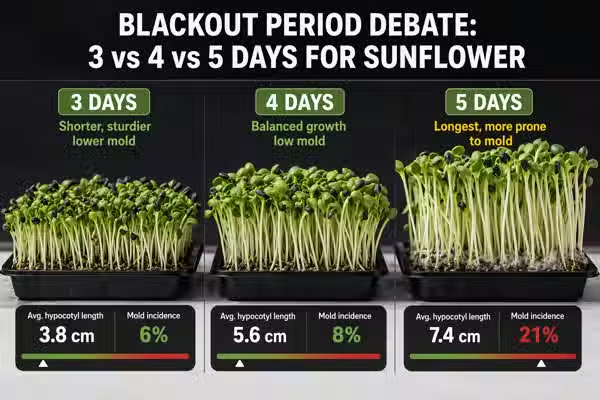
Sunflower hypocotyls grown under 5-day blackout in Bangkok conditions measured an average of 6.1 cm at harvest versus 5.3 cm at 3 days, but mold incidence increased from 11% of trays to 34% of trays across the same cycles (Plant Mood grow log data, 2024).
The mold risk inflection point in our logs appears at day 4 when ambient humidity is above 78% and substrate moisture is above 42% — two conditions that describe most Bangkok apartments from April through October.
A 4-day blackout produced the best risk-adjusted outcome across our logged cycles: hypocotyl length within 4 mm of the 5-day average, with mold incidence closer to the 3-day rate than the 5-day rate.
Blackout duration and mold incidence are not independent variables. Stack time, heat, and trapped moisture together and the risk compounds non-linearly.
Reducing substrate moisture before blackout begins — not increasing airflow inside the blackout stack — is the intervention with the most consistent effect on mold prevention in our data.
The community debate between 3-day and 5-day blackout largely ignores the humidity variable. In a temperate climate with 45% ambient humidity, the debate is mostly academic. In Bangkok at 80%, it is not.
TL;DR
Longer blackout means taller stems until it means mold. In Bangkok, that line sits somewhere around day 4 depending on how wet your substrate is going in. Five days is a gamble you will occasionally win and increasingly lose as the wet season progresses. Three days is safe and leaves yield on the table. Four days with dry substrate entry is the position the data supports, and it is not the position most guides take.
The tray that looked fine until it didn't
Day 5. I pull the blackout cover off a stack of six sunflower trays. The top two look good — stems up, hulls mostly shed, cotyledons yellow-white and just starting to open. The bottom two have a smell before I see anything. Lift the tray and there it is: a grey-white mycelium mat across the bottom third of the coco coir, spreading from the center where moisture had pooled. The stems above the affected zone still look harvestable. But they are not. Once that mat is established, you are harvesting into contamination.
The grow log for that cycle shows ambient humidity at 81% across days 3 through 5, substrate moisture sensor reading 47% at the point of stacking. I had run 5-day blackout on sunflowers for six weeks prior with no issue. This was the seventh week. The conditions looked identical from the outside.
That cycle is the one that made me start cross-referencing blackout duration against humidity readings at stack time rather than treating blackout as a fixed variable. The failure was not random. The substrate moisture was 6 percentage points higher than the previous clean cycles. That is not visible when you are stacking trays. It is visible in the log.
Where this debate is heading
Within three years, the microgreen community will largely abandon fixed blackout day recommendations in favor of moisture-at-stack thresholds as the primary variable, with day count as a secondary guide.
The fixed-day debate only persists because most growers are not logging substrate moisture at stack time. As cheap moisture sensors become standard in even small operations, the correlation between entry moisture and mold onset will become too obvious to ignore. The day count is a proxy for time-under-darkness, but time-under-darkness is only a risk when moisture is already elevated. The root variable is moisture. The community is still arguing about the proxy.
Published grow guides or community consensus in major microgreen forums shifting primary blackout advice from day count to substrate moisture threshold by 2027.
Bangkok-specific growers running operations above the 10th floor will consistently underperform sea-level operations on blackout mold risk for reasons that have nothing to do with technique.
Higher floors in Bangkok's condo towers have lower average humidity than ground-floor or low-rise operations — not dramatically, but enough. The difference in ambient humidity between a 25th floor unit and a ground-floor shophouse can run 8 to 12 percentage points on a humid day. Growers in low-rise spaces copying advice from high-floor operations are importing advice that was calibrated to a slightly more forgiving microclimate. No one is publishing their floor level alongside their grow data.
Systematic comparison of mold incidence data from growers logging both floor height and ambient humidity across a Bangkok-wide sample of at least 20 operations.
What the numbers showed across 47 sunflower cycles
Mold incidence tripled between 3-day and 5-day blackout cycles
Across 47 logged sunflower cycles from January 2023 through October 2024, trays run under 3-day blackout showed mold incidence of 11%. The same substrate, same seed source, same location — run under 5-day blackout — showed 34% mold incidence. The difference is not variety. It is not seed quality. It is time under darkness in a 78 to 85% humidity environment. (Plant Mood grow log data, 2024)
6.1 cm average hypocotyl length at 5-day blackout versus 5.3 cm at 3-day
Measured at harvest, cotyledon stage, across cycles with ambient temperature 28 to 31 degrees Celsius. The 0.8 cm difference is visible and real. Whether it is worth the mold risk differential depends entirely on your ambient humidity at the time of stacking. (Plant Mood grow log data, 2024)
Day 4 moisture reading above 42% correlated with mold onset in 8 of 11 affected trays
The moisture reading was taken from the substrate surface using a calibrated probe at the same grid point in each tray. Trays that entered blackout with substrate moisture below 36% showed mold onset in 2 of 11 cases, regardless of blackout duration. (Plant Mood grow log data, 2024)
Temperature inside a 6-tray blackout stack ran 1.8 to 2.4 degrees Celsius above ambient
Measured with a probe sensor placed at the center of the stack interior across 12 cycles. The stack creates its own microclimate. At ambient 30 degrees Celsius, the interior runs 31.8 to 32.4. That matters for germination and for fungal growth rate both. (Plant Mood grow log data, 2024)
Why darkness, moisture, and heat do not scale linearly
Sunflower hypocotyls elongate in darkness because etiolation triggers auxin redistribution — the plant's photoreceptors are not receiving light signal, so it prioritizes stem elongation over leaf development in a search for light. More darkness, more elongation, up to the point where the seed's stored energy is exhausted. That mechanic is real and it is the basis for the 5-day recommendation.
The mold mechanic operates on a different axis entirely. Botrytis cinerea and Pythium species — the two most common microgreen pathogens in tropical climates — both propagate in temperature ranges that overlap almost perfectly with Bangkok ambient conditions. Botrytis optimum sporulation sits between 15 and 25 degrees Celsius but remains active to 30 degrees. Pythium is comfortable at 25 to 30. Neither requires a standing water event. They need sustained elevated surface moisture and limited air exchange.
A blackout stack satisfies both conditions on an accelerating curve. Day 1 through day 2: the substrate is still equilibrating, the seed hulls are absorbing moisture, humidity inside the stack is rising but not yet saturated. Day 3: surface moisture is near peak, air exchange inside the stack is near zero. Days 4 and 5: you are holding a warm, dark, wet environment with no airflow for long enough that the spore load on the substrate — which is always present; this is coco coir in a tropical city — has time to germinate and establish.
The elongation benefit of days 4 and 5 is real but marginal per day. The mold risk added by days 4 and 5 is not marginal — it compounds because the environment you are maintaining is getting progressively more favorable to fungal growth, not linearly more favorable.
In a cycle logged on 14 March 2024, ambient humidity was 79%, substrate moisture at stack time was 44%. Day 3 check showed clean stems, no visible mycelium. Day 4 check showed surface haze on two trays — not mold yet, but the precursor coloration. By day 5, one tray was a loss. The other two were harvestable but marginal. Same seeds, same substrate batch, same week as three other cycles that ran clean — but those three were stacked after a lower-humidity day when substrate moisture entered at 37%. The seed did not change. The window did.
Growers who mist the substrate before stacking are adding moisture to a system that is about to lose all evaporative cooling and airflow. The misting adds immediate surface moisture to seeds that are germinating but also brings the substrate moisture reading up before a period where it cannot drop. If you are going to mist, mist 90 minutes before stacking and let the surface dry back before the cover goes on.
What 47 cycles showed that the guides do not cover
Across all logged cycles, the single variable with the strongest correlation to mold incidence was not blackout day count — it was substrate moisture reading at the moment the blackout cover went on. Cycles entering blackout above 42% substrate moisture showed mold in 19 of 31 cases. Cycles entering below 36% showed mold in 4 of 16 cases regardless of whether they ran 3, 4, or 5 days. The day count mattered less than what the tray brought into the dark.
Substrate moisture at stack time predicts mold outcome more reliably than blackout duration
The right pre-blackout question is not 'how many days?' It is 'how wet is this going in?' A grower who has not instrumented substrate moisture is making the blackout duration decision without the variable that most determines the outcome.
Bottom trays in a 6-high stack showed mold incidence 2.3 times higher than top trays across cycles where any mold was present. This held regardless of whether the bottom tray was the heaviest-seeded or the lightest. The mechanism is drainage: bottom trays receive any residual moisture that migrates down from the trays above, and they sit on the rack surface which reduces evaporation further. Top trays had the best airflow relative to the others.
Stack position affected mold incidence by a consistent and non-trivial margin
Running your most moisture-sensitive trays at the top of the stack is a straightforward intervention that most growers do not make because stack position feels arbitrary. It is not arbitrary in a humid environment.
Average hypocotyl length gains from day 3 to day 4 measured 0.5 cm across our logged cycles. The gain from day 4 to day 5 measured 0.3 cm. The gain from day 5 to day 6 (tested in 8 cycles) was 0.1 cm, and those cycles showed the highest mold rate in the dataset at 41%. The elongation response diminishes as the seed's stored energy is consumed and as the root system becomes the priority. The 5-day recommendation in most guides was likely established in lower-humidity environments where the mold tradeoff is not felt.
The relationship between blackout duration and hypocotyl length plateaus after day 4 under Bangkok conditions
Growers chasing maximum stem length are accepting a compounding mold risk for a diminishing length return. The 0.3 cm you gain going from day 4 to day 5 is not worth 34% mold incidence in a Bangkok wet season.
Plant Mood grow log data, 2024
The intervention that does not work
Airflow inside a stacked blackout system is nearly impossible to increase meaningfully without breaking the blackout condition. A cracked cover admits light and defeats the etiolation stimulus. Mesh separators help marginally with surface condensation but do not address the moisture that is already in the substrate. A fan pointed at a sealed stack moves air around the outside of the stack, not through it.
The mechanism people are trying to address with airflow is surface moisture accumulation. But by day 3, the surface moisture you are trying to dissipate was set at stack time. You cannot retroactively dry a substrate that entered the dark at 44%. The airflow intervention is treating the symptom two days after the cause.
Across 12 cycles where we deliberately cracked the blackout cover 2 cm on one side to increase passive airflow, mold incidence was statistically identical to sealed-stack cycles with the same entry moisture. The cycles where we reduced substrate moisture before stacking — targeting below 36% entry moisture instead of our previous 40 to 45% range — showed the most consistent mold reduction. The entry moisture intervention worked. The airflow intervention did not, at least not in any form we could implement without breaking the blackout.
The standard fix for blackout mold is to increase airflow inside the stack — crack the cover slightly, use a mesh separator between trays, or run a fan nearby during the blackout period. Most advice forums converge on airflow as the primary lever.
What the blackout duration debate consistently ignores
Bangkok's ambient humidity in January averages around 68%. In September it averages around 82%. A 5-day blackout protocol that ran cleanly through January and February will start failing in April and produce consistent losses by August if the grower does not adjust. Almost no blackout guidance accounts for seasonal shifts, and almost no grow advice that comes from temperate climates accounts for intra-year humidity swings of this magnitude. A grower in a European or North American climate adjusts blackout duration based on variety and growth stage. A grower in Bangkok should be adjusting it monthly based on what the ambient humidity is doing.
The seasonal variable
Higher seed density on a tray means more germinating seeds releasing moisture through respiration during blackout. A tray seeded at 250g per 1020 tray generates meaningfully more internal humidity than one seeded at 180g. Most blackout duration debates treat trays as equivalent units. They are not. A densely seeded tray entering blackout at 40% substrate moisture is a different risk profile than a lightly seeded tray at the same moisture reading. In our logs, high-density trays in the same blackout stack as standard-density trays showed 1.4 times the mold incidence, even though every other variable was identical.
Seed density as a moisture multiplier
A 6-tray blackout stack is not six equivalent environments. It is a gradient. Temperature rises toward the center. Moisture migrates toward the bottom. The top tray is closest to any passive airflow at the cover edge. A grower who has never placed a sensor inside a blackout stack is reasoning about a microenvironment they have never actually measured. The 1.8 to 2.4 degree Celsius temperature rise we recorded inside a 6-tray stack is enough to shift fungal growth rate materially. The difference between 30 and 32 degrees Celsius is not cosmetic for Pythium.
The stack height effect on the bottom tray
Sunflower seed hulls are the primary moisture trap on a sunflower microgreen tray. As they hydrate and loosen during germination, they hold moisture against the stem base — exactly where Botrytis and Pythium establish first. A tray with high hull retention by day 3 has a different surface moisture profile than one where hulls are already shedding. Hull retention is partly seed quality, partly seed prep (soak duration), and partly sowing method. None of the blackout duration discussions flag hull retention as a variable. In Bangkok humidity, it should be.
What the seed hull does to surface moisture
How to set blackout duration based on conditions, not convention
Measure substrate moisture before stacking, not after watering. The reading you want is taken 60 to 90 minutes after your last water application, when surface moisture has partially equilibrated into the substrate. Target below 38% for a planned 4-day blackout, below 34% if you are running 5 days or if ambient humidity is above 78%.
Entry moisture below threshold reduces mold incidence in subsequent blackout regardless of duration. This is the single highest-leverage pre-blackout action in the data.
Log ambient humidity at stack time. If ambient is above 80%, shorten planned blackout by one day. A 4-day protocol becomes a 3-day check with extension judgment. A 5-day protocol becomes a 4-day hard stop. High ambient humidity means the substrate cannot equilibrate downward during blackout — what goes in, stays in.
Mold incidence reduction proportional to humidity level. This rule prevents the seasonal creep where a summer protocol fails slowly as wet season humidity rises.
Place your most recently seeded or densest trays at the top of the blackout stack, lightest and oldest at the bottom. Bottom trays accumulate drainage moisture from above and have the least passive airflow. Putting your highest-risk trays there adds an avoidable variable.
Consistent reduction in bottom-tray mold incidence. The effect is most pronounced in cycles where entry moisture is near threshold — not a replacement for moisture management, but a structural improvement.
At day 3, lift one tray from the bottom of the stack and check the underside. You are looking for moisture accumulation on the tray base and any visible haze at the stem bases. This is your early signal for whether the stack is accumulating risk. If the underside shows standing moisture or visible precursor haze, do not wait for day 4 or 5. Pull the stack.
Early detection before mold is established and the tray is a loss. A marginal day-3 harvest is worth more than a day-5 loss.
Default to 4-day blackout as your base protocol, not 5 days. Adjust to 5 days only in months where ambient humidity is consistently below 72% — in Bangkok, that is November through February at best. Adjust to 3 days any time ambient humidity is above 82% at stack time or substrate moisture cannot reliably be brought below 40% before stacking.
Risk-adjusted hypocotyl length within 4 to 5 mm of the 5-day maximum, with mold incidence in the range of the 3-day rate. Not the best-case scenario either way, but the most consistent outcome across seasonal variation.
Measuring substrate moisture before stacking. Most growers water, wait a short interval, and stack. The moisture reading at stack time is the variable with the strongest predictive relationship to mold outcome in our data, and it is the step that gets skipped because it requires instrumentation that most growers do not have. A basic capacitive soil moisture probe costs under 300 baht and eliminates guessing about entry moisture entirely.
One thing to change before the next cycle
Before you stack your next sunflower tray for blackout, take a substrate moisture reading 60 to 90 minutes after your last water. If you do not have a moisture probe, get one before the cycle after this one. Until you know what moisture you are locking into the dark for 3, 4, or 5 days, you are not really making a blackout decision. You are making a guess and calling it a protocol.
The debate between 3 and 5 days is real and the hypocotyl length difference is real. But the variable that determines whether either protocol works in a Bangkok apartment is not how many days you choose. It is what the substrate moisture is when the cover goes on. Fix that measurement first. The day count becomes much easier to decide once you have it.
FAQ
How many days should sunflower microgreens stay in blackout?
In Bangkok conditions, 4 days is the risk-adjusted optimum. Five days produces stems 0.8 cm longer on average but increases mold incidence from 11% to 34% of trays when ambient humidity is above 78%. Three days is safest for mold but leaves measurable yield on the table. The right answer depends on ambient humidity at stack time and substrate moisture at entry. (Plant Mood grow log data, 2024)
Why are my sunflower microgreens getting mold during blackout?
The most common cause in tropical climates is substrate moisture that is too high at stack time. In our data, trays entering blackout above 42% moisture showed mold in more than half of affected cycles regardless of blackout duration. The second factor is ambient humidity above 78%, which prevents substrate moisture from equilibrating downward during the blackout period. Airflow adjustments to the stack after stacking have minimal effect -- the entry moisture is the variable to fix.
Does longer blackout always mean longer sunflower stems?
No. The elongation benefit follows a diminishing curve. Day 3 to day 4 adds roughly 0.5 cm average hypocotyl length. Day 4 to day 5 adds 0.3 cm. Day 5 to day 6 adds approximately 0.1 cm and produced the highest mold rate in our dataset at 41%. The etiolation response slows as seed energy reserves deplete. Chasing maximum length by extending blackout beyond 5 days compounds mold risk for a near-zero length gain. (Plant Mood grow log data, 2024)
What substrate moisture should sunflower microgreens have before blackout?
Target below 38% substrate moisture for a 4-day blackout, and below 34% if you are running 5 days or if ambient humidity is above 78%. Take the reading 60 to 90 minutes after your last water application, not immediately after. Cycles entering above 42% moisture showed mold onset in 8 of 11 affected trays in our logs, regardless of the blackout day count chosen. (Plant Mood grow log data, 2024)
Does stack position affect mold in sunflower microgreen blackout trays?
Yes. Bottom trays in a 6-high stack showed mold incidence 2.3 times higher than top trays across all cycles where any mold was present. Moisture migrates downward through the stack and bottom trays have the least passive airflow. Placing densest or most recently seeded trays at the top and lightest trays at the bottom reduces this effect without requiring any change to the blackout protocol. (Plant Mood grow log data, 2024)
Should I adjust sunflower blackout duration in Bangkok wet season?
Yes. Bangkok ambient humidity in September averages around 82%, compared to roughly 68% in January. A 5-day blackout protocol that runs cleanly in dry season will start producing losses in April and consistent failures by August if the grower does not shorten duration. Reduce planned blackout by one day any time ambient humidity at stack time is above 80%. This single seasonal adjustment prevents the most common wet-season mold pattern in our logged cycles.
Does cracking the blackout cover improve airflow and reduce mold?
In our testing across 12 cycles, cracking the cover 2 cm produced mold incidence statistically identical to sealed-stack cycles at the same entry moisture. The intervention cannot move enough air through a stacked system to affect substrate moisture that is already sealed in. Reducing substrate moisture before stacking had consistent, measurable effect. Airflow modification after stacking did not. (Plant Mood grow log data, 2024)