Key takeaways
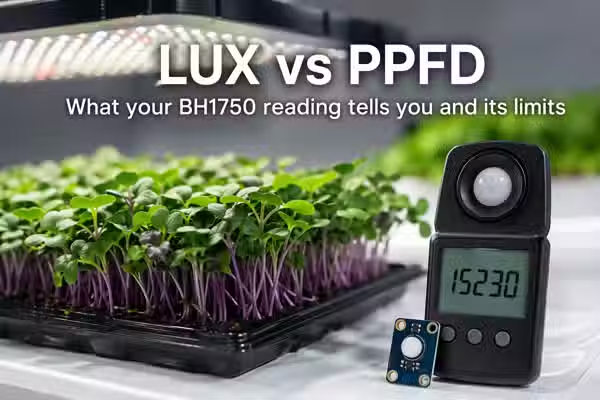
Lux measures light intensity as the human eye perceives it. PPFD measures photosynthetically active photons that plants can actually use. A BH1750 sensor measures lux -- which means its readings are weighted toward green and yellow wavelengths that plants use least.
The lux-to-PPFD conversion factor varies from roughly 0.013 to 0.025 depending on the light source spectrum -- a white LED panel and a blurple grow light at identical lux readings can deliver PPFD values that differ by nearly 50%.
For microgreens under a standard white LED panel, a BH1750 reading of 8,000 to 12,000 lux corresponds roughly to 100 to 150 PPFD -- within the working range for most microgreen crops but not enough for light-hungry varieties like sunflower at the cotyledon stage.
A BH1750 is a reliable consistency tool: if your reading drops from 9,000 to 6,000 lux on the same bench position with the same light, something changed -- the lamp is degrading, there is dust on the cover, or the fixture shifted. What it cannot tell you is whether 9,000 lux from that light source is sufficient photosynthetic input for the crop.
Growers who chase higher lux numbers by switching from white LED to blurple or red-heavy grow lights will often see lux readings drop while actual PPFD delivered to the tray increases -- the BH1750 is blind to the red wavelengths that plants prioritise.
No BH1750 reading will tell you whether your light spectrum matches what your crop needs at each growth stage. That requires either a PAR sensor, a known conversion factor for your specific light source, or longitudinal tray data mapped against lux readings.
TL;DR
The BH1750 is not measuring plant light. It is measuring human light. Those two things overlap enough that the sensor is useful -- it will catch a failing bulb, a shadowed tray, and consistency problems across your bench. What it will not catch is a light source that looks bright to your eye and the sensor but delivers weak photosynthetic input because its spectrum skips the wavelengths plants need. Knowing the difference stops you from optimising the wrong number.
The tray that looked fine under a bright light
We switched grow lights mid-cycle in late 2023 -- moved from a white LED strip to a blurple panel that had been sitting unused. The BH1750 on that bench dropped from around 9,500 lux to just under 6,000 lux. I almost moved the light closer to compensate. The trays under it looked, to my eye, like they were in reasonable light -- not dim, not washed out. By day 6 the pea shoots on that bench were noticeably more etiolated than the adjacent bench still running the white LED. Stems stretching. The canopy was reaching.
I did not move the light closer when the lux dropped. I left it and watched. By day 8 the difference between the two benches was undeniable -- the blurple bench had shoots that were 30 to 40% taller with thinner stems and paler colour compared to the white LED bench. The blurple panel was almost certainly delivering more usable PPFD at 6,000 lux than the white LED was at 9,500 lux, given its red-heavy spectrum. But the pea shoots were still stretching. The issue was not lux, not PPFD measurement, but light duration and distance combined. What the BH1750 number told me was that something changed. What it could not tell me was whether that change was good or bad for the crop. That distinction cost me one harvest cycle to work out.
Where the lux vs PPFD confusion is heading
Within three years, a meaningful proportion of hobbyist and small-scale commercial microgreen growers will have access to affordable PAR sensors -- either as standalone units under 1,500 THB or as integrated features in consumer grow light controllers -- and the BH1750 will be reclassified in the growing community from a light measurement tool to a consistency monitoring tool.
The cost of quantum PAR sensors has dropped significantly over the past five years as the indoor farming market has scaled. Units that cost 15,000 THB in 2019 are now available for under 5,000 THB from Chinese manufacturers with acceptable accuracy for hobbyist use. The trajectory continues. Once growers can afford a real PPFD reading, they will immediately see the gap between what their BH1750 reported and what their plants were actually receiving -- and the community understanding of the sensor's role will shift. This has already happened in the cannabis cultivation community, which runs approximately five years ahead of microgreens in sensor adoption.
Consumer PAR sensors available in Bangkok for under 1,500 THB by 2027, stocked by at least two domestic grow supply retailers.
Growers running blurple or red-heavy spectrum lights and using BH1750 readings as their primary light metric will systematically underestimate how much light they are delivering, leading to a specific pattern of over-lighting errors -- lights positioned too close, burn symptoms on cotyledons -- that will be widely misdiagnosed as heat stress.
Blurple and red-heavy panels read lower on the BH1750 than they should relative to their photosynthetic output, because the sensor underweights red wavelengths. A grower chasing a lux target will move the light closer than the crop needs. The resulting damage -- bleached or burned cotyledon tips -- looks identical to heat stress at close range, which is the diagnosis most growers will reach first. The root cause, systematic mis-measurement of a red-spectrum light, will be missed.
A pattern of 'heat stress' complaints from blurple-light users appearing in grower forums alongside BH1750 readings that seem low, where repositioning the light further away -- not adding cooling -- resolves the symptom.
The Bangkok microgreen market will develop a small tier of technically differentiated growers within the next two years who use PPFD data in their sales and production communications -- 'grown at 120 PPFD' -- creating a credibility gap with growers still working from lux numbers alone.
This pattern appeared in the craft coffee market with brew temperature and extraction yield, and in the cannabis market with VPD and PPFD documentation. Buyers who are educated enough to ask about growing conditions respond to specific, measurable claims. Lux is a sensor reading. PPFD is a plant physiology metric. Growers who can speak the plant physiology language will command differentiation in a market where most sellers currently offer no production data at all.
Three or more Bangkok microgreen producers citing PPFD data in customer-facing materials -- packaging, Line messages, or social content -- by end of 2026.
Why the sensor reads what it reads and not what the plant sees
The BH1750 is a photodiode with a spectral response curve that approximates the human eye's sensitivity -- which peaks around 555 nanometres, in the green-yellow part of the visible spectrum. This is the same weighting used to define the lux unit itself. Lux is photometric: it measures light as human vision perceives it. Plants do not perceive light like human eyes. Photosynthesis is driven primarily by chlorophyll a and b, which absorb most strongly in the red range around 660 to 680 nanometres and the blue range around 430 to 450 nanometres. Green light, which the human eye sees most efficiently and which the BH1750 weights most heavily, is the wavelength range that leaves reflect -- which is why leaves look green. They are not using most of it.
PPFD -- photosynthetic photon flux density -- counts photons in the 400 to 700 nanometre range equally, regardless of colour. A red photon and a green photon count the same toward PPFD. This is also imperfect as a measure of plant photosynthetic efficiency, but it is far closer to what the plant is actually using than a lux reading. The gap between a lux reading and PPFD depends entirely on how much of the light source's output falls in the ranges the BH1750 weights heavily versus the ranges plants use. For a warm white LED with a spectrum that peaks in the yellow-green, the conversion factor is lower -- the sensor reads high relative to photosynthetic output. For a red-heavy grow light, the sensor reads low -- significant photosynthetic photon output is essentially invisible to the BH1750.
Under the white LED strip we run on Bench A, a BH1750 reading of 9,200 lux corresponds to an estimated PPFD of approximately 115 to 125 micromoles per metre squared per second, based on the conversion factor published for cool-white LED spectra. Under the blurple panel on Bench B, a reading of 5,800 lux corresponds to an estimated PPFD of 110 to 130 micromoles -- nearly identical photosynthetic delivery from a reading that looks 37% lower. If I managed purely by lux, I would have concluded the blurple bench was significantly under-lit. It was not. The BH1750 was simply blind to a large portion of what that light was emitting.
Conversion factors from lux to PPFD are light-source-specific and cannot be generalised. Published conversion factors for common grow light types: cool white fluorescent approximately 0.0185, warm white LED approximately 0.0135, red-blue LED approximately 0.0220 to 0.0250, HPS approximately 0.0120. Applying the wrong factor introduces errors of 30 to 50%. If you do not know your light source's specific conversion factor, treat any lux-to-PPFD estimate as approximate to plus or minus 40%.
BH1750 versus PAR sensor: what each one actually tells a microgreen grower
BH1750 lux sensor
Measures light as human eyes perceive it. Weighted toward green-yellow wavelengths. Accurate and consistent for what it measures. Cost in Bangkok: 80 to 150 THB. Reads in lux and foot-candles. Does not measure photosynthetically active radiation directly. Conversion to PPFD requires knowing your specific light source spectrum. Excellent for detecting change -- degrading bulbs, shifted fixtures, dust accumulation on covers. Poor for determining whether a given light level is photosynthetically sufficient for a specific crop.
Use it for consistency monitoring across your bench positions and over time. If your reading drops 15% on the same bench position without moving anything, investigate the light. Do not use the absolute number to make decisions about whether your crop is receiving enough light for photosynthesis without applying a source-specific conversion factor.
Quantum PAR sensor (apogee, Licor, or comparable)
Measures photosynthetically active radiation in micromoles of photons per metre squared per second. Flat spectral response across 400 to 700 nanometres -- counts all photons equally regardless of colour. Directly reads PPFD. Cost for entry-level units: 3,500 to 8,000 THB for Chinese-manufactured sensors of acceptable hobbyist accuracy, 40,000+ THB for research-grade instruments. Result is immediately usable for crop light requirement decisions without conversion. Does not weight photon quality -- a red photon and a green photon count equally even though chlorophyll uses them at different efficiencies.
Worth purchasing if you are running more than 15 trays regularly, have switched light sources recently, or are trying to diagnose unexplained yield differences between bench positions. One reading session to map PPFD across your entire grow space costs less than one failed commercial tray batch. Not necessary for a hobbyist running a single fixed light source on a consistent schedule.
Smartphone plant light meter app (via camera sensor)
Highly variable accuracy depending on phone camera sensor and app calibration. Some apps attempt lux measurement; a few attempt PAR estimation. Camera sensors are not designed for photometric measurement and vary significantly between devices and conditions. Results are directionally useful in ideal conditions and unreliable in mixed light environments. Cost: free to 300 THB.
Useful as a rough sanity check when you have no sensor at all -- is this light much brighter or dimmer than that light? Not useful for calibrated decision-making or trend monitoring. Do not rely on app readings to validate light levels for crop decisions. A 150 THB BH1750 wired to any microcontroller is more reliable and repeatable than any phone camera approach currently available.
The numbers that change how you read your lux display
The potential PPFD difference between two light sources reading identical lux on a BH1750, depending on their spectral composition. A blurple LED at 6,000 lux and a warm white LED at 6,000 lux can deliver PPFD values that differ by nearly half. Growers comparing grow lights using lux as the metric are not comparing photosynthetic output. They are comparing how bright the light looks to a sensor calibrated to human vision.
100 to 150 PPFD
Estimated PPFD range corresponding to a BH1750 reading of 8,000 to 12,000 lux under a standard cool-white LED panel. This falls within the functional range for most microgreen crops at the cotyledon stage, which most published references place between 100 and 200 PPFD. Sunflower at cotyledon stage is typically cited at the higher end of that range. Below 80 PPFD, etiolation risk increases regardless of crop type. These are estimates requiring a source-specific conversion factor to validate.
555 nanometres
The wavelength at which the BH1750's spectral response peaks -- the green-yellow range that the human eye sees most efficiently and that plants reflect rather than absorb. This is not a design flaw in the sensor. It is exactly what the sensor is designed to do. The flaw is in applying a human-vision sensor to a plant-physiology question.
80 to 150 THB
Cost of a BH1750 sensor module in Bangkok as of 2024. A quantum PAR sensor of acceptable hobbyist accuracy costs 3,500 to 8,000 THB from the same supply channels. The 40 to 100x price difference is why virtually every small-scale microgreen operation in Bangkok uses a lux sensor for light monitoring and why the limitations of that approach remain widely unknown.
What recent plant science adds to the lux vs PPFD picture
Morrow, R.C. (2008). LED lighting in horticulture. HortScience 43(7): 1947-1950.
The relationship between lux and plant-usable light is spectrum-dependent and cannot be approximated by a single conversion factor across different light source types. The paper established that red-blue LED arrays deliver significantly more photosynthetic output per lux unit than white broad-spectrum sources, a finding that predates widespread LED grow light adoption but remains underused in practical growing guidance.
Any grow guide that gives a lux target for microgreens without specifying the light source type is giving you half an instruction. The target lux for a white LED strip and a red-blue grow panel are different numbers for the same photosynthetic outcome. If your guide does not name the light type alongside the lux number, the number is not actionable.
Bantis, F., Smirnakou, S., Ouzounis, T., Koukounaras, A., Ntagkas, N., Radoglou, K. (2018). Current status and recent achievements in the field of horticulture with the use of light-emitting diodes. Scientia Horticulturae 235: 437-451.
Microgreens show crop-specific responses to light spectrum composition that are not captured by PPFD alone. Red-to-blue ratio, far-red fraction, and photoperiod interact to affect hypocotyl length, cotyledon size, and anthocyanin accumulation in ways that a single PPFD number does not predict. Pea and sunflower microgreens showed different optimal red-to-blue ratios in controlled trials.
Even if you had a perfect PPFD reading, it would not tell you whether your spectrum composition is producing the growth morphology you want. Etiolation in pea shoots under adequate PPFD can be a spectrum issue, not a quantity issue. A BH1750 cannot detect spectrum composition at all. A PAR sensor gives you photon quantity but not quality. Understanding what your crop is doing at the stem and leaf level remains the most complete diagnostic tool a small grower has.
Taulavuori, K., Hyoky, V., Yli-Heikkila, M., Taulavuori, E., Julkunen-Tiitto, R. (2016). Species-specific differences in synthesis of flavonoids and phenolic acids under increasing periods of enhanced blue light. Environmental and Experimental Botany 121: 145-150.
Blue light fraction in the grow spectrum drives flavonoid and phenolic compound synthesis in leafy crops, with effects measurable at blue light fractions as low as 10 to 15% of total photon output. These compounds contribute to flavour intensity and nutritional density in microgreens beyond what chlorophyll-based growth metrics capture.
A white LED with meaningful blue output and a warm white LED at the same lux reading are producing different flavour and nutrition profiles in the crop, not just different photosynthetic rates. A BH1750 cannot distinguish between them. For a grower selling on flavour or nutritional claims, the quality of the lux reading is not the question -- the spectrum composition of the light source is.
What a lux sensor cannot see that matters to your crop
Two lights at the same lux reading can have entirely different spectral profiles. One might be skewed warm white, delivering most of its output in the 580 to 650 nanometre range with weak blue. Another might be a full-spectrum panel with strong peaks at 450 and 660 nanometres. The BH1750 reads both as the same brightness. The crop does not experience them as the same. Differences in stem length, leaf colour, and flavour intensity have been documented at identical lux levels under spectrally different sources. A grower who switches light brands and gets a different tray outcome at the same lux reading will often search for a humidity or watering explanation before considering spectrum.
Spectrum composition is invisible to the BH1750
A single BH1750 reading in the centre of the bench tells you the intensity at that point. Light intensity from almost all grow light types falls off significantly toward the edges of the bench -- often by 30 to 50% from centre to corner at typical mounting heights. Trays at the edge of a bench lit to 10,000 lux at centre may be receiving 5,500 to 7,000 lux. Over a 10-day microgreen cycle, that differential produces measurably different growth rate, stem height, and cotyledon development between centre-bench and edge-bench trays. Growers who rotate trays between positions often see this as tray-to-tray variability and look for a seed or watering explanation.
The lux number is a point measurement, not a canopy average
LED panels lose output gradually -- typically 1 to 3% per thousand hours of operation, with faster decline in high-heat environments like a Bangkok grow room without cooling. The BH1750 will track this decline accurately, but a grower who does not log readings over time will not notice a 15% drop over six months because each individual reading looks normal relative to memory. Logging the same bench position at the same time of day once per week and graphing it over months is the only way to catch gradual lamp degradation before it affects crop outcomes. No grower we have spoken to does this without automated logging.
Light degradation over time is invisible until the gap is large
The sensor has a maximum readable value of 65,535 lux in its standard configuration. This is rarely a problem for indoor microgreen growing -- most grow lights at practical distances produce well below this ceiling. But growers supplementing with strong natural light through windows, or running multiple high-output panels at close range, can hit the saturation ceiling. A reading that is stuck at 65,535 across a range of light distances is a saturated sensor, not an accurate measurement.
The BH1750 saturates above approximately 65,535 lux
What growers say about their light readings versus what is happening
'I increased my lux to 12,000 and my sunflower microgreens are still etiolating. I don't understand why -- the light is clearly bright enough.'
12,000 lux from a warm white LED strip corresponds to approximately 160 PPFD -- which is at the lower end of adequate for sunflower at the cotyledon stage, not clearly sufficient. If the light source is warm-white heavy, the conversion factor is lower than the grower is assuming. The etiolation is a photosynthetic light deficiency, not a puzzle. The BH1750 reading looks adequate because it is measuring perceived brightness, not photosynthetic input. Moving to a cooler spectrum LED or a source with stronger red output at the same or lower lux reading may produce better results -- which will look wrong by lux metrics and correct by crop outcome.
'My blurple light reads 5,000 lux but my crops look fine. My friend's white LED reads 9,000 lux and her crops look similar. Why is my number so much lower?'
The blurple light is delivering significant red-spectrum output that the BH1750 weights very low. The sensor reads lower because the human-vision weighting discounts wavelengths that the plant is using heavily. The crops look similar because both setups are delivering adequate PPFD -- the lux numbers are not comparable across different spectrum types. This is not a malfunction of either sensor. It is the sensor doing exactly what it was designed to do, in a context it was not designed for.
'I trust my BH1750. I have been using it for two years and my crops are consistent, so it must be telling me what I need to know.'
This is the most reasonable-sounding objection and the most important one to examine carefully. Consistency in crop outcomes with consistent lux readings from the same fixed light source means the sensor is working as a consistency tool -- which is exactly what it is good for. The problem emerges when the light source changes, the crop changes, or the grower tries to compare setups with different light types. The BH1750 is not wrong in this scenario. It is being used correctly. The risk is the grower concluding from two years of success that the lux number means more than it does, then applying that assumption to a new light source or a new crop with different light requirements.
Where light sensing for small growers is going
Integrated spectral sensors at hobbyist price points
Sensors like the AS7341 measure light across 10 spectral channels and cost under 400 THB as a bare module. They are not PAR sensors but they give spectrum composition data -- blue fraction, red fraction, green fraction -- that the BH1750 cannot provide. As Arduino and ESP32 community libraries improve for these sensors, small growers will be able to log not just lux but a rough spectral profile of their grow light. This does not replace a PAR measurement but it does reveal whether a light is red-heavy, blue-deficient, or changing spectrum as it ages. Expect this to become a standard grow monitoring feature in DIY logging setups within two to three years.
Affordable PAR sensors from Chinese manufacturers entering the Bangkok supply chain
Units marketed as quantum light meters for agriculture are available online for 2,000 to 4,000 THB from Chinese manufacturers as of late 2024. Accuracy claims vary and should be treated with caution -- independent comparisons against calibrated Apogee sensors show some units within 10% and others at 25 to 30% off. But even a 20% accurate PAR reading is more useful for crop decisions than a spectrally incorrect lux conversion. As these units appear in domestic Bangkok grow supply stores, the barrier to PPFD measurement drops from prohibitive to reasonable for growers running commercial-scale microgreen operations.
Grow light manufacturers beginning to publish PPFD maps rather than lux specifications
The transition from lux to PPFD as the primary light output specification is already well underway in the cannabis cultivation market and is moving into the general horticultural LED market. Grow lights marketed to microgreen and leafy green growers are increasingly shipped with PPFD distribution maps at standard mounting heights. A grower buying a new panel in 2025 is more likely to receive a PPFD map than a lux specification compared to 2020. This is the market slowly correcting a measurement problem. Growers who understand PPFD before the specification arrives on the box will be better positioned to use that data when it does.
FAQ
Does a BH1750 measure PPFD for plants?
No. The BH1750 measures lux -- light intensity weighted to human vision, which peaks at green-yellow wavelengths around 555 nanometres. PPFD counts photons across the full 400 to 700 nanometre range equally. Plants absorb most strongly in the red (660-680nm) and blue (430-450nm) ranges, which the BH1750 underweights. A lux reading and a PPFD reading from the same light source are related but require a source-specific conversion factor to translate -- and that factor varies by up to 50% depending on spectrum type.
How do I convert my BH1750 lux reading to PPFD for microgreens?
Use a source-specific conversion factor. For cool white LED: multiply lux by approximately 0.0185. For warm white LED: approximately 0.0135. For red-blue blurple LED: approximately 0.0220 to 0.0250. Applying the wrong factor introduces errors of 30 to 50%. If you do not know your light source type, treat any conversion as approximate to plus or minus 40%. For microgreens at the cotyledon stage, target PPFD of 100 to 200 micromoles per metre squared per second -- corresponding to roughly 8,000 to 12,000 lux under a cool white LED.
What lux reading do microgreens need?
The useful target range for most microgreen crops at the cotyledon stage is 8,000 to 15,000 lux under a standard cool-white LED panel, which corresponds roughly to 100 to 200 PPFD. Below 6,000 lux from a white LED source, etiolation risk increases for light-sensitive varieties like sunflower. These numbers are source-specific -- a blurple or red-heavy panel at 5,000 to 7,000 lux may deliver equivalent or greater PPFD than a white LED at 10,000 lux. The lux target is meaningless without knowing the light type.
Why do my microgreens etiolate even though my lux reading looks high enough?
The most common cause is a warm-white or green-heavy light source delivering lux that looks adequate to the sensor but insufficient PPFD to the plant. A warm white LED at 12,000 lux corresponds to roughly 160 PPFD -- at the low end of adequate for sunflower at the cotyledon stage. If the spectrum is warm-heavy, that estimate also runs high. Check your light source spectrum type and apply the correct conversion factor. If you are running a warm white strip and getting etiolation at 10,000 to 12,000 lux, the plant is telling you the photosynthetic input is insufficient before the sensor does.
Is a BH1750 worth using for microgreen growing if it cannot measure PPFD?
Yes, for consistency monitoring. If your BH1750 reads 9,200 lux on a given bench position today and 7,800 lux next week with no change to the setup, something changed -- a degrading bulb, dust on the cover, or a shifted fixture. The sensor is excellent for catching drift over time and differences across bench positions. It is not the right tool for determining whether a given light level is photosynthetically sufficient, or for comparing different light source types. Use it for what it is good at.
Why does my blurple grow light read lower lux than my white LED but my plants look similar?
The BH1750 underweights red wavelengths, which blurple panels deliver in high proportion. Your blurple light is likely delivering more photosynthetically useful photons per lux unit than the white LED -- the sensor just cannot see them efficiently. If your plants look similar under both, both setups are probably in an adequate PPFD range and the lux difference is a measurement artefact, not a real light deficit. This is the core limitation of comparing lights across spectrum types using lux.
What is the maximum lux the BH1750 can measure?
The BH1750 saturates at 65,535 lux in its standard measurement mode. For indoor microgreen growing at typical light-to-tray distances, this ceiling is almost never reached -- most grow light setups produce 5,000 to 20,000 lux at tray level. The saturation limit becomes relevant if you are supplementing with strong direct sunlight through a window or running multiple high-output panels at very close range. A reading stuck at 65,535 across a range of distances is a saturated sensor, not a valid measurement.