TL;DR
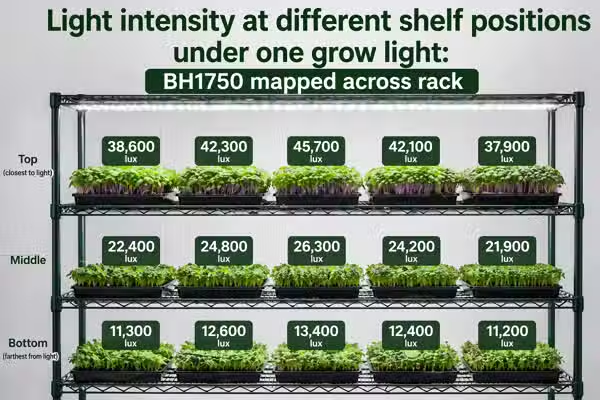
Every shelf on a grow rack has a light gradient. The centre gets the most. The corners get substantially less. The bottom shelf gets what the top shelf does not absorb. Most growers have never measured this and instead blame seeds, watering, or the seed supplier when trays in different positions produce different results. A BH1750 sensor and 20 minutes will show you a map of your rack that changes every tray rotation decision you make going forward.
When the same seed batch produced different trays
We had three consecutive cycles where the sunflower trays on the left side of the middle shelf came out noticeably thinner than the trays on the right. Same seed batch. Same soak time. Same coir depth. Same watering schedule. I had already checked the seeding density twice. The watering log showed nothing different between left and right positions. The obvious culprits had been ruled out, which meant I was probably looking at something I had not measured yet.
I took the BH1750 sensor and held it at tray height across nine positions on that shelf -- three across the front, three across the middle, three across the back. The right side of the shelf read between 9,200 and 9,800 lux. The left side read between 5,400 and 6,100 lux. The LED strip above that shelf was mounted 4 centimetres off-centre toward the right. I had not noticed. Nobody had moved it deliberately -- it had shifted slightly when a tray was pushed in too hard weeks earlier. Four centimetres of fixture drift produced a 38 to 45% lux difference across the shelf width. Three cycles of trays I had blamed on seed variability were a light positioning problem.
One light above a shelf does not mean one light level across a shelf
If you have a grow light mounted above a shelf, every tray on that shelf is getting essentially the same light. Minor position differences do not matter at this scale.
Light intensity from a linear LED strip falls off in two directions simultaneously: laterally from the centre of the strip toward the ends, and from the strip toward the edges of the shelf below it. At a typical grow rack mounting distance of 10 to 20 centimetres between light and tray surface, this falloff is steep enough to produce 30 to 55% intensity differences between the centre position directly beneath the strip and the corner positions at the furthest point from it. These are not subtle differences. At 9,500 lux in the centre and 5,200 lux in the corner, the corner tray is receiving a DLI approximately 45% lower than the centre tray across the same photoperiod. Over a 9 to 10-day sunflower cycle, that accumulates into a measurable yield and morphology difference that looks, to every diagnostic instinct a grower has, exactly like a seed or watering problem.
BH1750 mapping across six shelves on our Bangkok grow rack across two separate measurement sessions showed corner-to-centre lux ratios ranging from 0.45 to 0.68. Not one shelf showed a ratio above 0.70 -- meaning even the most evenly lit shelf had corners receiving less than 70% of the centre intensity. The two shelves closest to the ends of the LED strips showed ratios as low as 0.45. Plant Mood grow log data, 2024.
What the numbers look like before and after you measure them
0.45 to 0.68
Corner-to-centre lux ratio range across six shelves on our Bangkok grow rack, measured with BH1750 at nine positions per shelf. A ratio of 0.45 means the corner tray receives 45% of the light the centre tray receives from the same fixture. At a 16h photoperiod, this translates to a DLI difference of approximately 3.5 mol/m2/day between the best and worst positions on the same shelf -- a gap that exceeds the difference between our 12h and 18h photoperiod trial conditions. Plant Mood grow log data, 2024.
Lux difference across the shelf width produced by 4 centimetres of LED strip fixture drift from centre position. The strip had shifted when a tray was pushed in hard several weeks earlier. The drift was not visible by eye. Three consecutive grow cycles on the affected shelf showed left-side tray yield deficits that were attributed to seed variability before the measurement revealed the actual cause. Plant Mood grow log data, 2024.
Bottom shelf: 31 to 58% of top shelf lux
Light level on the bottom shelf of our four-tier rack as a proportion of top shelf lux, measured at the same nine grid positions. The bottom shelf receives whatever passes through or around the trays above it -- which varies substantially depending on canopy density at measurement time, whether trays are present on intermediate shelves, and whether the bottom shelf has its own dedicated light. On our rack, the bottom shelf has no dedicated fixture and relies on spillover. Trays positioned there during the post-dome grow phase are in a fundamentally different light environment than any other shelf. Plant Mood grow log data, 2024.
Approximate time required to conduct a nine-point BH1750 lux map across all shelves of a four-tier grow rack, including moving between shelf heights and recording readings. This is the measurement that would have prevented three cycles of misdiagnosed tray inconsistency on our middle shelf. It had never been done because nothing had obviously failed -- the trays looked reasonable, just variable. Variability without an obvious cause rarely triggers a measurement response.
1.8 to 3.2 centimetres
The LED strip mounting height variation we found across four shelves of the same rack after measuring carefully -- strips that appeared to be at the same height had drifted between 1.8 and 3.2 centimetres due to bracket movement from tray handling. At 15 centimetres mounting height, a 3-centimetre variation changes the beam spread angle enough to shift the lux distribution pattern meaningfully across the shelf surface. Plant Mood grow log data, 2024.
What the nine-point grid map showed across six shelves
We measured nine positions per shelf -- three rows front to back, three columns left to right -- on all four shelves of our main rack across two measurement sessions separated by three weeks. No two shelves produced the same distribution pattern. Shelf 1 (top, dedicated strip at 12cm height) had a centre-dominant pattern with steep corner falloff -- centre reading 11,200 lux, corner average 6,100 lux, ratio 0.54. Shelf 2 (second from top, strip at 15cm) had a more even distribution but with a leftward bias from the strip mounting position -- left-centre 8,400 lux, right-centre 9,600 lux, corner ratio 0.61 on the right side and 0.52 on the left. Shelf 3 (second from bottom, strip at 18cm) was the most even shelf on the rack -- corner ratio 0.68 -- because the greater mounting distance spread the beam more widely despite the lower centre intensity of 8,800 lux. Shelf 4 (bottom, no dedicated strip) had readings ranging from 1,200 to 3,800 lux depending on canopy density above and tray position. Plant Mood grow log data, 2024.
Every shelf had a distinct light fingerprint that did not match the others
Treating all shelf positions as equivalent when planning tray rotation is the source of most position-based yield inconsistency on multi-tier racks. Each shelf needs its own map and its own rotation logic based on that map, not a generic rack-wide rotation protocol.
Across all measured shelves, the front-to-back lux difference (tray closest to the front edge versus tray at the back of the shelf) averaged 12% across the rack. The left-to-right difference (centre tray versus corner tray on the same row) averaged 34%. Strip LED lights produce a cylindrical beam pattern that falls off more steeply perpendicular to the strip length than along it. On a standard rectangular shelf with the LED strip running front-to-back or side-to-side above the tray width, the beam covers the tray length reasonably but misses the edges substantially. Most growers who rotate trays front-to-back are addressing the smaller gradient. The larger gradient runs left-to-right and requires lateral rotation to equalise.
The front-to-back gradient was consistently smaller than the left-to-right gradient
If you can only rotate in one direction due to rack geometry, rotate left-to-right or corner-to-centre rather than front-to-back. The front-back gradient is real but smaller. Left-to-right is where most of the inequity sits on a linear LED strip setup.
Shelf 3 at 18cm mounting height had the highest corner-to-centre ratio of 0.68 -- the most even distribution -- despite having a lower centre lux of 8,800 compared to Shelf 1 at 11,200 lux centre with a ratio of 0.54. The physics are consistent: greater distance from the source spreads the beam across a wider area, reducing the centre peak and raising the edge floor. For a 30cm wide shelf, the difference between a 12cm and 18cm mounting height changes the illuminated footprint substantially. The tradeoff is that raising the light reduces maximum intensity at the centre -- which matters if you are already below the PPFD threshold the crop needs. At our intensity levels, the more even distribution at 18cm was worth the lower centre peak.
Mounting height was the single variable with the largest effect on distribution evenness
If tray-to-tray consistency across a shelf is the priority and centre lux is already above 8,000, raising the strip mounting height by 3 to 5cm will produce a more even distribution without buying new equipment. This is a free adjustment that most growers never make because they have not mapped the shelf and do not know the gradient exists.
Plant Mood grow log data, 2024
The shelf that reads lowest is not always the shelf to fix first
The shelf with the lowest average lux is not necessarily the shelf producing the worst crop outcomes, because what matters at the tray level is whether the light level clears the crop's minimum DLI threshold -- not whether it matches the brightest shelf on the rack. A shelf running 7,500 lux at centre with a corner ratio of 0.68 has a worst-case corner position of 5,100 lux. A shelf running 11,000 lux at centre with a corner ratio of 0.48 has a worst-case corner of 5,280 lux. The dimmer shelf at 7,500 lux is actually producing more even results -- every position is within a narrower range -- while the brighter shelf is producing more extreme within-shelf variation. Fixing the bright shelf's distribution is more valuable than raising the dim shelf's average, if both are clearing the minimum DLI threshold at their worst-case positions.
On our rack, Shelf 1 was the brightest by average lux and also the shelf with the most within-shelf yield inconsistency. Shelf 3 had the lowest centre lux of the three shelves with dedicated strips and the most consistent crop outcomes. The correlation between average brightness and crop consistency was negative across our four shelves -- the brighter shelves were less consistent. This is entirely explained by the inverse relationship between mounting distance and distribution evenness. We had been optimising for brightness and measuring the wrong thing. Plant Mood grow log data, 2024.
The priority for light management on a grow rack is to find the dimmest shelf and increase its light level. Bring everything up to the brightest shelf and the inconsistency problem is solved.
Why the falloff pattern is steeper than it looks
Light intensity from a point or linear source follows the inverse square law: intensity falls in proportion to the square of the distance from the source. At 10 centimetres from an LED strip, a position 15 centimetres laterally from the strip centre is at a total distance of approximately 18 centimetres from the source -- intensity at that position is roughly (10/18) squared, or about 31% of the intensity directly below the source at the same 10cm vertical distance. At 20 centimetres mounting height, the same 15-centimetre lateral offset produces a total distance of approximately 25 centimetres -- intensity at (20/25) squared, or about 64% of directly below. Greater mounting height reduces the penalty for lateral offset substantially.
LED strips compound this with their own emission angle. Most commodity LED strips have a beam angle of 120 degrees, which distributes light across a wide cone but with intensity concentrated toward the beam centre. A strip mounted at 15 centimetres above a 30-centimetre-wide shelf will illuminate the shelf width reasonably, but positions at the far edges -- particularly corners that are simultaneously at the end of the strip length and at the shelf width edge -- face both the lateral falloff and the end-of-strip falloff simultaneously. Corner positions on a rectangular shelf under a linear strip are in the double-penalty zone: maximum distance from the strip centre in both axes.
On Shelf 2 of our rack, the front-left corner position read 4,900 lux. The centre-right position directly below the strip read 9,600 lux. These two positions are on the same shelf, under the same light, in the same grow cycle. The front-left tray is receiving 51% of the light the centre-right tray receives. The strip is 45 centimetres long on a 40x50 centimetre shelf. The corner is 22 centimetres from the strip centre laterally and 8 centimetres from the strip end longitudinally -- exactly the double-penalty geometry. This is not a faulty light. It is a standard LED strip doing what LED strips do.
Reflective surfaces on the shelf walls and tray edges contribute a small amount of secondary illumination to corner positions, partially offsetting the geometric falloff. Mylar or white-painted shelf interiors can reduce corner falloff by 5 to 12% compared to bare wire shelving, which offers no reflective contribution. On our rack with bare wire shelves, corner readings were consistently at the low end of what the inverse square calculation predicted, with minimal reflective compensation.
What growers say when position is the problem they have not named
'My trays are inconsistent even when I use the same seed batch. I think I have a bad supplier.'
Seed supplier is almost never the cause of within-rack tray inconsistency on the same batch. The complaint pattern -- consistent trays from the same position and inconsistent trays from mixed positions -- almost always points to a position-dependent variable. Light is the most common because it is the most variable and the least measured. Before switching suppliers, spend 20 minutes mapping lux across every shelf position and note which positions the underperforming trays occupied. If they cluster in corner or end-of-strip positions, the diagnosis is complete. If they are random across positions, light is less likely and watering or seeding density differences become the next hypothesis.
'I rotate my trays every two days and I still get inconsistent results. Rotation is supposed to fix this.'
Rotation fixes the problem only if the rotation pattern covers the full range of positions and averages the light exposure across the cycle. A front-to-back rotation on a shelf with a left-to-right dominant gradient does not equalise light exposure -- it rotates trays through positions that all share the same lateral bias. On our shelf with a 34% average left-to-right gradient and a 12% front-to-back gradient, a front-to-back rotation addresses 26% of the positional variation. The majority of the gradient remains unchanged. Rotation protocol needs to be designed from the lux map, not from a generic 'rotate every two days' instruction.
'My top shelf always outperforms my bottom shelf. I assumed the bottom is always worse and just put fast-cycle crops there.'
The top shelf usually has the highest light level but not always the most even distribution -- our data showed the top shelf had the worst corner ratio on the rack. Assigning crops to shelves by assumed performance rank without measuring the actual lux distribution at each position means decisions are based on a rank order that may not reflect what the trays actually experience. The bottom shelf in our setup performs adequately for post-dome grow phase in crops with low light requirements -- wheatgrass and some brassicas -- because 2,000 to 3,500 lux clears their minimum threshold even if it would produce etiolation in sunflower. Matching crop light requirements to shelf light maps rather than shelf rank order is a more precise approach.
Approaches to managing light distribution across a grow rack
Single LED strip per shelf, fixed position, no rotation
Cheapest and most common setup. Produces the largest within-shelf gradients. Corner-to-centre ratios in our data ranged from 0.45 to 0.54 for single strips at 10 to 15cm mounting height. Entirely dependent on tray rotation to equalise exposure. Any inconsistency in rotation protocol translates directly to tray yield inconsistency. Fixture drift over time produces silent gradient shifts that are undetectable without periodic re-mapping.
Workable with a disciplined rotation protocol designed from a lux map. Not workable with a generic rotation assumption. Requires re-mapping every 4 to 6 weeks or after any tray-handling incident that could shift the fixture.
Single LED strip per shelf, raised to 18 to 22cm mounting height
No added cost beyond the initial adjustment. Reduces centre lux by 15 to 25% but improves corner-to-centre ratio from the 0.45 to 0.54 range toward the 0.60 to 0.70 range, based on our shelf 3 data. Wider, more even beam footprint. Best tradeoff available without additional hardware. Only valid if centre lux after raising still clears the crop's minimum PPFD threshold -- for sunflower at cotyledon stage, minimum is approximately 80 to 100 micromoles, corresponding to roughly 6,000 to 7,500 lux on a cool white LED.
This is the first adjustment to make on any rack before spending on additional lights. Map the shelf before and after raising the strip. If the corner-to-centre ratio improves and the new centre lux still clears the crop minimum, the adjustment is unambiguously better than the original configuration.
Two LED strips per shelf, positioned at one-third intervals across shelf width
Doubles the light hardware cost per shelf. Eliminates most of the lateral gradient by providing two illumination sources whose beam patterns overlap in the centre and each cover one lateral half of the shelf. In our limited testing of this configuration on Shelf 2, corner-to-centre ratio improved to 0.81 -- the most even distribution we measured. Centre lux also increased because of the doubled source, which required raising both strips to 20cm to avoid over-lighting the centre. More complex wiring. Strips need to be at equal height and parallel or the overlap pattern creates its own hot spots.
Worth the investment for a commercial operation running 15 or more trays per shelf where yield consistency has direct revenue consequences. Difficult to justify for a hobbyist or small operation where rotation can achieve adequate equalisation at lower cost. The wiring complexity is non-trivial on a rack that was not designed for dual strips.
Reflective shelf lining (mylar or white-painted interior)
Low cost -- mylar roll is 150 to 400 THB and covers multiple shelves. Partially compensates for corner falloff by redirecting some of the light that hits shelf walls and the back panel toward the tray surface. Measured improvement in our bare-wire versus reflective-surface comparison was 5 to 12% at corner positions. Does not address the fundamental geometric falloff and should not be treated as a substitute for adequate light positioning. Most effective when combined with a raised strip mounting height.
Worth doing as a low-cost addition to any rack, but do not expect it to close a 40% corner deficit. It closes a 40% deficit to approximately 35%. Meaningful at the margin, not transformative as a standalone fix.
How to map and manage light across a grow rack
Any grower running a multi-shelf rack who has not yet measured light distribution
Before the next grow cycle, take a BH1750 sensor and measure nine positions per shelf -- three across the front row, three across the middle row, three across the back row -- with the sensor held at the tray surface height and no tray blocking it. Record each reading. Do this with the lights on and no trays present for the cleanest baseline. The whole process takes 20 minutes for a four-shelf rack. Draw the nine readings as a simple grid for each shelf.
A lux map of the rack that shows the centre-to-corner gradient on each shelf, any lateral biases from off-centre strip mounting, and the relative intensity difference between shelves. This map is the information that makes every subsequent tray placement and rotation decision rational rather than assumed.
Growers whose map shows a corner-to-centre ratio below 0.60 on any shelf
Raise the LED strip mounting height on that shelf by 3 to 5 centimetres and re-map. If the ratio improves to above 0.65 and the new centre lux still exceeds 7,000 lux for sunflower or 5,000 lux for lower-light crops, keep the raised position permanently. If the centre lux drops below crop minimum after raising, the shelf needs a second light source rather than a height adjustment. Do not raise the strip without re-mapping -- the improvement is predictable in direction but not in magnitude without measurement.
Corner-to-centre ratio improvement of 0.08 to 0.15 points on most single-strip shelves, based on our shelf 3 data at 18cm versus other shelves at 12 to 15cm. Even distribution matters more than peak brightness when the crop minimum threshold is already cleared.
Growers designing a tray rotation protocol
Design the rotation from the lux map, not from a default schedule. Identify the highest-lux and lowest-lux positions on each shelf. Group trays that will occupy those positions in each rotation step and ensure every tray passes through both zones across the cycle. For a shelf with a dominant left-to-right gradient, the rotation must include at least one lateral swap -- left tray to right position and vice versa -- regardless of whether any front-to-back rotation also happens. For a 9 to 10-day sunflower cycle, a minimum of two position swaps is required to meaningfully equalise cumulative light exposure.
Cumulative light exposure difference between best and worst-positioned trays reduces from the raw gradient ratio to a fraction of it. On a shelf with a 0.55 corner ratio, two diagonal swaps across a 10-day cycle can bring cumulative exposure within 15% across all positions instead of the 45% gap the static position would produce.
Growers experiencing persistent tray inconsistency despite regular rotation
Re-map the shelf immediately -- do not wait for the next planned measurement. Check whether the strip has shifted from its last measured position by holding the sensor at each position and comparing to the previous map. A reading drop of 15% or more at any position without a corresponding change in the readings at adjacent positions suggests fixture drift rather than a systemic change. Also check mounting height with a tape measure at both ends of the strip -- height variation of more than 2 centimetres along the strip length creates a gradient that no rotation protocol can fully equalise.
Fixture drift identified and corrected before additional grow cycles are lost to a misdiagnosis. On our rack, the 4-centimetre drift that caused three misdiagnosed cycles would have been caught at re-map if we had been mapping regularly rather than treating the initial map as a one-time calibration.
Growers assigning crops to shelves on a multi-crop rack
Match crop minimum light requirements to the worst-case position on each shelf, not the shelf average. If the bottom shelf worst-case position reads 1,800 lux, do not place any crop there that requires more than 5,000 lux at minimum -- not even in the best corner position, because the rotation will cycle trays through all positions including the worst. Use the bottom shelf for crops that genuinely perform at low light: wheatgrass at cotyledon stage, some brassicas in early post-dome phase, and trays in the first 24 hours after dome removal when light requirements are minimal. The top shelf is not automatically the best shelf -- if its corner ratio is 0.48 and the middle shelf has a ratio of 0.68, the middle shelf produces more consistent yields for light-sensitive crops despite a lower average lux.
Crop assignment that matches what each shelf actually delivers to what each crop actually needs, rather than a top-is-best ranking that ignores distribution quality. Fewer position-based yield surprises across the rack.
Re-mapping after any rack disturbance -- trays pushed in hard, shelves adjusted, lights knocked during cleaning, or even vibration from adjacent equipment over weeks. Growers treat the initial lux map as permanent documentation when it is actually a snapshot that changes whenever anything physical moves. A quarterly re-map takes 20 minutes and catches drift before it costs cycles.
FAQ
Does tray position on a grow rack affect light intensity for microgreens?
Yes, substantially. BH1750 lux mapping across six shelves on our Bangkok grow rack showed corner-to-centre ratios ranging from 0.45 to 0.68 -- meaning corner positions received as little as 45% of the light the centre position received from the same fixture. At a 16h photoperiod, this translates to a DLI gap that exceeds the difference between a 12h and 18h photoperiod. Most tray-to-tray inconsistency that growers attribute to seed or watering differences is a light position problem they have never measured. Plant Mood grow log data, 2024.
How do I measure light distribution across my grow rack?
Use a BH1750 sensor held at tray surface height across nine positions per shelf -- three rows front to back, three columns left to right -- with the lights on and no trays blocking the sensor. Record each reading and draw the nine values as a grid. A four-shelf rack takes approximately 20 minutes to map fully. The map shows centre-to-corner gradients, lateral biases from off-centre strip mounting, and relative intensity differences between shelves. Repeat every 4 to 6 weeks or after any physical disturbance to the rack.
Why is my centre tray always better than my edge trays under the same light?
Light intensity from a linear LED strip falls off in two directions -- laterally from the strip centre toward the ends, and from the strip centreline toward the shelf edges. Corner positions face both falloffs simultaneously and sit in the double-penalty zone: maximum distance from the strip in both axes. At a 15cm mounting height, the corner position on a standard 40x50cm shelf can receive 40 to 55% less light than the centre position directly beneath the strip. The fix is either raising the mounting height to spread the beam more evenly, adding a second strip, or designing a rotation protocol that cycles every tray through both centre and corner positions.
Does rotating trays on a grow rack fix uneven light distribution?
Only if the rotation pattern addresses the dominant gradient direction. Most growers rotate front-to-back, but on a single LED strip setup the dominant gradient runs left-to-right -- the lateral distance from the strip centreline. A front-to-back rotation on a shelf with a left-to-right dominant gradient addresses approximately 26% of the positional variation and leaves the majority unchanged. Rotation protocol needs to be designed from a lux map: identify the gradient direction first, then build the rotation to ensure every tray passes through both high and low-intensity zones across the grow cycle.
What is the best shelf position for sunflower microgreens on a multi-tier rack?
Not necessarily the top shelf, despite the assumption that higher equals brighter equals better. The top shelf often has the highest centre lux but also the steepest corner falloff because strips are mounted closest to the tray surface. On our rack, the top shelf had a corner-to-centre ratio of 0.54 while the third shelf at greater mounting height had a ratio of 0.68 -- producing more consistent tray outcomes despite a lower average lux. For sunflower, the best shelf is the one whose worst-case corner position clears approximately 6,000 to 7,500 lux, with the most even distribution across positions.
How does mounting height affect light distribution on a grow shelf?
It is the single most impactful variable for distribution evenness and requires no additional hardware to adjust. Raising a strip from 12cm to 18cm above the tray surface improved corner-to-centre ratio from 0.54 to 0.68 in our rack data -- the most even distribution we measured. The tradeoff is a 15 to 25% reduction in centre lux. If centre lux after raising still clears the crop minimum (approximately 6,000 lux for sunflower at adequate PPFD), raising is unambiguously better for within-shelf consistency. Map the shelf before and after adjusting to confirm both the distribution improvement and the acceptable centre lux level.
Does reflective mylar on grow shelf walls improve light distribution?
Marginally. Mylar or white-painted shelf interiors redirected enough light to improve corner position readings by 5 to 12% in our comparison against bare wire shelving. This partially compensates for geometric corner falloff but does not address it -- a 40% corner deficit becomes approximately a 35% deficit with reflective lining. Worth doing as a low-cost addition at 150 to 400 THB for a mylar roll, but not a substitute for adequate strip mounting height or a rotation protocol. Most effective when combined with raised strip mounting.