TL;DR
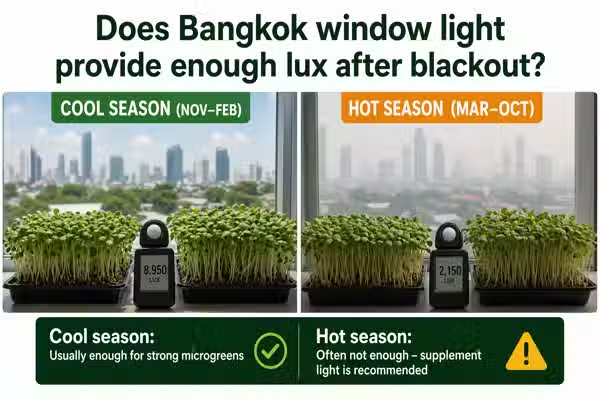
Bangkok window light is not consistent across the year and it is not consistent across the day. Cool season morning light through an east-facing window can hit 8,000 to 12,000 lux and genuinely green up a tray in 4 to 6 hours. Hot season haze cuts that same window to under 4,000 lux before 9am and the tray knows. Cotyledons stay pale longer, stems stretch sideways toward the glass, and you end up with a product that looks underdeveloped even though you followed the same post-blackout process you used in January. Season matters more than most guides admit.
Same window, different tray
January. I pull a sunflower tray out of blackout on day 4, yellow-white stems about 5 cm, cotyledons just beginning to open. I put it on the east-facing windowsill at 7am. By 11am the cotyledons are visibly greening, the stems have straightened, and the tray looks like the photo in every microgreen guide you have ever read. I do the same thing in April. Same windowsill. Same tray position. Day 4 out of blackout, same stem height. By 11am the cotyledons are still pale yellow. By 2pm they have the faintest green tint. The stems near the glass edge are leaning toward the window at a visible angle. The center of the tray looks like it is still in blackout recovery.
I spent two weeks thinking I had a seed quality problem before I pointed a lux meter at the glass. January east window at 8am: 9,400 lux. April east window at 8am: 3,200 lux. Same window. Same hour. The sky in April looks bright from inside the apartment. It is not delivering what January delivers, and the tray responds to what it actually receives, not what the sky looks like from the couch.
Hot season is not brighter for microgreens
The problem with this assumption is that microgreens on a windowsill are not receiving direct sun. They are receiving the diffuse sky light that makes it through your window glass, past your window frame, and into the angle of incidence your tray actually sits at. In hot season, two things change that work against you.
First, Bangkok hot season haze. The combination of heat, particulate, and pre-monsoon atmospheric conditions cuts diffuse sky brightness more than direct solar intensity. What the tray receives is diffuse sky, and diffuse sky in April haze is not the same as diffuse sky in January dry air. You can feel the difference if you stand at the window. You cannot always see it.
Second, sun angle. In cool season, the sun rises further south and stays lower in the sky through the morning hours. For an east-facing Bangkok window, this actually delivers more direct or near-direct light to a tray sitting on the sill, because the low sun angle sends light further into the room. By March and April, the sun is rising further north and higher in the sky. Morning light hits the top of the window frame and the sky above the tray rather than the tray itself. Less direct incidence. More diffuse. Lower effective lux at tray level even though outside is blinding.
I measured lux at tray level on the same east windowsill on the 15th of each month for six months running. January: 9,400 lux peak before 9am. February: 8,700. March: 6,100. April: 3,200. May: 2,900. June: 4,800 (cloud cover was lower than May despite wetter conditions). The April and May readings were the ones that explained every post-blackout greening failure I had logged in those months and not understood. The tray was not getting sick. It was getting 3,000 lux and responding accordingly.
Hot season in Bangkok means more sun, more light, better growing conditions for anything that needs light. The logic feels obvious: April and May are scorching, the sun is intense, plants should green up faster. Most growers assume their light problem, if they have one, is in cool season when the sky is occasionally overcast.
What the tray showed month by month
In cool season cycles with 8,000 to 10,000 lux available at the window, sunflower cotyledons showed visible green pigmentation within 4 to 6 hours of post-blackout light exposure. In hot season cycles with 2,500 to 3,500 lux at the same window, the same cotyledons took 18 to 26 hours to reach equivalent pigmentation. Pea shoots were less sensitive -- visible greening in 6 to 8 hours even at 3,000 lux. Sunflower and radish showed the most pronounced seasonal difference.
Cotyledon greening time after blackout scales directly with lux at tray level, not hours of exposure
A grower judging light adequacy by whether cotyledons green up is getting a delayed signal in hot season. The tray looks underdeveloped for a full day before it catches up, if lux is eventually sufficient. If the grower pulls the tray for market before that catch-up happens, they are selling a product that looks weaker than it is.
In cycles where post-blackout lux fell below 3,500 at tray level, stems within 4 cm of the center of the tray showed measurable phototropic lean toward the window within 3 to 4 hours. Stems at the window edge stayed vertical. This created an uneven tray where the window-side half looked correct and the center-to-back half looked like extended blackout. The lean preceded any change in cotyledon color by several hours.
Stem lean toward the window is the earliest observable signal of insufficient lux, not cotyledon color
If you see the near-window stems standing straight and the center stems leaning, the problem is lux distribution across the tray, not average lux. Rotating the tray 180 degrees every 4 hours corrects it. Not rotating produces a tray where half the stems are harvested at an angle.
In cool season, south-facing and east-facing windows in our apartment showed similar lux at tray level during morning hours -- within 15 to 20% of each other. In hot season, the difference widened. The south-facing window received more consistent diffuse sky light because the sun was tracking further north and the south sky stayed brighter longer. East-facing windows, which performed best in cool season due to direct morning incidence, dropped more sharply in hot season as the sun rose too high and too far north to enter the window at a useful angle. The best window in January is not necessarily the best window in April.
Window orientation matters more in hot season than cool season
Growers who set up their post-blackout light position once and never revisit it are working with a static solution in a seasonally variable environment. In Bangkok, the optimal window position shifts across the year and it is worth reassessing when the season turns.
Plant Mood grow log data, 2023 to 2024
Why the tray reads lux the way it does
Microgreen cotyledons begin chlorophyll synthesis when phytochrome and cryptochrome photoreceptors receive sufficient red and blue wavelength light. The threshold for meaningful chlorophyll production in most microgreen species sits somewhere between 2,000 and 5,000 lux depending on species, with sunflower at the higher end of that range. Below threshold, the seedling remains in an elongation-priority state -- it is still behaving as though finding light is more urgent than using it.
Window glass transmits most of the visible spectrum reasonably well but cuts UV and some near-infrared. That is not the main variable here. The main variable is intensity at tray level, which depends on how much sky the tray can see from its position, what the sky brightness is on that day, and how much of the light path is interrupted by the window frame, adjacent buildings, or the tray's own angle to the sky.
In a Bangkok apartment the tray can typically see a limited slice of sky -- not the full hemisphere. In cool season that slice contains a sun that is lower and more southerly, delivering more direct beam component into east and north-east windows. In hot season the sun rises north of east and climbs steeply, which means by 8am it has already risen above the window frame angle for most east-facing windows in a typical Bangkok condo. What the tray sees after that is reflected sky and diffuse light from the hazy sky dome, which in April and May is meaningfully dimmer than the clean December and January sky.
Phototropism -- the stem lean -- kicks in when the light gradient across the tray is steep. One side of the tray near the glass might be receiving 4,000 lux from the nearby sky. The center and back of the tray might be receiving 800 to 1,200 lux. The plant does not average those readings. Each stem responds to the light it is receiving. The result is a tray that looks like it is melting toward the window.
A radish tray pulled from blackout in May, placed 30 cm back from a north-facing window at 8am, showed no visible greening and significant stem lean by noon. The same tray moved to 5 cm from the glass showed greening beginning within 3 hours on the window-side stems, center stems catching up by hour 6. Distance from the glass is not trivial when the sky is the primary source and the sky is partially blocked by the building opposite.
Lux drops with the inverse square of distance from a point source. Sky is not a point source -- it is a distributed source -- so the fall-off is gentler, but it is still real. Moving a tray from 40 cm to 10 cm from the glass in a typical Bangkok apartment window can double or triple effective lux at tray level. Most growers place trays on a nearby shelf or rack. The 30-cm difference between the rack and the windowsill edge is not cosmetic in hot season.
How to assess whether your window is actually enough
Measure lux at tray level, not at the glass
A number you can compare to the species threshold. Sunflower needs 4,000 to 6,000 lux for normal greening speed. Pea shoots will manage on 2,500 to 3,000. Radish and broccoli sit in between.
The reading at the glass surface is not what the tray receives. Hold the meter flat, face up, at the center of where the tray sits. Take it at the time of day you actually run your post-blackout light cycle. A basic lux meter costs 300 to 500 baht and removes the guesswork entirely.
Do the measurement twice -- once in cool season, once in hot season
A seasonal baseline for each window position you use. Two readings taken six months apart will tell you more about your grow environment than six months of tray observation.
A single measurement taken in January tells you nothing about April. Take it again when the season turns. You are looking for whether the reading drops below your species threshold and by how much.
Check stem lean at 3 to 4 hours post-blackout
A yes or no on whether you need to rotate the tray, move it closer to the glass, or supplement with artificial light.
You do not need a meter to get an early signal. Look at the tray from the side at eye level. If center stems are leaning more than 10 to 15 degrees toward the window and edge stems are vertical, your lux distribution across the tray is insufficient. The lean is the plant telling you before the color changes.
Move the tray as close to the glass as physically possible before concluding the window is inadequate
Either a usable lux reading at the glass edge, or confirmation that the window genuinely cannot supply enough intensity and artificial supplementation is needed.
Most growers condemn their window position without testing the effect of proximity. In hot season with 3,000 lux at 30 cm, the reading at 5 cm from the glass is likely 5,000 to 7,000 lux, depending on sky conditions. Try the glass-edge position first.
Rotate the tray 180 degrees every 4 to 5 hours if you cannot supplement
A tray where the stem lean is distributed symmetrically rather than unidirectionally. Not a solution to low lux but a mitigation for its most visible symptom.
If lux is marginal and you cannot move the tray or add a light, rotation is the lowest-cost intervention for evening out stem lean. It does not increase total lux -- it distributes the deficit more evenly across the tray so the final product is straight rather than directionally leaning.
What growers miss when they assess their window light
In Bangkok condos, the building across the soi blocks a portion of the sky your tray can see. A window that faces east with no obstruction is different from a window that faces east with a 15-storey building 8 metres away. The obstructed window might receive 40 to 60% of the sky light that an unobstructed window of the same orientation receives. Growers rarely account for this when choosing their post-blackout light position, and it is not something that changes seasonally -- it is a fixed reduction on top of the seasonal variation.
The building opposite
A significant proportion of Bangkok condo windows have UV-blocking or heat-rejection film applied, either by the developer or by a previous tenant. This film reduces visible light transmission by 10 to 30% depending on type, and some films reduce blue wavelength light disproportionately -- the wavelength that most drives chlorophyll synthesis and photomorphogenesis in seedlings. If your window has any visible tint or film, your effective lux at tray level is lower than a clear glass window of the same orientation would give, and your spectral composition is skewed.
Glass tint and film
Some growers compensate for morning light insufficiency by planning to leave trays in window light through midday, reasoning that midday sky is brighter. In cool season this is sometimes correct for south-facing windows. In hot season, trays left in direct or near-direct midday light through glass in a Bangkok apartment can heat to 35 to 38 degrees Celsius surface temperature. That temperature range is outside the optimal window for most microgreen species and can cause wilting or stress that shows up as tip burn within 24 hours. Chasing lux hours by extending midday exposure trades one problem for another.
The midday gap assumption
Cotyledon greening is the signal most growers use to judge whether post-blackout light is working. But greening and full photosynthetic development are not the same threshold. A tray can achieve visible green color at 3,000 lux while still producing a stem that is lighter, less structurally firm, and faster to wilt post-harvest than a tray developed at 6,000 lux or more. The color is the early signal. The shelf life and post-harvest firmness are the downstream consequences of insufficient light during the greening phase.
The difference between enough to green and enough to develop
Adjustments that actually make a difference across the seasons
In cool season, prioritize east-facing windows for post-blackout light. The morning sun angle delivers the most direct incidence into east windows from November through February. Place trays as close to the glass edge as possible -- within 5 cm -- and let them run from 7am through midday without rotation unless you see lean developing.
Greening in 4 to 6 hours for sunflower, 3 to 5 for radish and broccoli. Cotyledons firm and well-colored by harvest. No stem lean on a tray that stays within 10 cm of the glass.
From March onward, reassess your window position before your first hot season cycle fails to green properly. Move to south-facing windows if available, or move your east-facing trays as close to the glass as the physical setup allows. Do not wait for a pale tray to tell you the season has changed.
Lux at tray level maintained closer to the cool season baseline. For apartments with only east-facing windows, expect a lux reduction and plan for either supplemental lighting or longer greening time before harvest.
If your post-blackout lux falls below 3,500 in hot season and you cannot reposition, add a basic LED grow light for 4 to 6 hours in the morning rather than trying to extend window exposure into midday heat. A 30W LED panel at 20 to 25 cm from the tray delivers 6,000 to 9,000 lux regardless of season. The cost is low and the consistency is something a window cannot match.
Reliable greening on a predictable timeline year-round. Eliminates the seasonal performance variation that window-only growers absorb as unexplained tray quality inconsistency.
Check for phototropic lean at the 3 to 4 hour mark after blackout removal. If center stems are leaning more than window-edge stems, rotate the tray 180 degrees immediately and again at the 8-hour mark. Combine rotation with moving the tray closer to the glass.
Even stem development across the tray. Harvestable product that does not show directional lean, which affects both presentation and the physical act of cutting evenly.
Do not harvest a sunflower tray for market based purely on cotyledon color reaching green. In hot season window light, a tray can show adequate color while the stems are structurally underdeveloped due to the slower, lower-lux greening process. Press the stem base lightly with a finger -- it should feel firm and resist compression. A soft or easily bent stem base means the tray needs more time or more light before harvest, regardless of what the cotyledons look like.
Post-harvest shelf life that matches cool season performance. Avoiding the hot season failure mode where trays green up but wilt within 6 to 8 hours of harvest because the stems never developed adequate structural integrity.
Measuring lux at tray level before concluding the window is adequate. Most growers look at the brightness outside, decide it is enough, and move on. A 500-baht lux meter takes 30 seconds to give you the actual number at the position that matters. That reading explains more unexplained tray failures than any other single measurement in a window-light operation.
FAQ
Does Bangkok window light provide enough lux for microgreens after blackout?
It depends on the season and window orientation. In cool season, an unobstructed east-facing Bangkok window can deliver 8,000 to 10,000 lux at tray level before 9am -- enough for sunflower cotyledons to green in 4 to 6 hours. In hot season, the same window can drop to 2,900 to 3,200 lux due to atmospheric haze and sun angle change. Sunflower needs 4,000 to 6,000 lux for normal greening speed. Below that threshold, cotyledons stay pale and stems develop phototropic lean toward the glass. (Plant Mood grow log data, 2023 to 2024)
Why are my microgreens not greening after blackout in hot season?
In Bangkok hot season, diffuse sky brightness drops due to pre-monsoon haze and the sun rises further north, reducing direct incidence into east-facing windows. A window that delivered 9,400 lux in January may deliver only 3,200 lux in April at the same hour. Microgreen cotyledons at 2,500 to 3,500 lux took 18 to 26 hours to reach pigmentation that took 4 to 6 hours in cool season in our observations. Move the tray as close to the glass as possible and check for stem lean as an early signal that lux is insufficient.
What is the minimum lux for microgreens after blackout?
Most microgreen species begin meaningful chlorophyll synthesis above 2,000 to 5,000 lux, with sunflower at the higher end and pea shoots managing on 2,500 to 3,000. Below species threshold, the seedling stays in elongation priority mode. In our observations, sunflower trays receiving under 3,500 lux showed visible phototropic stem lean within 3 to 4 hours post-blackout and required 18 to 26 hours to reach the greening level that high-lux cool season cycles achieved in under 6 hours.
Which window orientation is best for microgreens in Bangkok?
It changes by season. East-facing windows perform best in cool season (November through February) because the lower, more southerly sun angle delivers more direct morning incidence. From March onward, south-facing windows maintain more consistent diffuse sky light as the sun tracks north. In our monthly lux measurements, the east window dropped from 9,400 lux in January to 2,900 lux in May at the same hour. A south-facing window showed smaller seasonal variation. If you only have east-facing windows, expect to supplement with artificial light from March through October.
Why are my microgreen stems leaning toward the window?
Phototropic lean occurs when the light gradient across the tray is steep -- window-edge stems receiving 4,000 lux while center stems receive 800 to 1,200 lux. Each stem responds to its own light level, not the tray average. Lean develops within 3 to 4 hours post-blackout when lux is marginal, before cotyledon color changes. Fix it by moving the tray as close to the glass as possible, and rotate 180 degrees every 4 to 5 hours if repositioning is not enough to eliminate the gradient.
Can I use midday Bangkok sun to compensate for weak morning light on microgreens?
Not reliably, and it carries a temperature risk. Trays left in direct or near-direct midday light through glass in a Bangkok apartment can reach 35 to 38 degrees Celsius surface temperature. That range causes tip burn and wilting stress within 24 hours in most microgreen species. Extending morning window exposure into late morning works better than midday exposure. If morning lux is genuinely insufficient, a 30W LED panel at 20 to 25 cm delivers 6,000 to 9,000 lux consistently without the heat risk.
How do I know if my microgreens had enough light before harvest?
Cotyledon color reaching green is a starting signal, not confirmation. In hot season window light, trays can show adequate color while stems are structurally underdeveloped due to slow low-lux greening. Press the stem base lightly -- it should feel firm and resist compression. A stem that bends easily at the base was not developed under adequate light intensity, and it will wilt within 6 to 8 hours of harvest regardless of how it looks at cutting time.