Key takeaways
Across Plant Mood photoperiod trials on sunflower microgreens, the yield difference between 14h and 18h daily light was under 8% while electricity cost for the light circuit increased by 29% -- the return on extra hours drops sharply past 14 hours.
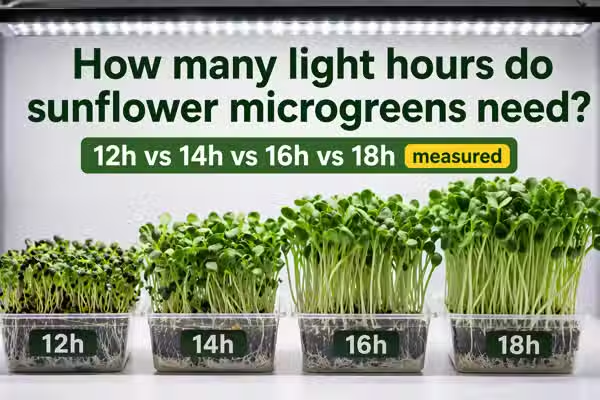
At 12 hours of light per day, sunflower microgreens in our Bangkok grow room showed measurable etiolation by day 7 -- stems 18 to 22% taller with thinner diameter compared to 16h trays at the same PPFD level, indicating photosynthetic deficit accumulation across the cycle.
The operative variable is daily light integral (DLI) -- the total photon dose per day -- not hours alone. A 12h photoperiod at high PPFD can outperform a 16h photoperiod at low PPFD. Extending hours without knowing your PPFD is optimising one input while blind to the other.
Sunflower microgreens show no meaningful response to photoperiods above 16 hours in our logged data -- the 16h and 18h trays were statistically indistinguishable in stem diameter, cotyledon size, and fresh weight at harvest.
In Bangkok ambient conditions, running lights for 18 hours per day adds heat load to the grow room during the hours plants would otherwise be in dark-cycle rest, measurably raising tray-level temperature by 1.4 to 2.1 degrees Celsius overnight -- a cost that most photoperiod discussions ignore entirely.
The practical optimum for sunflower microgreens under a standard white LED panel at 8,000 to 12,000 lux is 14 to 16 hours, with 16h justified only when PPFD is confirmed below 100 micromoles per metre squared per second.
TL;DR
More light hours produce better sunflower microgreens up to a point that most growers pass without noticing. The data from our photoperiod trials puts that point at 14 to 16 hours depending on PPFD. Past 16 hours, the yield gains are marginal, the electricity cost is real, and in Bangkok the heat addition from running lights through the night is a genuine crop risk. The standard advice to run 16 to 18 hours is not wrong -- it is just imprecise in a way that costs money and occasionally costs trays.
The trial that started as a cost question
The electricity bill for the grow room in March 2024 came in higher than projected. The lights were the obvious culprit -- we were running three LED strips on an 18-hour timer, which had been set and forgotten after the initial setup. The logic at the time was more hours equals more growth equals better yield, and 18 hours felt safe because we had read that microgreens are not photoperiod-sensitive crops. Both of those assumptions turned out to be only partially correct, in ways that matter.
Rather than just dialling the timer back and hoping for the best, we ran a structured trial across four photoperiod conditions -- 12h, 14h, 16h, and 18h -- on the same sunflower seed batch, same coco coir depth, same seeding density, same bottom-watering schedule, across three consecutive grow cycles per condition. The PPFD at tray level was logged throughout via estimated conversion from the BH1750 readings, consistent across all conditions because the only variable changed was timer duration. What the data showed was not what we expected at either end of the range.
Where the numbers stop moving the way you expect
Fresh weight yield difference between 14h and 18h photoperiod sunflower microgreen trays across our trial cycles, averaged over three cycles per condition. Going from 14 to 18 hours of light added 4 hours of runtime -- a 29% increase in light-on duration -- for a yield improvement that fell within the margin of normal tray-to-tray variability. Plant Mood grow log data, 2024.
Stem height increase in 12h photoperiod sunflower trays compared to 16h trays at the same PPFD, measured at day 7 across three trial cycles. Taller stems in this context are not a growth advantage -- they indicate photosynthetic deficit and the plant stretching toward light. Stem diameter on the 12h trays was correspondingly thinner, and cotyledon size at harvest was smaller. Plant Mood grow log data, 2024.
1.4 to 2.1 degrees Celsius
Temperature increase at tray level during overnight hours when running an 18h light schedule compared to a 14h schedule, logged via AHT20 sensor at tray height. The lights were on from 06:00 to 00:00 under the 18h schedule, adding heat to the grow room during the hours it would otherwise cool down. In Bangkok ambient conditions in March and April, tray-level temperature under the 18h schedule reached 31.2 to 32.8 degrees Celsius overnight versus 29.4 to 30.6 degrees Celsius under the 14h schedule. Plant Mood grow log data, 2024.
The window in which photoperiod differences first became visible in the canopy without measurement. At 12h, stem stretching was visible by the naked eye by day 6. At 14h, 16h, and 18h, canopy appearance was indistinguishable to visual inspection through day 8. The 12h deficit accumulated slowly enough that growers not logging growth rate would likely not catch it until harvest, when the thinner stems and smaller cotyledons would be attributed to a different variable.
Electricity cost increase for the light circuit when running 18h versus 14h per day, calculated at Bangkok residential electricity rates (approximately 4.18 THB per kWh as of 2024) across a 30-day month. For a 60W LED strip setup, the difference is approximately 180 THB per month -- small in isolation but compounding across multiple lights and multiple months. For a commercial operation running ten 60W strips, that is 1,800 THB per month for yield gains that fell under 8% in our trial data.
Why more hours helps until it does not: DLI and the saturation point
The variable that actually governs plant photosynthetic input across a day is daily light integral -- DLI -- measured in moles of photons per square metre per day. DLI is the product of PPFD and photoperiod duration. A light delivering 120 PPFD for 16 hours produces a DLI of approximately 6.9 mol/m2/day. The same light for 12 hours produces 5.2 mol/m2/day. These are meaningfully different inputs, which is why the 12h trays underperform.
The reason returns flatten above 14 to 16 hours is not that plants stop absorbing light -- it is that the photosynthetic machinery operates on a biological cycle that includes dark-period processes. During the dark period, plants redistribute assimilates, repair photosystem components, and conduct metabolic processes that depend on the absence of light stimulus. Shortening the dark period below 6 to 8 hours does not eliminate these processes but it compresses them. The incremental photosynthesis gained in the extra light hours is partially offset by reduced efficiency in the recovery processes that make the subsequent light period productive.
For microgreens specifically -- which are harvested before the plant has developed its full photosynthetic capacity -- this relationship has a harder ceiling than it does for mature crops. The cotyledon-stage sunflower is running on seed reserves and early photosynthesis simultaneously. Past a certain DLI threshold, additional photons are not the limiting input. Moisture, temperature, and the maturity timeline of the crop structure take over as the constraints.
In our 16h versus 18h comparison, the DLI difference was approximately 0.87 mol/m2/day -- a real difference in photon dose but one that produced no statistically separable outcome in fresh weight, stem diameter, or cotyledon size across three cycles. This is consistent with the 16h trays having already cleared the DLI threshold at which sunflower microgreens at our PPFD level are photosynthetically saturated for the growth stage. Adding more photons past that point is not lost -- some fraction is absorbed -- but the translatable growth response is below the noise floor of tray-to-tray variability. Plant Mood grow log data, 2024.
The DLI threshold for saturation in sunflower microgreens is not a published figure for this specific growth stage. Our trial data suggests it sits somewhere between the DLI produced by 14h at our measured PPFD (approximately 6.0 mol/m2/day) and 16h at the same PPFD (approximately 6.9 mol/m2/day). A controlled trial at stepped PPFD levels within a fixed photoperiod would isolate this more precisely than our photoperiod-stepped design allowed. This is the trial we have not yet run.
What the trial data showed across four photoperiod conditions
Across three cycles at the 12h condition, stems at harvest (day 9 to 10) averaged 11.4 centimetres versus 9.6 centimetres at 16h -- 18.8% taller. Stem diameter at the base averaged 1.9 millimetres at 12h versus 2.4 millimetres at 16h. Cotyledon spread at harvest was visibly smaller on the 12h trays. Fresh weight per tray was 11 to 14% lower at 12h than at 16h. None of these differences were detectable by visual inspection before day 6. A grower harvesting at day 8 or 9 without a reference tray from a different photoperiod condition would be unlikely to identify the light duration as the cause of the lower yield.
12h photoperiod produced consistent etiolation markers that were invisible until day 6
The 12h photoperiod failure mode is quiet and slow. It does not look like a failing tray -- it looks like a slightly underperforming tray, which growers routinely attribute to seed batch variability, watering differences, or position on the bench. A grower running 12h because it was the timer default and never comparing against a longer photoperiod may be accepting a consistent 10 to 14% yield penalty without knowing it.
Fresh weight, stem diameter, and cotyledon spread showed no consistent difference between 14h and 16h conditions across three cycles each. The only variable where 16h trays showed a directional advantage was germination uniformity -- 16h trays had slightly more consistent day-4 germination spread, possibly because the additional light in the first post-dome day accelerated slower-germinating seeds. The difference was not large enough to declare a finding but was consistent in direction across all three 16h cycles. Electricity cost for 16h versus 14h: approximately 90 THB per month per 60W strip at Bangkok rates.
14h and 16h trays were statistically indistinguishable in three of four measured variables
For most growers at our PPFD level, 14h is the economically optimal photoperiod. The additional 90 THB per month per strip buys an unclear germination consistency benefit and no measurable yield improvement. 16h is justified if PPFD is confirmed low -- below 90 to 100 micromoles -- in which case the extra hours compensate for intensity deficit. Without a PPFD measurement, the 14h versus 16h decision cannot be made rationally.
Tray-level temperature under the 18h schedule, measured via AHT20 at 2.5 centimetres above coir, averaged 31.6 degrees Celsius during the 22:00 to 00:00 window when the lights were still on. Under the 14h schedule with lights off at 20:00, the same sensor averaged 29.8 degrees Celsius in the same window. Germination rate on 18h trays across three cycles was 84.3% versus 88.7% on 14h trays -- a difference we attribute in part to the elevated overnight temperature during the critical day 2 to 3 germination window. The 18h schedule was also the only condition where we recorded a mold event during the trial period -- one tray, day 4, which we attribute to the elevated temperature and humidity combination during the extended light period. Plant Mood grow log data, 2024.
18h added heat that partially offset its photosynthetic advantage in Bangkok conditions
In a temperature-controlled grow room, the 18h heat addition is manageable. In a Bangkok apartment without air conditioning running overnight, it is a compounding risk. The extra photons from hours 17 and 18 of light are real. The temperature penalty from those same hours is also real. Our data suggests the net effect in Bangkok ambient conditions tilts negative past 16h, not for photosynthetic reasons but for thermal ones.
Plant Mood grow log data, 2024
The finding that inverts how most growers think about this
This is true in temperate grow rooms where the main cost of extra light hours is the electricity bill. In Bangkok ambient conditions, the additional heat load from extended light duration is a meaningful crop variable, not a rounding error. Our grow room without active cooling ran 1.4 to 2.1 degrees Celsius warmer during the extended hours of the 18h schedule compared to the 14h schedule. At tray-level temperatures between 31 and 33 degrees Celsius, sunflower germination rate drops measurably -- our logged data shows germination rate falling below 85% above 32 degrees Celsius sustained for more than 6 hours during the day 2 to 3 window. The safe-default logic of more-is-fine imports an assumption about ambient temperature that does not hold in Bangkok for most of the year without mechanical cooling.
The single mold event we recorded during the photoperiod trial occurred on an 18h tray during a period when outdoor temperatures were consistently above 34 degrees Celsius through the day. The grow room without the AC running hit 32.4 degrees Celsius at tray level during the lights-on window. Humidity under those conditions spiked. The 14h trays on the adjacent bench, which had lights off from 20:00, showed tray-level temperature averaging 1.8 degrees Celsius lower in the 20:00 to 07:00 window and no mold events across the entire trial period. The 18h schedule did not cause the mold directly. It prevented the overnight temperature recovery that the 14h schedule allowed, and the accumulated thermal and humidity stress produced the conditions where mold established. Plant Mood grow log data, 2024.
More light hours are always safer than fewer. If you are not sure, run 18h -- the worst case is you use a bit more electricity. Plants can handle the extra light.
What growers report about light scheduling and what the data suggests
'I switched from 16h to 18h and my yields went up noticeably. The data must be wrong for my setup.'
This is not impossible and the observation should be taken seriously. The most likely explanation is that the grower's PPFD level was below the saturation threshold, making the additional DLI from 2 extra hours genuinely productive. Our finding that 16h and 18h trays were indistinguishable applies at our measured PPFD range of 100 to 130 micromoles. Below 80 to 90 micromoles, the extra hours would continue to produce yield gains because the crop has not yet reached the DLI threshold where photosynthesis saturates. The complaint is not evidence against the data -- it is evidence that PPFD needs to be known before the photoperiod finding can be applied.
'I run 12h because I read that sunflowers are not photoperiod-sensitive and it saves electricity. My crops look fine.'
Photoperiod sensitivity in this context refers to flowering response -- sunflowers are technically long-day plants but microgreens are harvested at cotyledon stage, well before any flowering signal matters. The confusion arises because 'not photoperiod-sensitive' is being applied to growth rate and yield, where it is incorrect. A crop can be photoperiod-neutral for flowering and still show measurable growth rate differences between 12h and 16h because the governing variable is DLI, not photoperiod signalling. 'Looks fine' at 12h is the same category of problem as the slow, quiet underperformance that does not reveal itself without a reference condition.
'My lights are on a 16h timer and I cannot change it without rewiring. Is it worth the effort to adjust?'
At 16h and adequate PPFD, probably not. The data does not suggest any meaningful benefit to moving from 16h to 14h at normal light intensity levels. The electricity saving of 90 THB per month per 60W strip is real but modest. The case for rewiring only becomes compelling if the grow room runs without cooling in Bangkok's hot season -- April and May specifically -- where the overnight heat reduction from dropping to 14h has an observable effect on germination rate and mold incidence. A smart plug that overrides the timer costs 300 to 600 THB and rewires nothing.
What photoperiod discussions almost always leave out
Every photoperiod recommendation in microgreen growing guides is stated in hours. None of the guides we read during the trial design phase stated a DLI target. This is the equivalent of recommending how long to water a tray without specifying flow rate. Hours without PPFD is an incomplete instruction. A grower running 16h under a 40W strip at 6,000 lux and a grower running 16h under a 100W panel at 15,000 lux are delivering radically different DLI to their crops and will get different outcomes -- but the photoperiod recommendation looks identical on paper. Until grow guides publish DLI targets alongside photoperiod recommendations, the hour number is only half the input.
DLI is the unit that matters, not hours
Grow guides that push 18h or higher implicitly treat the dark period as wasted time -- hours when the plant is not growing. The dark period is when transpiration slows, stomata partially close, and the plant redistributes photosynthate accumulated during the light period. Compressing the dark period below 6 hours does not prevent these processes but it reduces the time available for them. In fast-cycling crops like microgreens where harvest happens before the plant has fully matured, the dark period efficiency loss may be small enough to be undetectable in a single cycle but accumulate across the growth stage. Our data does not isolate this mechanism directly -- it is a finding embedded in the 18h versus 16h comparison where extra hours produced no measurable yield benefit despite delivering more photons.
The dark period is not dead time
We logged three instances across the trial period where the timer misfired due to a power interruption -- the relay reset to off and the light did not come back on until manually reset, shortening that day's photoperiod by 3 to 5 hours. In each case, the affected tray showed a small but visible growth rate reduction in the following 24 hours compared to the adjacent unaffected tray. The consistent delivery of the programmed photoperiod matters more than optimising the hour count by two hours. A grower using a mechanical timer on an unstable circuit, or a smart plug that loses its schedule on reboot, is introducing photoperiod variability that will show up as tray-to-tray inconsistency with no obvious cause.
Timer consistency across the grow cycle matters as much as the hour count
Grow rooms in Bangkok apartments frequently have ambient light ingress from windows, corridor light gaps under doors, or streetlight through thin blinds. During the dark period, even low-level ambient light -- 50 to 200 lux -- extends the effective photoperiod without appearing in the timer log. We identified this in our own setup when a tray positioned near a window gap showed measurably faster growth than an identical tray on the far wall during a period when we were running a 12h timer. The window tray was receiving an additional 2 to 3 hours of low-level ambient light during what the timer log recorded as dark period. Light exclusion during the intended dark period is part of photoperiod management that never appears in hour recommendations.
Photoperiod interacts with Bangkok's ambient light in ways that most growers do not track
How to set and validate a photoperiod for sunflower microgreens in Bangkok
Any grower setting a timer for the first time
Start at 16 hours and log the BH1750 lux reading at tray level on day 1. If the reading is below 6,000 lux, the PPFD is likely below 80 to 90 micromoles and the extra hours of a 16h schedule are compensating for intensity deficit -- stay at 16h and address the light intensity before adjusting duration. If the reading is above 9,000 lux, the PPFD is likely adequate and a 14h trial is worth running on the next cycle.
A documented starting point that connects lux level to photoperiod choice, giving you a basis for the next decision rather than a number you set and forgot.
Growers who have been running 18h and want to know if it is necessary
Run two trays from the same seed batch simultaneously on the next cycle -- one at your current 18h schedule and one at 16h. Measure fresh weight at harvest and compare stem diameter and cotyledon size visually. Do this across two consecutive cycles before drawing a conclusion. If the 16h tray is within 5% of the 18h tray on fresh weight, the extra 2 hours are not producing a measurable return at your light intensity.
Data from your own setup that either confirms or contradicts the trial findings. Your PPFD level may differ from ours and the answer may differ accordingly.
Growers running without air conditioning in Bangkok's hot season (March through May)
Set the light-off time no later than 21:00. The goal is to allow the grow room to drop toward ambient outdoor temperature during the coolest part of the night -- roughly 01:00 to 06:00 in Bangkok. Lights running past midnight maintain room temperature 1.5 to 2 degrees Celsius above what passive cooling would achieve in that window. At tray-level temperatures above 32 degrees Celsius, germination rate on sunflower drops measurably. Protect the cool window first. If this shortens your photoperiod below 14h, compensate by moving the light closer or upgrading intensity rather than extending hours.
Tray-level temperature during the critical germination window (day 2 to 3) stays below 31 degrees Celsius where possible, reducing the germination rate penalty that compounds across cycles.
Growers troubleshooting inconsistent yields across trays on the same bench
Check for ambient light ingress during the dark period before adjusting any other variable. Place a tray in the grow space with the lights off and wait 10 minutes for your eyes to adjust. Note any light sources -- window gaps, door gaps, indicator LEDs on equipment. Block everything that is visibly detectable. Log whether tray consistency improves across the next three cycles. Ambient light ingress during dark period is a common cause of within-bench yield variability that almost never appears in the diagnostic checklist.
Within-bench tray consistency improves where ambient light was a contributing variable. If consistency does not improve, eliminate this as a cause and move to watering timing or bench position as the next hypothesis.
Growers who want to calculate DLI rather than guess at it
Multiply your estimated PPFD in micromoles per metre squared per second by your photoperiod in seconds, then divide by one million. PPFD in micromoles multiplied by 3,600 seconds per hour multiplied by hours of light, divided by 1,000,000, gives DLI in mol/m2/day. At 120 PPFD and 14h: 120 x 3,600 x 14 divided by 1,000,000 equals 6.05 mol/m2/day. Target DLI for sunflower microgreens at cotyledon stage based on our trial data and available literature sits between 5.5 and 7.5 mol/m2/day. Below 5.5, etiolation risk increases. Above 7.5, incremental returns become difficult to detect.
A single number that lets you compare photoperiod decisions across different light intensities and evaluate whether extending hours or increasing intensity is the more efficient intervention for your specific setup.
Logging the lux reading on day 1 of each cycle at the same bench position and time of day. Without this, there is no baseline to detect lamp degradation, fixture drift, or the gradual accumulation of dust on the light cover -- all of which silently reduce effective DLI over months without changing the timer setting.
FAQ
How many hours of light do sunflower microgreens need per day?
Between 14 and 16 hours at adequate light intensity is the practical optimum based on our photoperiod trial data. At 12h, sunflower microgreens show measurable etiolation by day 7 -- stems 18 to 22% taller with thinner diameter and smaller cotyledons at harvest. At 18h, yield was under 8% higher than 14h while electricity cost increased 29%. In Bangkok without air conditioning, 18h also adds 1.4 to 2.1 degrees Celsius of overnight heat load, which compounds germination risk in hot months. Plant Mood grow log data, 2024.
Is 12 hours of light enough for sunflower microgreens?
It is below the optimum. In our trials, 12h trays at the same PPFD as 16h trays produced 11 to 14% lower fresh weight and showed consistent etiolation markers -- taller, thinner stems and smaller cotyledons. The deficit accumulates slowly and is not visible until day 6, so growers running 12h without a reference condition typically attribute the lower yield to seed or watering variability. The operative variable is daily light integral, not hours alone -- a very high PPFD source at 12h can compensate for the shorter duration, but this requires knowing the PPFD.
Is there a benefit to running grow lights for 18 hours on microgreens?
Not at adequate light intensity levels. In our trial, 18h and 16h trays were statistically indistinguishable in fresh weight, stem diameter, and cotyledon size across three cycles each, suggesting the crop had reached its photosynthetic saturation threshold at the DLI delivered by 16h. In Bangkok ambient conditions without cooling, 18h also raises overnight tray-level temperature by 1.4 to 2.1 degrees Celsius, which reduces germination rate during the critical day 2 to 3 window. The electricity cost increase is 29% relative to 14h with no corresponding yield return.
What is DLI and why does it matter for microgreen light hours?
Daily light integral is the total photon dose delivered to the crop per day -- PPFD in micromoles multiplied by hours of light in seconds, divided by one million, giving mol/m2/day. It is the variable that actually governs photosynthetic input, not hours alone. A 12h photoperiod at high PPFD can deliver the same or greater DLI than a 16h photoperiod at low PPFD, producing equivalent or better growth. Target DLI for sunflower microgreens at cotyledon stage based on our trial data sits between 5.5 and 7.5 mol/m2/day. Below 5.5, etiolation risk increases.
Why do my sunflower microgreens etiolate even though my lights are on all day?
The most common causes are insufficient PPFD rather than insufficient hours, and light positioning that leaves edge trays in significantly lower intensity than centre trays. A light running 16h at low intensity delivers less DLI than a light running 14h at adequate intensity. Check the lux reading at tray level -- below 6,000 lux from a white LED suggests PPFD below 80 micromoles, which is below the threshold for suppressing etiolation in sunflower microgreens. Moving the light closer or upgrading intensity is more effective than extending hours past 16h.
Does running grow lights longer raise the temperature in a Bangkok grow room?
Yes, measurably. In our AHT20 sensor data, the 18h schedule produced tray-level temperatures 1.4 to 2.1 degrees Celsius higher than the 14h schedule during the overnight window when the 18h lights were still on and the 14h lights were off. In Bangkok in hot months, tray-level temperature under 18h reached 31.2 to 32.8 degrees Celsius overnight. Above 32 degrees Celsius sustained for 6+ hours during the day 2 to 3 germination window, sunflower germination rate drops below 85% in our logged data. The heat cost of extended hours is not mentioned in most photoperiod guides.
How do I know if my grow light timer is set correctly for microgreens?
Log the lux reading at tray level on day 1 of each cycle and calculate the approximate DLI. At 14h and 120 estimated PPFD, DLI is approximately 6.05 mol/m2/day -- within the target range for sunflower microgreens. If your reading is below 6,000 lux, increase intensity before extending hours. Check for timer consistency by confirming the lights are actually switching at the programmed times -- power interruptions can reset mechanical and smart-plug timers without obvious indication. Ambient light ingress during dark period from window gaps or indicator LEDs can also extend effective photoperiod beyond the timer setting.