TL;DR
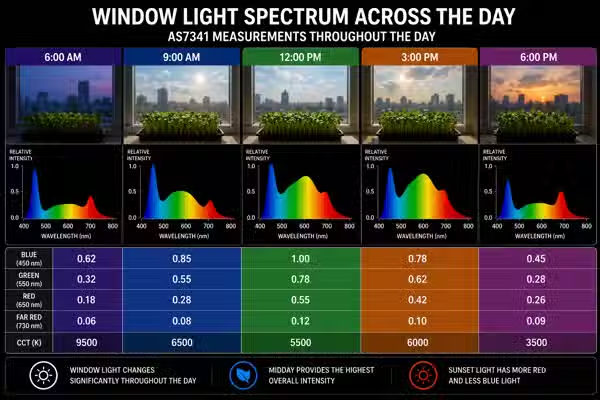
Bangkok window light changes spectrum across the day in ways a lux meter completely misses. The 6am and 6pm readings look similar in lux but are spectrally different from each other and from anything the sun produces between 9am and 3pm. The (F7+F8)/(F1+F2) ratio at 6am runs around 0.28 to 0.34 -- similar to a cheap LED strip. By 9am it climbs to 0.65 to 0.78. At 12pm it peaks. By 6pm it is back below 0.40. A grower who counts all daylight hours equally is counting some hours that contribute meaningfully to cotyledon development and some that barely differ from their cheap LED strip.
When the log showed that 6am light is not morning light
The question came from a yield inconsistency I could not resolve through the usual variables. Two sunflower cycles with identical lux-hours during the post-blackout greening phase were producing different color scores. Cycle A had most of its light exposure between 7am and 1pm. Cycle B had a split exposure: some morning hours, then a blocked window in the afternoon, then evening light until 7pm. Same total lux-hours on the meter. Color scores at harvest: 4.1 and 2.8.
I had the AS7341 running in the grow space but had not yet built the habit of logging at multiple time points across the day. The inconsistency pushed me to run a full diurnal measurement session: sensor face-up at tray level on the east-facing window, readings at 6am, 9am, 12pm, 3pm, and 6pm, clear sky, cool season, same position each time. What came back from the sensor was not what I expected from thinking of window light as a single consistent source with varying intensity.
The F8 channel at 6am registered 11% of clear. At 9am it registered 42% of clear. At 12pm it was 51% of clear. At 3pm it was back to 38%. At 6pm it was 13% of clear. The lux readings across the same time points rose and fell in a smooth curve. The F8 readings did not follow the same curve. They had a different shape -- lower at dawn and dusk relative to their lux level, higher in the mid-morning window than lux alone would predict. Cycle B had been getting most of its cumulative lux from the hours where F8 was lowest. The lux-hour count was identical. The red-wavelength-hour count was not.
What the literature says about diurnal spectral shift
Hernandez and Kubota, HortScience, 2016
Solar spectrum at low sun angles (dawn and dusk) is enriched in blue wavelengths relative to red due to Rayleigh scattering in the longer atmospheric path length the light travels. The red-to-far-red ratio increases through the morning as the sun rises, peaks around solar noon, and declines again through the afternoon. This diurnal variation in spectral composition is a natural signal that plants have evolved to respond to, with phytochrome photoequilibrium shifting across the day in response to the changing red-to-far-red ratio.
The spectral shift is not a Bangkok-specific phenomenon but its practical magnitude for a grower depends on window orientation and the proportion of direct versus diffuse sky light the tray receives. An east-facing Bangkok window captures the steepest part of the morning spectral transition -- from low-angle blue-heavy dawn light to the higher red content of mid-morning direct solar. A north-facing window receives only diffuse sky across the full day, which stays blue-dominant throughout and shows less pronounced diurnal spectral variation.
Kotilainen et al., Plant, Cell and Environment, 2020
End-of-day far-red light exposure drives phytochrome Pfr-to-Pr conversion in the low-light period before full darkness. Plants that receive a natural end-of-day light signal -- low sun angle, red and far-red enriched -- show different hypocotyl elongation and leaf expansion responses than plants exposed to artificial light that lacks the far-red component. The natural spectral transition at dusk is a developmental cue, not just a reduction in intensity.
Microgreens grown under artificial light that runs until an abrupt cutoff are not receiving the end-of-day spectral transition that window-grown plants experience. Whether this matters at the microgreen growth stage -- where the cycle is 7 to 14 days and the plant never reaches full vegetative development -- is a legitimate open question. The signal is present in window-grown trays. Its absence in artificially lit trays is a difference that the AS7341 diurnal data makes visible.
Sellaro et al., Plant Physiology, 2010
Blue light received during the first hours of the photoperiod has a disproportionate effect on cryptochrome-mediated stomatal opening, hypocotyl growth suppression, and anthocyanin synthesis relative to blue light received later in the day. Plants show a photobiological memory effect where early-photoperiod blue light sets the tone for the day's developmental responses even when total blue light dose is equalised across the day.
The blue-heavy spectrum at 6am and 7am through an east-facing Bangkok window is not wasted even from a plant biology perspective, despite its low red content. Early-photoperiod blue drives stomatal opening and growth suppression responses that affect the day's development. The practical question for a grower is not whether 6am light is valueless but whether it is as valuable per photon as 9am to 12pm light for the specific outcome of cotyledon color and chlorophyll accumulation. The data suggests it is not -- but it is not zero.
Five time points, five different spectra
(F7+F8)/(F1+F2) ratio ranged from 0.31 at 6am to 0.84 at 12pm on the same east-facing window in the same day
AS7341 measurements at tray level, east-facing Bangkok window, clear sky, cool season, January 2024. Gain and integration time held constant across all 5 sessions. The 0.53-point range across a single day exceeds the difference between a cheap LED strip (0.24 to 0.28) and a mid-range horticulture panel (0.50 to 0.60). The window delivers more spectral variation in a day than separates two different artificial light source categories. (Plant Mood sensor log data, 2024)
F8 channel as percentage of clear: 11% at 6am, 42% at 9am, 51% at 12pm, 38% at 3pm, 13% at 6pm
The F8 reading at 6am and 6pm is in the range associated with severe red deficit in artificial light sources -- the same threshold range that correlates with pale cotyledon outcomes in logged grow cycles. The 9am through 3pm window delivers F8 values consistently above the 25% threshold associated with adequate red wavelength delivery for chlorophyll synthesis. The 6-hour window between 9am and 3pm is where the east-facing Bangkok window earns its reputation as a capable grow light source. The 2 hours on either side do not share that reputation spectrally. (Plant Mood sensor log data, 2024)
F2 channel (445 nm blue) as percentage of clear: 78% at 6am, 52% at 9am, 44% at 12pm, 49% at 3pm, 71% at 6pm
The blue dominance at dawn and dusk is pronounced. F2 at 78% of clear at 6am is higher than the F2 reading from a cheap white LED strip (61 to 79%). The early morning east window is not a natural-light source that is spectrally better than a cheap LED strip -- it is spectrally similar to one. The transition from 6am blue dominance to 9am balanced spectrum happens over approximately 90 minutes and is the steepest spectral shift of the day. (Plant Mood sensor log data, 2024)
Total lux at tray level: 800 at 6am, 7,400 at 9am, 9,200 at 12pm, 6,100 at 3pm, 400 at 6pm
The lux curve rises and falls smoothly across the day. The F8 curve does not follow this shape -- it rises faster and falls faster than lux, peaking closer to solar noon and dropping more steeply toward evening. The 3pm reading shows this asymmetry clearly: lux at 3pm is 66% of the 12pm peak, but F8 at 3pm is 75% of the 12pm peak. The afternoon red content holds up better than total intensity on the way down, while the morning red content builds faster than total intensity on the way up. The spectral shape of the day is not the same as the lux shape of the day. (Plant Mood sensor log data, 2024)
Why sun angle and atmosphere produce a different spectrum at each hour
The spectral composition of sunlight reaching a tray through a window depends on two interacting variables: the path length through the atmosphere the light has travelled, and the ratio of direct beam to diffuse sky light arriving at the window.
At low sun angles -- 6am, 6pm -- direct sunlight travels through 8 to 10 times more atmosphere than at solar noon. Rayleigh scattering, which is wavelength-dependent and preferentially scatters shorter wavelengths, removes a proportionally larger fraction of red and orange wavelengths from the direct beam over this extended path. The direct beam at low angles is therefore depleted of red relative to a vertical sun. This is why the sky turns orange and red at sunset -- the red that would have been scattered on the way to your tray is instead scattered sideways and visible in the horizon sky.
Simultaneously, the diffuse sky at low sun angles is intensely blue from the scattered blue light filling the sky dome. A tray in an east-facing Bangkok window at 6am is receiving a small amount of direct beam (red-depleted) plus a large contribution from diffuse blue sky. The F2 channel reading of 78% of clear at 6am reflects this: the sky is delivering a photon distribution that concentrates in the blue range, similar to what a white phosphor LED delivers by design.
As the sun rises, two things change simultaneously. The path length through the atmosphere shortens, reducing red depletion in the direct beam and increasing the red content of direct sunlight. And the proportion of direct beam to diffuse sky increases as the sun climbs above the horizon and the geometric relationship between the sun angle and the east window becomes more direct. By 9am, the east-facing Bangkok window is receiving a substantial direct beam component with short path length plus a sky that is now partly lit from a higher sun angle and less dominated by pure blue scatter.
At solar noon, the sun is at maximum elevation and minimum atmospheric path length. The direct beam has traversed the least atmosphere and carries the most complete solar spectrum, including strong red content. The east window at noon is no longer receiving the sun directly -- for an east-facing window, direct solar incidence has shifted toward the west -- but the overall sky brightness and indirect illumination are at their maximum, and the spectral composition is balanced.
By 3pm, the process begins to reverse. The sun is declining in the western sky, path length is increasing, and the east window is receiving predominantly diffuse sky. The red content begins to decline but more slowly than it rose in the morning, because the afternoon sky scattering geometry differs from the morning geometry for an east-facing window.
At 6pm the process mirrors 6am: long path length, blue-dominant diffuse sky, minimal direct beam, F8 at 13% of clear.
Bangkok adds a hot-season complication. Haze and particulate matter in the atmosphere increase Mie scattering, which is less wavelength-selective than Rayleigh scattering. In hot season, the sharp spectral peaks and valleys of the diurnal cycle are smoothed -- less extreme blue at dawn and dusk, less extreme red enrichment at solar noon. The cool season diurnal spectral range of 0.31 to 0.84 in the (F7+F8)/(F1+F2) ratio narrows to approximately 0.33 to 0.61 in hot season as haze compresses the spectral variation.
A clear-sky cool season day versus a hazy hot season day at 9am, east window. Cool season 9am: (F7+F8)/(F1+F2) at 0.74, F8 at 42% of clear, lux at 7,400. Hot season 9am: ratio at 0.54, F8 at 31% of clear, lux at 3,100. The hot season morning is not just dimmer -- it is spectrally closer to the dawn and dusk readings. The haze compresses the day's spectral range and shifts the entire diurnal curve toward the blue-dominant end. A grower using only lux to compare these two readings would see a 58% lux drop and correctly identify the hot season morning as inadequate. What the lux reading misses is that even if the hot season morning lux were artificially boosted to 7,400, the spectrum would still be substantially more blue-dominant than the cool season morning it is replacing.
The AS7341 does not measure the sun angle directly and cannot compute atmospheric path length. What it measures is the consequence of those variables at tray level -- the spectral composition of the photons arriving at the sensor. For a fixed window position and consistent clear-sky conditions, the diurnal spectral pattern is repeatable enough to use as a grow planning tool. Clouds, building shadows, and seasonal haze all disrupt the pattern. The logged data from clear-sky days provides a ceiling -- actual grow days perform somewhere between the clear-sky diurnal pattern and a fully overcast sky with compressed spectral range throughout.
How each time window compares to common artificial sources
6am east window (Bangkok, cool season, clear sky)
F2 at 78% of clear, F8 at 11% of clear. (F7+F8)/(F1+F2) ratio 0.31. Lux approximately 800 at tray level. Spectrally indistinguishable from a cheap white LED strip at matched lux. Blue dominant, red severely deficient. Low absolute intensity compounds the spectral problem.
Contributes early-photoperiod blue light that drives stomatal opening and growth suppression signalling. Does not contribute meaningfully to cotyledon chlorophyll accumulation. Counting these hours in a total lux-hour calculation overstates their contribution to greening outcomes. For a grower whose window is blocked after 11am, starting post-blackout light exposure at 6am adds 3 hours of predominantly blue-dominant low-intensity light before the useful window begins.
9am east window (Bangkok, cool season, clear sky)
F2 at 52% of clear, F8 at 42% of clear. (F7+F8)/(F1+F2) ratio 0.74. Lux approximately 7,400 at tray level. Comparable to cool-season window performance at peak. Red content equivalent to a well-specified mid-range horticulture LED panel.
The beginning of the photosynthetically productive window for an east-facing Bangkok window in cool season. A tray placed at the window at 9am rather than 6am loses 3 hours of low-intensity blue-dominant light and gains nothing in terms of the chlorophyll synthesis outcome. The first 3 hours of meaningful red wavelength exposure begin here. For a grower managing limited window access, 9am to 1pm is the highest-value 4-hour window of the day.
12pm east window (Bangkok, cool season, clear sky)
F2 at 44% of clear, F8 at 51% of clear. (F7+F8)/(F1+F2) ratio 0.84. Lux approximately 9,200 at tray level. Best spectral ratio of the five measured time points. F8 at 51% of clear exceeds the reading from a dedicated horticulture LED panel measured under the same conditions.
Peak spectral quality and peak intensity coincide near solar noon for a diffuse-sky east window that is no longer receiving direct eastern sun. The window is lit by the full sky dome at its brightest and most spectrally balanced. Growers who rotate trays from east to south or west-facing positions at midday to chase the sun are often already exploiting this peak without realising the spectral basis for it.
3pm east window (Bangkok, cool season, clear sky)
F2 at 49% of clear, F8 at 38% of clear. (F7+F8)/(F1+F2) ratio 0.67. Lux approximately 6,100 at tray level. Still above the 0.65 threshold for adequate red content. Red content holding up better than lux relative to the 12pm peak.
Remains a productive window for chlorophyll accumulation. The spectral quality at 3pm is closer to the 9am reading than to the 6pm reading, despite being equidistant in clock time. The afternoon decline in spectral quality is slower than the morning rise. For growers with limited window access, a 9am to 3pm exposure captures the entire useful spectral window with minimal low-quality hours at either end.
6pm east window (Bangkok, cool season, clear sky)
F2 at 71% of clear, F8 at 13% of clear. (F7+F8)/(F1+F2) ratio 0.34. Lux approximately 400 at tray level. Mirrors the 6am reading in spectral profile but at approximately half the lux. Blue dominant, red severely deficient, low intensity.
Provides the end-of-day spectral transition signal described in plant biology literature. Low red, low intensity, declining toward darkness. Not a useful chlorophyll accumulation window. Contributes a natural phytochrome reset that artificial grow lights running until abrupt cutoff do not provide. Whether this developmental signal matters within a 7 to 14 day microgreen cycle is an open question -- the biology suggests it should, the grow data is not conclusive.
What logging five time points across multiple seasons revealed
Defined as the period where (F7+F8)/(F1+F2) exceeds 0.60 at tray level. Cool season clear-sky days: ratio crossed 0.60 at approximately 8:45am and dropped back below 0.60 at approximately 3:20pm -- a window of roughly 6.5 hours. Hot season clear-sky days: ratio crossed 0.60 at approximately 10:05am and dropped back below 0.60 at approximately 2:10pm -- a window of approximately 4 hours. The hot season productive spectral window is 38% shorter than the cool season window, independent of the lux reduction that also occurs in hot season. A grower running fixed post-blackout exposure hours across the year is receiving 38% less spectrally productive window time in hot season even before accounting for lower total intensity. (Plant Mood sensor log data, 2024)
The productive spectral window on an east-facing Bangkok window is 9am to 3pm in cool season and 10am to 2pm in hot season
Fixed-hour post-blackout protocols need seasonal calibration. A protocol built around 8am to 4pm window exposure in January is not delivering 8 hours of productive spectrum in July. It is delivering approximately 4 hours of productive spectrum and 4 hours of blue-dominant light that performs more like a cheap LED strip than the window light the protocol was designed around.
On fully overcast days, the AS7341 diurnal readings showed a compressed spectral range. The 6am overcast reading produced a ratio of 0.31, nearly identical to the clear-sky 6am. The 12pm overcast reading produced a ratio of 0.48, compared to 0.84 on clear days. The overcast sky eliminates the direct beam component that drives the midday red enrichment but does not eliminate the Rayleigh scattering effect on diffuse sky at low sun angles. Dawn and dusk under overcast skies remain blue-dominant. Midday under overcast skies is more balanced than dawn and dusk but significantly less red-enriched than clear-sky midday. (Plant Mood sensor log data, 2024)
Overcast days compress but do not eliminate the diurnal spectral shift
Overcast days do not simply scale the diurnal spectral pattern downward -- they flatten it. A grower who has calibrated their post-blackout timing based on clear-sky spectral windows will find that overcast days deliver worse spectral quality at the peak hours and similar spectral quality at the low-quality hours. The entire day shifts toward the blue-dominant, low-red profile of dawn and dusk.
A parallel measurement session on a north-facing window in the same grow space produced (F7+F8)/(F1+F2) readings of 0.38 at 6am, 0.44 at 9am, 0.47 at 12pm, 0.45 at 3pm, and 0.35 at 6pm. The range across the day was 0.12 points. The east-facing window range was 0.53 points. The north-facing window receives only diffuse sky across the full day -- no direct solar incidence at any point -- and diffuse sky is relatively stable in spectral composition compared to the direct beam that drives the east-facing window's midday red enrichment. The north-facing window is more consistent but consistently mediocre. Its best reading (0.47 at 12pm) is below the east-facing window's 9am reading. (Plant Mood sensor log data, 2024)
North-facing windows show minimal diurnal spectral variation compared to east-facing windows
Growers in apartments with only north-facing windows are not getting the same spectral benefit from the midday peak that east or south-facing windows provide. A north-facing window is a stable but low-ceiling light source spectrally. The case for supplemental artificial lighting is stronger for north-facing apartments than for east-facing ones, not because of lux -- north windows can deliver adequate lux at midday -- but because the spectral ceiling is lower.
Plant Mood sensor log data, 2024
What the diurnal spectral pattern means that most growers do not account for
A post-blackout exposure protocol that counts 12 lux-hours from 6am to 6pm is not delivering 12 equivalent hours of plant-useful light. In cool season on a clear day, approximately 4 of those hours (6am to 8am and 4pm to 6pm) are delivering a spectrum similar to a cheap LED strip at low intensity. The productive 6.5-hour window from 8:45am to 3:20pm contains approximately 70% of the day's spectrally useful photon dose despite representing only 54% of the total daylight hours. A grower optimising for cotyledon development should be thinking in spectrally weighted hours, not clock hours.
Lux-hour calculations that treat all hours equally
Adding exposure hours outside the productive spectral window does not improve cotyledon color outcomes. In paired cycles where one tray received 6am to 4pm exposure and another received 9am to 4pm exposure on the same clear cool-season day, color scores were within 0.2 points of each other despite a 3-hour lux-hour difference. The 3 early-morning hours added lux to the log and added blue photons to the tray without adding meaningful red wavelength dose. In hot season, where the productive window narrows to approximately 4 hours and temperatures before and after that window are already rising, extending exposure into the low-quality dawn hours can add heat stress without adding spectral benefit.
The assumption that more window hours always means better results
The 9am to 3pm productive window in cool season shifts toward 10am to 2pm in hot season because the haze that compresses spectral range arrives earlier in the morning. A grower who removes blackout covers and places trays at 7am year-round is exposing trays to 2 to 3 hours of blue-dominant pre-productive light in cool season and 3 to 4 hours of the same in hot season. The optimal blackout removal time is not a fixed clock time. It tracks the seasonal shift in when the spectral ratio crosses the productive threshold at the specific window position.
The seasonal shift in productive window timing
Adjacent buildings that cast shadows on a window in the morning or afternoon truncate the productive spectral window from one end. A shadow that falls on the east window from 9am to 11am -- caused by a building to the east or northeast -- removes the period of steepest spectral rise and delays the tray's entry into the productive window by 2 hours. The grower compensates by extending total exposure hours, adding more of the hours outside the productive window rather than fewer. The shadow is removing the best hours and the compensation adds the worst hours.
Building shadow interaction with the diurnal pattern
How diurnal spectral awareness will change grow practice
Growers using AS7341 or equivalent sensors will shift from fixed blackout removal times to threshold-triggered removal, where the cover comes off when the (F7+F8)/(F1+F2) ratio at window level crosses 0.55 rather than at a fixed clock time.
The productive spectral window varies by 90 minutes or more across Bangkok seasons and is further disrupted by cloud cover, building shadows, and haze. A fixed 7am blackout removal time is correctly timed on a clear cool-season morning and misses the productive window by 2 to 3 hours on a hazy hot-season morning. A sensor reading the window spectrum and triggering cover removal at a spectral threshold eliminates this variance entirely. The sensor infrastructure to do this exists and is cheap -- an AS7341 connected to an ESP32 monitoring the window and signalling or automating cover removal when the ratio threshold is met. The first grower to build and document this system will reframe how blackout removal is discussed in urban farming communities.
Published grow protocols or community-adopted practices specifying spectral ratio thresholds for blackout removal timing rather than fixed clock times, appearing in Thai or regional urban farming communities by 2027.
The spectral quality difference between dawn-to-dusk window exposure and productive-window-only exposure will be quantified in a published microgreen study within 3 years, and the productive window concept will enter mainstream grow guidance as a corrective to lux-hour-based advice.
The lux-hour model for plant light advice is already under pressure from PAR and DLI (daily light integral) frameworks that weight photons more accurately. The next step -- weighting not just total photon count but spectral composition across the day -- is a logical extension that the existing sensor infrastructure makes tractable. Microgreen research is a relatively fast-moving applied field and the question of whether dawn and dusk window hours contribute equally to cotyledon development as midday hours is specific, testable, and practically important enough to attract research attention. The grow data supporting the hypothesis already exists in sensor logs like ours.
A peer-reviewed study comparing cotyledon chlorophyll content under full-day versus productive-window-only natural light exposure in a tropical or subtropical urban environment, published by 2028.
FAQ
How does window light spectrum change across the day for microgreens?
Significantly, and in ways lux measurement completely misses. On a clear cool-season Bangkok day, an east-facing window AS7341 (F7+F8)/(F1+F2) ratio reads 0.31 at 6am, 0.74 at 9am, 0.84 at 12pm, 0.67 at 3pm, and 0.34 at 6pm. F8 at 680 nm -- the primary chlorophyll-a absorption peak -- reads 11% of clear at 6am, 42% at 9am, 51% at 12pm, 38% at 3pm, and 13% at 6pm. The 6am and 6pm readings are spectrally similar to a cheap LED strip. The 9am to 3pm window delivers the red content that drives cotyledon chlorophyll accumulation. (Plant Mood sensor log data, 2024)
What are the best hours for post-blackout microgreen light exposure from a window?
In cool season Bangkok, the spectrally productive window on an east-facing window runs from approximately 8:45am to 3:20pm -- about 6.5 hours where the (F7+F8)/(F1+F2) ratio exceeds 0.60. In hot season, haze compresses this to approximately 10am to 2pm, a 4-hour window. Adding exposure hours before 9am or after 3:30pm extends total lux-hours without adding meaningful red wavelength dose. In paired cycles, 9am to 4pm exposure produced cotyledon color scores within 0.2 points of 6am to 4pm exposure despite 3 fewer hours of light. The early morning hours add blue photons, not chlorophyll synthesis photons. (Plant Mood sensor log data, 2024)
Why is morning window light blue-dominant for microgreens?
At low sun angles -- 6am and early morning -- direct sunlight travels through 8 to 10 times more atmosphere than at solar noon. Rayleigh scattering preferentially removes shorter wavelengths from the direct beam over this extended path, depleting red content and leaving blue dominant. Simultaneously, diffuse sky at dawn is intensely blue from scattered blue light. The F2 channel (445 nm blue) at 6am through an east-facing Bangkok window reads 78% of clear -- higher than some cheap LED strip readings. The transition to balanced spectrum happens over approximately 90 minutes as the sun rises and path length shortens.
How does Bangkok hot season affect the diurnal window light spectrum?
Hot season haze compresses the diurnal spectral range significantly. Cool season (F7+F8)/(F1+F2) ratio range across the day: 0.31 to 0.84. Hot season range: approximately 0.33 to 0.61. The haze increases Mie scattering, which is less wavelength-selective than Rayleigh, smoothing out the spectral peaks. The midday red enrichment that defines the productive window is reduced. The productive spectral window (ratio above 0.60) narrows from 6.5 hours in cool season to approximately 4 hours in hot season. A grower running fixed-hour protocols year-round receives 38% less spectrally productive window time in hot season before accounting for any lux reduction. (Plant Mood sensor log data, 2024)
How does a north-facing window spectrum compare to an east-facing window across the day?
A north-facing Bangkok window shows minimal diurnal spectral variation: (F7+F8)/(F1+F2) ranged from 0.35 to 0.47 across the full day, compared to 0.31 to 0.84 for the east-facing window. North windows receive only diffuse sky throughout the day with no direct solar incidence, and diffuse sky spectrum is relatively stable across daylight hours. The north window's best reading at 0.47 sits below the east window's 9am reading. It is more consistent but spectrally capped. The case for supplemental artificial lighting is stronger for north-facing apartments not because of lux but because the spectral ceiling never reaches the levels an east or south window delivers in the productive midday hours. (Plant Mood sensor log data, 2024)
Is 6am window light useful for microgreen cotyledon development?
For chlorophyll accumulation specifically, no. The 6am east-facing Bangkok window delivers (F7+F8)/(F1+F2) ratio of 0.31 and F8 at 11% of clear -- values in the range of a cheap LED strip at low intensity. These parameters correlate with poor cotyledon color outcomes in artificial light. However, early-photoperiod blue light does drive cryptochrome-mediated stomatal opening and growth suppression responses that have developmental value independent of chlorophyll synthesis. The practical answer for grow scheduling: 6am light is not zero but it does not count toward the chlorophyll-accumulation light dose that determines cotyledon color at harvest.
What AS7341 ratio threshold marks the start of productive window light for microgreens?
In our logged cycles, (F7+F8)/(F1+F2) above 0.60 correlates consistently with adequate red wavelength delivery for cotyledon chlorophyll accumulation in sunflower and most logged species. Below 0.35 produces outcomes indistinguishable from cheap LED strip exposure. The 0.55 to 0.65 range is intermediate. For blackout removal timing and grow scheduling, crossing 0.60 at window level is the practical threshold. On a clear cool-season Bangkok morning this occurs at approximately 8:45am on an east-facing window. On a hazy hot-season morning it occurs approximately 75 to 90 minutes later. (Plant Mood sensor log data, 2024)