Key takeaways
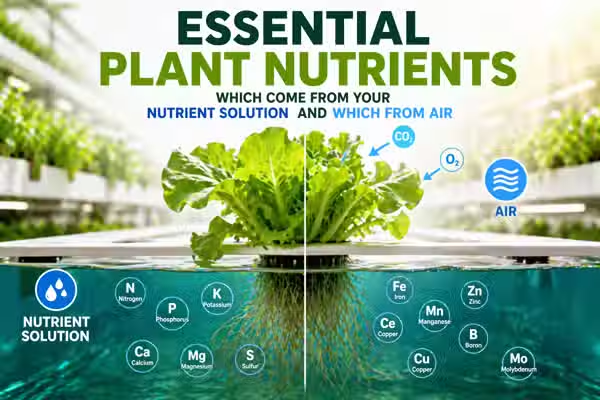
Three of the 17 essential plant nutrients -- carbon, hydrogen, and oxygen -- are sourced from air and water, not from your nutrient solution. No EC adjustment will fix a deficiency in any of these three.
Carbon enters plants exclusively as CO2 through leaf stomata. In a sealed indoor grow room in Bangkok, CO2 can drop below 400 ppm within hours of lights-on, visibly slowing growth before any sensor in your reservoir tells you anything is wrong.
Oxygen reaches roots dissolved in water. At Bangkok reservoir temperatures above 28 degrees Celsius, dissolved oxygen drops sharply -- our logs showed a consistent 30 to 40 percent reduction compared to a reservoir held at 22 degrees Celsius (Plant Mood grow log data, 2024).
The remaining 14 nutrients -- nitrogen, phosphorus, potassium, calcium, magnesium, sulfur, and eight micronutrients -- must come from your nutrient solution. If any of these appear deficient, the solution is where you look first.
Hydrogen enters plants primarily as water (H2O) through roots. In hydroponics, a clogged or dry root zone is a hydrogen delivery failure, not a solution formulation problem.
Growers who obsess over their nutrient formulation while ignoring airflow and reservoir temperature are optimising the wrong system. In Bangkok, the air-sourced nutrients are the first to fail.
TL;DR
Plants need 17 nutrients to grow. Three of them -- carbon, hydrogen, and oxygen -- come from air and water, not from anything you add to a reservoir. In Bangkok, these three are also the most likely to become limiting factors: CO2 gets depleted in sealed rooms, dissolved oxygen collapses when reservoir temperatures climb past 28 degrees Celsius, and hydrogen delivery fails when roots dry out or rot. Your nutrient solution is responsible for the other 14. Knowing which system to blame when growth stalls cuts troubleshooting time significantly.
The deficiency that was never in the solution
A grower running a small NFT system in a Bangkok condo messages us about yellowing leaves and stunted growth on week-three lettuce. She has already adjusted her EC twice, raised her pH, added a calcium-magnesium supplement, and switched nutrient brands. Nothing changed. The plants look like they are running out of something, which is correct -- they are. The problem is that what they are running out of is not in her reservoir and never will be. Her grow room is sealed, she runs lights 16 hours a day, and there is no fresh air intake. CO2 in that room is probably sitting somewhere below 350 ppm by the time she checks on her plants each evening.
When I asked her to describe the room, not the reservoir, the answer was immediate. One window, always closed, no fan pulling from outside. She had been troubleshooting the wrong system for two weeks. The solution formula was fine. The air was the problem.
What happens to dissolved oxygen at Bangkok temperatures
30 to 40 percent reduction in dissolved oxygen
Measured across reservoir cycles comparing temperatures above 28 degrees Celsius to those held at 22 degrees Celsius. Plant Mood grow log data, 2024. At 30 degrees Celsius, water holds roughly 7.5 mg/L of dissolved oxygen at saturation. At 22 degrees Celsius, that ceiling is closer to 9.1 mg/L (engineering toolbox reference values). Most Bangkok apartment reservoirs without active chilling run between 29 and 32 degrees Celsius in the warmer months.
CO2 ambient outdoor Bangkok: approximately 415 to 420 ppm
Consistent with global atmospheric averages. Indoor sealed grow rooms with active photosynthesis can drop below 300 ppm within three to four hours of lights-on with no fresh air exchange. Below 300 ppm, photosynthesis rate decreases measurably -- carbon fixation slows before any other visible symptom appears. (Source: controlled environment agriculture research, Bugbee, Utah State University, cited widely in CEA literature.)
14 of 17 nutrients are solution-dependent
Nitrogen, phosphorus, potassium, calcium, magnesium, sulfur, iron, manganese, zinc, copper, boron, molybdenum, chlorine, and nickel must all be present in or absorbed through the growing medium or nutrient solution. None of them enter through leaf stomata in any agronomically meaningful quantity.
The nutrient your solution cannot supply
Carbon is the most abundant element in plant dry matter -- typically 45 percent of it by weight (source: Plant Physiology, Taiz and Zeiger, 6th edition). Plants build every cell, every sugar molecule, every structural compound from carbon. And not one atom of it comes from the nutrient solution. Carbon enters only as CO2 through stomata. In a sealed indoor grow room, you can have a perfect nutrient solution at the ideal EC and pH, and your plants can still be carbon-starved. The stomata close under stress and under high temperatures -- both common conditions in Bangkok apartments without air conditioning. When stomata close, CO2 uptake stops. Photosynthesis stops. Growth stops. None of that shows up in a reservoir reading.
In the condo grow room described above, and in similar setups we have seen across Bangkok growers who reached out to us, the pattern is consistent. Plants in sealed rooms with no fresh air source underperform on growth rate before they show any classic nutrient deficiency symptoms. The first visible sign is usually slow internode extension or pale new growth that looks like a nitrogen issue but does not respond to nitrogen. CO2 depletion mimics nitrogen deficiency closely enough that growers chase it with more fertiliser for weeks.
If a plant looks deficient, the fix is in the nutrient solution. Adjust EC, check the formula, maybe add a supplement. Most growers think of deficiency as a water-and-fertiliser problem.
How each of the three air-sourced nutrients actually moves into the plant
Carbon, hydrogen, and oxygen are classified as non-mineral nutrients precisely because they do not come from soil or solution. Their delivery pathways are completely separate from the root zone.
Carbon enters as CO2 through stomata in the leaf surface. The stomata are small pores surrounded by guard cells. When the plant is actively photosynthesising, the guard cells open the pore and CO2 diffuses in. When temperatures are too high, humidity is too low, or the plant is under stress, the guard cells close the pore to prevent water loss -- and CO2 uptake stops with it. In Bangkok, afternoon temperatures in a west-facing apartment room without air conditioning regularly exceed 33 to 35 degrees Celsius. Guard cells respond to heat by closing. The plant effectively stops feeding on carbon mid-afternoon every day.
Hydrogen enters mostly as water (H2O). In hydroponics, roots absorb water directly from the solution, and that water is split during photosynthesis to release hydrogen for use in building sugars. In practical terms, hydrogen availability is a root zone access problem. If roots are sitting in waterlogged low-oxygen solution, or if they have rotted, hydrogen delivery fails regardless of how much water is present. Hydrogen deficiency as an isolated diagnosis is rare -- what you see instead is the downstream effects: wilting, poor photosynthetic output, slowed growth.
Oxygen reaches roots dissolved in the water that circulates through the root zone. This is where Bangkok growers feel it most directly. Warm water holds less dissolved oxygen. At 30 degrees Celsius, a reservoir at saturation holds about 7.5 mg/L. At 22 degrees Celsius, that same reservoir holds around 9.1 mg/L. Roots need oxygen to drive cellular respiration -- the metabolic process that powers active nutrient uptake. When dissolved oxygen drops, nutrient uptake slows even when the nutrients are present at correct concentrations. This is why a textbook-perfect nutrient solution in a warm Bangkok reservoir can still produce deficiency symptoms: the roots lack the energy to absorb what is in front of them.
A grower running a deep water culture bucket in a Bangkok apartment noticed calcium deficiency symptoms -- tip burn on lettuce -- despite calcium levels testing at 180 ppm, which is within normal range. Reservoir temperature was 31 degrees Celsius. Adding more calcium did nothing. Adding an air stone did. The roots needed dissolved oxygen to run the active transport that moves calcium against a concentration gradient into the plant. Without it, calcium sat in the reservoir unused.
Active uptake of calcium and other divalent cations is energy-dependent. Root cellular respiration -- powered by dissolved oxygen -- is what drives that energy. This is the mechanism behind the 'calcium deficiency in warm reservoirs' pattern that appears repeatedly in Bangkok grower reports.
What the grow logs show about air-sourced nutrient failures in Bangkok
Across DWC and NFT cycles logged between 2023 and 2024, every crop that showed brown or slimy root development had a reservoir temperature above 28 degrees Celsius for more than three consecutive days. None of the crops that maintained reservoir temperature below 26 degrees Celsius showed root health degradation during the same periods, even when nutrient concentrations were identical.
Dissolved oxygen and root health correlation
Root deterioration in Bangkok systems is primarily a dissolved oxygen problem, not a pathogen problem -- though pathogens follow quickly once root health declines. Growers who treat root rot with hydrogen peroxide or beneficial bacteria without addressing reservoir temperature are treating the symptom.
In one monitored grow space -- a 2.4 square metre sealed room with LED lighting running 16 hours -- CO2 readings dropped from ambient 415 ppm at lights-on to below 310 ppm by hour four, consistently. No fresh air source. The plants were consuming CO2 faster than it was replenishing through incidental air exchange. Growth rate in that room was visibly lower than in an adjacent open-shelf setup with passive airflow, even though nutrients, light, and watering schedule were identical.
CO2 depletion in sealed grow rooms
Sealing a grow room to control humidity or temperature in Bangkok creates a carbon depletion problem. The trade-off is real and the CO2 issue arrives faster than most growers expect.
Comparing EC consumption rates between cooled reservoirs (22 to 24 degrees Celsius, achieved with a small aquarium chiller) and ambient Bangkok reservoirs (28 to 31 degrees Celsius) across the same crop type and growth stage, EC consumption in the cooled reservoir was higher per gram of plant growth -- meaning the plant was using more nutrients relative to its size. In the warm reservoir, EC dropped more slowly despite poorer plant performance, which initially looked like the plant was not hungry. It was not absorbing efficiently.
Nutrient uptake efficiency versus reservoir temperature
Slow EC consumption in a warm-reservoir system is not a sign that nutrient levels are adequate. It can be a sign that root oxygen depletion is suppressing uptake. Growers who interpret flat EC as stable nutrition are misreading the signal.
Plant Mood grow log data, 2023-2024
The troubleshooting loops growers get stuck in
'I keep getting tip burn no matter how much calcium I add. I have tried three different nutrient brands.'
Tip burn in lettuce and leafy greens is a calcium distribution problem, not a calcium supply problem. The plant may have adequate calcium in the reservoir and even in the lower leaves, but calcium does not move easily through phloem -- it moves with the transpiration stream. When airflow is poor, ambient humidity is high (both typical in Bangkok apartments), and stomata are partially closed, transpiration slows and calcium transport to leaf tips stops. Adding more calcium to the reservoir does nothing if the delivery mechanism is broken. The fix is usually improved airflow over the crop canopy, not a higher calcium dose.
'My plants look pale and slow-growing but my EC and pH are always in range.'
This pattern almost always has one of three causes in Bangkok conditions: CO2 depletion in a sealed room, dissolved oxygen deficiency from a warm reservoir, or light intensity that is too low to drive photosynthesis even when CO2 and nutrients are present. All three produce the same visual -- pale new growth, slow extension, generally underwhelming performance. None of them show up in an EC or pH reading. The diagnostic question is not 'what is in the solution' but 'what is in the air and what is the reservoir temperature.'
'I followed the manufacturer's nutrient schedule exactly and got deficiencies anyway.'
Manufacturer nutrient schedules are calibrated for temperate growing conditions -- typically reservoirs around 18 to 22 degrees Celsius and ambient CO2. They do not account for the uptake suppression that happens at Bangkok reservoir temperatures or the CO2 depletion that happens in sealed rooms. A schedule that works in a Netherlands greenhouse in October will under-deliver in a Bangkok apartment in April, not because the formula is wrong but because the conditions change how much the plant can absorb.
'My roots look fine but the plants are struggling.'
'Fine' root appearance at tray or bucket inspection does not mean adequate dissolved oxygen. Roots can look white and healthy at 29 degrees Celsius while operating at reduced metabolic capacity. The visual threshold for root stress is higher than the performance threshold. A root that looks acceptable may still be oxygen-limited in a way that suppresses active nutrient transport without producing the brown slime or smell that growers associate with root problems.
How to audit which nutrient system is actually failing
Check reservoir temperature first
A temperature reading. If it is above 28 degrees Celsius, root oxygen depletion is a likely contributor to any growth or deficiency problem you are seeing. Address temperature before adjusting solution chemistry.
Dissolved oxygen is temperature-dependent. If the reservoir is above 28 degrees Celsius, root oxygen supply is compromised regardless of what else the solution contains. This is the most common undiagnosed limiting factor in Bangkok hydroponic systems.
Assess airflow and air exchange in the grow space
A yes or no on whether fresh air can reach the canopy. A CO2 monitor, even a basic one, will confirm depletion if you check it two to three hours after lights-on in a sealed room.
CO2 depletion happens fast in sealed rooms. If the grow space has no fresh air intake or exhaust, CO2 availability during active photosynthesis hours is likely limiting plant growth.
Check transpiration conditions at canopy level
If a fan aimed at canopy level reduces tip burn within a harvest cycle, transpiration was the bottleneck, not the formula.
Calcium and other nutrients that depend on the transpiration stream for distribution need airflow and moderate humidity at the leaf surface. Stagnant humid air at the canopy means slow transpiration means poor calcium distribution regardless of solution levels.
Read EC consumption rate relative to plant mass, not just absolute EC
Track EC at the same time each day. Flat EC with poor plant performance points to a delivery problem, not a supply problem.
A reservoir where EC is dropping quickly means the plant is actively absorbing. One where EC is stable while the plant looks stressed means absorption is impaired -- usually by root oxygen depletion. The direction and rate of EC movement tells you more than the absolute value.
Only then look at solution composition
A targeted adjustment to one variable, not a formula overhaul.
If temperature is controlled, airflow is adequate, and transpiration is happening, solution deficiencies produce predictable patterns. Nitrogen shows as uniform yellowing from oldest leaves. Iron shows as yellowing on newest growth with green veins. Calcium shows as distorted or burnt new growth. Match the visual to the deficiency, then adjust the solution.
How to manage all three nutrient delivery systems in a Bangkok apartment grow
Any Bangkok hydroponic grower
Keep reservoir temperature below 26 degrees Celsius. A small aquarium chiller rated for the reservoir volume is the single highest-impact equipment upgrade available to a Bangkok grower. Insulating the reservoir with foam sheeting reduces ambient heat gain between top-ups. Without temperature control, dissolved oxygen management is reactive and unreliable.
Root health improves within one to two crop cycles. Active nutrient uptake normalises. The 'deficiency symptoms despite correct EC' pattern typically disappears.
Growers running enclosed or partially sealed grow spaces
Install a passive or active fresh air intake. This does not need to be a carbon dioxide enrichment system. A 100mm duct fan drawing air from an adjacent room or window is enough to prevent CO2 depletion in a room under 6 square metres. Run it continuously during the light period. Seal the intake at night if pest pressure is a concern.
CO2 remains at or above ambient outdoor levels (approximately 415 to 420 ppm) throughout the light period. Growth rate measurably improves within two weeks on crops with short cycles.
Growers experiencing tip burn or calcium-related deficiency symptoms
Before adjusting calcium concentration, add a fan aimed directly at the crop canopy. Run it at low speed continuously. The goal is not to dry out the medium but to move air across leaf surfaces to encourage transpiration. Check if tip burn frequency decreases over the next harvest cycle before concluding a formulation change is needed.
In most Bangkok cases, improved airflow resolves tip burn without any change to nutrient solution. If tip burn persists after airflow improvement, then a solution adjustment is warranted.
All hydroponic growers
Log reservoir temperature and EC daily at the same time. The relationship between EC consumption rate and plant performance is more diagnostic than either reading alone. A week of flat EC alongside poor growth is a clear signal that absorption is impaired -- check temperature and dissolved oxygen before touching the formula.
You stop adjusting nutrient solutions in response to symptoms that are not caused by the solution. Troubleshooting time drops and the number of failed crop cycles from over-supplementation also drops.
Growers scaling beyond four to six growing sites or buckets
Add an air stone or recirculating pump to every DWC bucket or reservoir that cannot be actively chilled. Aeration does not replace temperature control, but it slows the rate at which dissolved oxygen depletes in warm water. For NFT and other thin-film systems, increasing flow rate has a similar partial effect.
Root health decline onset is delayed. Gives the grower more of a buffer in Bangkok's warmer months before root oxygen depletion becomes acute.
Adding a fan at canopy level. Most growers focus on airflow for drying and mold prevention, not for transpiration-driven nutrient distribution. The result is persistent calcium delivery problems in crops where the solution chemistry was never the issue.
Where to start this week
If you have a struggling crop right now and you have been adjusting your nutrient solution without result, stop adjusting the solution. Measure your reservoir temperature. Stand in your grow space two hours after lights-on and think about when fresh air last reached it. Check whether any fan is actually moving air across the plant canopy, not just circulating the same stale air at high humidity. Three of the 17 nutrients your plants need are delivered by systems that have nothing to do with what is in your reservoir. In Bangkok conditions, those three are frequently the first to fall short -- and they are invisible to every test a standard nutrient kit can run. Fix the air and the temperature first. Then look at the solution.
FAQ
Which of the 17 essential plant nutrients come from air and not from a nutrient solution?
Three: carbon, hydrogen, and oxygen. Carbon enters as CO2 through leaf stomata. Hydrogen is absorbed as part of water (H2O) through roots. Oxygen reaches roots dissolved in water. None of these are supplied by adding anything to your nutrient solution -- they require adequate airflow, CO2 availability, and dissolved oxygen in the root zone.
Why does my hydroponic lettuce have tip burn even though my calcium levels are correct?
Tip burn is a calcium distribution failure, not a calcium supply failure. Calcium moves through the plant with the transpiration stream, not through the phloem. If airflow over the canopy is poor or ambient humidity is high -- common in Bangkok apartments -- transpiration slows and calcium never reaches the leaf tips. Adding more calcium to the reservoir does not fix this. Pointing a fan at the canopy usually does.
How does Bangkok heat affect dissolved oxygen in a hydroponic reservoir?
At 30 degrees Celsius, water holds roughly 7.5 mg/L of dissolved oxygen at saturation. At 22 degrees Celsius it holds around 9.1 mg/L -- a difference of around 20 percent. Plant Mood grow logs showed 30 to 40 percent reduction in effective dissolved oxygen at temperatures above 28 degrees Celsius compared to cooled reservoirs. Roots need dissolved oxygen to drive the cellular respiration that powers active nutrient uptake, so warm reservoirs suppress absorption even when nutrients are present at correct concentrations.
Can CO2 depletion stunt plant growth in an indoor grow room?
Yes. In a sealed grow room of under 6 square metres with active photosynthesis and no fresh air intake, CO2 can drop from ambient 415 ppm to below 300 ppm within three to four hours of lights-on. Below 300 ppm, photosynthesis rate decreases measurably. The visual symptom -- pale new growth and slow internode extension -- closely mimics nitrogen deficiency, which causes growers to add fertiliser rather than open a vent.
Why is my EC not dropping even though my plants look stressed?
Flat EC alongside poor plant performance usually means absorption is impaired, not that nutrient levels are adequate. The most common cause in Bangkok systems is dissolved oxygen depletion from warm reservoir temperatures -- roots lack the metabolic energy to actively absorb nutrients even when those nutrients are present. Check reservoir temperature before adjusting solution chemistry. If the reservoir is above 28 degrees Celsius, that is almost certainly the bottleneck.
Which nutrients must come from the nutrient solution in hydroponics?
Fourteen: nitrogen, phosphorus, potassium, calcium, magnesium, sulfur, iron, manganese, zinc, copper, boron, molybdenum, chlorine, and nickel. These cannot be obtained from air or plain water in any meaningful quantity and must be present in the nutrient solution or growing medium. If any of these are deficient, the solution formula is where to look -- but only after ruling out delivery failures caused by poor dissolved oxygen, low transpiration, or blocked root zones.
How do I prevent root rot in a Bangkok hydroponic system without using hydrogen peroxide?
Root rot in Bangkok systems is primarily a dissolved oxygen problem triggered by warm reservoir temperatures. Beneficial bacteria and hydrogen peroxide treat the resulting pathogen load but do not address the cause. Keep reservoir temperature below 26 degrees Celsius using an aquarium chiller or reservoir insulation. Add an air stone to increase aeration. Root health typically stabilises within one to two crop cycles once temperature is controlled, without any chemical treatment.