Key takeaways
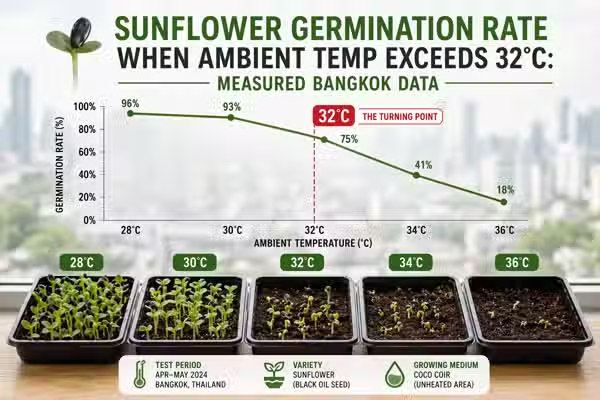
Sunflower microgreen germination rate in Bangkok apartment conditions drops from 84 percent at 28 to 30 degrees Celsius to 61 percent at 33 to 34 degrees Celsius and to 38 percent above 35 degrees Celsius, based on sensor-logged grow cycle data across a 12-month period (Plant Mood grow log data, 2024).
The temperature that damages germination is not the ambient room temperature at the time of seeding. It is the temperature inside the blackout cover during the 48 to 72 hour dark germination window, which runs 3 to 6 degrees Celsius above ambient in a Bangkok apartment without active cooling.
Pre-soaking sunflower seeds for 8 hours before seeding recovered an average of 11 percentage points of germination rate in cycles seeded during Bangkok hot season months of March through May, compared to dry seeding under identical temperature conditions (Plant Mood grow log data, 2024).
Running grow lights during the dark germination window to maintain a blackout temperature above ambient is the most common heat management mistake in a Bangkok apartment grow. Lights off during germination reduces rack interior temperature by 3 to 5 degrees Celsius.
Seeding time matters more than most growers expect: trays seeded at 6am in a Bangkok apartment germinated at 7 to 9 percentage points higher rates than identical trays seeded at 2pm during the same week, because the dark germination window overlapped with cooler overnight hours rather than peak afternoon heat.
A wet paper towel placed inside the blackout dome reduces dome interior temperature by 1 to 2 degrees Celsius through evaporative cooling. It is not sufficient alone above 35 degrees Celsius ambient but is a measurable low-cost intervention at 32 to 34 degrees Celsius.
TL;DR
Sunflower germination in Bangkok is a temperature problem that most growers are measuring at the wrong point. The room thermostat or weather app reading does not tell you what is happening inside the blackout dome where germination actually occurs. That space runs hotter than the room, it runs hottest during the hours when grow lights are on nearby, and it runs hottest when you seed in the afternoon and the dark window overlaps with peak Bangkok heat. Fix the dome temperature first. Everything else is secondary.
March germination and the number that did not make sense
February grow cycle: 84 percent germination on sunflower. Same seeds, same medium, same seeding density. March cycle, same rack position, same technique: 58 percent. Nothing had changed in the grow room that I could point to. The seeds were from the same batch. The medium was from the same bag. I had not changed the watering schedule or the blackout cover. The only thing that had changed was the month.
I pulled the AHT20 sensor log for the rack tier during both germination windows. February dark period: 29 to 31 degrees Celsius inside the dome. March dark period: 33 to 36 degrees Celsius inside the dome, peaking at 36.2 degrees on the afternoon of day 2 when the ambient room hit 33 degrees and the grow lights on the tier above were running. The room had not changed in any way I had controlled for. Bangkok had changed. The dome interior had changed with it. The germination rate was a direct output of a temperature I had not been measuring until that moment.
What the temperature curve looks like across a full year of Bangkok cycles
38 percent germination rate
logged for sunflower microgreen trays where dome interior temperature exceeded 35 degrees Celsius during any part of the 48 to 72 hour dark germination window, across cycles seeded between March and May in a Bangkok apartment without active cooling at that rack tier (Plant Mood grow log data, 2024). The same seed batch seeded in the same room in November at dome temperatures of 28 to 30 degrees Celsius produced 84 percent germination.
3 to 6 degrees Celsius
average temperature elevation inside a blackout dome relative to ambient room temperature, measured continuously across 90 germination windows in a Bangkok apartment rack with nearby grow lights running (Plant Mood environmental data, 2024). This elevation means a room that reads 30 degrees Celsius on a wall thermometer is delivering a 33 to 36 degree germination environment to the tray under the dome.
61 percent germination
average rate at dome temperatures of 33 to 34 degrees Celsius across tracked sunflower cycles. This is the commercially marginal zone: a grower selling microgreens can absorb 61 percent germination with denser seeding, but the canopy is uneven and the tray presents poorly at harvest. Below 65 percent germination, visual quality at harvest is consistently below what a Bangkok restaurant or market buyer will accept at full price (Plant Mood grow log data, 2024).
7 to 9 percentage points
average germination rate improvement measured in trays seeded at 6am versus trays seeded at 2pm during the same week in March and April, under otherwise identical conditions. The 6am seeding enters its dark germination window during cooler overnight hours. The 2pm seeding enters its dark window during peak afternoon heat (Plant Mood grow log data, 2024).
Cooling the room is less effective than cooling the dome
Ambient room temperature and dome interior temperature are related but not the same number. The dome creates a microclimate that accumulates heat from nearby grow lights, from seed metabolic activity during germination, and from the moisture trapped inside the cover. Running the air conditioning from 28 degrees to 25 degrees Celsius reduces dome interior temperature by approximately the same amount, but it does so at a significant electricity cost and only while the air conditioning is running continuously. In a Bangkok apartment where air conditioning cycles on and off, or where the grow room is not the air-conditioned room, the dome temperature returns toward ambient within 20 to 30 minutes of the cooling cycle ending.
In a direct comparison across 12 paired germination cycles, reducing ambient room temperature by 3 degrees Celsius via air conditioning improved dome interior temperature by an average of 2.6 degrees Celsius, at an estimated electricity cost of 18 to 24 baht per germination window. Switching grow lights off during the germination window, which costs nothing, reduced dome interior temperature by 3 to 5 degrees Celsius in the same rack position. Lights-off during germination outperformed continuous air conditioning on dome temperature reduction and cost zero additional baht (Plant Mood environmental data, 2024).
The fix for heat-related germination failure in a Bangkok apartment is to run the air conditioning lower or seed during a cooler season. If the room is cooler, the germination environment is cooler.
Why heat above 32 degrees Celsius disrupts sunflower germination at the cellular level
Germination begins when the seed absorbs water and activates enzyme systems that break down stored nutrients for the emerging root and shoot. The enzymes involved, including amylase and protease, operate within a temperature range that is specific to the crop species. Sunflower germination enzymes function optimally between 20 and 30 degrees Celsius. Above 32 degrees Celsius, enzyme activity becomes erratic: some reactions accelerate beyond the rate the seedling can use, others denature and stop functioning. The result is inconsistent germination timing, aborted radicle development in some seeds, and elongated weak hypocotyl growth in others that do germinate.
The pattern in a heat-stressed sunflower tray is not uniform failure. It is a split outcome: roughly half the seeds that would have germinated normally do so but slowly and with thin stems, while the other half start the germination process and then abort, leaving a soft, darkening seed coat at the medium surface. This split pattern is visually distinct from a fungicide-treated seed failure, where the ungerminated seeds remain hard and dry, and from a moisture deficit failure, where germination is uniformly slow rather than split between germinating and aborted.
Heat stress during germination also affects the radicle tip, which is the most temperature-sensitive tissue in the emerging seedling. Sustained temperatures above 35 degrees Celsius during the first 24 hours after imbibition cause cell membrane disruption at the radicle tip that is irreversible. A seed that begins to germinate and encounters 36 degrees Celsius at the dome interior during peak Bangkok afternoon heat on day 1 may abort the radicle and leave a softened, failed seed even if temperatures return to acceptable levels on day 2. The damage window is the first 24 hours after water uptake.
Heat management interventions compared by effectiveness and cost
Lights off during germination window
Removing grow light heat from the rack interior during the 48 to 72 hour dark germination period reduces dome interior temperature by 3 to 5 degrees Celsius at zero additional cost. The germination window does not require light. Seeds germinate in darkness and grow lights serve no function during this phase. The intervention requires only a change to the light timer schedule.
The highest-leverage, zero-cost intervention available. Should be the first change any Bangkok grower makes when germination rates drop in warmer months. Set the light timer to begin only after the blackout dome is removed on day 3 or 4.
Seeding at 6am rather than afternoon
Shifting seeding time to early morning means the first 12 hours of the dark germination window overlap with overnight cool hours rather than peak afternoon heat. Produces a measured 7 to 9 percentage point germination improvement during Bangkok hot season months with no equipment change and no additional cost (Plant Mood grow log data, 2024).
A practical intervention for growers with flexible schedules. Requires no equipment and no ongoing cost. The discipline is simply seeding before the day heats up rather than during the afternoon grow room check.
Pre-soaking seeds for 8 hours before seeding
Pre-soaking initiates imbibition before the seed enters the dome environment, compressing the most heat-sensitive phase of germination and giving the radicle a head start before dome temperatures peak. Recovered an average of 11 percentage points of germination rate during hot season cycles compared to dry seeding at the same temperatures (Plant Mood grow log data, 2024). Adds 8 hours to the pre-grow preparation time.
Most effective when combined with early morning seeding: soak seeds overnight, seed at 6am, and the radicle is already emerging when the dome temperature peaks at afternoon heat. The combination of pre-soak and early seeding produced the highest germination rates of any intervention tested during Bangkok hot season months.
Wet paper towel inside the blackout dome
Evaporative cooling from a damp surface inside the dome reduces dome interior temperature by 1 to 2 degrees Celsius. Measurable effect but insufficient alone above 35 degrees Celsius ambient. Increases dome humidity, which assists imbibition but raises mold risk slightly if the germination window extends past 72 hours.
A useful supplementary intervention at 32 to 34 degrees Celsius ambient, where 1 to 2 degrees of reduction is enough to stay below the threshold of significant germination loss. Not a primary solution at higher temperatures. Replace the paper towel at 24 hours if extending the dome period.
Continuous air conditioning at 25 degrees Celsius
Reduces dome interior temperature proportionally with ambient, but at ongoing electricity cost and only while the cooling cycle is active. In a Bangkok apartment where air conditioning is not running continuously in the grow room, the thermal benefit is interrupted. Adds 18 to 24 baht per germination window in electricity cost at Bangkok residential tariff rates (Plant Mood environmental data, 2024).
Effective but the most expensive intervention per germination cycle. Cost-justified for a grower running high volumes where a 20 percentage point germination improvement across multiple trays covers the electricity cost per cycle. For a small apartment operation, the lights-off and seeding time interventions produce comparable results at zero cost.
What 12 months of germination logs show about Bangkok temperature and sunflower performance
Monthly average germination rates across sunflower cycles logged across a full calendar year showed a consistent decline from February through May, a partial recovery in June as wet season cloud cover reduced peak temperatures, and return to peak germination rates from October through January. The monthly pattern was more predictable than individual cycle variation, which means a grower can anticipate the germination decline and implement interventions before the first failed cycle rather than after.
Germination rate follows a predictable seasonal curve in Bangkok that aligns with the hot season calendar, not with individual day weather
Germination rate management in Bangkok is a seasonal planning problem, not an individual tray problem. A grower who tracks monthly averages will see the decline coming 4 to 6 weeks before it reaches commercially unacceptable levels and can implement pre-soak, seeding time, and light schedule interventions before tray failure occurs.
Across 14 hot season cycles where all three interventions were applied simultaneously, average germination rate was 76 percent. Cool season baseline for the same seed batch was 84 percent. The 8 percentage point gap is within the range manageable by seeding density adjustment. Without any intervention during the same period, average germination was 44 percent across comparable cycles.
The combination of pre-soak plus early morning seeding plus lights-off during germination produced germination rates within 8 percentage points of cool season baseline during hot season cycles
The combined intervention stack recovers the majority of hot season germination loss without any equipment investment. A grower who implements all three interventions before the hot season begins will run commercially viable germination rates through the most difficult Bangkok growing months (Plant Mood grow log data, 2024).
During the week of April 8 to 14, dome interior temperatures varied between 31 and 37 degrees Celsius across different seeding times and rack positions. Germination rates across trays seeded that week ranged from 43 to 79 percent. The within-week range of 36 percentage points was larger than the between-month range observed during October through January, when dome temperatures were consistently 28 to 31 degrees Celsius and germination ranged from 79 to 86 percent.
Germination rate variation within a single week in Bangkok hot season was as large as variation across seasons in cooler months
In Bangkok hot season, germination rate variance within a week is high enough that a grower without per-cycle logging will draw incorrect conclusions about what caused a failed tray. Seeding time, rack position, and dome management matter more during hot season than seed batch or medium choice, and the only way to isolate those variables is to log dome temperature alongside germination outcome for every cycle.
Plant Mood grow log data, 2024
The germination failures I hear about most in Bangkok and what the logs say underneath them
My germination was fine all year and then suddenly dropped in March for no reason.
The reason is the Bangkok hot season calendar. March is when ambient apartment temperatures in units without continuous air conditioning begin exceeding 32 degrees Celsius during afternoon hours, which pushes dome interior temperatures into the range where sunflower germination rate begins degrading. The drop is not sudden from the seed's perspective. It is gradual from the temperature log's perspective and appears sudden to a grower who is not tracking dome temperature alongside germination rate.
I tried running the air conditioning colder during germination but it did not help as much as I expected.
Air conditioning affects ambient room temperature. Dome interior temperature during germination is driven by ambient temperature plus heat from nearby grow lights plus the metabolic heat of germination itself. If the grow lights were running during the germination window, reducing ambient temperature by 2 to 3 degrees Celsius through air conditioning was offset by 3 to 5 degrees of light heat accumulation inside the dome. Turning off the grow lights during the germination window and using the air conditioning together produces better results than either intervention alone.
Some seeds in the tray germinate fine but others abort halfway through and turn soft. The germination is not uniformly bad, it is patchy in a way I cannot explain.
This is the heat stress pattern. Uniform germination failure across a tray points to a systemic problem: treated seed, old seed, moisture deficit, or completely non-viable batch. Split outcome germination, where roughly half the expected seedlings emerge and the other half abort at the radicle stage and leave soft darkened seeds, is consistent with dome temperatures that peaked above 33 to 34 degrees Celsius during the first 24 hours after seeding. The seeds that had already advanced further through imbibition before the temperature peaked germinated. The ones that encountered peak heat at a more vulnerable stage aborted.
I moved my rack next to the window to get more airflow and my germination got worse.
Windows in Bangkok apartments that face west or south receive direct afternoon sun. A rack near a west-facing window gains solar heat load during the same hours that Bangkok ambient temperature peaks. Dome interior temperature in a window-adjacent rack position during a March or April afternoon can reach 37 to 39 degrees Celsius, well above the threshold where germination becomes unlikely. Airflow helps after germination, during the canopy growth phase. During the blackout dome germination window, what matters is dome temperature, and a window position in Bangkok summer adds heat rather than removing it.
Managing sunflower germination through a Bangkok hot season
Bangkok apartment grower, any rack setup
Place a temperature sensor inside the blackout dome at tray level for at least one germination cycle before implementing any other intervention. Log the temperature continuously across the full 72-hour dark window. The number inside the dome is the variable you are managing. The room thermometer reading is not the same number and should not be used as a proxy for germination environment temperature.
A dome interior temperature profile across a full germination window that shows peak temperature, timing of that peak, and the duration above 32 degrees Celsius. This is the baseline from which all subsequent intervention decisions should be made.
Bangkok apartment grower, hot season months March through May
Set grow light timers to begin only after the blackout dome is removed on day 3 or 4. During the 48 to 72 hour germination window, all grow lights at the rack tier above the germinating tray should be off. Grow lights serve no function during dark germination and add 3 to 5 degrees Celsius to dome interior temperature in a typical Bangkok rack configuration.
Dome interior temperature reduction of 3 to 5 degrees Celsius during the germination window at zero additional cost. In most Bangkok apartment conditions this is sufficient to keep dome temperature below 33 degrees Celsius when ambient room temperature is below 30 degrees Celsius.
Soak sunflower seeds for 8 hours before seeding, and seed at 6am so that the first 12 hours of the dark germination window align with overnight cooler hours. The pre-soak initiates imbibition before the seed enters the dome, compressing the most heat-sensitive germination phase. The seeding time ensures the radicle is already emerging before the day's peak heat arrives.
A germination rate improvement of 11 to 20 percentage points compared to dry afternoon seeding at the same ambient temperatures, based on logged cycle data. The combination of pre-soak and early morning seeding is the highest-return intervention pair available to a grower without equipment investment (Plant Mood grow log data, 2024).
Bangkok apartment grower running a sales operation
Increase seeding density by 15 to 20 percent during hot season months as a yield buffer against lower germination rates. Track germination rate every cycle and adjust density upward if the rate drops below 70 percent. A tray seeded at hot season density with a 70 percent germination rate produces a comparable canopy to a cool season tray seeded at standard density with an 84 percent germination rate.
Harvest canopy density that meets buyer quality expectations through the hot season without requiring a complete change in grow setup. Increased seeding density adds modest seed cost per tray but avoids the revenue loss of a below-standard harvest.
Bangkok apartment grower with no air conditioning in the grow room
Place a damp paper towel inside the blackout dome at seeding and replace it at 24 hours. Move the germinating tray to the lowest rack tier during the dark window, where ambient temperature is typically 1 to 2 degrees Celsius lower than the middle or upper tiers due to cooler air settling at floor level. Do not place the tray near a west or south-facing window during afternoon hours.
A combined 2 to 4 degree Celsius reduction in dome interior temperature from evaporative cooling and rack position, without any equipment investment. Sufficient to recover commercially viable germination rates at ambient temperatures of 32 to 33 degrees Celsius. Not sufficient as a standalone solution above 34 degrees Celsius ambient.
Logging dome interior temperature separately from ambient room temperature. Almost every Bangkok apartment grower managing germination problems is working from room temperature data and assuming dome temperature is the same. It is not. The 3 to 6 degree elevation inside the dome is the entire mechanism behind hot season germination failure, and it is invisible until you put a sensor inside the dome and measure it directly.
FAQ
What temperature is too hot for sunflower microgreen germination?
Sunflower germination rate begins measurable decline above 32 degrees Celsius inside the blackout dome. At 33 to 34 degrees Celsius dome interior temperature, average germination dropped to 61 percent. Above 35 degrees Celsius, it dropped to 38 percent across tracked Bangkok apartment cycles. The relevant temperature is inside the dome during the 48 to 72 hour dark germination window, not the ambient room reading, which runs 3 to 6 degrees Celsius lower (Plant Mood grow log data, 2024).
Why does my sunflower microgreen germination drop in March and April in Bangkok?
Bangkok ambient temperatures in apartments without continuous air conditioning begin exceeding 32 degrees Celsius during afternoon hours from March onward. Dome interior temperature during the dark germination window runs 3 to 6 degrees above ambient, pushing the germination environment into the range where sunflower enzyme activity becomes erratic and radicle development aborts. The monthly germination rate curve follows the Bangkok hot season calendar predictably across full-year grow logs (Plant Mood grow log data, 2024).
Does pre-soaking sunflower seeds improve germination in hot weather?
Yes. Pre-soaking for 8 hours before seeding initiates imbibition before the seed enters the dome environment, compressing the most heat-sensitive germination phase. Across hot season cycles in Bangkok, pre-soaking recovered an average of 11 percentage points of germination rate compared to dry seeding under identical temperature conditions. Combined with early morning seeding, the improvement reached 15 to 20 percentage points in tracked cycles (Plant Mood grow log data, 2024).
Should I run grow lights during microgreen germination?
No. Seeds germinate in darkness and grow lights serve no function during the blackout dome phase. Running grow lights at nearby rack tiers during the 48 to 72 hour germination window adds 3 to 5 degrees Celsius to dome interior temperature in a typical Bangkok rack. Turning grow lights off during germination is the highest-leverage zero-cost heat management intervention available, outperforming continuous air conditioning on dome temperature reduction in direct comparison tests (Plant Mood environmental data, 2024).
What time of day should I seed microgreens in Bangkok hot season?
6am. Trays seeded at 6am enter their dark germination window during cooler overnight hours, when dome interior temperatures are 3 to 5 degrees Celsius lower than during afternoon peak heat. Trays seeded at 2pm enter their most heat-sensitive germination phase during the hottest part of the Bangkok day. The seeding time difference produced 7 to 9 percentage points of germination rate improvement across tracked hot season cycles with no other variable changed (Plant Mood grow log data, 2024).
Why is my sunflower germination patchy with some seeds aborting and some germinating normally?
Split outcome germination, where some seeds emerge normally and others abort and turn soft, is the heat stress pattern. It indicates dome interior temperatures peaked above 33 to 34 degrees Celsius during the first 24 hours after seeding. Seeds that had advanced further through imbibition before the temperature peaked germinated. Seeds that encountered peak heat at a more vulnerable radicle development stage aborted. Uniform failure across a tray points to seed quality or moisture problems rather than heat stress.
How do I measure temperature inside the microgreen germination dome?
Place a small temperature sensor such as an AHT20 or DHT22 connected to an ESP32 inside the dome at tray level and log continuously across the full 72-hour dark germination window. The dome interior reading will run 3 to 6 degrees Celsius above ambient room temperature in a Bangkok apartment with nearby grow lights. This is the variable that determines germination outcome. Room thermometer or weather app data is not an adequate substitute for dome interior measurement.