Key takeaways
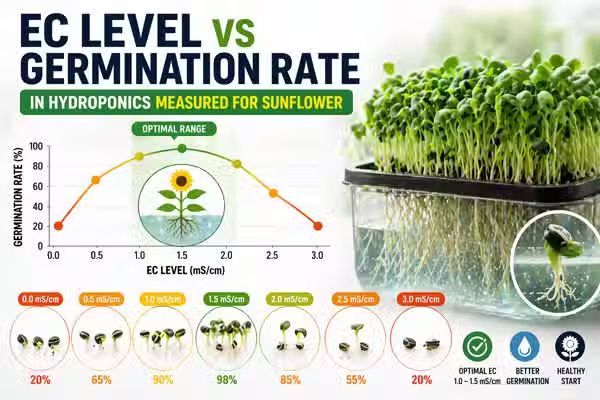
Sunflower germination in hydroponic systems held above 90 percent at EC 0.8 and EC 1.2 mS/cm across repeated tray cycles in Bangkok conditions. At EC 1.6, germination dropped to an average of 74 percent. At EC 2.0, it fell to 51 percent. Plant Mood grow log data, 2024.
The failure signal at high EC is not a germination count -- it is hull adhesion. Seeds that germinate at EC 2.0 show significantly higher rates of hull stuck to the cotyledon, which indicates the seed coat softened incompletely during imbibition. This appears on day 2, before the full germination picture is clear.
Bangkok humidity amplifies EC stress during germination because seeds absorbing solution in high-humidity conditions absorb more liquid faster, increasing the effective osmotic load on the embryo compared to the same EC in a lower-humidity environment.
EC 1.2 mS/cm is the practical ceiling for sunflower germination in Bangkok hydroponic conditions. EC 0.8 produces marginally better uniformity but the difference from 1.2 is small enough that starting at 0.8 and stepping up post-germination is the more useful protocol than trying to hold 0.8 across the full cycle.
Germination rate and germination uniformity diverge at elevated EC. At EC 1.6, the seeds that do germinate spread across a wider window -- first sprouts appearing at 36 hours and laggards still pushing at 72 hours -- which creates a tray with uneven development that is harder to harvest cleanly.
TL;DR
Sunflower seeds in hydroponics are not uniformly tolerant of EC up to the point where they fail. The drop-off is sharp, it starts lower than most guides suggest, and in Bangkok humidity it starts earlier than the germination count will tell you. Hull adhesion on day 2 is the real signal. EC 1.2 is about as high as you want to go at the germination stage, and if you are starting seeds into nutrient solution rather than plain water, you are already making a choice that costs you uniformity.
The tray that germinated fine until it didn't
I had been running sunflower trays in the NFT channel at EC 1.6 for three cycles without obvious problems. Germination looked acceptable -- not great, but not a failure. Then I started counting properly instead of eyeballing. Cycle four: 68 percent germination by day three. Cycle five: 71 percent. Cycle six, which ran during a hot week in March with ambient sitting at 34 degrees Celsius: 61 percent. The seeds that did push through were uneven. Some cotyledons were clean and open by 48 hours. Others were still stuck at 72 hours, hulls clamped on like they had been glued. I was pulling them by hand, which is not a scalable operation when you have 200 seeds per tray.
I pulled the EC down to 1.2 for the next cycle. Same seed batch, same tray depth, same ambient temperature. Germination came in at 88 percent on day three. Hull adhesion dropped to isolated cases I could count on one hand. The difference was not subtle. I had been running a protocol that was costing me roughly 20 to 30 seeds per tray, every cycle, and blaming it on seed quality.
The chart that gets quoted without being questioned
Sunflower seeds can germinate successfully in hydroponic nutrient solution at EC levels up to 2.0 or even 2.5 mS/cm because they are a salt-tolerant crop -- hardier than sensitive varieties like basil or lettuce -- so high EC at germination is not a concern.
Salt tolerance in a mature sunflower plant does not transfer to the germinating seed. The embryo at imbibition stage is doing something fundamentally different from a plant managing osmotic pressure through developed roots and stomata. It is absorbing solution directly through the seed coat, and that process is sensitive to osmotic concentration in a way that the three-week-old plant in your garden is not. The tolerance figures cited in most hydroponic guides are drawn from vegetative growth studies or field germination research in soil, where the osmotic environment around the seed is buffered by the growing medium in ways that a hydroponic channel is not.
Across six tray cycles tracked at EC 2.0 in Bangkok conditions, average germination landed at 51 percent with high variance between cycles -- ranging from 44 percent to 61 percent. The variance is itself a signal. A crop that handles a condition well does not produce inconsistent results under consistent inputs. Inconsistency at EC 2.0 indicates the seeds are operating near a threshold, not comfortably below it. Plant Mood grow log data, 2024.
The seeds that germinate at high EC are not the healthy ones
Germination rate counts sprouts. It does not measure the quality of the germination event or what the seedling looks like 48 hours later. At EC 2.0, the seeds that push through first tend to be the largest ones with the most stored energy -- they can overcome the osmotic resistance because they have more reserves to draw on. The smaller seeds in the same batch, which in a healthier environment would germinate only slightly later and produce a reasonably uniform tray, either fail to germinate or push through late and stunted. So the tray at EC 2.0 is not just low germination -- it is also a biased sample of the seed batch, heavily weighted toward the largest seeds. If you then look at that tray and think the survivors look reasonable, you are looking at a selected subset, not a representative outcome.
At EC 1.2, the spread between first germination and last germination on a tray was typically 18 to 24 hours. At EC 2.0, that spread widened to 36 to 48 hours, with some seeds still moving at 72 hours. A tray with a 48-hour germination spread is almost impossible to harvest uniformly because the earliest sprouts are already elongating past ideal cut height while the late ones are still pushing. The EC effect on germination uniformity is, in practical terms, a bigger problem than the rate drop. Plant Mood grow log data, 2024.
If a seed germinates, it handled the condition. The germination rate is the relevant measure and anything that makes it through is fine.
What the germination numbers look like across the four EC levels
Germination rate dropped from 91 percent at EC 1.2 to 51 percent at EC 2.0 -- a 40-percentage-point fall across a 0.8 mS/cm increase
Plant Mood grow log data, 2024. Averaged across six tray cycles per EC level, same sunflower seed batch, Bangkok ambient conditions, NFT channel delivery. The drop is not gradual. EC 0.8 and EC 1.2 produced similar results. EC 1.6 was the first level where the tray looked visibly different at day three. EC 2.0 looked like a partial failure.
EC 0.8: 93 percent average germination, hull adhesion in fewer than 4 percent of germinated seeds
Plant Mood grow log data, 2024. The cleanest germination across all tested levels. Cotyledons opened uniformly between 36 and 54 hours. The practical disadvantage is that EC 0.8 means the seedlings are in near-plain water for the first 48 to 72 hours, which is fine but creates an extra step if you want to transition to a higher-EC vegetative solution.
EC 1.2: 91 percent average germination, hull adhesion in approximately 7 percent of germinated seeds
Plant Mood grow log data, 2024. Statistically close to EC 0.8. The 2-percentage-point germination difference is within the noise range across cycles. EC 1.2 is the level that behaves like 0.8 but does not require a solution change after germination for most sunflower grow protocols.
EC 1.6: 74 percent average germination, hull adhesion in 23 percent of germinated seeds
Plant Mood grow log data, 2024. This is the level where the tray starts costing real yield. Hull adhesion at 23 percent means roughly one in four germinated seeds needs intervention or will develop with distorted cotyledons. If you are running a commercial tray, that is not a minor cosmetic issue.
EC 2.0: 51 percent average germination across six cycles, with cycle-to-cycle variance ranging from 44 to 61 percent
Plant Mood grow log data, 2024. The variance across cycles at EC 2.0 is as notable as the average. Consistent inputs produced inconsistent outputs, which is characteristic of seeds operating near or above their osmotic tolerance ceiling.
What the trays showed that the germination count did not
Germination count is typically assessed at 48 to 72 hours. Hull adhesion is visible at 36 to 48 hours, when the cotyledons are just emerging. At EC 1.6 and above, seeds that do germinate show the hull clamped onto one or both cotyledons at a rate that is clearly higher than at EC 0.8 or 1.2. The hull is softened by moisture during imbibition, and when the osmotic concentration of the solution slows water uptake, the seed coat does not soften as fully or as fast. The cotyledon pushes through but the hull comes with it.
Hull adhesion rate is an earlier and more sensitive indicator of EC stress than germination count
Hull adhesion gives you an actionable signal on day 2. Germination count gives you a final answer on day 3. If you are monitoring hull adhesion and see rates above 15 percent, you know before the final count that the EC is too high for this seed batch in these conditions. That is 24 hours of lead time that the germination count does not offer.
Comparing cycles run at EC 1.6 during September (ambient RH averaging 78 percent) against cycles run at the same EC in March (ambient RH averaging 54 percent), the March cycles showed 9 to 11 percentage points lower germination on average. The seed batch was identical. The likely mechanism is that lower ambient humidity reduced surface moisture around the seeds during the critical early imbibition window, increasing the effective osmotic load at the seed-solution interface.
The EC effect on germination was more pronounced during Bangkok dry season than during wet season
The EC tolerance ceiling for sunflower germination is not a fixed number. It moves with ambient humidity. A protocol that works at EC 1.6 in October may not hold at EC 1.6 in March. This is not mentioned in any germination guide I have found that covers sunflower in hydroponics. The guides give a number. The number changes with the season.
A pre-soak in plain water or EC 0.3 solution before placing seeds in the channel allowed the seed coat to begin softening before encountering the higher-concentration solution. Germination rate across three cycles using this method at EC 1.6 averaged 84 percent versus 74 percent for seeds placed directly into EC 1.6. Hull adhesion also dropped -- from 23 percent to approximately 12 percent of germinated seeds.
Seeds soaked in plain water for 4 hours before introduction to EC 1.6 solution showed germination rates closer to the EC 1.2 baseline
If the grow protocol requires EC 1.6 at germination -- for example, because the system does not allow easy solution changes between germination and vegetative phases -- a plain-water pre-soak is a practical intervention that partially offsets the osmotic stress. It does not fully recover the EC 1.2 outcome but it narrows the gap meaningfully.
Plant Mood grow log data, 2024
Why high EC damages germination at the seed level
Germination begins with imbibition -- the seed absorbing water to rehydrate the embryo and activate the enzymes that start cell division. The rate and completeness of imbibition depends on the osmotic gradient between the inside of the seed and the solution surrounding it. A seed at rest has a very high internal solute concentration; clean water moves into the seed rapidly because the gradient is steep. As the surrounding solution concentration increases -- meaning as EC rises -- the osmotic gradient flattens. The seed still absorbs water, but more slowly and less completely. At moderate EC levels this produces a slightly slower germination event. At higher EC levels it produces incomplete softening of the seed coat, slower radicle emergence, and in the worst cases a germination event where the embryo activates but cannot fully exit the seed coat before its energy reserves are exhausted.
The hull adhesion problem is a direct expression of this mechanism. The seed coat of a sunflower is relatively thick compared to smaller-seeded crops. It needs substantial moisture uptake to soften enough for the cotyledons to push through cleanly. At EC 2.0, the imbibition is incomplete enough that the coat softens partially but not fully -- it stays attached to the emerging cotyledon rather than splitting and falling away. The cotyledon then carries the hull into the light stage, where it either falls off if conditions are humid and the cotyledon continues expanding, or clamps permanently as the tissue dries slightly. In Bangkok dry season, with lower ambient humidity, the hull clamps. In wet season, it sometimes falls away on its own, which is why the problem looks worse in dry season even at the same EC.
Osmotic potential in the germination environment is calculated as the negative of the osmotic pressure the solution exerts. EC is a proxy for total dissolved solute concentration, not a direct measure of osmotic potential, because different solutes contribute differently to osmotic pressure per unit of EC. A solution at EC 1.6 mS/cm using a calcium-nitrate-heavy nutrient formula exerts slightly different osmotic pressure than the same EC from a balanced hydroponic mix. For practical germination management, treating EC as a direct proxy for osmotic stress is accurate enough -- but growers switching between nutrient formulas should recalibrate rather than assume EC readings are directly comparable across different salt profiles.
The complaints that are actually EC complaints in disguise
My sunflower seeds keep germinating unevenly. Some are up by day two and others are still sitting there on day four.
Germination spread this wide is almost always an osmotic stress problem, not a seed quality problem. At EC levels above 1.4 mS/cm, the smallest seeds in the batch -- which have less stored energy to overcome osmotic resistance -- lag the larger seeds by 24 to 48 hours. The tray looks like a bad seed batch. It is usually a high-EC problem. Drop to EC 1.2 or below for germination and check whether the spread tightens. If it does, the seeds were fine.
I get hulls stuck on my sunflower cotyledons no matter how much I mist them. Everyone says misting fixes it but it doesn't work for me.
Misting addresses hull adhesion that is caused by insufficient surface humidity during the light stage. But hull adhesion caused by incomplete imbibition during germination -- which is the EC mechanism -- is different. The hull did not stick because it dried out after emergence. It stuck because it never fully softened during the germination event itself. Misting the already-emerged cotyledon after the fact cannot undo an incomplete imbibition. You can sometimes work the hull off manually, but the fix is at the germination stage: lower EC, not more misting post-emergence.
My germination rates are inconsistent cycle to cycle even when I use the same seed batch and the same protocol.
If the protocol includes a fixed EC that sits above 1.4 mS/cm, the inconsistency is probably seasonal. Higher EC interacts with lower ambient humidity during dry season to produce worse germination than the same EC in wet season conditions. The inputs feel identical because the EC reading is the same. The outcome differs because the effective osmotic stress on the seed is higher when ambient RH is lower. Growers who do not track ambient humidity alongside germination results have no way to see this pattern.
I switched to a more concentrated nutrient mix and now my germination is down. I thought more nutrients would help the seedlings.
Nutrient concentration above what the germinating seed can tolerate does not help seedling development -- it prevents complete germination in the first place. The seedling cannot use dissolved nutrients it cannot absorb through the seed coat. More nutrients in the solution do not benefit the embryo until after radicle emergence, when the seedling can begin taking up dissolved ions through root hairs. For the germination window, the nutrient solution concentration is a stressor, not a resource.
EC 0.8 versus EC 1.2 for sunflower germination: the practical tradeoff
Germinating at EC 0.8 mS/cm
Germination rate averages 93 percent with hull adhesion below 4 percent and a tight 36-to-54-hour emergence window. The cost is operational: if your system uses a single reservoir or channel for germination and early vegetative growth, you are running at a concentration that is too low for productive growth past day four or five. You need to step the EC up after germination, which either means a solution change or a separate germination tray. In an NFT system where the same channel feeds germination and vegetative phases, EC 0.8 creates extra handling.
Best choice if you have separate germination trays or a system that allows easy solution changes. The germination outcome is cleaner and the hull adhesion rate is low enough that it stops being a hands-on management task.
Germinating at EC 1.2 mS/cm
Germination rate at 91 percent is statistically indistinguishable from EC 0.8 across the cycles tracked. Hull adhesion at 7 percent is higher but manageable -- around 14 seeds per 200-seed tray, which is a minor intervention compared to the 46 seeds affected at EC 1.6. The advantage is that EC 1.2 is close enough to early vegetative targets that no solution change is required for the first week of growth in most sunflower protocols. The system stays at a single concentration across germination and early vegetative phases.
The better choice for most Bangkok growers running continuous NFT systems without separate germination infrastructure. The germination penalty versus EC 0.8 is real but small. The operational simplicity is real and significant.
Germinating at EC 1.6 mS/cm
Germination rate drops to 74 percent and hull adhesion climbs to 23 percent. The tray starts to look like a partial failure by day three. The seeds that germinate are biased toward larger seeds in the batch, which means the tray is not representative and the growth after germination is less uniform. In dry season conditions, the germination rate can drop further. There is no operational advantage to EC 1.6 at germination that justifies the yield cost.
Not recommended for the germination window. If a system constraint requires it -- for example, a system that cannot be adjusted mid-cycle -- use the plain-water pre-soak protocol to partially offset the osmotic stress. Accept that germination will be lower and hull adhesion will require manual intervention.
Germinating at EC 2.0 mS/cm
Average germination of 51 percent with high cycle-to-cycle variance. The tray is unreliable enough that it cannot be planned around. Some cycles will come in at 44 percent; others at 61 percent. Hull adhesion in the germinated seeds runs high enough that manual intervention is not optional. The seeds that fail to germinate represent direct cost -- lost seed, lost tray space, lost cycle time.
This is not a viable germination EC for sunflower in Bangkok conditions. The yield loss per tray at 51 percent germination, combined with the labour cost of hull management and the cycle-to-cycle unpredictability, makes it the worst-performing level across every metric tracked.
FAQ
What EC level is best for sunflower germination in hydroponics?
EC 1.2 mS/cm is the practical ceiling for sunflower germination in Bangkok hydroponic conditions. Across tracked cycles, EC 0.8 and EC 1.2 produced similar results -- 93 percent and 91 percent germination respectively -- while EC 1.6 dropped to 74 percent and EC 2.0 fell to 51 percent. EC 1.2 is the better operational choice because it is close enough to early vegetative targets that no solution change is needed after germination. Plant Mood grow log data, 2024.
Why are my sunflower hulls sticking to the cotyledons in hydroponics?
Hull adhesion in hydroponic sunflower is most commonly caused by incomplete imbibition during germination, which happens when the EC of the solution is too high. The seed coat does not fully soften when osmotic stress slows water uptake, so the hull stays attached as the cotyledon emerges. Misting after emergence does not fix this -- the problem is at the germination stage. Dropping EC to 1.2 or below at germination reduces hull adhesion significantly. At EC 1.6, roughly 23 percent of germinated seeds show hull adhesion; at EC 1.2, it drops to around 7 percent.
Does EC affect sunflower germination rate the same way in all climates?
No. In Bangkok conditions, the EC effect on germination is amplified during dry season (February to April) when ambient humidity drops to 50 to 60 percent. Lower humidity reduces surface moisture around seeds during imbibition, increasing the effective osmotic load. Cycles run at EC 1.6 during March showed 9 to 11 percentage points lower germination than cycles at the same EC during wet season months. A protocol that works at EC 1.6 in October may not hold in March. Plant Mood grow log data, 2024.
How do I tell early if EC is too high for my sunflower germination?
Check hull adhesion at 36 to 48 hours rather than waiting for the full germination count at 72 hours. Seeds germinating under high EC stress show the hull clamped onto the emerging cotyledon at higher rates than seeds in lower-EC solution. Hull adhesion rates above 15 percent on day 2 are a reliable early signal that EC is too high for the conditions. This gives approximately 24 hours of lead time before the final germination count confirms the problem.
Can I germinate sunflower seeds in full-strength hydroponic nutrient solution?
It depends on the concentration. At EC 1.2 mS/cm, germination held at 91 percent across tracked cycles -- close to the EC 0.8 baseline. At EC 1.6 and above, germination drops meaningfully: 74 percent at 1.6 and 51 percent at 2.0. Full-strength solutions for mature sunflower vegetative growth typically run EC 1.8 to 2.5, which is above the threshold where germination is reliable in Bangkok conditions. Starting seeds in full-strength solution will cost germination rate and uniformity.
Why are my sunflower germination rates inconsistent cycle to cycle?
If your germination EC is above 1.4 mS/cm, cycle-to-cycle inconsistency is likely seasonal. Lower ambient humidity during Bangkok dry season increases effective osmotic stress on seeds at the same EC level. A protocol that produced 68 percent germination in October may produce 55 percent in March using the same EC, seed batch, and system. Tracking ambient humidity alongside germination results is the only way to see this pattern. The fix is either dropping germination EC or adjusting the protocol seasonally.
Does soaking sunflower seeds before putting them in a hydroponic system help germination?
Yes, particularly when germination EC is above 1.2. A 4-hour pre-soak in plain water or EC 0.3 solution before placing seeds in an EC 1.6 channel raised average germination from 74 percent to 84 percent across three tray cycles, and reduced hull adhesion from 23 percent to approximately 12 percent. The pre-soak allows the seed coat to begin softening before encountering the higher-concentration solution. It does not fully recover the EC 1.2 outcome but narrows the gap meaningfully. Plant Mood grow log data, 2024.