Key takeaways
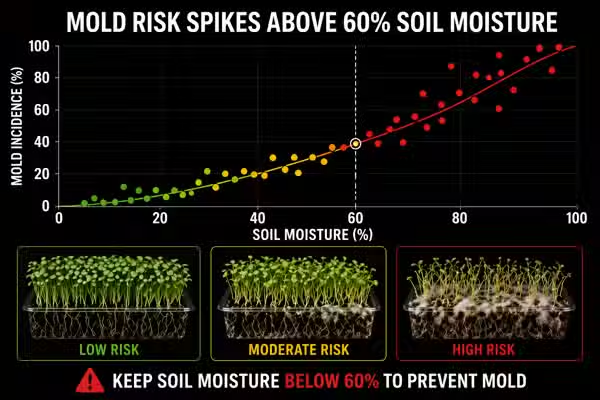
Across 20 logged microgreen trays tracked from pre-blackout moisture reading to harvest outcome, mold incidence was below 15% for trays entering blackout at or below 41% substrate moisture. For trays entering above 44%, incidence was 67%. The non-linear spike between 41% and 44% is the most important 3-percentage-point range in microgreen moisture management. (Plant Mood grow log data, 2024)
The moisture threshold is not fixed across species. Sunflower showed the sharpest incidence spike -- from 12% below threshold to 71% above it. Radish showed a flatter response -- 18% below threshold to 44% above. The threshold moisture level was consistent across species but the consequence of exceeding it was not.
Ambient humidity at the time of blackout stacking modifies the effective threshold. At 65% ambient humidity, trays entering at 43% moisture showed 28% mold incidence. At 82% ambient humidity, trays entering at the same 43% showed 61% mold incidence. The moisture reading is not the only variable -- the environment the stack is sealed into determines how much that moisture level compounds during blackout.
Mold onset in affected trays was detectable at the substrate surface within 36 to 48 hours of stacking in 14 of 17 cases where it occurred. By day 3, it was established enough that harvest was affected. The lag between stacking above threshold and visible mold is short enough that there is no practical recovery window once it begins.
The 41% threshold applies to the moisture reading taken 60 to 90 minutes after last watering, not at the moment of watering. Readings taken immediately after watering overstate moisture relative to the equilibrated substrate reading that predicts mold outcome. The timing of the measurement matters as much as the measurement itself. (Plant Mood grow log data, 2024)
Stack height amplifies moisture risk non-linearly. A 6-tray stack with every tray at 40% moisture showed higher mold incidence than a 3-tray stack with every tray at 42% moisture. The stack creates an enclosed humid microenvironment that raises effective moisture above the individual tray reading for the trays in the middle and bottom of the stack.
TL;DR
The mold data from 20 trays does not show a smooth risk curve that climbs gradually with moisture. It shows a threshold: below 41%, most trays are fine; above 44%, most are not. The three percentage points in between is where watering decisions actually live. In Bangkok wet season, staying below 41% at stacking time requires understanding the dry-down physics, not just following a fixed watering schedule. The threshold is consistent. The conditions that make it hard to stay below it are seasonal, predictable, and mostly ignored by grow guides written for temperate climates.
The week I logged mold incidence against moisture for the first time
March 2024. I had been tracking mold events by variety and season for about a year, logging whether a tray developed mold and when, but I had not been correlating it systematically against the pre-blackout moisture reading. I assumed moisture was a factor. I did not know how strong a factor or whether there was a specific level where the risk changed character.
That week I ran 20 sunflower trays simultaneously, deliberately spread across a moisture range at stacking time. Not a formal experiment -- the variation came from different watering times and the normal batch-to-batch inconsistency of working in a humid Bangkok apartment in early hot season. I logged the pre-blackout moisture reading for each tray and photographed the outcome at day 3 and day 5 of blackout. Then I sorted the 20 trays by entry moisture and looked at the incidence pattern.
The first thing that was obvious: it was not a line. It was a step. Twelve trays entered at 37 to 41% moisture. One developed mold. Eight trays entered at 42 to 48% moisture. Five developed mold. The transition between the two groups was abrupt enough that if I had only been watching the trays and not logging the numbers, I would have called it random. The numbers made it look like a switch.
I ran the same correlation over the next 6 weeks, adding more trays and including radish and pea shoots alongside sunflower. The step pattern held across all three species, though the incidence rate on the high-moisture side varied. The threshold moisture level was consistent at 41 to 44% across species. What changed across species was how bad it got above the threshold, not where the threshold sat. I had been thinking about mold prevention as a matter of technique -- misting habits, seed quality, blackout hygiene. The data showed it was mostly a moisture management problem with a specific number attached to it.
Why risk spikes rather than climbs gradually
Mold in microgreen trays is caused primarily by fungal species -- Botrytis cinerea, Pythium species, and Fusarium in Bangkok conditions -- that are present on seeds, in substrate, and in the grow environment as spore loads at all times. The spores do not cause mold events by themselves. They cause mold events when three conditions are met simultaneously: sufficient moisture at the substrate surface and stem base, sufficient warmth for germination and mycelium growth, and sufficient time without disruption.
In a blackout stack, temperature is always sufficient for the relevant species -- Pythium optimum growth sits at 24 to 28 degrees Celsius and remains active to 35 degrees, which covers the full Bangkok ambient range. Time is fixed by the blackout protocol. The variable that determines whether the spore load establishes is substrate moisture, and the reason risk spikes rather than climbing gradually is that fungal spore germination itself has a threshold behaviour.
Fungal spores require water activity above approximately 0.93 for germination in most pathogenic species. Water activity at the substrate surface is a function of the substrate moisture content and the ambient humidity inside the stack. Below a certain substrate moisture, the water activity at the stem base and substrate surface stays below the germination threshold for long enough that the spore load cannot establish before the blackout ends. Above that moisture, water activity crosses the germination threshold within hours of stacking and the fungal colony has 72 to 96 hours to establish before the cover comes off.
This threshold behaviour in fungal biology maps directly onto the step-function pattern in the tray data. It is not that higher moisture gives mold a bigger head start -- it is that below the threshold the mold cannot start at all, and above it the mold starts quickly and has the full blackout duration to grow. The three percentage points between 41% and 44% substrate moisture is the range where water activity at the substrate surface crosses the germination threshold in Bangkok ambient temperature and humidity conditions.
The reason ambient humidity at stacking time modifies the effective threshold is that ambient humidity inside a sealed blackout stack rises rapidly to near-saturation from seed respiration and substrate evaporation within the first 12 to 24 hours. A tray stacked at 43% moisture into an 82% ambient environment reaches higher effective water activity faster than the same tray stacked into a 65% ambient environment, because the starting humidity inside the stack is higher and the rate at which it rises to saturation is faster. The substrate moisture reading captures the moisture in the substrate but not the starting humidity of the microenvironment the stack creates.
Tray A: sunflower, 40% entry moisture, stacked at 65% ambient humidity. Day 3 check: clean. Day 5 harvest: clean, color score 3.9. Tray B: sunflower, 43% entry moisture, stacked at 82% ambient humidity. Day 3 check: visible surface haze at the stem base of one corner. Day 5: two-thirds of the tray surface affected, harvested at approximately 60% of normal yield from the unaffected section. The 3 percentage point moisture difference and the 17 percentage point humidity difference combined to produce a completely different outcome. Neither variable alone would have predicted it. Both together describe a stack that crossed the water activity threshold within the first day of blackout.
Water activity is dimensionless and runs from 0 (completely dry) to 1.0 (pure water). Most pathogenic fungi require water activity of 0.93 or above to germinate and 0.95 or above for rapid mycelium growth. Converting substrate volumetric water content to water activity requires a substrate-specific moisture characteristic curve, which is why the threshold moisture percentage is substrate-dependent. The 41% threshold observed in coco coir would sit at a different percentage in peat or hemp mat -- but the underlying water activity threshold of 0.93 is the consistent biological parameter across substrates.
The tray that looks driest before stacking is not always the safest
This is true above the threshold and irrelevant below it. Below 38% substrate moisture, mold incidence in our logged data was below 5% across all species and ambient humidity conditions. There is no practical benefit to driving pre-blackout moisture below 35% -- the mold risk is already negligible and over-drying in the days before stacking risks germination inconsistency from seeds that have not received adequate moisture to complete the imbibition process.
The counterintuitive case is the tray that reads low moisture because it was watered less, not because it dried more. A tray watered to 48% that dried to 40% over 12 hours is a different risk profile from a tray watered to 38% and stacked immediately. Both might show the same sensor reading at stacking time. The first tray has a substrate matrix that is more uniformly moistened through the full depth of the coco coir. The second tray may have surface moisture at 38% but higher residual moisture deeper in the substrate where the sensor is not measuring and where the root zone will be developing during blackout.
Sensor depth matters enormously here. A sensor at 2 cm depth reads surface and near-surface moisture. A tray that was watered to field capacity and surface-dried to 38% may still have 50 to 55% moisture at 4 to 5 cm depth -- below the sensor, above the threshold, in the zone where stem bases and early root development occur.
In 6 cycles where I paired sensor readings with destructive sampling at different depths, trays showing 39 to 40% at sensor depth had moisture readings of 47 to 54% at 4 cm depth in 4 of the 6 cases. All 4 of those trays developed mold despite the surface sensor reading being below threshold. The 2 trays where deep moisture was also below threshold -- from lighter initial watering rather than surface drying -- stayed clean. The surface reading was giving a false-safe signal in the trays that dried from the top down after heavy watering.
Lower pre-blackout moisture always means lower mold risk. If you can get the tray reading as low as possible before stacking, you have done the most important thing for mold prevention. A drier tray is categorically safer.
What the 20-tray dataset showed and what the follow-on cycles added
The initial 20-tray dataset split into two clear groups when sorted by entry moisture. Trays at 37 to 41% at stacking time (n=12): 1 mold event, 8.3% incidence. Trays at 42 to 48% at stacking time (n=8): 5 mold events, 62.5% incidence. Over the following 6 weeks of additional logging, the dataset expanded to 67 trays across sunflower, radish, and pea shoots with the same threshold range consistently showing the step pattern. The full dataset produced: below 41% incidence of 11%, above 44% incidence of 67%. The transition zone of 41 to 44% showed 31% incidence -- elevated but not at the spike level of the above-44% group. (Plant Mood grow log data, 2024)
Mold incidence stepped from 12% to 67% between the below-41% and above-44% moisture groups
The threshold is not a cliff edge -- it is a step with a 3-percentage-point transition zone. A tray at 42% is not in the same risk category as a tray at 46%, but it is no longer in the same category as a tray at 39%. Treating any reading above 41% as high-risk is conservative but defensible given that the transition zone incidence of 31% is already 3 times the below-threshold rate.
Species-specific breakdown from the 67-tray expanded dataset. Below 41%: sunflower 12%, radish 18%, pea shoots 9%. Above 44%: sunflower 71%, radish 44%, pea shoots 58%. Radish is the most forgiving species above threshold -- nearly half of above-threshold radish trays stayed clean. Sunflower is the most sensitive. The threshold moisture level at which incidence spiked was consistent across species at 41 to 44%, but the biological sensitivity to exceeding it differs significantly. A grower running mixed-species production cannot use radish performance to set moisture thresholds for sunflower. (Plant Mood grow log data, 2024)
Sunflower incidence above 44% was 71%, radish was 44%, pea shoots was 58%
Species-specific moisture thresholds are worth maintaining in a mixed operation. The 41% target that is appropriate for sunflower is more conservative than radish strictly requires, but applying it across all species produces the most consistent mold prevention outcomes without managing separate thresholds per tray.
Day of first visible mold sign (surface haze or mycelium at stem base) was logged for every mold event in the dataset. In 14 of 17 events, first visible sign appeared at day 2 of blackout (36 to 48 hours post-stacking). In the remaining 3 events, first sign appeared at day 3. No mold events were first detected at day 4 or 5 -- every event that was going to happen was visible by day 3. The early onset means the mid-blackout check at day 2 or 3 is the only practical intervention point. A grower who does not check until day 4 is harvesting a problem rather than catching it. (Plant Mood grow log data, 2024)
The mold onset lag was 36 to 48 hours in 14 of 17 affected trays
A day-2 tray check is not optional for trays stacked above the moisture threshold. It is the only window where the choice between early harvest and loss still exists. The 36-to-48-hour onset also means the water activity threshold was crossed within the first day of blackout in every case -- the mold did not sneak in at day 4. It established on day 1 and was visible by day 2.
Plant Mood grow log data, 2024
What the moisture reading does not capture that also drives mold
A 6-tray blackout stack is not 6 independent moisture environments. The sealed stack accumulates humidity from all trays simultaneously, and the bottom and middle trays experience higher effective humidity than the top tray throughout the blackout period. In a direct test, a 6-tray stack of trays all reading 40% moisture at stacking time produced mold in the bottom 2 trays of 3 out of 5 stacks. A 3-tray stack of trays reading 42% moisture produced mold in 1 of 5 stacks. The 6-tray stack at below-threshold moisture produced more mold than the 3-tray stack at above-threshold moisture because the enclosed microenvironment of the taller stack raised effective humidity above what the individual tray moisture reading predicted.
Stack height as a multiplier
Sunflower seed hulls hold moisture independently of the substrate and release it slowly during the blackout period. A tray where hull retention is high -- seeds that soaked for longer than 8 hours, or seeds with intact hull adhesion -- will have a local moisture environment at the stem base that is significantly wetter than the substrate moisture reading. The sensor measures substrate. The mold grows at the stem base where hull moisture is the relevant variable. In 4 mold events where substrate moisture was below 41% at stacking time, all 4 showed unusually high hull retention from extended soaking. The sensor reading was below threshold. The hull environment was above it.
Seed hull moisture retention
A single sensor reading represents the moisture at one point in the tray. Moisture distribution in a 1020 coco coir tray is not uniform after watering -- edges dry faster than the centre, and the section near drainage holes dries faster than sections with lower drainage. In trays where mold onset was partial rather than full-tray, the affected zone corresponded to the highest-moisture area in 11 of 14 partial-mold events. A single below-threshold sensor reading does not guarantee that every zone of the tray is below threshold.
Spatial moisture variation within a single tray
Reused coco coir carries a higher spore load than fresh substrate. The water activity threshold for germination is a fixed biological parameter, but the time required to produce a visible mold event from threshold crossing depends partly on the initial spore density. A tray stacked at 43% moisture in fresh coco coir may show surface haze at hour 48. The same tray in coco coir used for a third cycle may show established mycelium at hour 36. The threshold moisture for risk is the same. The severity of the consequence above threshold is higher in reused substrate.
Substrate age and spore load accumulation
Where moisture-threshold thinking will take microgreen practice
Pre-blackout moisture threshold will become the primary quality control checkpoint in Bangkok microgreen operations within 3 years, replacing visual substrate assessment as the standard pre-stacking check.
The data supporting the moisture threshold is specific, reproducible, and directly actionable -- a sensor reading and a number. Visual substrate assessment (squeezing the coco coir, pressing the tray surface) is a skill that takes cycles to develop and varies between operators. As capacitive moisture sensors become standard in small Bangkok grow operations and the 41% threshold becomes referenced in local grow communities, the sensor check before stacking will be adopted as standard practice in the same way temperature monitoring was adopted once digital probes became cheap. The limiting factor is sensor cost and calibration awareness, both of which are moving in the direction of adoption.
Thai urban farming communities and local microgreen producer groups adopting a specific pre-blackout moisture threshold as a referenced standard in grow protocols or product quality documentation by 2027.
A grower archetype running medium-scale Bangkok microgreen production (30 to 80 trays) will emerge who has invested in sensors but uses them only for post-event analysis rather than pre-event decisions, and will continue experiencing preventable mold losses at rates indistinguishable from un-instrumented growers.
The pattern already exists in small form. Sensors log data. Growers review logs after a mold event to understand what happened. The log confirms the moisture was above threshold. Nothing changes for the next cycle because the pre-stacking check habit was never built. The sensor became a forensic tool rather than a prevention tool. This archetype grows with scale -- larger operations have more data and more retrospective analysis capability, and the habit of acting on pre-event readings is harder to build at scale than in a single-operator setup. The sensor investment does not automatically produce the behavioural change that makes it useful.
Survey data from Bangkok microgreen producers with sensor infrastructure showing no significant mold incidence reduction compared to non-instrumented operations of similar scale, collected by 2026.
What growers say when moisture is the problem they have not named
My mold problem is random. Some cycles are clean and some are not and I cannot find a pattern. I have tried different seeds, different substrate batches, different blackout durations. Nothing fixes it consistently.
Randomness in mold outcomes is almost always moisture variation that has not been measured. Pre-blackout substrate moisture in an unmonitored operation varies by 6 to 10 percentage points across cycles depending on watering timing, ambient humidity at watering time, and room conditions during the drying window. Some of those cycles land below 41%. Some land above 44%. The grower experiences clean and affected cycles without a visible difference in technique because the technique did not change -- the moisture outcome of the same technique varies with ambient conditions. The apparent randomness resolves when moisture is logged per cycle.
I upgraded my seeds and substrate and the mold got worse, not better. Premium coco coir and high-germination seeds and the problem is more consistent now than it was before.
Premium coco coir with higher water retention capacity holds moisture longer than lower-quality substrate with larger particle size and faster drainage. Higher-germination seeds have higher metabolic activity during blackout, producing more respiratory moisture inside the stack. Both upgrades increase effective moisture in the mold-risk zone. The grower improved the inputs without adjusting the pre-blackout moisture management to account for the higher retention and higher respiration of the upgraded system. Better substrate and seeds require a lower entry moisture threshold to achieve the same mold outcome as standard inputs.
I only have mold problems in hot season. My cool season cycles are consistently clean with exactly the same process. I must be doing something wrong specifically in hot season.
Nothing is wrong with the hot season technique. The dry-down physics changed. At 82% ambient humidity, coco coir equilibrium moisture is 42 to 46% -- above the 41% mold threshold. The cool season process that reliably produces below-41% entry moisture does the same in hot season but arrives at a higher moisture plateau because the ambient humidity constrains how far the substrate can dry passively. The technique is identical. The substrate moisture outcome of that technique is different. The fix is seasonal adjustment of watering timing and possibly active air circulation, not a change in the core process.
I added a moisture sensor and I am hitting below 41% before every stack. I am still getting mold in about one cycle in five.
The surface sensor reading is below threshold but deeper substrate moisture or hull moisture at the stem base is above it. Alternatively, stack height is creating a microenvironment that raises effective humidity above what individual tray moisture predicts. The sensor is correctly reading what it measures. What it measures does not capture the full moisture environment in the mold-initiation zone. Check sensor depth, hull retention, and stack height as the three variables most likely to produce above-threshold conditions despite a below-threshold surface reading.
Using the threshold to make better stacking decisions
Take the pre-blackout moisture reading 60 to 90 minutes after last watering, not immediately after. The post-watering reading overestimates the equilibrated substrate moisture by 4 to 8 percentage points. The 60-to-90-minute window allows surface moisture to redistribute into the substrate matrix and gives a reading that predicts mold outcome more accurately than the immediate post-water reading. This timing rule applies regardless of sensor type or substrate.
A moisture reading that corresponds to the equilibrated substrate state the tray enters blackout with, rather than the surface-wet condition immediately after watering. Reduces false-safe readings from surface moisture that has not yet penetrated the substrate.
Set 41% as the hard stacking threshold for sunflower and pea shoots. Set 43% for radish, which shows lower sensitivity above threshold. Do not stack any tray above these values regardless of schedule pressure. A delayed cycle costs one day. A mold event costs the full tray and potentially contaminates adjacent trays in the same stack.
Mold incidence below 15% for sunflower and pea shoots, below 20% for radish, based on the logged dataset. Not zero -- the threshold is a risk reduction measure, not an elimination, and seed hull moisture and spatial variation within the tray can still produce occasional events below threshold.
Do a day-2 blackout check on every tray stacked within 2 percentage points above the threshold -- between 41 and 43% for sunflower. Lift the bottom tray of the stack and check the stem bases and substrate surface with a torch for the early grey-white haze that precedes established mycelium. If present, pull the affected tray immediately. Early harvest at day 2 from a haze-onset tray recovers some yield. Waiting until day 4 or 5 loses it entirely.
Early detection of mold onset in the trays most at risk. The 36-to-48-hour onset window means a day-2 check is the only intervention point between stacking and loss for trays in the transition zone.
In wet season when ambient humidity is above 78%, reduce stack height from 6 trays to 4 trays for sunflower. The enclosed microenvironment in a 6-tray stack raises effective humidity above what individual tray moisture readings predict. A 4-tray stack creates a less extreme interior humidity environment, which raises the effective entry moisture at which mold onset occurs. Combined with the 41% threshold, this reduces the two variables that compound to produce mold at moderate moisture levels.
Reduced mold incidence in wet season cycles where achieving below-41% entry moisture is difficult due to dry-down physics constraints. Stack height reduction is a partial compensation for the higher equilibrium moisture that Bangkok wet season imposes.
Log pre-blackout moisture and harvest outcome for every cycle, even when the outcome is clean. The clean cycles are as important as the affected cycles for understanding where the threshold sits in your specific setup. After 15 to 20 cycles with both data points, plot moisture versus outcome and check whether the 41% threshold holds in your grow space or whether your conditions place it slightly higher or lower. Sensor calibration, substrate brand, and ambient conditions all shift the threshold slightly. Your own 20-cycle dataset is more reliable than a number from a grow guide.
A grow-space-specific moisture threshold calibrated to your substrate, sensor, and ambient conditions. The 41% figure from our data is the starting point. Your logged data is the refinement.
The day-2 blackout check. Most growers set the blackout cover and do not look again until the planned harvest day. For trays stacked in the transition zone -- 41 to 44% moisture -- the day-2 check is the only window where early harvest from an onset tray is still possible. Skipping it converts a partial loss into a full loss in the majority of cases where mold begins at hour 36 to 48.
FAQ
What substrate moisture level causes mold in microgreens?
Across 67 logged microgreen trays, mold incidence was 11% for trays entering blackout at or below 41% substrate moisture and 67% for trays entering above 44%. The risk does not climb gradually -- it spikes in the 41 to 44% transition zone. Below 41%, most trays stay clean. Above 44%, most do not. The threshold applies to the moisture reading taken 60 to 90 minutes after last watering, not immediately after. Readings taken at watering time overstate equilibrated substrate moisture by 4 to 8 percentage points. (Plant Mood grow log data, 2024)
Why does microgreen mold happen on some cycles but not others with the same technique?
Pre-blackout substrate moisture varies by 6 to 10 percentage points across cycles when it is not measured, depending on watering timing and ambient humidity at drying time. Some cycles land below the 41% mold threshold. Some land above 44%. The technique did not change -- the moisture outcome of that technique varies with ambient conditions, especially Bangkok seasonal humidity. The apparent randomness resolves when moisture is logged per cycle. In Bangkok wet season at 82% ambient humidity, the dry-down physics prevent passive drying below 41% regardless of watering schedule, which is why mold problems cluster in wet season even when nothing in the technique changes.
How does ambient humidity affect mold risk in microgreen blackout stacks?
Significantly. At 65% ambient humidity, trays entering blackout at 43% moisture showed 28% mold incidence. At 82% ambient humidity, the same entry moisture produced 61% incidence. The sealed stack accumulates humidity from seed respiration and substrate evaporation, and the starting ambient humidity determines how quickly effective water activity inside the stack crosses the fungal germination threshold of approximately 0.93. Higher ambient humidity at stacking time means the stack reaches the mold-enabling water activity faster and from a higher baseline. The substrate moisture reading captures one variable. The humidity the stack is sealed into determines how that moisture compounds. (Plant Mood grow log data, 2024)
When does mold first appear in microgreen blackout trays?
In 14 of 17 logged mold events, the first visible sign -- surface haze or mycelium at the stem base -- appeared at day 2 of blackout, 36 to 48 hours after stacking. No events were first detected at day 4 or 5. Every mold event that occurred was visible by day 3. This means the day-2 check is the only practical intervention window between stacking and loss. A tray showing surface haze at day 2 can still be harvested early for partial yield. A tray not checked until day 4 is a full loss in most cases. The 36-to-48-hour onset indicates water activity crossed the fungal germination threshold within the first day of blackout. (Plant Mood grow log data, 2024)
Is sunflower more sensitive to substrate moisture mold risk than radish?
Yes. Above the 44% moisture threshold, sunflower mold incidence was 71% versus 44% for radish across 67 logged trays. Below 41%, sunflower was 12% and radish was 18% -- both low and comparable. The threshold moisture level that separates low-risk from high-risk was consistent across species at 41 to 44%. What differed was the consequence of exceeding it. A grower running mixed-species production cannot use radish performance to judge moisture management adequacy for sunflower. The 41% pre-blackout target appropriate for sunflower is more conservative than radish strictly requires but applying it across all species produces the most consistent outcomes. (Plant Mood grow log data, 2024)
Can a below-threshold moisture reading still lead to mold in microgreens?
Yes, in three documented situations. First, the surface sensor reads below threshold while deeper substrate moisture -- where root development occurs -- is above threshold from heavy watering that dried from the top down. In 4 cycles with below-threshold surface readings and mold events, all showed high moisture at 4 to 5 cm depth on destructive sampling. Second, high seed hull moisture from extended soaking creates a wet local environment at the stem base regardless of substrate moisture reading. Third, tall blackout stacks create enclosed microenvironments where collective humidity from multiple trays raises effective water activity above what individual tray readings predict. A below-threshold reading reduces risk significantly but does not eliminate it.
How does stack height affect mold risk in microgreen blackout?
A 6-tray stack of trays all at 40% moisture showed higher mold incidence than a 3-tray stack of trays at 42% moisture in direct comparison tests. The taller stack creates a more enclosed humid microenvironment from the combined respiration and evaporation of 6 trays, raising effective water activity above what individual tray moisture readings predict -- particularly for the bottom and middle trays. In Bangkok wet season where achieving below-41% entry moisture is already difficult, reducing stack height from 6 to 4 trays for sunflower is a partial compensation that reduces the stack microenvironment humidity amplification effect. (Plant Mood grow log data, 2024)