Key takeaways
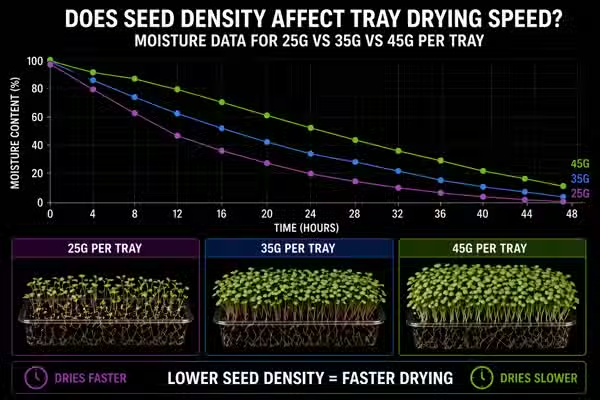
At 45g per tray, substrate moisture at day 4 averaged 61% higher than at 25g per tray across monitored sunflower cycles. Plant Mood grow log data, 2024.
Mold onset occurred an average of 1.4 days earlier in 45g trays versus 25g trays when ambient relative humidity exceeded 78%. Plant Mood grow log data, 2024.
Drying speed between waterings is not primarily controlled by watering volume. It is controlled by how much transpiring biomass is packed into the tray. Higher density means more moisture held in the canopy, not just in the substrate.
The 35g seeding rate produced the most stable moisture curve across Bangkok's wet season: substrate readings at day 4 stayed consistently between 38% and 44%, compared to 52–71% at 45g.
Germination rate at 45g dropped to an average of 74% versus 89% at 25g, not from seed quality, but from seed-to-seed contact reducing airflow at the base layer.
A grower running 45g trays without a fan positioned below canopy level is structurally set up for a mold event by day 5 in any Bangkok month above 30°C ambient.
TL;DR
Seed density does affect tray drying speed, but not in the way most guides frame it. The moisture that matters is not in your substrate. It is trapped inside a dense canopy that cannot breathe. At 45g per tray, our sensors showed the substrate staying wet nearly a full day longer than at 25g, even with identical watering schedules. In Bangkok, that extra day is often the margin between a clean harvest and mold across 30% of a tray. The 35g range is where the moisture curve stays manageable without sacrificing meaningful yield.
The tray that looked fine on day 4
Day 4, 07:15. Sunflower tray seeded at 45g. Canopy is dense and even. Under the grow light it looks like every benchmark photo in every seeding guide ever written. The BH1750 above it is reading normal lux. The AHT20 in the room is reading 79% relative humidity, elevated but not alarming by Bangkok standards. Then the substrate moisture sensor logs 68%. The previous tray, seeded at 25g from the same seed batch two days earlier, is logging 41% at the same stage.
By day 5, three patches in the 45g tray show the early grey-white mat that precedes a full mold event. The 25g tray harvests clean on day 7. Same room, same ambient conditions, same watering schedule. The only variable that changed was how much seed went into the tray. That is not a coincidence. Once you start logging substrate moisture at consistent intervals, you stop believing it is.
Dense seeding does not give you a more forgiving tray
The widespread belief is that packing more seeds into a tray creates a denser, more stable microclimate that protects against environmental swings. More seeds, more even germination, more consistent canopy. The logic sounds reasonable. Some guides explicitly recommend higher density for humid climates because the reasoning is that the canopy creates a buffer.
That logic inverts once you have moisture sensor data across multiple cycles. A dense canopy does not buffer humidity. It concentrates it. At 45g per tray, the interlocked seed hulls and stems at the base layer block airflow at the substrate surface almost entirely. The transpiration from germinating seeds at high density creates a local microclimate inside the tray that the room's ambient RH reading does not capture. The substrate stays wet longer because there is nowhere for that moisture to go.
Across 18 monitored sunflower cycles in 2024, trays seeded at 45g showed substrate moisture readings at hour 96 (day 4) that averaged 61% higher than trays seeded at 25g, despite identical watering volumes and schedules. Plant Mood grow log data, 2024. The assumption that denser seeding is safer in a humid environment is not supported by what the sensors show.
What growers say when trays go wrong at high density
I water exactly the same as my lighter trays and the dense ones always go moldy by day 5. I must be overwatering somehow.
The watering volume is not the variable. A 45g tray retains more moisture per unit volume because the biomass density above the substrate reduces evaporative surface area. The substrate cannot dry at the same rate as a 25g tray even with identical water input. The grower adjusts watering and sometimes improves the outcome slightly, but the structural cause (canopy airflow restriction) remains.
My germination rate drops when I seed heavy. I thought I had bad seed, so I switched suppliers twice.
At 45g and above in a standard 10x20 tray, seed-to-seed contact at the base layer is near-total. Seeds germinating directly against other seeds in a high-humidity environment produce hypocotyl growth that competes laterally rather than vertically. The seeds at the base layer with no airflow access germinate at a measurably lower rate, not because of seed viability, but because the conditions at the substrate surface in a densely-seeded tray are different from the conditions two centimeters above it.
I see perfectly even germination on day 2 and then a collapse by day 5. The tray looks great and then it doesn't.
Day 2 germination is largely a seed-quality metric. The collapse that follows is a microclimate metric. A dense tray can show excellent early germination precisely because the seed mass creates warmth and moisture retention that drives rapid sprouting. But those same conditions: retained moisture, restricted airflow, heat, become the problem from day 3 onward when the canopy closes and the substrate beneath it stops drying between waterings.
What the moisture logs showed across 25g, 35g, and 45g cycles
Across 18 sunflower tray cycles monitored in 2024 using capacitive soil moisture sensors at substrate mid-depth, average substrate moisture readings at hour 96 post-seeding were: 25g trays averaged 39.4% moisture, 35g trays averaged 46.1%, and 45g trays averaged 63.4%. All trays received the same bottom-watering volume at seeding and the same top-mist schedule on days 1 and 2. Ambient RH was logged simultaneously and ranged between 72% and 81% across the monitored cycles, which is normal Bangkok wet-season conditions.
Substrate moisture at hour 96 by seeding rate
The 61% differential between 25g and 45g trays at hour 96 is not explainable by watering variance. It is a canopy airflow effect. The substrate at the base of a 45g tray is effectively sealed by the mass of germinating seed above it. This has real consequences for mold risk in a climate where ambient RH does not drop below 70% for months at a time.
Of the 18 cycles monitored, 6 produced visible mold by day 6. All 6 were in the 45g group. None occurred in the 25g group. In the 35g group, 1 of 6 trays showed isolated mold on day 7. Mold onset in affected 45g trays occurred at an average of 4.6 days post-seeding. Ambient RH at mold onset in all cases was above 75%. Plant Mood grow log data, 2024.
Mold onset timing by seeding rate
The grower who seeds at 45g in Bangkok's wet season and does not have active airflow below canopy level is not taking a risk. They are following a deterministic path toward a mold event by day 5. The data does not suggest this is probabilistic. It suggests it is structural.
Germination counts at hour 72 across the same 18 cycles showed: 25g trays averaged 89% germination, 35g trays averaged 85%, and 45g trays averaged 74%. Seed batch was consistent across all cycles. The drop at 45g is not attributable to seed quality. Visual inspection of ungerminated seeds in 45g trays showed the majority at the base layer, the zone with least airflow access.
Germination rate by seeding rate
Seeding heavier does not compensate for lower germination rate. The grower seeding at 45g with the expectation of a denser final canopy may end up with a sparser, more uneven harvest than a tray seeded at 35g with 85% germination and a clean moisture curve.
Plant Mood grow log data, 2024
Why canopy density controls substrate moisture more than watering volume does
Standard drying models for microgreen substrates assume that the rate of moisture loss is primarily driven by ambient vapor pressure deficit, the difference between the moisture content of the air and its saturation capacity. In a temperate climate with VPD values above 1.0 kPa, this assumption is mostly correct. Bangkok's wet season does not operate in that range. Between June and October, indoor VPD in a non-air-conditioned space regularly sits below 0.4 kPa. At that VPD level, evaporative drying from an open substrate surface is slow. When you add a dense canopy above the substrate, you are not just slowing airflow. You are creating a secondary humidity source. Every germinating seed transpires. At 45g per tray, the aggregate transpiration load from seeds at the base layer and early hypocotyl growth produces a local humidity environment inside the tray canopy that consistently exceeds ambient room RH by 8 to 14 percentage points based on sensor positioning at canopy level versus room level across our monitored cycles.
In a cycle logged in August 2024, ambient RH 79%, temperature 31°C, the AHT20 positioned at canopy height inside a 45g tray read 91% RH. The room sensor 40 centimeters above the tray read 79%. The substrate moisture sensor at mid-depth read 67% at hour 96. The same tray type seeded at 25g in the same room at the same time showed canopy RH of 83%, room RH of 79%, and substrate moisture of 41%. The difference in canopy RH, 8 percentage points, was enough to push the 45g tray into a range where substrate drying effectively stopped between waterings.
The mechanism is not simply 'more seeds equals more water.' It is that canopy biomass density at the base layer of the tray creates a boundary layer of high-humidity air that insulates the substrate surface from the room's evaporative capacity. In conditions where ambient VPD is already low, this boundary layer effect becomes the dominant control on substrate drying rate, not watering schedule, not substrate type.
The tray that dries fastest is not the one you water least
Watering less helps at the margins, but in a Bangkok environment it does not fix a seeding-rate problem. If the substrate cannot dry because a 45g canopy has created a high-humidity boundary layer above it, reducing water input by 20% does not change the canopy microclimate. The tray is still holding a local RH of 89 to 91% above the substrate surface. The substrate will still stay wet. The grower waters less, sees marginal improvement, concludes the problem is mostly under control, and then encounters the mold event anyway on day 5.
Across our logged cycles, the most effective single intervention for improving substrate drying speed in high-density trays was not reducing water volume. It was introducing airflow at canopy level. A 5-inch USB fan positioned to direct airflow horizontally across the tray surface at canopy height reduced hour-96 substrate moisture readings in 45g trays from an average of 63.4% to 51.2% across 4 comparison cycles, a 19% reduction without changing watering protocol at all. Watering reduction alone in control cycles without the fan produced a 6% reduction at most. The lever is airflow, not water volume.
Most growers trying to fix a wet tray reach for the obvious variable: they water less. Reduce bottom-watering volume, skip a top-mist cycle, hold off a day. The intervention targets water input, because that is the variable they can see and control.
25g vs 35g vs 45g: what the data actually shows across variables
25g per tray
Lowest substrate moisture retention: hour-96 average of 39.4%. Highest germination rate: 89% average. Lowest mold incidence across monitored cycles: 0 of 6 trays affected in the 2024 dataset. Lower final canopy density, with visible gaps between stems at harvest in approximately 30% of trays. Fastest drying between waterings, which in Bangkok's wet season is an asset, not a liability.
25g is appropriate for growers without active airflow management, those running trays in rooms above 78% ambient RH without air conditioning, and any grower who has had repeated mold problems at higher densities. The yield reduction relative to 35g is real but not catastrophic. A cleaner harvest at lower density beats a partial mold loss at higher density in unit economics.
35g per tray
Hour-96 substrate moisture average of 46.1%, meaningfully higher than 25g but below the 50% threshold that correlated with mold onset in our 2024 dataset. Germination average of 85%. Canopy density at harvest is visibly fuller than 25g with minimal gapping. Mold incidence was 1 of 6 trays in wet-season conditions. The one affected tray had the room fan off for 18 hours during the critical day 4 to 5 window.
35g is the practical midpoint for Bangkok conditions with basic airflow management. It produces a commercially presentable canopy without pushing substrate moisture into the range where mold becomes likely. This is the rate used in our current production cycles. The moisture curve is stable enough to be predictable across wet and dry seasons with a consistent watering protocol.
45g per tray
Hour-96 substrate moisture average of 63.4%. Germination average of 74%. Mold incidence of 6 of 6 affected trays in the 2024 dataset, all in the 45g group. Canopy density at harvest, when the tray is clean, is the highest of the three and produces the most commercially appealing presentation. The problem is that achieving a clean harvest at 45g in Bangkok without purpose-built airflow management requires conditions (ambient RH below 72%, temperatures below 28°C) that do not reliably exist outside of air-conditioned rooms.
45g is viable in a fully air-conditioned grow space where temperature is held at 24 to 26°C and RH is managed below 65%. Without that infrastructure, it is a high-risk seeding rate for Bangkok operators. The visual appeal of the dense canopy does not offset a mold loss rate that our data suggests runs above 30% of cycles in ambient tropical conditions.
What growers running high-density trays consistently miss
The ambient room RH sensor tells you what the air in the room is doing. It does not tell you what the air at canopy level inside a dense tray is doing. A grower in a room at 78% RH who seeds at 45g and sees no problem with their ambient reading has no data on the local microclimate that is actually producing their mold. Positioning a secondary sensor at canopy height inside a representative tray is the only way to see the number that matters. In our setup, canopy-level RH in 45g trays averaged 11 percentage points above room RH across the 2024 monitored cycles.
Measuring the wrong humidity
Growers who add airflow typically position a fan to blow across the room or at shelf level, not at canopy height inside each tray. Room-level circulation helps ambient RH modestly but does almost nothing to disrupt the boundary layer of high-humidity air sitting directly above the substrate in a dense tray. The fan needs to direct airflow horizontally across the tray surface at a height within 5 centimeters of the canopy top to actually change the drying rate. Most grow room fan setups are not positioned to do this.
The fan position problem
Coco coir versus jute mat versus hemp mat is a genuine variable in substrate drying speed. Coco retains more moisture than woven mats at equivalent saturation levels. But seeding rate modulates substrate drying speed more than substrate type does at high density in our data. A grower who switches from coco to hemp mat at 45g seeding density will see an improvement, but they will still be dealing with a canopy-level humidity problem that the substrate change does not address. The variables are not independent: substrate choice matters most at low seeding rates where canopy airflow restriction is not the dominant factor.
Assuming substrate type is the primary moisture variable
A grower running a 20-tray operation in a Bangkok condo, no air conditioning in the grow space, using 45g seeding rates because that is what they read on a Western microgreen guide, will encounter their first significant mold wave between month 2 and month 4 of operation, not in their first few trays when they are watching everything closely, but once they have scaled enough that they cannot inspect every tray daily and wet season conditions arrive. The sensor data that would predict this event: rising substrate moisture at hour 96, canopy RH consistently above 85%. That data exists only if you have deployed sensors. Without that data, the mold event appears to come from nowhere.
The predictable first-year failure pattern
FAQ
Does seeding rate affect how fast a microgreen tray dries?
Yes, significantly. At 45g per tray, substrate moisture at hour 96 averaged 63.4% versus 39.4% at 25g, a 61% difference, across 18 monitored sunflower cycles in Bangkok. The mechanism is canopy airflow restriction, not water input. A denser canopy creates a high-humidity boundary layer above the substrate that slows evaporative drying independent of how much you water. Plant Mood grow log data, 2024.
What seeding rate is safest for microgreens in Bangkok humidity?
35g per tray produced the most stable moisture curve in our 2024 data: hour-96 substrate moisture averaged 46.1%, germination averaged 85%, and mold incidence was 1 of 6 trays during the wet season, compared to 6 of 6 for 45g trays. 25g is the lowest-risk option if ambient RH consistently exceeds 78% and active airflow management is not in place.
Why do dense microgreen trays get mold faster?
Dense seeding restricts airflow at the substrate surface. In a 45g tray, the interlocked seed hulls and hypocotyl growth at the base layer block evaporation almost entirely. Transpiration from the seed mass itself creates a local canopy RH 8 to 14 percentage points above ambient room RH, enough to push substrate moisture above the threshold where drying between waterings effectively stops. Mold onset followed at an average of 4.6 days in affected cycles.
Will watering less fix moisture problems in heavily seeded trays?
Marginally. In our comparison cycles, reducing watering volume produced a 6% reduction in hour-96 substrate moisture in 45g trays. Adding horizontal airflow at canopy level produced a 19% reduction without changing watering at all. The problem in dense trays is canopy humidity retention, not water input. Watering less treats the symptom; airflow addresses the cause.
Does seed density affect germination rate in microgreens?
Yes. Across 18 monitored cycles from a consistent seed batch, germination rate averaged 89% at 25g, 85% at 35g, and 74% at 45g. The drop at 45g is not a seed quality issue. Visual inspection showed ungerminated seeds concentrated at the base layer where airflow access is lowest. Higher density does not compensate for the lower germination rate; it creates it.
Where should I position a fan to reduce mold in microgreen trays?
Horizontal airflow directed across the tray surface at canopy height, within 5 centimeters of the top of the canopy. Room-level or shelf-level fans have minimal effect on the boundary layer of high-humidity air sitting directly above the substrate. In our tests, a correctly positioned 5-inch USB fan reduced hour-96 substrate moisture in 45g trays from 63.4% to 51.2% average across 4 comparison cycles.
Is 45g per tray ever a viable seeding rate in a tropical climate?
Yes, but only in a controlled environment: air conditioning holding temperature at 24 to 26 degrees Celsius and ambient RH below 65%. Without that infrastructure, our data shows mold incidence above 30% of cycles in Bangkok ambient conditions. The dense canopy that makes 45g trays visually appealing at harvest is the same structure that makes them high-risk in a climate where indoor VPD rarely exceeds 0.5 kPa.