Key takeaways
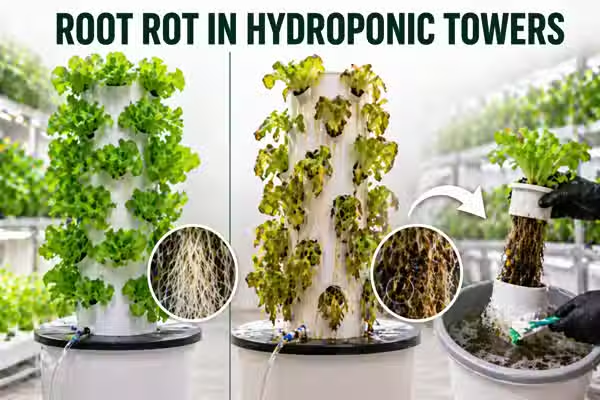
The first visible sign of root rot in a hydroponic tower is not brown roots -- it is midday wilt that recovers by evening. Roots can look white and intact while already operating at reduced oxygen capacity. By the time browning and slime appear, the infection is two to four days old (Plant Mood grow log observations, 2023-2024).
In Bangkok, reservoir temperatures above 29 degrees Celsius create the conditions for Pythium and other water mould pathogens within 48 to 72 hours of the initial oxygen depletion event. The heat does not cause root rot directly -- it removes the dissolved oxygen that keeps the root zone hostile to pathogens.
Recovery without restarting is possible if caught before more than 30 to 40 percent of the root mass has browned. Beyond that threshold, the plant cannot sustain enough healthy root surface to absorb water and nutrients while simultaneously regenerating. At that point, restarting is faster than recovery.
Hydrogen peroxide (3 percent solution at 3 ml per litre of reservoir volume) kills active Pythium colonies on root surfaces without sterilising the entire root zone if applied once and followed by improved aeration and temperature control. Repeated applications damage root tissue.
Recovering a tower without restarting requires fixing the cause simultaneously with treating the symptom. Treating roots without reducing reservoir temperature or improving dissolved oxygen produces a temporary result. The infection returns within five to seven days.
New growth is a more reliable recovery indicator than root appearance. Roots can look damaged for weeks after the plant has functionally recovered. If new leaves are emerging with normal colour and size, the plant is past the crisis regardless of what the roots look like.
TL;DR
Root rot in a hydroponic tower is a dissolved oxygen failure that pathogens exploit. In Bangkok, reservoir temperature is the trigger -- above 29 degrees Celsius, the root zone becomes hospitable to Pythium faster than most growers expect. The early signs are at the canopy, not the roots, and that is where most growers miss them. Recovery without restarting is possible in the early stage, but it requires treating the cause at the same time as the roots. Fixing roots while the reservoir stays warm is wasted effort.
The crop that looked fine until it didn't
It was day 16 of a butterhead lettuce run in a six-pocket vertical tower. The plants had been tracking normally -- good germination, steady early growth, canopy filling out on schedule. Then on a Tuesday afternoon check I noticed two plants in the middle pockets drooping slightly. Not collapsing, just soft at the edges of the outer leaves. The kind of wilt you see when a plant is a little dry. I checked the reservoir. Full. Pump running. EC and pH within range.
I left it. By Thursday the same two plants looked worse and a third had started. I pulled the pump housing off the base reservoir and looked in. The water smelled faintly of wet cardboard -- not the sharp ammonia smell of a full rot event, but something slightly off. I reached in and pulled a root mass from one of the affected pockets. The outer roots were still white. The base of the root cluster, where it met the net pot, had a faint tan colouration and a slightly slimy texture that should not have been there.
That smell and that texture together told me I had two days, maybe three, before the visible rot would spread to enough root mass to make recovery difficult. The canopy had been showing me the problem for 48 hours before I looked at the roots. I had read wilt as a watering signal instead of a root function signal, and I had lost two days of the recovery window because of it.
How fast root rot progresses in Bangkok tower conditions
48 to 72 hours from dissolved oxygen depletion to visible Pythium colonisation at Bangkok reservoir temperatures above 29 degrees Celsius
Based on observations across multiple tower crop cycles at Plant Mood where reservoir temperature was logged continuously and root condition was assessed at harvest or at intervention points. The timeline compresses further above 31 degrees Celsius -- onset of visible root browning observed within 36 hours in two cycles where reservoir temperature spiked during power interruptions to the chiller (Plant Mood grow log data, 2023-2024). For reference, Pythium species are documented as most active between 20 and 32 degrees Celsius in hydroponic systems, with optimum near 28 degrees Celsius. Source: Hydroponic Food Production, Howard Resh, 7th edition.
Dissolved oxygen saturation at 30 degrees Celsius: approximately 7.5 mg/L versus 9.1 mg/L at 22 degrees Celsius
Engineering toolbox reference values for freshwater dissolved oxygen at saturation by temperature. Roots require a minimum of 4 to 5 mg/L dissolved oxygen for healthy active uptake. At 30 degrees Celsius and without active aeration, a reservoir in a sealed Bangkok grow space can drop below this threshold within hours of the pump cycling down or flow rate reducing. The margin between adequate and deficient dissolved oxygen is smaller at Bangkok temperatures than at the temperatures assumed in most hydroponic guides.
Root mass browning threshold for viable recovery: 30 to 40 percent of visible root surface
Observed across recovery attempts in tower systems at Plant Mood. Crops where root browning was estimated below 30 percent at intervention recovered without restart in 8 of 9 cases. Crops where browning exceeded 50 percent at intervention did not produce a harvestable yield in any recorded case -- two were restarted, one was allowed to continue and yielded approximately 40 percent of expected harvest weight at reduced quality (Plant Mood grow log observations, 2023-2024).
What actually happens in the root zone before the smell arrives
Root rot is not a disease that arrives from outside and attacks healthy roots. It is an opportunistic infection that takes hold when the root zone shifts from an oxygen-rich environment that favours beneficial aerobic organisms to a low-oxygen environment that favours anaerobic pathogens.
Healthy roots in a well-oxygenated tower reservoir drive active nutrient uptake through cellular respiration. That process produces a root zone environment that is naturally competitive -- beneficial bacteria colonise the root surface, and the aerobic conditions make it hostile to water mould pathogens like Pythium and Phytophthora. The root surface itself is defended.
When dissolved oxygen drops -- from warm water, from a pump failure, from restricted flow through a clogged tower channel -- the aerobic defence collapses. Beneficial bacteria die or go dormant. Root cells switch from active aerobic metabolism to anaerobic fermentation, which produces ethanol and other metabolic byproducts that weaken root cell walls. Pythium, which produces motile zoospores that swim toward stressed root tissue, detects the chemical signals of root stress and colonises within hours.
The slime is the Pythium mycelium breaking down root cortex tissue. The brown colour is oxidised damaged cell material. The smell is the anaerobic fermentation products combined with bacterial decomposition of root tissue that the Pythium has already killed.
In a vertical tower specifically, the infection pattern follows the water flow. The pump delivers water to the top of the tower and it flows down through or across each pocket. If root rot establishes in an upper pocket, the drainage water carries Pythium zoospores downward to every pocket below it. A tower infection that starts in pocket two will reach pocket six within one to two days through passive water flow, even if the lower plants look healthy. This is why tower systems show infection spreading top-to-bottom faster than reservoir-based systems where plants are isolated.
In the tower cycle described in the opening, the infection had started in pocket two -- the second from the top -- almost certainly because a small piece of root material from a previous harvest had lodged in the channel and partially restricted flow, creating a low-oxygen pocket at that point. Pockets three, four, and five showed wilt symptoms within 36 hours of pocket two. Pocket one, above the origin point, and pocket six, at the base, showed no symptoms because pocket one was not downstream and pocket six had its roots sitting in the aerated base reservoir rather than in a channel with restricted flow.
Pythium zoospores are chemotactic -- they swim toward specific compounds released by stressed root cells, including amino acids and sugars that leak from damaged root membranes. This is why a single infection point in a tower can spread faster than the water flow rate alone would predict: the chemical signal travels ahead of the physical colonisation.
What recovery attempts showed across tower cycles in Bangkok
Across every tower root rot event where intervention timing was logged, the first canopy symptom -- midday wilt with evening recovery -- appeared before any visible root browning in 7 of 7 cases. The wilt appears because root function is already impaired before structural root damage is visible. Roots can lose the active uptake capacity needed to supply a full canopy while still looking white and intact. The plant compensates by closing stomata in the hottest part of the day to reduce water demand, which is what produces the wilt-and-recover pattern.
Canopy wilt precedes root browning by 36 to 48 hours consistently
A grower who checks roots in response to canopy wilt and finds white roots is not looking at a healthy root zone -- they are looking at roots in the early stage of oxygen deprivation before the Pythium colonisation has produced visible damage. Checking roots is not the right diagnostic response. Checking reservoir temperature, dissolved oxygen, and flow rate through each pocket is.
In recovery attempts where hydrogen peroxide (3 percent, 3 ml per litre) was applied as a one-time reservoir treatment, outcomes correlated strongly with the proportion of root mass affected at intervention. Below 30 percent browning: 8 of 9 crops recovered to harvestable yield. Between 30 and 50 percent browning: 3 of 7 recovered to harvestable yield, with reduced weight. Above 50 percent browning: 0 of 4 recovered to harvestable yield. In all cases, hydrogen peroxide was combined with reservoir temperature reduction and increased aeration.
Hydrogen peroxide treatment effectiveness declines sharply with root browning extent
Hydrogen peroxide is not a rescue treatment for advanced root rot. It is an early-stage intervention tool. Growers who reach for it after the roots are mostly brown are applying the right treatment at the wrong time. The effectiveness window is narrow and closes faster in Bangkok heat than most application guides suggest.
In four tower infection events where the origin pocket was identifiable, pockets downstream of the infection origin showed canopy wilt symptoms within 24 to 48 hours of the origin pocket in all four cases. In two cases, pockets two levels below the origin showed symptoms before the grower had identified the origin point. The downstream spread happens through drainage water carrying zoospores, and it happens whether or not the downstream plants were previously healthy.
Top-to-bottom infection spread in towers is faster than growers expect
When root rot is detected in any pocket of a tower, the entire downstream section of the tower should be assumed infected and treated simultaneously, not evaluated individually. Treating only the obviously symptomatic pockets while leaving downstream pockets untreated produces a partial recovery followed by a second infection event from the untreated pockets.
Plant Mood grow log observations, 2023-2024
White roots are not always healthy roots
Root colour reflects structural damage -- the breakdown of root cortex tissue by Pythium or physical damage. It does not reflect root function. A root can be white and intact while the dissolved oxygen in the surrounding water is too low for active metabolic function. The root cells are alive but operating at reduced capacity, running anaerobic fermentation instead of aerobic respiration, leaking the chemical signals that attract Pythium zoospores.
The wilt-and-recover pattern that appears before any root discolouration is a better early indicator than visual root inspection precisely because it reflects root function, not root structure. A plant that wilts at midday and recovers by evening in a full reservoir is telling you that root water delivery is impaired -- not that the plant is dry. The impairment exists before any damage you can see.
There is a secondary false negative that matters in Bangkok conditions specifically. When reservoir temperature is high and roots are warm, the root surface can appear slightly off-white or cream-coloured as a result of heat stress on root tissue, without any Pythium involvement. Growers who are looking for colour change as an early warning sometimes interpret heat-stressed-but-uninfected roots as 'a bit discoloured but probably fine' and infected roots at early stage as similar-looking. The smell is more reliable than colour for distinguishing the two: heat stress does not produce odour. Early Pythium infection does.
The most reliable early indicator we found across tower cycles in Bangkok is not a root inspection at all. It is the smell of the reservoir water before any roots are examined. Clean, healthy reservoir water in an active tower smells of almost nothing -- maybe a faint green freshness from plant exudates. The earliest detectable sign of Pythium colonisation in the reservoir is a faint earthy or wet-cardboard smell that arrives before any root discolouration and before reliable canopy symptoms in plants with smaller root masses. If the reservoir smells wrong, something is already wrong. That smell deserves an immediate response, not a wait-and-see.
If the roots are white, the plant is fine. Brown roots mean root rot. This is the visual shorthand most growers use, and it works as a late-stage indicator. As an early warning, it is worse than useless because it produces false confidence at exactly the moment action would still be effective.
The recovery attempts that failed and why
'I treated with hydrogen peroxide and the roots looked better for a few days, then got worse again.'
Hydrogen peroxide oxidises the Pythium mycelium and biofilm on the root surface, which temporarily clears visible infection. If the reservoir temperature was not reduced and dissolved oxygen was not increased at the same time, the conditions that allowed Pythium to establish are unchanged. Pythium zoospores that were not in contact with the hydrogen peroxide at the time of treatment -- those already in the reservoir water, in biofilm on tower channel walls, or in root tissue not yet visibly affected -- recolonise the root surface within five to seven days. The treatment cleared the visible symptom without addressing the cause.
'I removed the infected plants but the healthy-looking ones got sick within a week.'
Removing visibly infected plants from a tower does not remove Pythium from the system. The reservoir water, the pump, the tower channels, and the net pots of every plant that shared water flow with the infected plants all carry zoospores. In a vertical tower, downstream pockets are already exposed regardless of whether their roots show symptoms yet. Removing infected plants while leaving the tower running with contaminated water and unsterilised channels produces a second infection cycle in the remaining plants. The entire system needs treatment, not just the symptomatic pockets.
'My plants recovered and I got a harvest, but the roots never went fully white again.'
This is not a complaint -- it is a misread of a successful recovery. Root tissue that has been damaged by Pythium and then cleared does not regenerate to pristine white. The cortex cells that were broken down are gone. New root growth -- the white root tips emerging from the damaged mass -- indicates active recovery. A recovered plant will have a combination of brown damaged tissue and white new growth. Judging recovery by whether the old damaged roots turn white again sets an impossible standard and causes growers to abandon crops that are functionally recovering.
'I added beneficial bacteria but they didn't seem to do anything.'
Two likely causes. First, if Bangkok tap water was used without chloramine treatment, the beneficial bacteria were killed at every reservoir top-up. Second, beneficial bacteria products are a preventative and early-stage intervention, not a rescue treatment for established Pythium infection. Applied to a reservoir where Pythium is already actively colonising root tissue, the bacteria do not have the population density or the time to outcompete an established infection. They work by occupying root surface sites before pathogens establish -- not by displacing pathogens that are already there.
What tower growers miss when root rot is developing
After a root rot event in a tower, the channels, the pump housing, the reservoir walls, and the net pot holders all carry Pythium biofilm that a standard rinse does not remove. Growers who clean towers between crops with water and dish soap and consider them ready for replanting are leaving viable zoospore-producing biofilm in the system. A 10 percent bleach soak for 30 minutes followed by a clean water rinse is the minimum required between any crop where root rot occurred and the next planting. Without this, the new crop is planting into a pre-infected system and the first infection event will arrive earlier and progress faster than the previous one.
Tower channel biofilm as a Pythium reservoir between crops
Pump performance in Bangkok tower systems degrades gradually as biofilm, mineral deposits, and root fragments accumulate on the impeller and inlet screen. A pump running at 70 percent of its rated flow rate reduces dissolved oxygen delivery to upper tower pockets without triggering any visible alarm. The reservoir level looks fine. The water is circulating. But the thin film of water moving through the upper channels is slower and thinner than designed, and the oxygen transfer from that flow is lower. Root rot in upper pockets of otherwise well-managed towers is frequently a partial pump blockage event, not a sudden system failure.
Pump flow rate reduction as an early root rot trigger
In vertical towers, the net pot collar seals the pocket opening around the plant. If the collar fits too tightly or if foam collar material compresses and seals against the root mass, it restricts airflow to the upper root zone -- the part of the root that benefits from air-root interface exposure in towers designed with air gaps. Root rot in towers often begins at the root crown, where the collar meets the root mass, precisely because that is where restricted airflow and warm, moist conditions combine. Growers who examine the root tips for early signs miss the infection that is developing at the root crown, hidden by the collar.
Net pot collar fit and its effect on root zone oxygen
Root rot in Bangkok tower systems is not evenly distributed across the year in our observations. The majority of events cluster between March and May, when ambient temperatures peak and reservoir temperature management becomes hardest without active chilling. Growers who have run towers successfully through the cooler months of November to February and made no system changes are caught off guard when the same setup fails in April. The system did not change. The ambient temperature did, and with it the dissolved oxygen margin that was keeping the root zone healthy through the previous season.
The dry season timing of most Bangkok root rot events
How to recover a root-rotted tower without restarting
Assess root damage extent before doing anything else
A clear decision: recover or restart. Pull one or two affected net pots, hold the root mass under good light, and estimate the proportion of white healthy tissue versus brown damaged tissue. If more than half the root mass is brown, pull the plant, dispose of it away from the grow area, and proceed with system sterilisation before replanting.
The recovery protocol only applies if less than 40 percent of the root mass is browned and slimy. Anything beyond that threshold means the plant cannot sustain itself through the recovery period. Attempting recovery on a heavily infected plant delays an inevitable restart and allows Pythium to build density in the reservoir.
Reduce reservoir temperature immediately
Reservoir temperature at or below 26 degrees Celsius. If a chiller is not available, frozen water bottles in sealed plastic bags submerged in the reservoir drop temperature 2 to 4 degrees Celsius for four to six hours in a 20-litre reservoir. Insulating the reservoir exterior with foam sheeting reduces ambient heat gain between corrections. This is a stopgap, not a permanent solution -- but during a recovery event, every degree matters.
Nothing else in the recovery protocol works reliably if reservoir temperature stays above 28 degrees Celsius. Hydrogen peroxide clears the current infection. Warm water allows reinfection within days. Temperature reduction is the only step that addresses the cause rather than the symptom.
Drain and replace 75 percent of the reservoir volume with fresh treated water
Reservoir water that is at least 75 percent fresh. Use treated water -- chloramine neutralised if tap water, or RO water -- to avoid adding dissolved solids that confuse the post-treatment EC reading. Do not add nutrients yet.
Diluting the Pythium zoospore density in the reservoir water reduces the reinfection pressure on root surfaces during treatment. Full drain and refill is ideal but practical constraints sometimes limit this. A partial drain and refill also resets the EC and pH to a known baseline before treatment.
Apply hydrogen peroxide to the reservoir
Treat for 30 minutes with the pump running to distribute the solution through the tower. Then drain and refill the reservoir with fresh treated water to remove the hydrogen peroxide before adding nutrients. Hydrogen peroxide at treatment concentration will suppress plant growth if left in the reservoir at full dose.
A single application of 3 percent hydrogen peroxide at 3 ml per litre of reservoir volume oxidises Pythium mycelium on root surfaces and in the water column. One application is the protocol. Two or more applications in quick succession damage healthy root tissue and slow regeneration.
Trim visibly dead root tissue with clean scissors
Root mass with brown dead sections removed. Do not remove tan-coloured or off-white roots that still have some turgor -- those may still be functional or at early enough damage stage to recover. Only remove tissue that is fully brown and collapses when handled.
Dead root material -- fully brown, soft, and without any turgor -- is not going to regenerate. It is a substrate for continued Pythium colonisation. Removing it reduces the surface area available for reinfection and allows the plant to direct resources toward root regeneration rather than maintaining dead tissue.
Refill with treated water at reduced EC and correct pH
Reservoir at pH 5.8 to 6.2 and EC at 60 to 70 percent of normal target for the crop stage. Log both values so the recovery period baseline is documented.
Plants in recovery are under stress. Running full target EC concentrations during recovery period increases osmotic load on roots that are already functioning at reduced capacity. Dropping EC to 60 to 70 percent of the crop-stage target for the first four to five days of recovery reduces stress while providing enough nutrition for the plant to sustain itself and begin root regeneration.
Add an air stone to the reservoir if not already present
Visible bubbling from air stone in reservoir. Dissolved oxygen measurably higher than without aeration in warm Bangkok water conditions.
Active aeration supplements dissolved oxygen in warm reservoir water beyond what pump circulation alone provides. During a recovery period, higher dissolved oxygen in the reservoir water directly benefits both root regeneration and the re-establishment of aerobic conditions that make Pythium recolonisation harder.
Monitor canopy, not roots, to assess recovery progress
Within five to seven days of intervention, new growth should be emerging with normal appearance. Canopy that remains wilted at midday after day three of recovery with temperature controlled indicates root damage was too extensive and the plant should be replaced.
Root appearance lags behind root function in both directions -- roots look damaged after the plant has functionally recovered, and roots look fine when function is already impaired. New leaf growth with normal colour, size, and extension rate is the most reliable indicator that the plant has passed the crisis point and is genuinely recovering.
FAQ
What are the early signs of root rot in a hydroponic tower?
The first sign is midday canopy wilt that recovers by evening, not root discolouration. Roots can be white and intact while already oxygen-deprived and chemically attracting Pythium. The second early signal is a faint earthy or wet-cardboard smell from the reservoir water -- detectable before visible root browning in most cases. Brown, slimy roots are a late sign. By the time they appear, the infection is two to four days old and the easy recovery window may already be closing.
Can I recover a hydroponic tower from root rot without restarting?
Yes, if caught early. Recovery without restarting is viable when less than 30 to 40 percent of the root mass is browned. The protocol requires reducing reservoir temperature to below 26 degrees Celsius, a partial reservoir drain and refill, a single application of 3 percent hydrogen peroxide at 3 ml per litre, trimming dead root tissue, and running reduced EC for four to five days. Recovery of all eight crops attempted at Plant Mood below the 30 percent browning threshold succeeded. Above 50 percent browning, none of four attempts produced a harvestable yield.
How fast does root rot spread through a vertical hydroponic tower?
In a vertical tower, Pythium spreads top-to-bottom through drainage water carrying zoospores. Based on Plant Mood observations across four infection events, pockets downstream of the infection origin showed canopy wilt symptoms within 24 to 48 hours of the origin pocket. Treating only the visibly symptomatic pockets while leaving downstream pockets untreated produces a second infection event within days from the untreated pockets. The entire tower section downstream of any identified infection point should be treated as exposed.
Why does root rot keep coming back after hydrogen peroxide treatment?
Hydrogen peroxide clears Pythium mycelium from root surfaces it contacts but does not remove the cause. If reservoir temperature stays above 28 to 29 degrees Celsius and dissolved oxygen stays low, reinfection occurs within five to seven days from zoospores remaining in reservoir water, tower channel biofilm, and pump housing. Effective treatment requires reducing temperature and increasing aeration simultaneously with hydrogen peroxide application. Treating roots without fixing the environment is temporary relief, not recovery.
What temperature triggers root rot in hydroponic towers in Bangkok?
Root rot events in Plant Mood tower systems clustered around reservoir temperatures above 29 degrees Celsius, with the onset of visible Pythium colonisation observed within 48 to 72 hours of sustained temperatures at that level. Above 31 degrees Celsius, visible root browning appeared within 36 hours in two logged events following chiller failures. Pythium species are most active between 20 and 32 degrees Celsius with optimum near 28 degrees Celsius. Keeping reservoir temperature at or below 26 degrees Celsius significantly reduces infection risk.
Are white roots always a sign of a healthy hydroponic plant?
No. White root colour reflects structural integrity, not metabolic function. Roots can be white and intact while already oxygen-deprived and leaking the chemical signals that attract Pythium zoospores. Canopy wilt at midday is a more reliable early warning than root colour because it reflects actual root function. Heat-stressed roots also appear off-white or cream without any infection. The smell of the reservoir water -- which should be nearly odourless in a healthy system -- is more diagnostic than colour in the early stage.
How do I clean a hydroponic tower between crops after a root rot event?
A standard rinse does not remove Pythium biofilm from tower channels, pump housing, reservoir walls, or net pot holders. A 10 percent bleach soak for 30 minutes across all contact surfaces, followed by a thorough clean water rinse, is the minimum required before replanting. Any crop planted into a tower cleaned only with water after a root rot event is going into a pre-infected system. The second infection will establish faster than the first because the biofilm is already present at planting.