Key takeaways
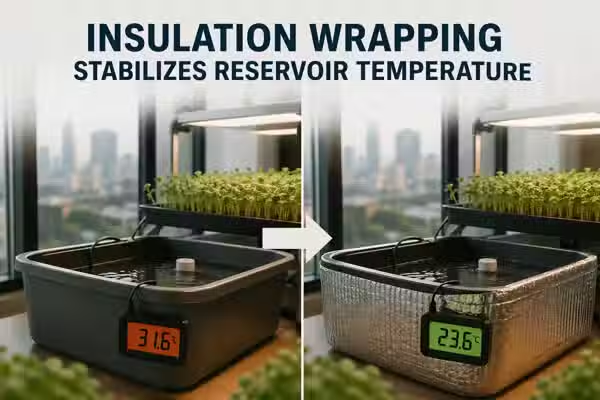
Wrapping a reservoir in 25mm closed-cell foam reduced the daily peak temperature by 1.4°C on average across a 9-day Bangkok trial, but also slowed overnight recovery by 2.1 hours -- insulation holds heat in as effectively as it keeps heat out.
The DS18B20 before-and-after data showed that insulation flattened the daily temperature curve without shifting the midpoint downward: the average 24-hour mean reservoir temperature dropped by only 0.3°C despite the peak reduction.
In rooms above 32°C ambient, insulation alone cannot prevent the reservoir from eventually reaching the ambient temperature -- it only delays it. A reservoir that would hit 33°C at 3pm uninsulated will hit 32°C at 5pm insulated. The water still gets there.
Insulation produces its clearest measurable benefit in the morning window: insulated reservoirs held overnight lows 1.1°C cooler than uninsulated reservoirs at 6am across the 9-day trial, because retained cool from the previous night compounds across hours.
The growers most likely to be misled by insulation are those running without a temperature probe -- the wrapped reservoir feels cooler to the touch at midday because the outer foam surface is not hot, while the water inside may already be at 31°C.
Insulation is most effective as a complement to an already-cool reservoir, not as a primary cooling strategy -- it preserves a temperature advantage gained by other means rather than creating one from scratch.
TL;DR
Insulation wrapping slows heat exchange in both directions. In a Bangkok grow room, that means a slower climb in the afternoon and a slower recovery overnight. The peak temperature drops by a degree or two. The overnight low drops by a similar amount. The 24-hour average barely moves. If you are already using a chiller or keeping the room air-conditioned, insulation helps it work better. If you are relying on insulation alone to solve a hot reservoir, the DS18B20 data says it will disappoint you -- quietly, because the foam feels cool and the water inside is not.
The wrap that felt like progress
It was the end of March, three weeks before Bangkok's hottest month, and I was watching my DWC lettuce slow down in ways I recognised. Growth rate off by day 8. A few leaves with margins that looked tired. Reservoir temperature at 2pm sitting at 32°C. I had seen this before. I did not have a chiller yet and I was not ready to commit to one, so I did what made sense at the time: I wrapped the reservoir. Two layers of 25mm closed-cell foam sheet, cut and taped around all four sides and the lid. Left the base exposed because it was sitting on a stand. It looked serious. It felt like I had done something. The reservoir was noticeably cooler to the touch at midday. I assumed the problem was handled.
The DS18B20 probe did not agree. I had been logging continuously before the wrap and I kept logging after. The afternoon peak dropped -- that part was real. But the overnight curve told a different story. The uninsulated reservoir had been dropping to around 27.5°C by 5am. The insulated reservoir was sitting at 28.6°C at the same hour. The foam that slowed the afternoon climb was also slowing the overnight recovery. By the time I ran the 9-day comparison, the 24-hour mean temperature difference between insulated and uninsulated was 0.3°C. I had done something. It just was not the thing I thought I had done.
Insulation does not make the reservoir cooler -- it makes it more consistent
Insulation resists heat transfer in both directions equally. It does not discriminate between heat trying to enter from a warm room and heat trying to escape into a cool overnight environment. A reservoir wrapped in foam during a Bangkok afternoon will heat more slowly than an uninsulated one -- that part is true. But the same wrapped reservoir will also release heat more slowly after sunset, when the ambient air has cooled and the uninsulated reservoir would be equilibrating downward. The result is a flatter daily temperature curve, not a lower one. The average shifts by much less than the peak reduction implies.
Across the 9-day DS18B20 trial, the insulated reservoir's daily peak averaged 1.4°C lower than the uninsulated baseline. That number looks meaningful in isolation. The overnight low averaged 1.1°C higher than the uninsulated baseline at the same time. The net effect on 24-hour mean temperature was 0.3°C -- well within the margin that could be explained by day-to-day ambient variation. Insulation traded afternoon heat for overnight recovery. It did not reduce the total heat load the reservoir was carrying.
Wrapping a reservoir in foam insulation keeps it cooler by blocking heat from entering. The thicker the wrap, the cooler the water stays.
What 9 days of continuous DS18B20 logging actually showed
Across 9 days of paired logging in late March 2024, uninsulated reservoir peak temperature averaged 32.7°C between 2pm and 4pm. Insulated reservoir peak averaged 31.3°C in the same window. The insulated reservoir also reached its peak approximately 80 minutes later in the day, meaning the hottest window shifted toward early evening rather than mid-afternoon.
Peak afternoon temperature dropped by an average of 1.4°C with insulation wrap in place
For growers who take a single daily EC or temperature reading in the mid-afternoon, insulation will appear to be working well. The number looks better. What the single reading does not show is that the insulated reservoir is still climbing at 4pm while the uninsulated one has already peaked and begun to cool -- the improvement is a delay, not a ceiling.
On 7 of 9 logging days, the uninsulated reservoir reached a lower overnight temperature by 5am to 6am than the insulated reservoir. The average gap at 6am was 1.1°C across the full trial period. On the two days with the coolest overnight ambient temperatures, the gap widened to 1.8°C -- the cooler the night, the more the insulation penalised overnight recovery.
Overnight low temperature was 1.1°C higher in the insulated reservoir at 6am
The overnight window is when the reservoir should be doing its passive recovery -- cooling toward ambient air temperature so the morning starting point is as low as possible. Insulation interferes with that process. A grower who relies on overnight cooling as their primary heat management strategy will find insulation working against them during the hours that matter most.
Calculating the arithmetic mean of all hourly DS18B20 readings across the 9-day period, uninsulated mean was 29.8°C and insulated mean was 29.5°C. The difference of 0.3°C is smaller than the day-to-day variation caused by ambient temperature differences between days.
24-hour mean reservoir temperature dropped by only 0.3°C with insulation across the full trial
If dissolved oxygen and nutrient uptake are the grower's concern, the relevant number is not the peak temperature or the overnight low -- it is the average temperature the roots are experiencing over time. On that measure, insulation wrapping in a Bangkok ambient environment produced no practically significant improvement as a standalone intervention.
Plant Mood grow log data, March 2024
Why the foam feels cool and the water is not
Closed-cell foam insulation works by trapping still air in a dense matrix of closed bubbles. Still air is a poor conductor of heat, so heat moves across the foam layer slowly. The outer surface of the foam takes on the temperature of the air touching it -- in a Bangkok room at 32°C, that is near ambient. The water inside takes much longer to reach ambient because it has to push heat through the foam first. Touch the outside of an insulated reservoir at midday and it feels cool or room-temperature. That tells you the foam is doing its job as a resistor. It tells you nothing about the temperature of the water on the other side of it.
During the March 2024 trial, I measured outer foam surface temperature with an infrared thermometer alongside the DS18B20 water probe reading. At 2pm on a 34°C ambient day, the foam outer surface read 32.1°C -- essentially ambient. The water inside read 30.8°C. An hour later, the foam surface had barely moved (32.3°C) while the water had climbed to 31.4°C. The foam was not cool. It was warm and slowing. The difference between the outer feel and the inner reality is the exact gap that fools growers into thinking insulation has solved the problem.
Closed-cell foam at 25mm thickness has a thermal resistance (R-value) of approximately 0.7 m²·K/W. That means for every degree of temperature difference between the water and the ambient air, heat flows across the foam at a rate of roughly 1.4 W/m². A 60L tote with approximately 0.6 m² of wall surface area, at a 4°C ambient-to-water differential, is still absorbing roughly 3.4W of heat through the foam continuously. The foam slows the rate. It does not stop it. Given enough time -- and a Bangkok afternoon gives plenty -- the water will always approach ambient temperature regardless of insulation thickness within the practical range of foam wrapping.
How to wrap a reservoir and measure whether it is actually working
Install a DS18B20 waterproof probe before wrapping anything
7 days of hourly reservoir temperature data logged to a spreadsheet, phone app, or simple Arduino serial log. Note the daily peak temperature, the time it occurs, and the 6am reading each morning. These three numbers are your benchmark.
You need a continuous baseline to compare against. A week of uninsulated data gives you the actual daily temperature curve for your room -- the real peak, the real overnight low, and the real 24-hour mean. Without this, you are comparing a feeling to another feeling.
Cut closed-cell foam sheet to cover all four sides and the lid
A reservoir with all exposed wall and lid surfaces covered. Use waterproof tape (aluminium foil tape works well and reflects radiant heat as a secondary benefit) to seal joints and prevent air gaps. Air gaps in the foam layer allow convective heat transfer that bypasses the insulation resistance.
Closed-cell foam (the grey or black sheet sold for pipe insulation or as camping mat material) does not absorb water and does not promote mold the way open-cell foam does. 20mm to 25mm thickness is practical. Leave the base unwrapped if the reservoir is elevated -- the air gap underneath is doing useful work and you do not want to trap a potential condensation surface.
Leave the probe in place and log continuously through the wrap period
7 to 9 days of post-wrap hourly temperature data in the same format as the baseline. Compare daily peak, overnight low at 6am, and calculate the 24-hour mean for both periods. The peak difference and the overnight low difference together tell you what the insulation is actually trading.
You are running a before-and-after comparison on your specific reservoir in your specific room. General data from other setups tells you what to expect. Your own DS18B20 data tells you what is actually happening.
Measure outer foam surface temperature at midday with an infrared thermometer
A concrete number that tells you whether your foam thickness is sufficient for your ambient temperature or whether you are past the point where more foam would help. In Bangkok conditions above 33°C ambient, 25mm foam typically shows an outer surface 1°C to 2°C below ambient at peak heat -- a meaningful but not large resistance.
This single measurement shows the gap between what the foam feels like and what the water inside is doing. If the foam outer surface reads 31°C and the water reads 30°C, the foam is slowing heat gain by 1°C and you can see the mechanism directly. If the foam surface reads 32°C and the water reads 31.8°C, the insulation is nearly saturated and providing minimal protection.
Decide based on the data whether insulation alone is your answer or whether it is a complement to something else
A clear position on what role insulation plays in your specific setup, based on numbers rather than the feel of the foam.
If the 24-hour mean dropped by less than 0.5°C, insulation is not your primary cooling tool -- it is an efficiency layer for whatever primary tool you use next (elevated placement, chiller, air-conditioned room). If your grow space already stays below 30°C ambient and the reservoir is only a degree or two above that, insulation may be sufficient to keep it in the safe range.
What the wrapped reservoir hides from you
When a reservoir is wrapped, the tactile signal growers use to estimate water temperature -- touching the container -- is gone. The foam outer surface will feel close to ambient air temperature regardless of the water temperature inside, because the foam is doing its job as a thermal resistor. A grower who uses hand feel to check whether the reservoir is too warm will consistently underestimate reservoir temperature in an insulated setup. This is not a minor calibration error -- in a 34°C Bangkok room, the foam can feel borderline-cool while the water inside is at 31°C. The probe is not optional once the reservoir is wrapped.
The foam surface temperature as a proxy for water temperature
In Bangkok's high humidity, air trapped between the foam and the reservoir wall can condense when the water inside is cooler than dew point -- which happens most often in the early morning hours when the water is at its coolest. If the foam is not sealed against the reservoir surface, this creates a persistent wet layer between the foam and the container. Wet foam insulates less effectively and the dark, moist gap is a mold risk for the foam itself. Aluminium foil tape sealing all joints and edges prevents this. An unsealed wrap may perform measurably worse than no wrap after a few weeks.
Condensation underneath an improperly sealed wrap
Most growers who wrap a reservoir wrap the sides and forget or undersize the lid. The lid of a DWC or storage tote reservoir can be a significant heat exchange surface, particularly if there are net pot holes that allow warm, humid air to contact the water surface directly. In the March 2024 trial, adding a properly insulated lid cover (not just a thin foam layer but a fitted piece with the same 25mm thickness as the sides) reduced afternoon peak temperature by an additional 0.4°C compared to sides-only wrapping. The lid matters more than its surface area alone implies because warm air convects into the reservoir through any opening.
The lid as the largest uninsulated surface
The clearest risk in the data is not that insulation fails -- it is that insulation succeeds just enough to prevent the grower from taking the next step. A reservoir that was at 33°C and drops to 31.5°C with foam wrapping is still too warm for reliable dissolved oxygen levels and optimal nutrient uptake in a Bangkok grow. But 31.5°C feels like progress and is less visually alarming than 33°C. Growers who wrap and stop there are more likely to attribute continued slow growth or mild deficiency symptoms to other variables rather than tracing back to the reservoir temperature that is still 4°C above the 27°C to 28°C target range.
Insulation as a reason to delay a real fix
How to use insulation where it actually earns its place
Any Bangkok grower considering reservoir insulation as a first step
Log your reservoir temperature continuously for 7 days before wrapping anything. Note the daily peak, the time it occurs, and the 6am reading. Calculate the 24-hour mean. These numbers define your actual problem and tell you whether a 1°C to 1.5°C peak reduction will move you into a meaningful range or whether you are already too far above target for insulation to matter.
You know your starting point with numbers instead of a feeling. If your daily peak is 31°C to 32°C and your overnight low is 27°C to 28°C, insulation may get you into a workable range. If your peak is 34°C and your overnight low is 30°C, the data tells you insulation is not your primary tool.
Growers who decide to wrap after reviewing their baseline data
Use closed-cell foam at 20mm to 25mm minimum thickness. Cover all four sides and the lid with equal thickness. Seal every joint with aluminium foil tape -- no gaps, no overlaps that create air pockets. Leave the base unwrapped if the reservoir is on an elevated stand with air circulation underneath. Keep the DS18B20 probe in place and log continuously after wrapping.
A measurable reduction in afternoon peak temperature of 1°C to 2°C depending on ambient conditions, a slight delay in when peak temperature occurs, and a slight increase in overnight low temperature. The 24-hour mean will shift by less than the peak reduction implies.
Growers running a chiller in a Bangkok room above 30°C ambient
Add insulation wrapping as a complement to the chiller, not instead of it. A well-insulated reservoir requires the chiller to run shorter cycles to maintain target temperature -- the foam reduces the rate at which ambient heat re-enters the water that the chiller has already cooled. This is where insulation produces its clearest return: preserving a temperature that active cooling has already achieved rather than trying to create a temperature that passive measures cannot reach.
Shorter chiller compressor run times, lower electricity draw, and a more stable reservoir temperature between chiller cycles. The chiller sets the temperature. The insulation holds it.
Growers who have wrapped but are not sure it is working
Take your infrared thermometer and measure the outer foam surface temperature at 2pm on a warm day, then immediately check the DS18B20 reading. The gap between those two numbers is your active insulation margin -- how many degrees of protection the foam is currently providing. Compare it to your pre-wrap 2pm water temperature. If the foam surface is at 32°C and the water is at 31.5°C, the foam is providing 0.5°C of protection and you need an additional intervention. If the water is at 29°C, the insulation is working in a room that is genuinely cooler than expected.
A concrete assessment of whether the insulation is performing, underperforming, or irrelevant given your actual ambient conditions. The number either validates your setup or tells you what to do next.
Growers in the hottest Bangkok months (April and May) relying on insulation only
Accept that insulation is buying time, not solving the problem. Use the reduction in peak temperature to extend the window before you need to intervene actively -- frozen bottles, cool water top-ups, or moving the reservoir to a cooler part of the space during peak hours. The foam reduces how fast the reservoir heats, which means each active intervention lasts longer before the reservoir climbs back to a problem temperature. Treat insulation as a force multiplier for whatever active measure you use, not as a standalone answer.
Fewer intervention cycles per day needed to keep the reservoir below 30°C. If you were adding frozen bottles every 3 hours, insulation may extend that to every 4 to 5 hours. The intervention is still required. It is just less frequent.
Logging temperature before and after the wrap with the same probe at the same interval. Nearly every grower who wraps a reservoir decides it is working based on how the foam feels at midday -- which is not a measurement. The foam will always feel cooler than an unwrapped container at peak heat because it is a thermal resistor. That sensation is real and it is also completely uninformative about whether the water inside is within the temperature range your roots need. The DS18B20 probe costs under 100 THB. The before-and-after comparison is the only way to know what the wrap is actually doing.
FAQ
Does wrapping a hydroponic reservoir in foam insulation actually reduce temperature?
It reduces the daily peak temperature but not the 24-hour mean by a meaningful amount. In a 9-day DS18B20 trial in a Bangkok grow room, 25mm closed-cell foam wrapping reduced afternoon peak temperature by an average of 1.4°C but raised overnight low temperature by 1.1°C -- the insulation slows heat exchange in both directions. The 24-hour mean temperature dropped by only 0.3°C. Insulation flattens the daily curve without significantly lowering the average temperature the roots experience.
What is the best insulation material for wrapping a hydroponic reservoir in Bangkok?
Closed-cell foam sheet at 20mm to 25mm thickness is the practical choice. It does not absorb water, does not promote mold growth, and is available at Bangkok hardware shops (HomePro, Global House) at low cost. Open-cell foam absorbs moisture in Bangkok's humidity and degrades quickly. Seal all foam joints with aluminium foil tape -- gaps in the wrap allow convective heat transfer that bypasses the insulation's resistance, and in Bangkok humidity, unsealed gaps create condensation between the foam and the reservoir wall.
How do I know if my reservoir insulation is working?
Measure outer foam surface temperature with an infrared thermometer at 2pm and compare it to the DS18B20 water temperature reading at the same moment. The gap between those two numbers is your active insulation margin. Also compare your 6am reservoir reading before and after wrapping -- if the overnight low has risen, the insulation is slowing your overnight recovery as well as your afternoon peak. Do not judge performance by how the foam feels; it will always feel cooler than the water inside.
Why does my wrapped reservoir still feel warm to the touch?
Because the foam is a resistor, not a cooler. It slows the rate of heat transfer but cannot prevent the water from eventually reaching ambient temperature if the room is warm enough and the exposure time is long enough. In a Bangkok room above 32°C, a 25mm foam wrap typically provides 1°C to 2°C of peak temperature reduction, not 5°C to 6°C. If the water feels warm through the foam, the foam layer may be too thin, has unsealed gaps, or the ambient temperature is simply beyond what passive insulation can manage alone.
Should I insulate the lid of my DWC reservoir as well as the sides?
Yes. In the March 2024 trial, adding a properly fitted 25mm foam lid cover reduced afternoon peak temperature by an additional 0.4°C compared to sides-only wrapping. The lid is significant because net pot openings allow warm, humid air to contact the water surface directly -- a convective heat path that bypasses the foam on the sides. A fitted lid cover with the same foam thickness as the sides, sealed with foil tape, closes that pathway.
Is reservoir insulation enough to manage temperature in a Bangkok apartment without air conditioning?
In most cases, no. In a Bangkok room reaching 33°C to 35°C in April and May, a 25mm foam wrap shifts the afternoon peak by 1°C to 1.5°C and the 24-hour mean by roughly 0.3°C. If your uninsulated reservoir is hitting 33°C, insulation brings it to approximately 31.5°C -- still above the 27°C to 28°C range where dissolved oxygen and nutrient uptake are reliable. Insulation is most effective as a complement to active cooling (a chiller) or a cooler ambient environment, not as a standalone fix above 31°C ambient.
Does insulating a reservoir affect the chiller I use with it?
Positively. An insulated reservoir loses heat to the ambient room more slowly, which means the chiller has to run shorter cycles to maintain target temperature. The foam preserves the temperature the chiller has achieved rather than fighting continuous ambient heat gain. In practical terms: shorter compressor run times, lower electricity draw, and more stable water temperature between cycles. If you are running a chiller in a Bangkok room, insulation wrapping is worth adding -- it makes the chiller more efficient rather than substituting for it.