Key takeaways
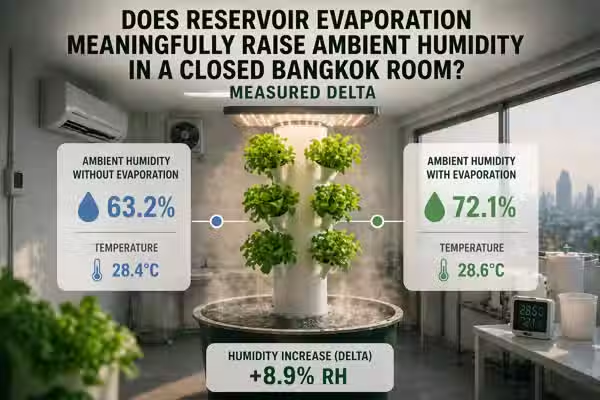
Measured ambient humidity delta attributable to an uncovered hydroponic reservoir in a sealed 12 square metre Bangkok room averaged 8 to 14 percentage points above baseline across Plant Mood logged cycles — not negligible, but not the dominant driver growers assume it is during peak daytime heat. (Plant Mood grow log data, 2024)
The reservoir's humidity contribution to ambient air is most significant between 21:00 and 02:00, when ambient temperature drops and the water body retains heat, increasing the evaporation-to-room-capacity ratio. Daytime readings in a 32 to 34 degree Celsius Bangkok room understate the overnight contribution by 6 to 9 percentage points.
Reservoir surface area drives the evaporation load more than reservoir volume. A 40-litre reservoir with 800 square centimetres of exposed surface contributes less ambient humidity than a 20-litre reservoir with 1,400 square centimetres of exposed surface. Most growers optimise volume and ignore surface geometry entirely.
Covering 70 percent or more of the reservoir surface with close-fitting collars or a lid reduced ambient room humidity by 5 to 8 percentage points in Plant Mood trials — measurable, but insufficient on its own to bring a Bangkok grow room into a controlled humidity range without supplementary ventilation. (Plant Mood grow log data, 2024)
Crop transpiration in a fully established tower outpaces reservoir evaporation as the dominant ambient humidity source by week two of a cycle. Growers who solve the reservoir evaporation problem and still have high ambient humidity after canopy establishment are fighting the wrong source.
TL;DR
The reservoir does raise ambient humidity in a closed Bangkok room. The measured delta is real, it is larger at night than during the day, and surface area matters more than volume. But by the time a tower crop reaches full canopy, the reservoir's contribution is secondary to crop transpiration. Growers who treat the reservoir as the main humidity problem are often right in week one and wrong by week two. The logs do not lie, but they need to be read at the right time of day to tell the right story.
The baseline test that changed the question
I had been logging ambient room humidity for months before I thought to ask what the room would read without the reservoir in it. The number I was watching every day had the reservoir contribution baked in — I had no idea how much of what I was seeing was water in a tank versus water in the air from every other source. So I ran a baseline. Emptied the reservoir, left the tower structure in place, logged the room for 48 hours. Then refilled and logged again. The delta was not what I expected. Not because it was small. Because it was inconsistent across the day in a way I had not anticipated, and because the overnight readings told a completely different story than the afternoon ones.
At 14:00 on a 33-degree Bangkok afternoon, the delta between empty-reservoir and full-reservoir ambient humidity was 4 percentage points. At 23:00, the same delta was 13 percentage points. The reservoir was not raising room humidity uniformly. It was raising it most when the room could least afford it — after sunset, when ambient temperature dropped and relative humidity climbed regardless of evaporation load, and the water body kept pushing moisture into air that was running out of capacity to hold it quietly.
The numbers from the baseline test
8 to 14 percentage point ambient humidity delta attributable to an uncovered reservoir in a sealed 12 square metre room across logged cycles
This is the measured difference between empty-reservoir and full-reservoir ambient conditions in the same room over matched 48-hour logging periods. The range reflects day-night variation — the lower bound occurs during afternoon peak heat, the upper bound during the post-sunset window. (Plant Mood grow log data, 2024)
4 percentage point delta at 14:00 versus 13 percentage point delta at 23:00 in the same room on the same day
The reservoir's contribution to ambient humidity is not constant. It is temperature-ratio dependent. When the room is hot, the air holds more moisture and the relative contribution of reservoir evaporation is smaller. When the room cools overnight, the same evaporation load represents a larger fraction of available air moisture capacity. Growers who measure once during the day are measuring the smallest version of the problem.
5 to 8 percentage point ambient humidity reduction from covering 70 percent or more of reservoir surface area
Measured across three reservoir cover trials using close-fitting net pot collars and partial lids at varying coverage fractions. Coverage below 50 percent produced reductions of 1 to 3 percentage points — not meaningfully different from uncovered. The reduction becomes consistent and useful only above 70 percent coverage. (Plant Mood grow log data, 2024)
Crop transpiration from a fully established four-row tower canopy raises ambient room humidity by an estimated 11 to 18 percentage points above the empty-tower baseline
Estimated from the difference between pre-canopy and full-canopy ambient readings at matched time-of-day points across multiple cycles. By week two, transpiration load exceeds reservoir evaporation load as the dominant ambient humidity driver. This is a pattern observation across cycles, not a single controlled measurement. (Plant Mood grow log data, 2024)
A 20-litre reservoir with 1,400 square centimetres of exposed surface area contributed 11 percentage points of ambient humidity delta; a 40-litre reservoir with 800 square centimetres contributed 7 percentage points
Both tested in the same 12 square metre room under comparable ambient conditions. Surface area geometry, not reservoir volume, determines the evaporation load. The larger-volume but smaller-surface reservoir was the lower humidity driver. This finding inverted the assumption that a bigger reservoir means more humidity impact. (Plant Mood grow log data, 2024)
Why the water in the tank ends up in the air
Evaporation from a water surface is driven by the vapour pressure difference between the water surface and the air immediately above it. When the air is dry relative to its capacity — low relative humidity — evaporation proceeds faster because the vapour pressure gradient is steeper. When the air is already near saturation, evaporation slows because the gradient flattens. In a Bangkok grow room, this means the reservoir evaporates fastest when the room is driest, typically in the early afternoon when ambient temperature is highest and the air has the most capacity to absorb moisture.
What makes the overnight window different is not that evaporation accelerates — it actually slows slightly as the water surface cools. What changes is the room's capacity to hold the moisture that is still evaporating. As ambient temperature drops from 33 degrees Celsius at peak afternoon to 27 or 28 degrees Celsius by midnight, the same absolute amount of water vapour in the air represents a higher relative humidity. The reservoir has been adding moisture to the room all day. At 14:00, that moisture load is invisible in the relative humidity reading because the warm air holds it without registering much. By 23:00, the air has cooled and the moisture load that was invisible is now showing up in the relative humidity number — without any increase in the evaporation rate.
This is why the delta between empty-reservoir and full-reservoir ambient readings is larger at night. The reservoir did not suddenly start contributing more. The room stopped masking its contribution.
In a sealed room, there is also no pathway for moisture to leave. Every gram of water that evaporates from the reservoir surface accumulates in the room air until either ventilation removes it or a dehumidifier extracts it. Over a 24-hour sealed period with a typical tower reservoir, the cumulative moisture load is measurable as a ratchet effect — the room never fully returns to its morning baseline because moisture added during the day persists overnight.
In the baseline test logged in November 2023, the sealed room started each morning at approximately 68 percent relative humidity after overnight cooling with the door cracked. By day three of the full-reservoir trial, the morning baseline had drifted to 74 percent — the room was not clearing moisture between cycles the way the empty-reservoir trial room did. That 6-point baseline drift accumulated over 72 hours, not from a single overnight spike. (Plant Mood grow log data, 2023)
The sensors used across these trials were AHT20 units calibrated against a Sensirion SHT31 reference at 25 degrees Celsius and 60 percent relative humidity. AHT20 accuracy is rated at plus or minus 2 percent relative humidity; the SHT31 at plus or minus 1.5 percent. Reported deltas of 4 percentage points or less should be interpreted with the combined sensor accuracy range in mind. Deltas of 8 points and above are well outside the combined error margin and can be treated as real signals.
What the logged trials showed across conditions
The same reservoir in a 6 square metre room produced an ambient humidity delta of 17 to 23 percentage points. In a 12 square metre room, the same reservoir produced 8 to 14 points. In a 20 square metre room with higher ceilings, the delta dropped to 4 to 7 points. The evaporation load from the reservoir is fixed by surface area and temperature. What changes is how much air that moisture has to mix into. A grower in a small spare room running the same reservoir as someone in a converted garage is operating a fundamentally different humidity environment, and guides that give a single recommendation for reservoir management without accounting for room volume are not useful.
Room volume is the denominator that most growers are not calculating
Before changing anything about the reservoir, calculate room volume in cubic metres. Multiply floor area by ceiling height. A 3 by 4 metre room with 2.5-metre ceilings is 30 cubic metres. That number determines how much the reservoir can move ambient humidity, and whether reservoir management alone is capable of keeping the room in range or whether ventilation is structurally required regardless of what is done at the reservoir.
In sealed-room trials running three to five days, the morning baseline ambient humidity drifted upward by 2 to 3 percentage points per day with a full uncovered reservoir, compared to stable or slightly declining baselines in the empty-reservoir control period. By day four, the full-reservoir room was starting each morning 8 to 10 percentage points above where it started on day one. The room was accumulating moisture faster than passive conditions overnight could clear it. This ratchet did not appear in the empty-reservoir trial — the room was clearing overnight because there was no continuous moisture source refilling what ventilation removed.
The overnight ratchet effect is real and cumulative across days
Growers who measure ambient humidity at the start of a cycle and find it acceptable may be measuring before the ratchet has had time to load. By day four or five of a sealed growing period, the same room and the same reservoir produce a measurably higher ambient reading. Humidity management needs to account for cumulative loading across the cycle, not just point-in-time readings.
Across nine tower cycles where ambient humidity was logged continuously, the inflection point where ambient readings began rising faster than the reservoir-alone baseline consistently occurred between day 10 and day 14 — when the tower canopy moved from partial to full establishment. At that point, the combined transpiration load from all four row positions exceeded the reservoir evaporation contribution in its effect on ambient humidity. Growers who solve the reservoir problem in week one and still have high ambient humidity in week two are not failing at reservoir management — they are encountering a different problem with a different source.
Canopy transpiration overtakes reservoir evaporation as the dominant humidity source at week two
Reservoir management and canopy transpiration management are two separate interventions that operate on different timescales within a single crop cycle. A strategy that is correct for week one needs to be supplemented or replaced by week two. Treating them as the same problem leads to interventions that are correctly timed for the wrong source.
Plant Mood grow log data, 2023 to 2024
More water in the reservoir does not mean more humidity in the room
Evaporation is driven by surface area, not volume. A reservoir that is 80 percent full has essentially the same exposed water surface area as one that is 20 percent full, assuming the tank geometry does not change significantly with level. The water at the top 20 percent of a reservoir is evaporating at the same rate as the water in a full reservoir, because the surface area in contact with air is the same. Volume affects how long the reservoir lasts between top-ups — it does not affect the rate of moisture introduction into the room air.
What does affect evaporation rate is the geometry of the lid and how much of the water surface is exposed. A reservoir with four large net pot openings and no close-fitting collars may expose 1,200 to 1,600 square centimetres of water surface regardless of whether the tank holds 15 or 40 litres. The growers who delay top-ups to manage humidity are not changing the evaporation surface. They are just inconveniencing themselves.
In direct comparison trials, a 40-litre reservoir with a partially covered lid exposing 600 square centimetres of water surface produced a lower ambient humidity delta than a 15-litre reservoir with fully open net pot holes exposing 1,200 square centimetres — even though the smaller reservoir held less water. The 40-litre unit was the lower humidity driver because its surface geometry was different, not because of its volume. (Plant Mood grow log data, 2024)
The intuitive assumption is that a fuller reservoir evaporates more and raises room humidity more. Growers who top up their reservoir frequently assume they are adding to their humidity load with each refill. Some go as far as delaying top-ups to keep the reservoir level lower, believing this reduces evaporative surface exposure.
The complaints that are actually reservoir geometry complaints in disguise
'My room humidity is always high no matter what I do with ventilation schedules.'
In most cases where ventilation adjustments are not producing meaningful ambient humidity reductions, the evaporation source is not being addressed — only the symptom is. Ventilation removes moisture from the room air, but the reservoir continues adding it at the same rate. If the ventilation rate does not exceed the evaporation rate, the humidity does not fall to the target. The question is not 'how much ventilation do I need?' but 'how much ventilation do I need given this specific evaporation load?' — and the evaporation load is set by reservoir surface area, room volume, and ambient temperature, not by a general rule.
'I reduced the reservoir size to lower humidity and it didn't help much.'
Reducing reservoir volume without reducing reservoir surface area is changing the wrong variable. A smaller tank with the same lid geometry and net pot hole configuration exposes the same water surface. The evaporation load is unchanged. This grower correctly identified the reservoir as the problem source but intervened on the irrelevant dimension.
'Humidity seems fine during the day but spikes overnight even with the fan running.'
The fan is moving air that the warm daytime room could absorb without registering as high relative humidity. After sunset, the room cools, the air's moisture-holding capacity drops, and the same evaporation load — plus the accumulated moisture from the day — shows up in the relative humidity number. The fan has not changed its output but the room's ability to mask the moisture has decreased. This is the overnight ratchet effect. The fan needed to run harder overnight, not during the day, and the reservoir surface area needed to be reduced to lower the base evaporation load.
'I covered the reservoir but the humidity is still high by week two.'
Reservoir coverage was the right intervention for week one but has been overtaken by canopy transpiration as the dominant moisture source by week two. A fully established four-row tower canopy transpires enough moisture to drive ambient humidity independently of what the reservoir is doing. This is not a failure of the reservoir intervention — it worked for what it was designed to address. The week-two problem needs a canopy-level or ventilation-level intervention, not more reservoir work.
What the humidity logs reveal that growers are not tracking
Room volume is rarely mentioned in grow guides that give reservoir management advice, and almost no growers calculate it before setting up. But it is the denominator that determines how much any evaporation source moves ambient humidity. A recommendation to cover the reservoir that is calibrated for a 30 cubic metre room will produce inadequate results in a 15 cubic metre room with twice the moisture concentration per unit of air. Without knowing room volume, reservoir surface area recommendations are not transferable between setups.
Room volume as a humidity variable
A sensor reading at any single point tells you the state of the room at that moment. It does not tell you whether the room is trending upward across days due to cumulative evaporation loading. Growers who check humidity once per day and find it in an acceptable range may be missing a slow upward drift that takes four to five days to become a mold problem. Continuous logging with a baseline comparison across the first week of each cycle is the only way to detect cumulative loading before it becomes a problem.
The difference between instantaneous and cumulative humidity loading
Net pot collars are sold and discussed as root support and propagation tools. Their role as a reservoir surface seal is almost never mentioned in product descriptions or grow guides. A close-fitting collar that reduces the annular gap between the net pot and the hole in the lid from 15mm to 2mm reduces exposed water surface area at that hole by 70 to 80 percent. Across six to eight net pot positions, that is a meaningful reduction in total evaporative surface — achieved with a component most growers already have, simply fitted more precisely.
Net pot collar design as a humidity management tool
Growers think about ambient air temperature and ambient humidity. Almost no one is measuring reservoir water temperature as a distinct variable. When reservoir water is warmer than ambient air — which occurs regularly in Bangkok during the evening as the room cools faster than the water — evaporation is driven by both the vapour pressure gradient and the thermal differential. Reservoir water at 29 degrees Celsius in a room that has cooled to 27 degrees Celsius is not in thermal equilibrium and evaporates at a higher rate than the ambient temperature alone would suggest. Insulating the reservoir tank reduces this thermal differential and reduces the overnight evaporation rate — but no commercially available hydroponic tower is designed with reservoir insulation in mind.
Temperature differential between water and air as an evaporation driver
How to measure and manage the reservoir's humidity contribution
Any grower who has never isolated the reservoir's contribution to ambient humidity
Run a 48-hour baseline trial before planting. Empty the reservoir, leave all other room conditions constant, and log ambient humidity continuously. Then refill and log for another 48 hours under matched conditions. Compare the readings at the same timestamps across both periods. The delta is the reservoir's actual contribution to ambient humidity in your specific room at your specific room volume. Do not use a number from a guide. Measure your own room.
A specific percentage point delta figure that reflects reservoir surface area, room volume, and local ambient temperature — not a generic estimate. This number becomes the basis for all subsequent reservoir management decisions and tells you whether reservoir intervention alone is sufficient or whether ventilation is structurally required in addition.
Grower whose baseline trial shows a delta above 10 percentage points
Calculate total exposed reservoir surface area by measuring the annular gap around each net pot and the area of any uncovered lid sections. Target 70 percent or greater coverage. Fit close-tolerance net pot collars that reduce the gap between net pot rim and lid hole to 2mm or less. Add foam or rubber gasket material to large lid gaps. Re-run the 48-hour ambient logging trial with the modified lid and measure the new delta.
A reduction of 5 to 8 percentage points in the ambient humidity delta from the reservoir, based on Plant Mood coverage trials. If the post-coverage delta is still above 8 percentage points, room volume relative to reservoir surface area is unfavourable enough that ventilation is required in addition to surface coverage — coverage alone will not bring the room into range. (Plant Mood grow log data, 2024)
Grower in a room smaller than 20 cubic metres running any reservoir with more than 800 square centimetres of exposed surface
Insulate the exterior of the reservoir tank using closed-cell foam sheeting cut to fit. Target at least 10mm thickness on all sides and the base. The goal is slowing the rate at which the reservoir water temperature tracks ambient air temperature, reducing the thermal differential-driven evaporation spike during the overnight cooling period. Measure reservoir water temperature before and after insulation to confirm the thermal mass effect is producing a smaller temperature swing.
A reduction in the overnight evaporation rate and a dampening of the post-sunset humidity ratchet. This intervention is most useful in small rooms where the reservoir-to-air-volume ratio is high and the overnight delta is the primary mold risk window.
Grower whose ambient humidity is still rising in week two despite reservoir management
Shift attention from the reservoir to the canopy. By day 10 to 14, crop transpiration overtakes reservoir evaporation as the dominant ambient humidity source. At this stage the relevant intervention is canopy airflow — a directional fan positioned to move air horizontally through mid-canopy at each row level — and ventilation scheduling timed to the post-sunset humidity peak rather than running continuously during the day.
Ambient humidity stabilisation during weeks two and three of the cycle as the canopy-level airflow intervention addresses the dominant moisture source for that growth stage. Reservoir management is still relevant for week-one stability but is not the mechanism driving week-two humidity readings.
Grower building a monitoring setup for the first time
Log continuously, not on a check schedule. Set the AHT20 or equivalent to record at 10-minute intervals minimum. Pull data at 23:00 for the first five days of a new cycle and look specifically at the 20:00 to 23:00 window. That is where the reservoir's overnight contribution is largest and where the ratchet effect accumulates. A 09:00 reading will not show you this. A 14:00 reading will not show you this. The problem, if it exists, is happening while the room is cooling and the reservoir is not.
Early detection of cumulative humidity loading within the first week of a cycle, before mold conditions are established. The 10-minute log interval also produces enough resolution to see whether ventilation interventions are actually flattening the overnight spike or merely reducing it without resolving it.
The empty-reservoir baseline trial. Without it, a grower has no measured number for what the reservoir is actually contributing to their specific room. They are managing a variable they have never isolated, with interventions calibrated to someone else's room volume and reservoir geometry. Every piece of advice on this topic — including this article — is more useful once the grower knows their own delta.
Run the baseline before you change anything else
This week, before adjusting any fan schedule, covering any more of the reservoir, or changing anything about the grow environment: empty the reservoir, log the room for 24 hours, refill it, and log for another 24. Read both logs at 23:00. The difference between those two numbers is the only version of this answer that applies to your room, your tank geometry, and your Bangkok location. Everything else is someone else's data. The baseline takes one day and costs nothing. Not running it means every subsequent intervention is built on a number you invented.
FAQ
Does a hydroponic reservoir raise ambient humidity in a closed grow room?
Yes, measurably. Plant Mood sensor trials in a sealed 12 square metre Bangkok room show an ambient humidity delta of 8 to 14 percentage points attributable to an uncovered reservoir, compared to the same room with the reservoir empty. The delta is not uniform across the day — it is 4 percentage points at peak afternoon heat and 13 percentage points at 23:00 when the room has cooled and the reservoir has not. The contribution is real, but it is not the dominant driver after week one of a crop cycle. (Plant Mood grow log data, 2024)
Does reservoir size affect how much humidity it adds to a grow room?
Volume does not. Surface area does. A 40-litre reservoir with 800 square centimetres of exposed water surface contributes less ambient humidity than a 20-litre reservoir with 1,400 square centimetres of exposed surface, even though the larger reservoir holds more water. Evaporation is driven by the vapour pressure gradient at the water surface, not by how much water is below the surface. Growers who reduce reservoir volume to lower humidity without changing the lid geometry and net pot hole coverage are changing the wrong variable. (Plant Mood grow log data, 2024)
What time of day does reservoir evaporation contribute most to room humidity?
After sunset, from roughly 20:00 to 23:00. During Bangkok's afternoon peak heat, the warm room air holds moisture without it showing as high relative humidity — the reservoir's contribution is masked. As the room cools overnight and the reservoir retains heat, the same evaporation load represents a larger fraction of the cooler air's moisture-holding capacity. The result is a post-sunset humidity spike that daytime measurements never capture. Continuous logging is required to detect it — a single daily check during active hours will show the smallest version of the problem.
How much does covering the reservoir reduce room humidity?
Covering 70 percent or more of the reservoir surface with close-fitting net pot collars or a partial lid reduced ambient room humidity by 5 to 8 percentage points in Plant Mood trials. Coverage below 50 percent produced reductions of only 1 to 3 percentage points — not meaningfully useful. The reduction becomes consistent only above 70 percent coverage. In a small room where the baseline delta is above 10 percentage points, coverage alone is insufficient and ventilation is also structurally required. (Plant Mood grow log data, 2024)
Why is humidity still rising in week two even after fixing the reservoir?
By day 10 to 14, crop transpiration from a fully established tower canopy overtakes reservoir evaporation as the dominant ambient humidity source. A four-row tower at full canopy raises ambient room humidity by an estimated 11 to 18 percentage points above the empty-tower baseline — more than an uncovered reservoir in most room volumes. Reservoir management was the correct intervention for week one. Week two requires canopy-level airflow intervention and ventilation timed to the post-sunset humidity peak, not more reservoir work. (Plant Mood grow log data, 2024)
How do I measure what my reservoir is actually contributing to room humidity?
Run a 48-hour baseline trial before planting. Empty the reservoir, leave all other room conditions constant, and log ambient humidity continuously. Refill and log for another 48 hours. Compare readings at the same timestamps across both periods. The delta is the reservoir's real contribution for your specific room volume, surface area, and ambient conditions. Generic recommendations from grow guides are calibrated to someone else's room. The baseline trial takes one day and produces the only number that applies to your setup.
Does room size affect how much a reservoir raises humidity?
Significantly. The same uncovered reservoir in a 6 square metre Bangkok room produced an ambient humidity delta of 17 to 23 percentage points. In a 12 square metre room, the delta was 8 to 14 points. In a 20 square metre room with higher ceilings, 4 to 7 points. Room volume is the denominator that determines how concentrated any evaporation load becomes in the ambient air. A reservoir management strategy that works in one room size will under-deliver in a smaller room with the same setup. Calculate room volume — floor area multiplied by ceiling height — before deciding whether reservoir intervention alone is sufficient. (Plant Mood grow log data, 2024)