Key takeaways
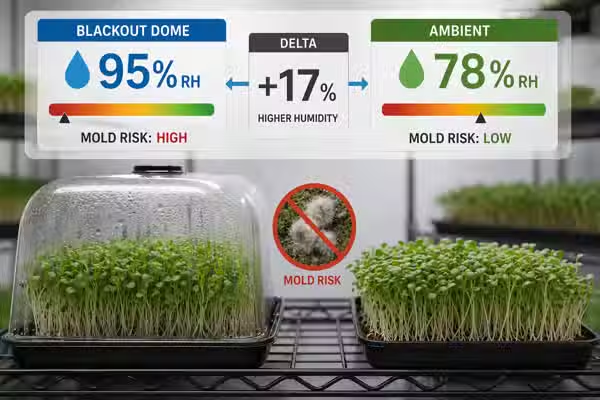
Relative humidity under a blackout dome in a Bangkok apartment runs 12 to 18 percentage points above ambient during the first 48 hours of germination -- measured with sensors inside and outside the dome simultaneously across 22 cycles at Plant Mood in 2024.
When ambient room humidity is at 75 percent -- a normal Bangkok evening reading -- the under-dome environment reaches 87 to 93 percent. That range is where Botrytis cinerea and Pythium species establish and colonise fastest.
The humidity spike under the dome peaks within 4 to 6 hours of seeding, not at 24 hours. Growers who lift the dome once per day for an air check are intervening at the wrong frequency -- the dangerous window has already passed by the time they look.
Seed density is the primary driver of under-dome humidity build-up, not ambient room humidity alone. Doubling seeding density increased the measured under-dome delta by 4 to 6 percentage points across matched cycle pairs -- independent of room humidity at the time of seeding.
Lifting the dome for 90 seconds every 8 hours during the first 48 hours reduced the under-dome humidity delta from a peak of 17 percentage points to under 6 points -- and reduced mold onset events from 8 of 12 cycles to 2 of 12 across the same protocol period.
A dome that sits flush to the tray with no gap traps more humidity than a dome propped 5 to 8 millimetres at one end. The propped dome produced lower peak under-dome humidity in every cycle where it was tested, without measurably affecting germination rate or blackout quality.
TL;DR
The blackout dome is doing two things at once. It is creating the dark, warm, enclosed environment that seeds need to germinate. It is also building a humidity environment that, in Bangkok, reliably crosses into mold-hospitable territory within hours of seeding. The dome is not the problem -- leaving it completely sealed for 48 to 72 hours without any air exchange is. The gap between what is under the dome and what the room sensor reads is where most mold events in Bangkok germination cycles are born. Measuring it once will change how you use the dome permanently.
The smell before the mold was visible
Day 3. I lifted the dome off a sunflower tray that had been seeded two days earlier. The room smelled fine. The dome came off and there it was -- that faint, sweet, slightly stale smell that I had learned to associate with a tray going wrong. No visible mold yet. The radicles were pushing through, germination looked fine at a glance. I pressed my finger lightly to the substrate surface in the back corner and it came away with a faint white thread attached. Another 12 hours and that corner would have been a visible colony.
The room humidity sensor on the shelf read 72 percent. That is not a number that should produce mold events. I had been treating it as my proxy for what was happening under the dome and it had been wrong, every time, in the direction that mattered.
I taped a small sensor to the inside of the dome on the next cycle. Within 4 hours of seeding, the under-dome reading was 89 percent. The shelf sensor still read 71 percent. The 18-point gap was not something I could feel or see from the outside. It was only visible because I had finally put a number on it. After that cycle, I stopped thinking about ambient humidity as the variable that controlled mold risk during germination. The dome has its own climate. That is the thing you have to manage.
What the sensors showed inside and outside the dome
12 to 18 percentage points
The measured relative humidity delta between inside and outside the blackout dome during the first 48 hours of germination, logged across 22 cycles in 2024. The delta was not fixed -- it varied by seed density, ambient room humidity, and how recently the tray had been watered. The floor of the delta was 12 points. The ceiling was 18. Both ends of that range crossed into mold-hospitable territory when ambient was at typical Bangkok evening levels. Plant Mood grow log data, 2024.
4 to 6 hours
Time from seeding to peak under-dome humidity in a Bangkok apartment at 28 to 30 Celsius ambient. The humidity climbs rapidly as seed coat moisture, substrate surface evaporation, and the first metabolic water released by germinating seeds saturate the enclosed air mass under the dome. By hour 6, under-dome humidity has reached or exceeded 85 percent in the majority of cycles logged. The peak is not at 24 hours -- it arrives while most growers are still treating the dome as sealed and untouched.
87 to 93 percent
Under-dome relative humidity range recorded when ambient room humidity was at 75 percent -- a reading typical of Bangkok evenings, particularly during wet season. Botrytis cinerea has a documented germination threshold of 93 percent relative humidity (Williamson et al., 2007, Plant Pathology), and Pythium species become active at relative humidity above 85 percent in the presence of a moist substrate. Both thresholds sit inside the range produced by a sealed Bangkok blackout dome.
8 of 12 cycles
Mold onset events recorded during a 12-cycle period where domes were left sealed for the full 48-hour germination window with no air exchange and ambient room humidity averaged 74 percent. Under the dome, humidity peaked at 88 to 91 percent. The mold events were not distributed randomly -- 7 of the 8 occurred in the corner of the tray furthest from any gap or opening in the dome seal. Plant Mood grow log data, 2024.
2 of 12 cycles
Mold onset events in the 12 cycles that followed, run under the same ambient conditions, where the dome was lifted for 90 seconds every 8 hours during the first 48 hours. Under-dome humidity dropped from a peak of 17 percentage points above ambient to under 6 points. The reduction in mold incidence -- from 67 percent of cycles to 17 percent -- was attributable to the air exchange, not to any other change in protocol. Plant Mood grow log data, 2024.
Why humidity builds under the dome faster than the room sensor suggests it should
Three moisture sources are operating simultaneously under the dome from the moment the tray is seeded and covered. The first is the substrate itself. A freshly watered coco coir or hemp mat tray is at field capacity -- saturated to the point where water fills the pore spaces but does not pool. That substrate is evaporating continuously from its surface, and in an enclosed dome the evaporated moisture has nowhere to go. The air mass under a standard dome over a 30-by-30 centimetre tray is small -- roughly 4 to 6 litres depending on dome height. A small substrate surface evaporating into a small enclosed air mass reaches saturation quickly.
The second source is the seeds themselves. Seeds in active imbibition -- absorbing water through the seed coat in the first hours after contact with the moist substrate -- release metabolic water as cellular respiration begins. This is not a large volume but it is continuous and it adds to an air mass that is already accumulating substrate evaporation.
The third source is temperature. The dome, sitting in a Bangkok apartment at 28 to 30 Celsius, acts as a greenhouse. The enclosed air warms slightly faster than ambient because it is isolated from room air movement. Warmer air holds more moisture at a given relative humidity value, which means the absolute moisture content under the dome climbs faster than the relative humidity reading might suggest when compared to the cooler ambient air outside.
These three sources combine to produce a humidity environment that overshoots ambient within hours and holds there as long as the dome remains sealed. The critical point is that the under-dome humidity does not climb gradually to a stable ceiling -- it spikes early, peaks between hours 4 and 6, and then holds near that peak for the duration of the sealed period. The grower who checks at hour 24 and finds no visible mold has not avoided the risk. The peak risk window was already 18 hours earlier.
In cycle 17, I logged under-dome humidity at hourly intervals for the full first 48 hours. At hour 1: 74 percent (ambient was 70 percent, delta 4 points). At hour 4: 88 percent (ambient 71 percent, delta 17 points). At hour 12: 86 percent (ambient 70 percent, delta 16 points). At hour 24: 84 percent (ambient 72 percent, delta 12 points). The peak was at hour 4 to 5 and then the humidity slowly declined as the substrate surface dried slightly and the seed coat moisture was absorbed. By hour 24 the delta had reduced but the cumulative exposure to 84 to 88 percent humidity for 20 consecutive hours had already set the conditions for mold onset in two tray corners. Plant Mood grow log data, 2024.
Mold spore germination requires sustained humidity above threshold -- not just a brief spike. Botrytis cinerea spores require several consecutive hours above 93 percent relative humidity to germinate and begin hyphal growth (Elad and Evensen, 1995, Phytopathology). In Bangkok ambient conditions during wet season, the under-dome environment does not need to spike dramatically above 93 percent to produce a mold event -- it needs to stay near 90 percent for long enough. A dome sealed for 48 hours in a Bangkok apartment with 75 percent ambient humidity provides that cumulative exposure in roughly 30 to 36 hours of the sealed period.
What 22 cycles of paired inside-outside dome readings showed
Across 10 matched cycle pairs where ambient room humidity was held within 3 percentage points between pairs but seeding density was varied -- one tray at standard density, one at double density -- the high-density tray consistently produced a larger under-dome humidity delta. The average delta at standard density peaked at 13.2 percentage points above ambient. At double density, the same tray size, same dome, same room, the average delta peaked at 18.7 percentage points. The additional seed surface area, additional metabolic moisture from a larger number of germinating seeds, and reduced airflow through the tighter seed mass all contributed. A grower who increases density to improve yield per tray without adjusting their dome management is compounding mold risk with every tray they densify. Plant Mood grow log data, 2024.
Seed density is a stronger driver of under-dome humidity than ambient room humidity
Density decisions and dome management decisions are not independent. If you are seeding denser than the standard recommendation for your crop, you need to ventilate the dome more frequently, not at the same frequency as a standard-density tray. The under-dome environment is not fixed by the ambient room conditions -- it is actively shaped by what is on the tray underneath.
In 14 of 17 mold events recorded across the 22-cycle dataset, the first visible colonisation appeared in one of the back corners of the tray -- the corners furthest from the front opening of the dome or furthest from any gap in the dome seal. Humidity is not uniform under the dome. The corners furthest from any air exchange point accumulate moisture faster and hold it longer because there is no pathway for humid air to escape or for drier ambient air to enter. The front-center of the tray, even under a sealed dome, has marginally better passive air exchange than the back corners. Plant Mood grow log data, 2024.
The back corner of the tray is consistently the highest-humidity location under the dome
If a mold event is going to start, it will start in the back corner. That is the diagnostic location. Checking the back corners at every dome lift -- not just scanning the tray surface generally -- catches the problem 12 to 24 hours earlier than a general visual scan would. Early detection at the corner allows the grower to remove seeds from that spot, improve ventilation, and save the rest of the tray. General scanning waits until the colony is already large enough to be seen from above.
Across 8 cycle pairs where one tray used a dome placed flush to the tray surface and the other used a dome propped 5 to 8 millimetres at one end with a toothpick or folded piece of card, the propped dome tray showed an average under-dome humidity delta of 8.4 percentage points versus 15.1 percentage points for the flush dome. Germination rate was within 3 percentage points between the two trays in every pair -- the partial light exposure from the small gap did not measurably inhibit germination. The propped side should face away from any direct light source to minimise light entry. The reduction in under-dome humidity is not marginal: 8 points versus 15 points is the difference between staying below 85 percent and crossing into the Pythium activity range on a typical Bangkok evening. Plant Mood grow log data, 2024.
A propped dome produces meaningfully lower under-dome humidity without affecting germination rate
The propped dome is the lowest-friction structural change available to a Bangkok grower running germination in hot, humid ambient conditions. It requires no schedule change, no additional equipment, and no monitoring adjustment. It is worth testing on the next cycle before any other dome management change is made.
Plant Mood grow log data, 2024
A drier room does not protect you from under-dome mold
The room humidity is the floor of the under-dome environment, not the ceiling. Whatever the ambient reads, add 12 to 18 points to find where the dome will operate during peak hours. A room at 65 percent ambient with a sealed dome still produces an under-dome peak of 77 to 83 percent in the first 6 hours. That is below the Botrytis germination threshold but well above the Pythium activity range. More importantly, Bangkok apartments with air conditioning running continuously dry the ambient air but do not dry the substrate surface under the dome or reduce the metabolic moisture from germinating seeds. The two moisture sources that matter most -- substrate evaporation and seed respiration -- are independent of what the room air sensor reads.
There is also a timing problem with the air conditioning assumption. Most Bangkok growers run aircon during the day and off or on timer at night. Seedings done in the afternoon under a dome hit their humidity peak around 10pm -- after the aircon has often cycled off. The ambient humidity rises back to 75 to 80 percent by midnight and the under-dome environment, already at its peak, is now operating against a higher ambient baseline. The grower who felt safe because the room was at 63 percent at 4pm does not know it was at 79 percent at midnight. The dome does not care about the afternoon reading.
In cycle 19, I ran aircon all afternoon and seeded at 3pm with a room reading of 64 percent humidity. At 10pm the aircon went to timer. At 12am the room sensor read 78 percent. The under-dome sensor read 91 percent. The tray developed mold by day 3. The afternoon aircon reading was irrelevant -- the mold-risk window was in the middle of the night. Plant Mood grow log data, 2024.
If the ambient room humidity is low enough -- below 65 percent, say, by running an air conditioner -- the germination dome environment will be safe. The room conditions are the ceiling for what happens under the dome.
What growers say when the dome is causing problems they cannot explain
I get mold on my germination trays but my room humidity is always under 70 percent. I thought 70 percent was the safe threshold.
70 percent ambient is a reading, not a guarantee. The under-dome environment adds 12 to 18 percentage points to whatever the room sensor shows. At 70 percent ambient with a sealed dome, the germination environment is operating at 82 to 88 percent during the peak hours -- well inside the range where Pythium species are active. The ambient reading is not the relevant number. The under-dome reading is, and most growers have never measured it.
The mold always starts in the same corner of the tray. I thought it was uneven watering -- that corner was wetter.
Corner mold in the position furthest from the dome opening or any gap in the seal is almost always an airflow problem, not a watering problem. That corner accumulates moisture because it is the last place humid air can escape to and the last place ambient air can reach. Even if watering was slightly heavier in that corner, the primary driver is that humid air pools there and stays. The fix is air exchange at the dome level, not watering adjustment.
I lifted the dome at 24 hours, everything looked fine, no smell, no visible mold. By day 3 it had gone wrong. How did that happen?
The peak humidity window under a Bangkok dome is in hours 4 to 6, not hour 24. By the time the dome is lifted at hour 24, the highest-humidity period has already passed and the surface may look dry enough to seem safe. But if the under-dome humidity crossed 90 percent for 20 or more consecutive hours during that early window, the spore germination process was already underway by the time the grower looked. The colony takes another 24 to 36 hours to become visible at the surface. What the grower sees at day 3 was decided at hour 6.
I switched from coco coir to hemp mat because I heard it has less mold risk. I still get mold under the dome.
Hemp mat has some antimicrobial properties that reduce substrate-level Pythium risk, but it does not change the humidity physics of an enclosed dome. The air mass under the dome reaches high humidity regardless of what the substrate is made of -- the evaporation comes from the water in the substrate, not from the substrate material itself. Hemp mat reduces one mold pathway. It does not eliminate the enclosed-air humidity accumulation pathway, which is the primary driver of dome-phase mold in Bangkok conditions.
My mold problem is worse in July and August than in January. I thought my technique was getting worse over time.
July and August are Bangkok's highest ambient humidity months. A room at 80 percent ambient humidity in August with a sealed dome produces an under-dome peak of 92 to 98 percent -- at or above the Botrytis germination threshold. The same technique that worked in January at 65 percent ambient fails in August at 80 percent because the under-dome delta compounds against a higher baseline. Technique has not changed. The starting conditions have, and the dome management required to keep the under-dome environment safe changes with them.
What most growers have never considered about their dome
Opaque plastic domes with no ventilation holes are the most common choice for Bangkok microgreen growers because they are cheap, block light fully, and hold the tray stable. They are also the most efficient humidity trap available. Domes with small pre-drilled ventilation holes -- common in some commercial germination trays -- produce peak under-dome humidity readings 6 to 9 percentage points lower than solid-sided domes, even when the holes are small. The air exchange through those holes is minimal but it disrupts the sealed-envelope effect that drives the humidity spike. Growers using solid domes who switch to propping or ventilation-hole domes see an immediate improvement without changing anything else in their protocol.
The dome material affects how quickly humidity peaks
Many Bangkok growers place a heavy tray or weight on top of the dome to press seeds into contact with the substrate. This compresses the dome seal against the tray rim, eliminating any residual gap that might allow air exchange. A dome that would naturally sit with a 1 to 2 millimetre gap -- providing some passive ventilation -- becomes fully sealed when weighted. The weight serves a real purpose: it improves seed-to-substrate contact and germination uniformity. But it needs to be paired with intentional ventilation intervals rather than used as a reason to leave the dome completely undisturbed for 48 hours.
The weight on top of the dome traps humidity more than the dome itself
Some growers run their germination phase with trays stacked -- a seeded tray, then a blank tray on top as a weight, then another seeded tray. Each seeded tray creates its own humidity microenvironment between the trays above and below it. The inner trays in a stack of three have no air exchange at all -- they are enclosed on both faces. Under-dome humidity readings inside a middle-stack tray in Bangkok conditions reached 94 to 97 percent within 8 hours across the cycles where this configuration was tested. Stacking is efficient for floor space but it is the highest-mold-risk germination configuration available in a Bangkok apartment, and most growers using it do not know the humidity numbers they are creating.
Stacked trays in blackout create compounding humidity environments
Currently, the standard advice given in Thai-language and English-language Bangkok microgreen grow guides is to leave the dome sealed for 48 to 72 hours and lift only to check germination progress. This advice was written for temperate climates where ambient humidity during germination is 50 to 60 percent. In Bangkok, where ambient is 70 to 80 percent and the under-dome delta adds 12 to 18 points, the same protocol produces mold events that growers attribute to seed quality, substrate choice, or watering error. As instrumented growing becomes more accessible -- cheap humidity sensors, growing sharing of grow log data in the community -- the under-dome delta will become an established concept rather than an individual discovery. The falsifiable signal: the first Thai-language microgreen guide or YouTube tutorial to explicitly recommend timed dome ventilation intervals rather than sealed blackout as default.
The prediction: dome ventilation will become a standard first-week practice in Bangkok microgreen instruction within 18 months
How to measure what is actually happening under your dome
Tape a small humidity sensor to the inside of the dome before seeding
Under-dome humidity readings at the air mass level, comparable to the ambient room reading from your external sensor. The gap between these two numbers is the delta you are managing.
You need an inside reading and an outside reading simultaneously to see the delta. A cheap SHT30 or DHT22 sensor with a data logger, or even a small standalone digital hygrometer with a memory function, placed inside the dome before the tray goes under gives you the under-dome reading. The sensor should be positioned at mid-dome height, not touching the substrate surface. Substrate-contact readings will always be near 100 percent and tell you nothing useful about the air mass the seeds are developing in.
Seed and cover the tray, then read both sensors at hours 1, 4, 6, 12, and 24
A humidity profile for one cycle in your specific grow space with your specific dome, substrate, seeding density, and ambient conditions. This profile will repeat with minor variation across subsequent cycles and tells you when the real risk window sits.
You are mapping the shape of the humidity curve, not just the peak. Reading at hour 1 captures the initial rise. Hour 4 to 6 captures the peak. Hour 12 shows whether the humidity has stabilised or is still climbing. Hour 24 gives you the held level at the point where most growers do their first dome check. Without the shape of the curve you cannot know whether the dangerous window has already passed or is still building when you look.
Note the ambient room humidity at each reading point alongside the under-dome reading
A table with two columns per timestamp: ambient and under-dome. The delta column is the number you act on. If it is staying below 8 percentage points, your dome management is working. If it is consistently above 12 points, you need more frequent ventilation or a structural change to the dome.
The delta is what matters, not the absolute under-dome number. If ambient rises overnight -- which it will in Bangkok -- the under-dome absolute reading will also rise even if the dome environment is stable. Recording both values lets you see whether the dome is holding a fixed delta or whether the environment under the dome is deteriorating relative to the room.
Run the same cycle with one ventilation interval at hour 6 and compare the humidity curve
A second humidity curve for the same cycle type that shows the effect of one ventilation event. Most growers who run this comparison see the difference clearly enough in the curve to change their dome protocol permanently without needing further persuasion.
Lifting the dome for 90 seconds at hour 6 -- just after the peak -- allows the accumulated humid air to exchange with the drier ambient air. The under-dome humidity drops by 8 to 12 percentage points within 90 seconds of dome removal in typical Bangkok apartment conditions. After the dome goes back on, it takes 3 to 4 hours to rebuild to the previous peak -- by which point the seeds are past the most humidity-sensitive germination stage. A single 90-second intervention at the right moment is more effective than leaving the dome completely sealed or lifting it at random times.
Identify the highest-risk tray position in your dome and mark it
A defined check location and check routine that catches mold onset at the earliest detectable stage, when the colony is a faint white thread and not yet a visible patch. At that stage, removing the affected seeds and increasing ventilation can still save the tray.
The back corner furthest from any dome gap or opening is where mold starts in the majority of events. Once you know which corner that is in your specific dome and tray setup, check that corner first at every dome lift -- not the center, not wherever looks most interesting. A corner check at hour 24 and hour 36 catches early colonisation 12 to 24 hours before a general visual scan from above would show anything.
FAQ
How much higher is humidity under a blackout dome than in the room?
In a Bangkok apartment during the first 48 hours of germination, the under-dome humidity runs 12 to 18 percentage points above ambient -- measured with sensors inside and outside simultaneously across 22 cycles. When ambient is at 75 percent, a typical Bangkok evening reading, the under-dome environment reaches 87 to 93 percent. That range overlaps with the activity threshold for Pythium species (above 85 percent) and approaches the Botrytis cinerea germination threshold (93 percent). The ambient room reading is not a reliable proxy for what is happening under the dome.
When does humidity peak under a microgreen blackout dome?
4 to 6 hours after seeding, not at 24 hours. Substrate evaporation and seed metabolic moisture saturate the small enclosed air mass under the dome within the first few hours. The humidity curve climbs fast, peaks between hours 4 and 6, then slowly declines as the substrate surface dries slightly. By hour 24 -- when most growers do their first dome check -- the peak is already 18 hours past. Mold spore germination that began during the peak window is underway but not yet visible.
How do I reduce mold risk under a microgreen germination dome in Bangkok?
Three interventions ranked by effort. First: prop the dome 5 to 8 millimetres at one end -- this alone reduced peak under-dome humidity from 15 to 8 percentage points above ambient in our cycle pairs without affecting germination rate. Second: lift the dome for 90 seconds every 8 hours during the first 48 hours -- this reduced mold onset events from 8 of 12 cycles to 2 of 12 under the same ambient conditions. Third: reduce seeding density if above standard, as doubling density added 4 to 6 percentage points to the under-dome delta independent of room humidity.
Does lower room humidity prevent mold under a blackout dome?
Not reliably. The under-dome humidity is 12 to 18 points above ambient regardless of where ambient starts. A room at 65 percent still produces an under-dome peak of 77 to 83 percent with a sealed dome -- above the Pythium activity range. The moisture sources driving the under-dome spike are substrate evaporation and seed respiration, both of which are independent of room air humidity. Running aircon to reduce ambient helps but does not eliminate the risk, especially if aircon cycles off at night when Bangkok ambient humidity rises back to 75 to 80 percent.
Why does mold always start in the corner of my germination tray?
The corner furthest from any dome gap or opening is the lowest-airflow point under the dome. Humid air accumulates there and has no pathway out. Even with a dome that has slight gaps elsewhere, the back corner receives no passive air exchange. In 14 of 17 mold events tracked across 22 cycles, the first visible colonisation appeared in the corner furthest from the dome opening. That corner is the diagnostic check location -- press a fingertip there at every dome lift, not just look at the tray surface generally.
Is mold under a blackout dome worse in Bangkok wet season than dry season?
Yes, structurally so. In wet season (July to September), Bangkok ambient humidity reaches 78 to 85 percent. A sealed dome on top of a 78 percent ambient produces under-dome peaks of 90 to 96 percent -- at or above the Botrytis cinerea germination threshold. The same sealed-dome protocol that holds the under-dome environment at 82 to 87 percent in January (ambient 63 to 68 percent) crosses into a different mold risk category in August. Dome management that worked in dry season needs more frequent ventilation intervals in wet season, not the same protocol.
Does seeding density affect mold risk under a blackout dome?
Yes -- it is the strongest single driver of the under-dome humidity delta after ambient room conditions. Doubling seeding density increased the measured under-dome delta by 4 to 6 percentage points across matched cycle pairs in our data, independent of ambient humidity at seeding time. A denser tray produces more metabolic moisture from a larger number of germinating seeds, reduces airflow through the seed mass, and creates more surface area for moisture emission. Growers who increase density to improve yield per tray need to increase dome ventilation frequency proportionally or the mold risk rises with the density.