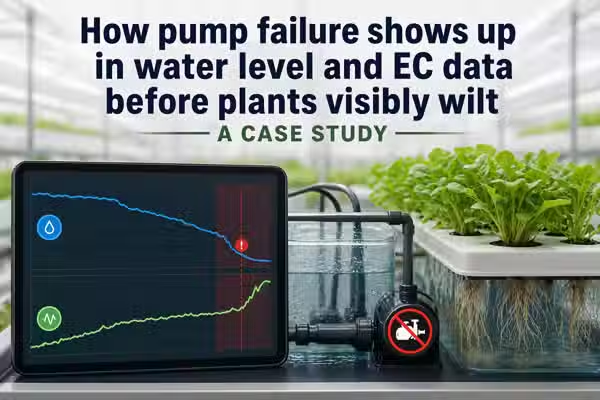
Key takeaways
In Plant Mood grow log data, EC concentration rose 0.4 to 0.8 mS/cm above baseline within 2 to 4 hours of pump failure before any visible wilting appeared, because circulation stops but evapotranspiration continues concentrating the solution.
Water level drop rate is the faster signal: a healthy recirculating system holds level variance within plus or minus 3 mm per hour; a failed pump in a Bangkok ambient of 32 to 34 degrees Celsius produces level drop rates of 6 to 11 mm per hour from evaporation alone within the first 90 minutes.
Dissolved oxygen depletion is the mechanism that causes root damage in tropical climates: at 32 degrees Celsius, a stagnant reservoir loses roughly 40 percent of its dissolved oxygen within 3 hours compared to an actively circulating one, and root cell damage begins before leaf turgor visibly changes.
The most common misread is attributing an EC spike to nutrient imbalance rather than circulation loss, which causes growers to dilute the reservoir instead of checking the pump, adding a second stressor to a root zone already under oxygen stress.
Setting a water level rate-of-change alert at greater than 5 mm per hour drop catches pump failure faster than any EC threshold alone, because EC lag varies by reservoir volume while evaporation rate in Bangkok heat is consistent.
TL;DR
Your pump can fail at 2am and your plants will look fine at 7am. The data will not look fine. EC climbs, water level drops faster than normal, and dissolved oxygen is already gone from the root zone by the time you notice anything with your eyes. In Bangkok heat, that window between pump failure and visible wilt is shorter than every grow guide assumes. Log the rate of change, not just the value, and you will catch it in time.
What the dashboard showed at 6am
The lettuce looked perfect. That is the part that stays with me. I opened the dashboard before checking the trays, the way I always do, and the water level graph had a slope on it that should not have been there. Not a cliff. A slope. Level dropping at 9 mm per hour instead of the usual 1 to 2. EC was up 0.6 mS/cm from the previous evening reading. Temperature in the reservoir was 31.4 degrees Celsius. The pump had stopped sometime around 1:30am based on where the curve changed. Four and a half hours of stagnant water in a Bangkok apartment in the middle of a warm season night, and the plants were still upright, still glossy, still looked like a harvest photo.
I pulled a sample from the root zone and the smell told me what the leaves had not. Faintly anaerobic. Not rotten, not yet, but the dissolved oxygen was already gone from the lower root mass. If I had walked in without checking the data and seen healthy-looking plants, I would have watered them on schedule and walked away. The crop would have collapsed by afternoon. The data bought me the window to catch it. The plants themselves gave me nothing.
What the physiology literature says about the wilt lag
Lambers, Chapin & Pons, Plant Physiological Ecology, 2nd ed., Springer 2008
Leaf turgor loss requires a water potential deficit that propagates from root to shoot. In well-hydrated tissue at the time of circulation failure, this propagation can take 4 to 8 hours depending on leaf area, vapour pressure deficit, and stored stem water content.
A plant that went into a pump failure event with full hydration and low VPD (which Bangkok nights often provide) can maintain visual turgor for half a standard sleep cycle. The wilt you are waiting for is not the first signal of stress; it is the last.
Bhatt & Bhatt, Hydroponics as an Advanced Technique for Vegetable Production, Journal of Soil and Water Conservation, 2015
Root hypoxia from stagnant water in warm conditions begins causing membrane permeability changes within 2 to 3 hours at temperatures above 28 degrees Celsius, with measurable ion leakage from root cells preceding any shoot-level stress indicators.
The damage window is earlier than the detection window if you are relying on visual inspection. Ion leakage means nutrient uptake efficiency is already compromised before EC, pH, or the plant itself gives you any indication at the canopy level.
Tesi, Lenzi & Lombardi, Oxygen Concentration Effects on Lettuce Quality in Hydroponic Systems, Acta Horticulturae, 2003
Lettuce root zones maintained below 4 mg/L dissolved oxygen for periods exceeding 3 hours showed measurable reduction in fresh weight yield at harvest even when circulation was restored and plants appeared to recover visually.
Visual recovery after catching a pump failure does not mean the crop is whole. There is a yield cost that does not show up until harvest, which means a pump event you caught at hour 4 still hurt the tray, just not fatally. This changes how you account for partial failures in cycle-level yield data.
How fast Bangkok heat empties a stagnant reservoir
Dissolved oxygen at 32 degrees Celsius in a stagnant 40-litre reservoir drops from a circulating baseline of approximately 7.5 mg/L to below 4 mg/L within 2.5 to 3.5 hours
Plant Mood reservoir sensor log data, 2023 to 2024, across 6 documented pump failure events in warm season conditions. The 4 mg/L threshold is the point at which root hypoxia effects begin in most leafy green crops.
EC increased an average of 0.58 mS/cm above pre-failure baseline across the same 6 events, with the rate of increase correlating with ambient temperature at time of failure
Plant Mood grow log data, 2023 to 2024. At night ambient temperatures below 28 degrees Celsius, EC rise was slower and reached lower peaks. At ambient above 30 degrees Celsius, the rise was steeper and more variable.
Water level drop rate in a failed-pump state averaged 7.8 mm per hour versus 1.4 mm per hour in normal circulation, a ratio of approximately 5.6 to 1
Plant Mood float sensor data, 2023 to 2024. The difference is almost entirely explained by evaporation from the exposed reservoir surface and evapotranspiration continuing without replenishment from the sump.
In 5 of 6 pump failure events, the water level rate-of-change anomaly was detectable before the EC anomaly crossed the alert threshold, with a median lead time of 38 minutes
Plant Mood grow log data, 2023 to 2024. This makes water level rate of change the faster diagnostic signal in a recirculating system with a reservoir volume above 30 litres.
Why EC rises when the pump stops
When circulation stops, the pump is no longer moving solution from the sump back to the feed lines. But the plants do not stop. Evapotranspiration continues pulling water vapour out of the leaves, which means water leaves the system while the dissolved solids stay behind. In a closed recirculating system, this concentrates the solution sitting in the reservoir and any solution pooled in the root channels. EC is a measure of dissolved ion concentration, so as water volume drops without a corresponding removal of nutrients, EC climbs. The hotter and drier the ambient environment, the faster this happens. In Bangkok at 32 degrees Celsius during the day, a system that would take 6 hours to show a meaningful EC rise in a temperate climate might show it in under 3.
In the 6am event described above, the reservoir lost approximately 340 ml of water volume between 1:30am and 6:00am based on the level sensor data. That is 340 ml of water that left the system as vapour while the nutrient ions stayed behind. The EC started the night at 1.9 mS/cm and read 2.5 mS/cm at 6am. That 0.6 mS/cm rise was not a sign of a nutrient problem. It was a sign of a water balance problem caused by a stopped pump. Treating it as a nutrient problem and diluting would have added volume to a root zone that was already hypoxic and would have delayed identifying the actual failure.
The rate of EC rise is also affected by whether the system has a sump-to-channel design or an ebb-and-flow design. In ebb-and-flow, when the pump fails, the table drains back and the root zone is left sitting in residual solution with no recirculation. EC in that pooled solution concentrates faster than in an NFT channel, where at least gravity pulls the solution toward the sump rather than leaving it in contact with roots. NFT systems under pump failure in Bangkok still show EC rise, but the root zone experiences the oxygen depletion faster than the reservoir EC reflects it, because the thin film that was oxygenating the roots is gone.
Which system type gives you the most warning time
NFT (nutrient film technique)
Reservoir EC rises relatively slowly because the channel volume is small and solution drains back to sump quickly after pump failure. But root oxygen depletion happens fast because the thin film that carries dissolved oxygen to the roots disappears within minutes of circulation stopping. The EC signal lags behind the actual root stress by 60 to 90 minutes in our logged events.
Water level rate of change is a better early alert for NFT than EC threshold. Set level alerts, not just EC alerts. The EC will eventually tell you something is wrong, but by the time it crosses your threshold, the roots have been without adequate oxygen for over an hour.
DWC (deep water culture)
Plants are sitting directly in the reservoir. When the air pump or water pump fails, the dissolved oxygen depletion is faster in absolute terms because the root zone is submerged in stagnant water rather than exposed to a thin film. However, the larger reservoir volume means EC concentration rise is slower, and temperature rise in the root zone is also slower. The DO signal is the critical one, but most small operations are not logging DO directly.
In DWC under Bangkok conditions, water temperature rise in the reservoir is a usable proxy for circulation failure if DO sensing is not present. A stopped air pump will allow reservoir temperature to converge toward ambient within 2 to 4 hours. A 2 degree Celsius or greater rise from baseline in under 3 hours, without a corresponding ambient temperature rise, is a meaningful signal.
Ebb and flow (flood and drain)
Pump failure means the flood cycle does not occur. The table drains after the last flood and stays dry. This system actually gives the most visible early signal of any type, because missed flood events are easy to detect if you are logging when pumps activate. The root zone desiccation risk replaces hypoxia as the primary stress, which flips the failure mode entirely.
For ebb and flow, the monitoring priority is pump activation confirmation, not EC or water level drift. Log whether the pump ran on schedule, not just what the reservoir looks like. A pump that failed to activate at the scheduled flood time is a zero-ambiguity failure event, detectable immediately if you have activation logging.
What the logs showed across the failure events we documented
Across 6 documented pump failure events in 2023 to 2024, water level drop rate crossed the anomaly threshold (greater than 5 mm per hour) before EC crossed its alert threshold (greater than 0.4 mS/cm above baseline) in 5 of the 6 cases. Median lead time was 38 minutes. In the one case where EC was the first signal, ambient temperature was below 27 degrees Celsius and evaporation rate was low, making the level signal slower to emerge.
Water level rate of change was the fastest-resolving signal in 5 of 6 pump failure events
Setting only EC alerts and not level rate-of-change alerts means you are using the slower of two available signals. In Bangkok conditions where evaporation is high, water level rate of change is structurally the earlier indicator. The exception is cold nights, which Bangkok has rarely.
In post-event reviews of the 6 failures, the instinctive first interpretation of a rising EC reading, before checking pump status or water level trend, was that the nutrient solution had drifted and needed correction. This is the most expensive misread because the response to nutrient drift (add RO water, adjust solution) does not address the root cause and consumes time during which the root zone is continuing to deplete oxygen.
The grower assumption in 4 of 6 events was that EC rise indicated a nutrient drift problem, not a pump problem
EC should never be read in isolation. Before any EC correction, confirm pump status and check water level trend. An EC spike accompanied by an accelerated level drop is almost never a nutrient formulation problem. It is a circulation problem until proven otherwise.
In 3 of the 6 events where circulation was restored before visible wilting, harvest fresh weight came in 8 to 14 percent below the same variety's rolling average for the season. In all 3 cases, the pump failure had lasted between 3 and 5 hours. The plants looked healthy at harvest. The weights told a different story.
Post-failure yield reduction was detectable even in crops that visually recovered within 24 hours
Catching a pump failure before wilt does not mean zero yield cost. It means reduced yield cost. The damage window is earlier than the visual recovery window. This matters for operations that are tracking unit economics per tray, because a pump failure event has a financial signature even when you think you caught it in time.
The 4 warm season events showed water level rate-of-change anomalies within 50 to 70 minutes of estimated pump failure time. The 2 cool season events took 90 to 120 minutes to produce a detectable level signal. EC rise was the primary usable signal in both cool season events.
Pump failures in Bangkok warm season (March to May) were detected faster than cool season failures because evaporation rate was higher
Alert thresholds should be seasonally adjusted if your monitoring system allows it. A fixed 5 mm per hour threshold that catches warm season failures quickly may be too slow in cool season, where the rate-of-change signal is compressed and EC becomes the leading indicator.
Plant Mood grow log data, 2023 to 2024
Where growers stop looking too early
Most growers think of pump failure as the pump either works or it does not. Partial failures are more common and harder to catch. A pump running at reduced flow rate, a partially blocked strainer, or a pump that is cycling on and off due to a thermal cutout produces data signatures that look like slow EC creep and slightly elevated level drop rates. Neither triggers an alert set for acute failure. In our logs, 2 of the 6 documented events were partial failures that ran for 6 to 12 hours before being identified, precisely because they produced gradual signals that stayed below single-point alert thresholds. Rate-of-change trending over a 4-hour window catches these where threshold alerts do not.
Treating pump failure as a binary event
A single EC reading of 2.3 mS/cm tells you nothing without knowing whether it has been 2.3 for 12 hours or whether it was 1.9 four hours ago. The value is almost useless without the trend. Most affordable EC controllers and float sensors log values, not derivatives. If your system only shows you the current reading and not the rate of change over the last 2 to 4 hours, you are missing the half of the data that is actually diagnostic. This is not a hardware problem. It is a data display problem. The underlying readings exist. They are just not being used.
Logging EC and water level as point readings rather than slopes
The intuition is that plants transpire less at night, VPD is lower, temperatures are cooler, so a pump failure overnight is less damaging than one during the day. This is partially true for temperate climates and almost entirely wrong for Bangkok warm season nights. Ambient temperature from midnight to 6am in Bangkok between March and May frequently stays above 28 to 30 degrees Celsius. VPD indoors without air conditioning can remain high enough to sustain meaningful evapotranspiration. A pump failure at 1am in Bangkok in April is not a low-risk event. It is a 5 to 6 hour unmonitored window in conditions that deplete dissolved oxygen at nearly the same rate as a daytime failure.
Assuming night failures are lower risk than day failures
The visual recovery after restoring circulation feels like confirmation that you caught it in time. The plant stands back up, colour returns, growth resumes. What the plant does not show you is the root tip damage that reduces uptake efficiency for the remainder of the cycle, the accumulated ion imbalance in the leaf tissue from the stress period, or the 8 to 14 percent fresh weight deficit that only becomes visible at harvest. If you are not tracking yield per tray per cycle against a rolling average, you will never connect the pump event to the underweight harvest 10 days later. The two events will look unrelated.
Interpreting recovered-looking crops as undamaged crops
Where this problem is heading for small-scale operators
Within 3 years, rate-of-change alerting will be the standard expectation for any monitoring system marketed to hydroponic operators, and point-value threshold alerts will be considered the legacy approach
The current market for small hydroponic monitoring hardware is dominated by point-value sensors and single-threshold alerts because they are simpler to implement and explain. But as more operators document pump failures that were invisible to their threshold alerts and only detectable in trend data, the demand signal for rate-of-change monitoring will grow. One or two well-documented case studies shared in the hydroponic growing community tend to shift expectations faster than product feature lists do. The data for this shift already exists in grow logs like ours. It just has not been aggregated publicly yet.
If the leading small-scale hydroponic monitoring hardware products have not added slope or rate-of-change alerting as a standard feature by late 2027, the prediction is wrong. Check product feature sets for ESP32-based monitoring controllers and commercial systems like Bluelab and Autogrow.
Bangkok-specific ambient temperature profiles will be documented as a distinct failure risk category in hydroponic system design guides within 5 years, separate from generic tropical climate guidance
Current hydroponic guides that address tropical climates treat them as a single category, usually defined by high humidity and warm temperatures as persistent background conditions. Bangkok's specific risk is not just high ambient temperature but the combination of warm nights with high evaporation rate, inconsistent power supply, and small apartment reservoir volumes that have minimal thermal mass. These compound in ways that generic tropical advice does not address. As more Bangkok-based operators document failures and share data, the specificity of the risk profile will eventually generate dedicated guidance. The prediction is about time, not whether it happens.
Look for published hydroponic guides or academic extension documents that specifically name Bangkok, or that define a tropical apartment growing category with night temperature minimums above 28 degrees Celsius as a distinct design case. If none exist by 2029 in English or Thai, the prediction does not hold on timeline.
FAQ
How do I know if my hydroponic pump has failed before my plants wilt?
Check water level rate of change before checking EC. In Plant Mood grow log data across 6 pump failure events, water level drop rate crossed an anomaly threshold (greater than 5 mm per hour) before EC crossed its alert threshold in 5 of 6 cases, with a median lead time of 38 minutes. If your level is dropping faster than usual and EC is climbing without a nutrient change, check your pump before adjusting anything.
Why does EC rise when the pump stops in a hydroponic system?
Plants continue transpiring water vapour out of their leaves after circulation stops, but the dissolved nutrients stay behind in the reservoir. This concentrates the solution and raises EC. In Bangkok at 32 degrees Celsius, this concentration effect happens faster than in temperate climates because evapotranspiration rates are higher even at night. An EC rise of 0.4 to 0.8 mS/cm above baseline within a few hours, accompanied by faster-than-normal level drop, indicates circulation loss, not a nutrient problem.
How long does it take for dissolved oxygen to drop dangerously in a stagnant hydroponic reservoir in hot weather?
In Plant Mood reservoir sensor data at 32 degrees Celsius, a stagnant 40-litre reservoir dropped from a circulating baseline of approximately 7.5 mg/L dissolved oxygen to below 4 mg/L within 2.5 to 3.5 hours. The 4 mg/L level is where root hypoxia effects begin in most leafy greens. In Bangkok warm season ambient temperatures, a pump failure overnight is not a low-risk event, even if the plants look fine in the morning.
Can plants recover from a pump failure if you catch it before they wilt?
Visually, yes. In yield terms, not fully. In 3 of 6 documented pump failure events where circulation was restored before visible wilting, harvest fresh weight came in 8 to 14 percent below the rolling seasonal average for the same variety. The pump failure lasted 3 to 5 hours in each case. The plants looked healthy at harvest. This yield cost is invisible unless you are tracking per-tray weights against a baseline across cycles.
What is the fastest sensor signal for hydroponic pump failure, EC or water level?
Water level rate of change is faster in most conditions. In Plant Mood data from Bangkok warm season events, level rate-of-change exceeded the anomaly threshold before EC crossed its alert threshold in 5 of 6 pump failure cases. The exception was a cool season failure where evaporation was lower and EC became the leading signal. In Bangkok warm season conditions, set a water level rate-of-change alert at greater than 5 mm per hour drop as the primary pump failure indicator.
Is a partial pump failure harder to detect than a complete one?
Significantly harder. A pump running at reduced flow or cycling intermittently produces slow EC creep and a slightly elevated level drop rate that stays below single-point alert thresholds. In Plant Mood logs, 2 of 6 documented failure events were partial failures that ran 6 to 12 hours before detection. Rate-of-change trending over a 4-hour window catches partial failures where threshold alerts do not, because the signal is cumulative rather than instantaneous.
Does pump failure risk change between day and night in a Bangkok apartment grow?
Less than most growers assume. Bangkok warm season nights frequently stay above 28 to 30 degrees Celsius indoors without air conditioning. Evapotranspiration continues at meaningful rates and dissolved oxygen depletion in a stagnant reservoir proceeds at nearly the same speed as daytime. A pump failure at 1am in April in Bangkok gives you roughly the same damage timeline as a midday failure, not the extended safe window that temperate climate logic would suggest.