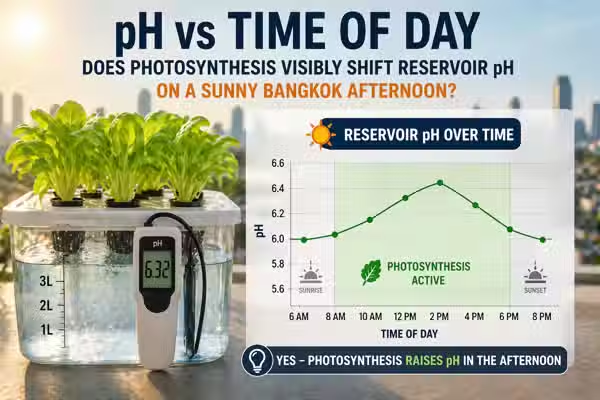
Key takeaways
Photosynthesis removes CO2 from reservoir water during daylight hours, which raises pH. In Bangkok conditions with strong afternoon sun and a reservoir near a window or under a skylight, pH can climb 0.4 to 0.6 units between a 7am reading and a 3pm reading without any nutrient or pH-up addition.
The pH swing is larger in systems with algae growth in the reservoir than in clean reservoirs, because algae photosynthesize directly in the water and consume CO2 aggressively from midmorning onward.
Growers who test pH once daily at an inconsistent time will sometimes see a reading 0.5 units above or below their actual 24-hour average, making it impossible to know whether the pH they are acting on reflects where the reservoir sits most of the time.
The safest single test time for a consistent comparable pH reading in a Bangkok hydroponic system is before direct sun hits the reservoir -- typically between 6am and 7:30am -- when overnight CO2 reabsorption has brought pH to its daily low point.
A one-off afternoon pH reading above 7.2 in an otherwise well-managed reservoir does not necessarily mean the system is out of control. It may mean photosynthesis has been active for six hours and the CO2 equilibrium has shifted. Test again at dawn before adjusting.
Nutrient lockout from diurnal pH swing is real but often blamed on pH drift rather than identified as a time-of-day measurement problem. If your plants show intermittent deficiency symptoms despite pH readings that look fine, the readings may be fine -- at the time you are taking them.
The pH reading that looked wrong but wasn't
A Wednesday in March. Clear sky, the kind Bangkok gets in the dry season before the haze builds. I tested the reservoir on a lettuce DWC channel at 7am: pH 6.1. Good. I added a small amount of pH-up, brought it to 6.3, logged it, moved on. By 2pm I came back to check nutrient levels. I tested pH out of habit. It read 6.8. I had not added anything. The reservoir was not near the end of a cycle where pH creep would be expected from ion depletion. The water had not changed. The pH had moved 0.5 units in seven hours on a sunny afternoon in a room with a west-facing window.
My first instinct was that the meter had drifted. I calibrated it on the spot. The calibration was fine. So I stood there looking at a reservoir that I had set to 6.3 seven hours earlier and which now read 6.8, and I had to decide whether to dose pH-down or not. I did not. I came back at 6am the next morning. It read 6.2. The pH had returned to near its morning level overnight, without intervention. That cycle was the one that made me start logging time-of-day against every pH reading, not just the value.
How far pH actually moves across a Bangkok day
0.4 to 0.6 pH units
Observed diurnal pH swing in DWC lettuce reservoirs positioned near west-facing windows in Bangkok, measured at 7am and compared to peak afternoon reading between 2pm and 3pm on clear dry-season days, Plant Mood grow log data, 2023 to 2024. Swing was consistently smaller on overcast days and during wet season when direct sun intensity was lower.
0.1 to 0.15 pH units
Typical diurnal swing in the same reservoirs on heavy overcast days or during monsoon-season cloud cover. The contrast between clear and overcast readings illustrates that the driver is light intensity and the photosynthetic activity it triggers, not ambient temperature or time alone.
Up to 0.9 pH units
Maximum single-day swing recorded in a reservoir with visible green algae growth on the container walls, measured across the same 7am to 3pm window. Algae-contaminated reservoirs show a dramatically amplified diurnal pH response because the algae are photosynthezing directly in the water column and stripping CO2 faster than plant roots alone would. Plant Mood grow log data, 2024.
6 to 8 hours
Time required for pH to return to near morning baseline overnight, under typical Bangkok conditions with no light and passive CO2 reabsorption from ambient air. Reservoirs with air stones showed slightly faster overnight recovery than still-water systems, because agitation at the surface accelerates CO2 dissolution back into the solution.
The pH correction that makes things worse
The problem is that a pH rise driven by photosynthetic CO2 consumption is self-correcting overnight. The plants stop photosynthesising when light drops, CO2 reaccumulates in the water from root zone respiration and ambient air exchange, and pH drifts back toward its morning baseline without any intervention. If you add pH-down at 2pm to correct a reading of 6.8 back to 6.3, you will wake up the next morning to a reservoir reading 5.8 or lower -- because the overnight CO2 recovery happened on top of the acid you added. You have now created a genuine pH problem where there was previously a temporary and predictable daily fluctuation.
In three cycles where I intervened on afternoon pH readings, the next morning reading was below 5.9 in all three. In cycles where I observed the same afternoon highs and did not intervene, the next morning reading was within 0.15 units of the previous day's morning reading. The intervention created more instability than it resolved. The pH-down I added in the afternoon was not addressing a problem -- it was colliding with the overnight recovery the system was already going to make on its own.
If the reservoir reads high in the afternoon, add pH-down and bring it back to target. That is what pH management means. You see a number outside the range, you correct it.
What growers say and what is actually happening
My pH is all over the place. I correct it in the afternoon and by morning it's crashed. I don't know what is wrong with my nutrients.
The afternoon correction is the problem. The pH rise between morning and afternoon is photosynthesis-driven and recovers overnight on its own. Adding pH-down in the afternoon means the system corrects twice -- once from your addition and once from the overnight CO2 reabsorption. The crash to 5.7 or 5.8 the next morning is not a nutrient incompatibility. It is the result of two corrections applied to what was originally a single temporary shift.
I tested at 11am and the pH was fine. I tested again at 4pm and it was 0.4 higher. My reservoir is not stable and I don't know why.
The reservoir is stable. The time of day is not. An 11am reading on a sunny Bangkok day catches the pH partway through its daily rise. A 4pm reading catches it near the peak. Both readings are accurate. Neither one represents where the reservoir sits at night or in the morning. The instability is in the measurement schedule, not the water chemistry.
I have tried three different pH meters and they all give me different readings throughout the day. I think they are all broken.
The meters are likely all working correctly. pH varies with temperature, and reservoir temperature in a Bangkok apartment changes across the day as ambient temperature climbs into the afternoon. Most basic pH meters have automatic temperature compensation (ATC) but ATC is calibrated for a standard rate of temperature change, not for Bangkok's rapid afternoon temperature increases. A reading at 7am at 26 degrees Celsius and a reading at 3pm at 31 degrees Celsius in the same reservoir will differ both from pH chemistry and from temperature compensation error. If all three meters give consistent readings when tested simultaneously in the same water sample, the meters are fine.
My basil looks like it has an iron deficiency -- yellowing between veins on new leaves -- but my pH readings are always in range.
'Always in range' depends entirely on when you are testing. Iron availability in hydroponics drops sharply above pH 6.5. If the reservoir sits at 6.8 to 7.0 between noon and 4pm on clear days -- which a morning-only testing routine would never capture -- the plants are spending several hours each day in a range where iron is partially locked out. Intermittent deficiency symptoms that appear inconsistently and do not worsen at a predictable rate are one of the signals of diurnal pH swing that the grower is not measuring.
What the time-stamped logs showed
After logging time-of-day pH readings across two dry seasons and one wet season, the pattern became reliable enough to anticipate. Clear dry-season days: morning to afternoon swing of 0.4 to 0.6 units. Partially cloudy days: 0.2 to 0.3 units. Overcast or rainy days: 0.1 to 0.15 units. The swing was largest in February and March when UV index in Bangkok is highest. This predictability is useful: on a clear February afternoon, seeing a pH of 6.8 when my morning baseline was 6.3 is expected, not alarming. I stopped treating it as a problem to fix.
The pH swing was consistent enough to predict by season and sky condition
Growers who understand the seasonal pattern can use sky condition as a rough predictor of afternoon pH behaviour. On clear dry-season days, plan for a 0.4 to 0.5 unit rise from morning baseline and do not schedule pH corrections in the afternoon. On overcast days, the afternoon reading is closer to reality and more worth acting on if it deviates from target.
One cycle in mid-2024 had visible green algae beginning to colonise the reservoir walls and lid edges by week two. The morning-to-afternoon pH swing in that cycle reached 0.9 units on clear days. By contrast, a clean parallel reservoir running the same nutrient solution in the same room showed a 0.45 unit swing on the same days. The algae were directly responsible for doubling the amplitude of the diurnal shift. Managing the algae -- blocking light from the reservoir with reflective tape over all gaps -- reduced the swing in subsequent cycles to a level consistent with clean reservoirs.
Algae in the reservoir amplified the swing to a degree that made the system unmanageable
A diurnal pH swing that is significantly larger than expected -- above 0.6 units on a clear day -- is one of the early indicators of algae presence in the reservoir before the growth becomes visible. If your afternoon pH is climbing further than it used to on comparable weather days, check the reservoir lid and walls before blaming the nutrients.
Across 60 logged pH test events with timestamps, morning readings between 6am and 7:30am had the lowest variance day to day -- a standard deviation of 0.11 pH units across clean-reservoir cycles. Readings taken between 1pm and 4pm had a standard deviation of 0.29 units across the same cycles, driven by variation in sky condition and light intensity. If you can only test once a day and you want that reading to be comparable across days and cycles, 7am is the time.
Morning is the most consistent single test time; afternoon is the least comparable
Afternoon pH testing is appropriate for diagnosing a suspected problem in the moment. It is not appropriate as the primary data point for system management decisions. A single afternoon number compared to a morning baseline from two days ago tells you almost nothing useful about whether the system is drifting.
Plant Mood grow log data, 2023 to 2024
pH stability does not mean pH is constant across the day
A stable hydroponic system maintains consistent pH around the clock. If your pH is moving during the day, something is wrong with the system -- the nutrients are incompatible, the reservoir is contaminated, or the meter is unreliable.
Diurnal pH variation is a normal property of any hydroponic system with living plant roots near light. The CO2 cycle that drives it -- uptake during photosynthesis, release during respiration -- happens in every system with plants, regardless of how well managed it is. A pH swing of 0.3 to 0.5 units across a clear Bangkok day in a clean, well-managed DWC system is not a sign of instability. It is evidence that the plants are photosynthesising actively. The target is not a flat pH line across 24 hours. The target is a pH that stays within a range that supports nutrient availability across the full diurnal cycle -- which is a different and more useful way to think about it.
In our cleanest, highest-yielding lettuce cycles, the morning-to-afternoon pH swing was present and consistent at 0.4 to 0.5 units. Attempting to flatten that swing by correcting in the afternoon consistently produced worse outcomes -- overshooting to acidic conditions overnight -- than allowing the natural cycle to run while managing only the morning baseline. The myth of pH constancy causes more intervention than the system needs and more instability than the plants would experience if left to the natural diurnal pattern.
The CO2 loop that runs every sunny day
Plant roots and any microorganisms in the root zone continuously produce CO2 through cellular respiration, day and night. That CO2 dissolves into the reservoir water and forms carbonic acid, which pushes pH downward. During daylight hours, plant leaves above the water consume CO2 through photosynthesis. In systems where the reservoir is near a light source -- a window, a skylight, or in outdoor or semi-outdoor setups -- photosynthetic CO2 demand is high enough to outpace the respiration input. The net effect is CO2 removal from the water, which reduces carbonic acid concentration and allows pH to rise. After dark, photosynthesis stops and respiration continues, CO2 accumulates in the water again, carbonic acid builds back up, and pH drifts downward toward the morning baseline.
The clearest way to see this mechanism in action is to compare a reservoir in a dark room versus one near a bright window on the same afternoon. In one cycle, I had two reservoirs running the same nutrient solution -- one under artificial LED lighting on a 16-hour timer in a closed cabinet, one near a south-facing window with natural Bangkok afternoon sun. At 3pm on a clear day, the window reservoir read 6.7. The cabinet reservoir read 6.35. The cabinet reservoir had not changed meaningfully from its morning reading because the LED light intensity was insufficient to drive CO2 uptake beyond what root respiration was producing. The window reservoir had been receiving direct sun for five hours.
The buffering capacity of the nutrient solution also determines how far the pH moves for a given amount of CO2 change. A solution with higher alkalinity -- more dissolved calcium and magnesium carbonates -- resists pH change better than a low-alkalinity solution. In Bangkok, where dry season tap water carries elevated calcium and magnesium, the natural buffering capacity of the tap water provides some resistance to diurnal pH swings. Growers using RO water or very low-EC source water may see larger amplitude swings than our logged data shows, because they are starting with lower buffering capacity before nutrients are added.
How different system placements change the diurnal pH pattern
Reservoir near a south or west-facing window, Bangkok dry season
Receives direct afternoon sun for 4 to 6 hours on clear days. CO2 demand from ambient light reaching any water surface algae or plant foliage positioned near the reservoir is highest in this configuration. Diurnal swing in our data: 0.4 to 0.6 units on clear days. Morning baseline recovery: reliable overnight if no afternoon pH correction is applied.
This placement produces the largest and most predictable diurnal pH swing. It is manageable if understood. Test only in the morning for management decisions. Accept that afternoon readings will be elevated and resist the urge to correct them unless the morning baseline itself has shifted above or below target range.
Reservoir under artificial LED lighting, no direct sunlight
LED grow lights at the intensities used in most home setups -- 200 to 400 PPFD at canopy level -- drive lower photosynthetic CO2 demand than direct Bangkok sun. The diurnal pH swing under LED-only conditions in our observations was 0.15 to 0.25 units on a 16-hour light cycle, substantially smaller than in window-adjacent setups.
LED-grown systems in enclosed cabinets or rooms without windows show much more stable pH across the day. Growers in this setup who see larger swings should look first at whether any natural light is entering the space -- even indirect -- and at whether algae is present in the reservoir. pH instability in a light-controlled environment is more likely to be a chemistry or contamination issue than a diurnal CO2 issue.
Outdoor or balcony system, Bangkok
Full exposure to Bangkok sun can drive diurnal pH swings above what we observed in indoor setups, particularly in algae-present reservoirs. An outdoor system in peak dry season with a green-tinted reservoir is capable of swings of 0.8 to 1.0 units across the day. Temperature also rises more dramatically in outdoor reservoirs, which affects both pH chemistry directly and the speed of biological activity in the water.
Outdoor Bangkok systems should treat pH management as a morning-only activity. Afternoon readings in direct sun are the furthest from meaningful for management decisions. Prioritise blocking light from the reservoir -- opaque containers, covered lids with no gaps -- to limit algae growth, which is the primary amplifier of diurnal swing in outdoor conditions.
The single daily pH test is not worth the anxiety it creates
Most small hydroponic growers test pH too often or at the wrong time, then correct it based on readings that do not represent where the reservoir actually sits across a full day. The result is a cycle of intervention that creates more instability than the original pH variation would have caused. My honest opinion: in a clean, well-managed system running established crops, pH needs active correction far less often than most guides suggest. Morning baseline testing three times per week is sufficient for most systems. Daily testing generates noise. Hourly testing generates panic.
That argument holds for systems with a history of instability or during the first two weeks of a new crop cycle when the system is still establishing. It does not hold as a permanent management approach for a stable running system. The answer is to understand your system well enough to know the difference between a reading that looks alarming and one that is alarming. A 6.9 pH at 3pm on a clear Bangkok afternoon in a clean reservoir with healthy-looking plants is the first type. A 6.9 pH at 7am when yesterday morning it was 6.4 is the second. One requires patience. The other requires investigation. Treating them the same is where growers create problems.
The case against this is that pH can shift quickly when something actually goes wrong -- a root rot event, a contamination, a nutrient incompatibility -- and infrequent testing means a real problem goes undetected longer. Daily testing catches genuine drift before it causes visible crop damage.
FAQ
Does photosynthesis raise pH in a hydroponic reservoir during the day?
Yes. During daylight hours, photosynthesis removes CO2 from reservoir water, which reduces carbonic acid concentration and allows pH to rise. In Bangkok conditions with direct afternoon sun, this produces a measurable 0.4 to 0.6 pH unit rise between a 7am reading and a 3pm reading in DWC lettuce reservoirs, based on Plant Mood grow log data from 2023 to 2024. The swing is smaller on overcast days and in systems under LED lighting without natural sun exposure.
What is the best time of day to test pH in a hydroponic system?
Between 6am and 7:30am, before direct sun hits the reservoir. Morning readings represent the daily pH low point after overnight CO2 reabsorption from root respiration, and they have the lowest day-to-day variance -- a standard deviation of 0.11 pH units across clean-reservoir cycles in Plant Mood's logged data, compared to 0.29 units for afternoon readings. Morning readings are the most comparable across days and cycles for management decisions.
Should I correct pH if it rises in the afternoon in my hydroponic system?
Not based on an afternoon reading alone. A pH rise of 0.4 to 0.5 units on a clear Bangkok afternoon is photosynthesis-driven and self-correcting overnight. Adding pH-down in the afternoon and then allowing the overnight CO2 recovery to proceed produces a double correction -- the reservoir crashes to 5.7 or 5.8 by morning. In three cycles where afternoon pH corrections were applied to diurnal-driven highs, the next morning reading fell below 5.9 every time. Check the morning baseline first.
Why does my hydroponic pH spike in the afternoon and then recover overnight?
The mechanism is the CO2 cycle. During the day, plant photosynthesis consumes CO2 from the water, reducing carbonic acid and raising pH. At night, photosynthesis stops and root respiration continues releasing CO2, which dissolves back into the water as carbonic acid and pulls pH back down. This cycle runs every day in every system with living plant roots near a light source. It is not a malfunction -- it is normal biological behaviour.
Why is my hydroponic pH so unstable and crashing overnight?
The most common cause is correcting afternoon pH readings that were elevated by photosynthesis. If you add pH-down at 2pm to bring a reading of 6.8 back to 6.3, the overnight CO2 recovery adds another 0.4 to 0.5 units of downward drift on top of your correction, leaving the reservoir at 5.8 to 5.9 by morning. The instability is created by the correction, not the original fluctuation. Test at 7am and correct only when the morning baseline is outside target range.
Does algae in the reservoir make pH swings worse?
Significantly. In a cycle with visible algae growth on reservoir walls, Plant Mood recorded a diurnal pH swing of up to 0.9 units on clear days -- compared to 0.45 units in a clean parallel reservoir running the same nutrient solution in the same room. Algae photosynthesize directly in the water and strip CO2 faster than plant roots alone. A diurnal swing that has grown larger than it used to be on comparable weather days is one early indicator of algae developing in the reservoir before it becomes visible.
Does my hydroponic system placement affect how much pH changes during the day?
Yes, directly. Reservoirs near south or west-facing windows in Bangkok receiving direct afternoon sun showed swings of 0.4 to 0.6 units on clear dry-season days. Reservoirs under artificial LED lighting with no natural sun exposure showed swings of 0.15 to 0.25 units on a 16-hour light cycle. Outdoor Bangkok systems with algae-present reservoirs can exceed 0.8 to 1.0 units. Light intensity reaching the system -- both plants and reservoir surface -- is the primary driver.