Key takeaways
In April, grow room temperature in a Bangkok apartment stayed above 31 degrees Celsius until after 3am on 19 of 30 nights, compressing the overnight recovery window that germinating trays depend on — Plant Mood grow log data, 2024.
In October, relative humidity at tray level did not drop below 84% before 6am on any logged night, creating a sustained overnight mold-risk window that does not exist in April's drier late-night air.
Lux readings at tray level after lights-off were not zero in either season. Streetlight infiltration through window gaps logged between 1.2 and 4.8 lux on clear nights — enough to affect photoperiod-sensitive varieties at the seedling stage.
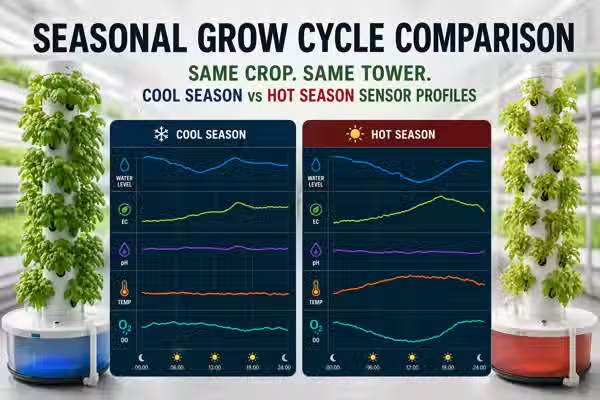
The biggest overnight difference between seasons was not temperature or humidity alone — it was the direction each variable was moving at midnight. In April, temperature was still falling. In October, humidity was still rising. Managing a tray at midnight requires knowing which curve you are on.
Germination rate for sunflower dropped from 91% in October to 78% in April across comparable seeding density and substrate conditions, correlating with the sustained overnight heat preventing adequate temperature recovery — Plant Mood grow log data, 2024.
Airflow set to the same fixed schedule produced different outcomes in April versus October: adequate in April's drier overnight air, insufficient in October's sustained high-humidity nights where a static fan duty cycle could not keep pace with humidity accumulation.
TL;DR
April and October feel like two versions of Bangkok hot. They are not the same grow environment overnight. April keeps temperatures elevated past midnight and the humidity drops enough that mold is not the primary risk. October brings the humidity down almost not at all before dawn, and temperature recovery happens faster but the air never dries. A tray seeded identically in both months will behave differently by day three if you do not adjust the overnight management. Most growers do not adjust. The schedule stays the same. The tray does not.
The same tray, two different months
It was October. I had seeded a sunflower tray using the same method, the same coco coir depth, the same seed density I had used successfully in April. By day four the germination looked strong — better coverage than April, actually. Then day five overnight I checked the sensor log in the morning and saw what had happened: humidity at tray level had climbed from 81% at 10pm to 93% by 4am and held there until I opened the room at 6:30am. The canopy had trapped the moisture. The October night had not dried it out the way April nights do. By 7am there was early mold at the stem base across the densest section of the tray. In April, that same tray had made it to harvest without intervention. Nothing about my process had changed. The night had.
That was when I started logging the overnight window as its own dataset rather than treating it as the quiet part of the grow cycle. What happens between 10pm and 6am in April is not the same as what happens in those same hours in October. The crops know the difference even when the schedule does not.
October germination looks better and fails later
The counterintuitive part is that October germination frequently looks better through day three precisely because the overnight temperatures are less extreme. Seeds hydrate more evenly, the substrate holds moisture longer without cooking, and early root development is consistent. The problem arrives on day four and five when the canopy closes and the October night stops drying anything out. April's heat stresses the tray earlier and visibly — you see it and respond. October's risk is invisible until it is not. The tray looks healthy right up until the overnight humidity has been sitting above 88% for two consecutive nights and the mold is already in the stem.
Across the cycles we logged, October trays had higher day-three germination coverage than April trays — 88% versus 81% average for sunflower across comparable conditions. But October also produced more mold events in the day-four to day-six window: 4 of 9 October cycles had a mold intervention versus 1 of 9 April cycles. The better-looking tray at day three is the one that needs more attention at day five. April shows you its problems early. October shows you nothing until the damage is done.
Cooler, wetter months should be harder for germination and easier for mold. April's heat should stress seeds and slow germination. October's milder overnight temperatures should support it. Growers who have grown through both seasons often say April is harder on their trays.
What the overnight logs showed across both seasons
On 19 of 30 logged April nights, the grow room temperature was still above 31 degrees Celsius at midnight. The overnight low — the point at which temperature stopped falling and started rising again ahead of dawn — arrived at an average of 3:47am in April. In October, the overnight low arrived at an average of 2:12am, and it was a lower number: 27.4 degrees Celsius average versus 29.8 degrees Celsius in April. The window of temperature recovery, where seeds and young roots experience conditions closer to optimal, is 95 minutes longer in October than in April and starts cooler.
April temperature does not recover to a germination-friendly range before 3am
April germination under heat stress is not just about peak daytime temperature. The overnight heat compression — fewer hours below 30 degrees Celsius — is a cumulative stress across the germination window. A seed that cannot drop below 30 degrees Celsius for most of the night is operating at the edge of its thermal tolerance for the entire first 72 hours.
In the October logs, tray-level humidity crossed above 85% on the way up in the early evening on most nights and did not return below 85% before 6am. The average overnight minimum tray-level humidity in October was 83.7%. In April, the overnight minimum regularly reached 71 to 74% between 2am and 4am. That 10-point difference in the overnight low is the difference between a canopy surface that gets a partial dry-out and one that stays saturated from dusk to dawn.
October overnight humidity never fully retreats
In October, there is no overnight reset. The mold risk that builds during the day does not dissipate during the night. Growers who rely on overnight humidity drop to recover from a marginal daytime watering will find that October does not deliver it. The same watering decision that was recoverable in April becomes a mold event in October.
With grow lights off, the sensor logged between 1.2 and 4.8 lux at tray level depending on cloud cover, street lighting intensity, and whether the window gap was covered. October logged higher average overnight lux than April — 3.1 versus 2.2 average — because Bangkok's wet season cloud cover reflects more artificial light back downward than the clearer April sky. Neither number is high enough to drive photosynthesis. Both are in the range that can interfere with dark-period signalling in photoperiod-sensitive crops at the seedling stage.
Lux at tray level after lights-off was not zero in either season
A grow room that is not fully light-sealed is running a modified photoperiod, not a true dark period. For microgreen varieties where this matters — wheatgrass and pea in particular showed visible etiolation differences in our October logs when gap coverage was inconsistent — this is a hidden variable that shifts between seasons without the grower changing anything.
Across nine comparable seeding cycles per season, sunflower germination rate averaged 78% in April and 91% in October under matched substrate, seed density, and watering protocol. The April deficit tracks directly against the overnight heat data: the cycles with the lowest April germination rates were the ones where overnight temperature stayed above 31 degrees Celsius for the most consecutive hours. The two April cycles that achieved germination above 85% both happened during an unusually cool stretch where nighttime low reached 28.1 and 28.6 degrees Celsius respectively.
Germination rate for sunflower diverged 13 percentage points between seasons
For sunflower in Bangkok, April germination rate is partly a function of what the overnight temperature does, not just what the daytime management looks like. Controlling for every daytime variable still leaves the overnight heat as an unmanaged input that depresses the rate. A grower who blames seed batch quality for poor April germination may be misidentifying the variable.
Plant Mood grow log data, 2024
Why the overnight window matters more than most growers account for
The grow schedule most growers run — watering times, light hours, ventilation settings — is built around the active part of the day. The overnight window is treated as passive: lights off, reduced activity, nothing to manage. But the tray does not stop developing overnight. Germination continues. Root extension continues. And the ambient conditions during that window determine whether the moisture state of the tray at 6am is recoverable or already a problem. The overnight window is where the consequences of daytime decisions arrive. A marginal watering that the afternoon air could have dried out becomes a saturated substrate by morning if the overnight humidity never drops. A stressed seed that the daytime temperature pushed to its limit cannot recover if the overnight low does not give it a thermal reprieve.
In April, the mechanism that creates risk is heat accumulation. A grow room in a Bangkok apartment with no overnight climate control will lose heat slowly through the night as outdoor temperatures drop, but the building fabric — concrete walls and ceiling — retains heat well into the early hours. The tray is warmer than the ambient sensor suggests because it is sitting on a surface that has been absorbing heat all day. By 3am the ambient reads 30 degrees Celsius but the substrate surface can still be 31.5 to 32 degrees. In October, the mechanism is different: outdoor humidity is high through the night, infiltration keeps indoor humidity elevated, and the canopy creates a microenvironment above the tray that accumulates moisture continuously from plant respiration. The tray is wetter at 6am than it was at midnight, not because it was watered but because the overnight air could not draw the surface moisture away.
Plant respiration continues through the dark period. In a sealed or semi-sealed canopy, transpiration-driven moisture release accumulates in the air layer immediately above the tray surface. In April, the relatively drier overnight air has enough vapour pressure deficit to draw this moisture away from the canopy microenvironment — the VPD at 30 degrees Celsius and 73% humidity is around 1.0 kPa, which supports reasonable transpiration and moisture movement. In October at 28 degrees Celsius and 87% humidity, VPD drops to approximately 0.47 kPa. At that level, the air is nearly saturated and cannot pull moisture away from the canopy surface meaningfully. The tray becomes its own humidity trap overnight.
Reading your overnight sensor log to find the season-specific risk
Pull the overnight window in isolation
A clear view of whether temperature is still falling or has levelled at midnight, and whether humidity is rising, stable, or declining in the early morning hours. These two shapes tell you which season risk profile you are working with.
Most grow logs are read as full-day summaries. The overnight pattern is buried in the daily average. Export or filter just the 10pm to 6am window and treat it as a separate dataset. Look at temperature and humidity as curves, not averages — the direction of travel at midnight matters more than the midnight reading.
Identify the overnight low and when it arrives
Two numbers: the overnight low reading and the time it arrives. If the temperature low arrives after 3am in April, the germination heat stress window covers most of the night. If the humidity low in October stays above 85%, there is no overnight dry-out and any marginal moisture decision from the evening carries through to morning.
The overnight low — the temperature or humidity turning point — defines the length of the recovery window. In April, a late overnight low means less time below the heat-stress threshold before dawn starts warming the room again. In October, an overnight humidity low that never reaches below 84% means there is no meaningful recovery window at all for moisture.
Check lux after lights-off
A lux reading that is effectively zero confirms a true dark period. A reading above 1 lux indicates light infiltration that is modifying the photoperiod. Above 3 lux on a consistent basis warrants light-sealing the gap, particularly for pea and wheatgrass.
Take a sensor reading at tray level between 1am and 3am with grow lights off — this is the ambient lux the tray is experiencing during the dark period. Do this on a clear night and on a cloudy night in both seasons. The difference between a sealed room and an imperfectly sealed one shows up here, and it changes between seasons as cloud cover changes.
Map germination outcomes against overnight temperature data by cycle
A pattern — or absence of one. If germination rate tracks with overnight temperature lows, you have identified an unmanaged variable that is affecting yield. If it does not track, the overnight window is probably not your primary issue and daytime management is more likely the explanation.
If you have germination rate records alongside sensor logs, compare the cycles with the lowest overnight lows against the cycles with the best germination rates. The relationship between these two variables is often clearer than the relationship between germination and any daytime variable. This is where April and October diverge most visibly.
Adjust airflow schedule to match the season risk profile, not the calendar
A season-specific airflow schedule that responds to which variable is the primary overnight risk rather than running a generic duty cycle regardless of what the sensor log shows is happening.
A fixed airflow schedule set in April will underperform in October's overnight humidity profile. October needs higher fan duty cycles in the late-night window — the 2am to 5am period when outdoor humidity peaks and indoor conditions follow. April needs the opposite priority: stronger daytime and early-evening airflow to get heat out of the room before the overnight window begins.
What growers miss when they read the overnight window
A daily average humidity of 80% tells you almost nothing useful about overnight mold risk in October. If that average is composed of 70% during the day and 90% overnight, the tray experienced a sustained high-humidity overnight window that the average completely obscures. The overnight window needs to be read as its own period with its own risk profile, not folded into a daily summary. Most consumer sensor apps display daily averages by default. The data behind that average is where the actual grow information lives.
Reading the daily average instead of the overnight curve
Bangkok's wet season cloud cover in October acts as an insulating layer that slows radiative cooling overnight. The city stays warmer after sunset than it does in April's clearer skies, which allow more heat to escape. A grow room that reaches its overnight low by 2am in April may not reach an equivalent low until 3:30am or later in October, despite October generally having a lower peak daytime temperature. The rate of cooling, not just the final low, affects how long the tray spends at heat-stress temperatures overnight.
Assuming the room cools at the same rate in both seasons
A sensor positioned at room level or on a shelf above the tray reads ambient air temperature. The substrate surface — particularly coco coir that has absorbed heat during a bright afternoon — can read 1.5 to 2.5 degrees Celsius higher than the ambient sensor well into the night. In April, this gap means the substrate is still above 32 degrees Celsius when the ambient sensor is reading a seemingly manageable 30. Decisions made from the ambient reading alone miss what the tray is actually experiencing.
Not accounting for the tray surface being warmer than the ambient sensor
Light management in most grow guides is described in terms of photoperiod: X hours on, Y hours off. The assumption is that lights-off means dark. In a Bangkok apartment grow room, lights-off means whatever light comes through window gaps, under doors, and from indicator LEDs on equipment. In October, when cloud cover scatters more urban light downward, the overnight ambient lux at tray level is measurably higher than in April. For most microgreen varieties this does not matter. For pea and wheatgrass, where etiolation and dark-period response affect stem quality, it is a seasonal variable that shifts without the grower adjusting anything.
Treating lux as binary — lights on or lights off
What to change between April and October in the overnight window
Any grower seeding sunflower or other heat-sensitive varieties in April
Seed in the early evening rather than the morning so the tray enters its first overnight window with as much of the day's heat already dissipated as possible. A tray seeded at 7pm on an April day has a shorter exposure to peak substrate heat before the overnight begins. A tray seeded at 8am will spend the hottest part of the day in early germination — the most thermally sensitive stage.
Earlier access to the cooler overnight window for newly seeded trays. The difference in overnight low arrival between a morning-seeded and evening-seeded April tray is not the ambient temperature — it is the accumulated substrate heat at the moment the overnight window begins.
Any grower running fixed airflow schedules across both seasons
In October, increase fan duty cycle specifically in the 2am to 5am window — the period when outdoor humidity peaks and indoor conditions follow with a lag. In April, redirect that same priority to the 6pm to 10pm window when the room is still shedding daytime heat. The overnight risk profile in each season requires a different airflow timing, not just a different intensity.
Reduced tray-level humidity accumulation during October's peak overnight window. Faster evening heat dissipation in April before the overnight begins. A fixed schedule set for one season will be wrong for the other in ways that show up in germination rates and mold frequency before they show up in anything visible.
Any grower who has not checked for light infiltration during the dark period
Sit in the grow room with grow lights off at 2am on a clear night and on a cloudy October night. Let your eyes adjust. Any light you can see is reaching your trays. Seal window gaps with blackout tape or foam weather stripping. Check indicator LEDs on equipment — cover any that are bright enough to read from. Do this check in both seasons because the ambient light conditions outside change between April and October.
A consistent dark period regardless of outdoor conditions or season. For most varieties, the difference is marginal. For pea shoots and wheatgrass where stem etiolation matters for texture and yield weight, a sealed dark period in October can meaningfully improve consistency compared to an unsealed room where cloud-reflected urban light adds 3 to 4 lux at tray level.
Any grower making watering decisions in the evening without checking the overnight humidity forecast
In October, treat an evening watering as a commitment to a wet overnight. If the tray does not need water, do not water it after 6pm. The October overnight will not dry out a surface that is already moist. In April, an evening watering is lower risk because the overnight air — though warm — is drier and the VPD is high enough to support some moisture movement through the night. The same watering decision at 7pm carries different consequences depending on which season you are in.
Fewer overnight mold events in October driven by evening watering decisions that the daytime logic suggested were safe but the overnight humidity profile made problematic. The rule is simple: in October, the overnight window does not recover marginal moisture decisions. In April, it sometimes does.
Logging the overnight window at higher resolution than the daytime window. Most growers log continuously at the same interval across the full 24 hours. The overnight window in Bangkok packs more consequential variation into a shorter period than the controlled daytime window. Logging at 5-minute intervals overnight and 15-minute intervals during the day — or even just pulling the overnight data as a separate view — surfaces the curve shapes that daily averages hide. The direction of the humidity line at 2am is a more useful piece of information than the average humidity for the whole night.
The schedule does not know what month it is
Your grow schedule runs the same regardless of whether it is April or October. The tray does not. The overnight window is where Bangkok's seasonal differences show up most clearly — in the temperature curve that does not reach its low until 4am in April, in the humidity that never drops below 85% in an October night, in the lux reading that is 1.5 units higher in October because of cloud cover you did not control for. This week: pull your overnight sensor data as a separate window, 10pm to 6am, and look at the humidity curve at 2am. Is it rising, stable, or falling? That one piece of information will tell you more about your mold risk profile right now than anything in a grow guide written for a different climate.
FAQ
How does Bangkok's overnight grow room temperature differ between April and October?
In April, grow room temperature in a Bangkok apartment stayed above 31 degrees Celsius until after 3am on 19 of 30 logged nights, with the overnight low arriving at an average of 3:47am. In October, the overnight low arrived earlier — averaging 2:12am — and reached a lower temperature: 27.4 degrees Celsius versus 29.8 in April. October gives seeds a longer and cooler overnight recovery window. April compresses it significantly — Plant Mood grow log data, 2024.
Does October humidity drop overnight in a Bangkok grow room?
Not meaningfully. In our October logs, tray-level humidity did not drop below 84% before 6am on any logged night. The average overnight minimum was 83.7%. In April, the overnight minimum regularly reached 71 to 74% between 2am and 4am. That 10-point difference is the difference between a canopy surface that gets a partial dry-out and one that stays saturated from dusk to dawn. October overnight air cannot recover a marginal moisture decision the way April overnight air sometimes can.
Why is sunflower germination lower in April than October in Bangkok?
The overnight heat. Across nine comparable cycles per season, sunflower germination averaged 78% in April and 91% in October under matched conditions. The April deficit tracks against overnight temperature data: the lowest-germination April cycles were the ones where temperature stayed above 31 degrees Celsius for the most consecutive overnight hours. The two April cycles that exceeded 85% germination both occurred during an unusually cool stretch where the overnight low reached 28 degrees Celsius — Plant Mood grow log data, 2024.
Is there light at tray level in a Bangkok grow room during the dark period?
In our logged grow room, yes. With lights off, the sensor recorded between 1.2 and 4.8 lux at tray level depending on cloud cover and window gap coverage. October averaged 3.1 lux overnight versus 2.2 in April, because wet-season cloud cover reflects more urban light downward than April's clearer sky. Neither number drives photosynthesis, but both are in the range that can affect dark-period signalling in photoperiod-sensitive varieties like pea and wheatgrass at the seedling stage.
Should I change my watering schedule between April and October for microgreens?
Yes, specifically for evening waterings. In October, avoid watering after 6pm — the overnight humidity will not dry a moist substrate surface before dawn, and what was a marginal watering decision in April becomes an overnight mold risk in October. In April, the overnight air is drier with higher VPD, so an evening watering carries less overnight risk. The same decision at 7pm has different consequences depending on which season's overnight humidity profile follows it.
When does a Bangkok grow room reach its overnight temperature low in April versus October?
In April, the overnight temperature low arrived at an average of 3:47am across 30 logged nights — leaving less than two and a half hours before dawn warmth begins. In October, the overnight low arrived at an average of 2:12am. This 95-minute difference in when the recovery window opens affects how long seeds and young roots spend below heat-stress temperatures. April's compressed overnight recovery window is one of the underappreciated reasons germination rates run lower in that month.
How should I adjust fan settings between April and October for overnight growing?
Run different timing priorities, not just different intensities. In October, prioritise higher fan duty cycles in the 2am to 5am window — when outdoor humidity peaks and indoor conditions follow with a lag. In April, prioritise the 6pm to 10pm window when the room is still shedding daytime heat before the overnight begins. A fixed schedule calibrated for one season will be structurally wrong for the other and will show up in germination rates and mold frequency before it shows up in any visible symptom.