Key takeaways
pH must be corrected before nutrients are added. At pH above 6.5, calcium, iron and phosphorus precipitate out of solution. The EC reading stays the same but the plant cannot absorb what is there.
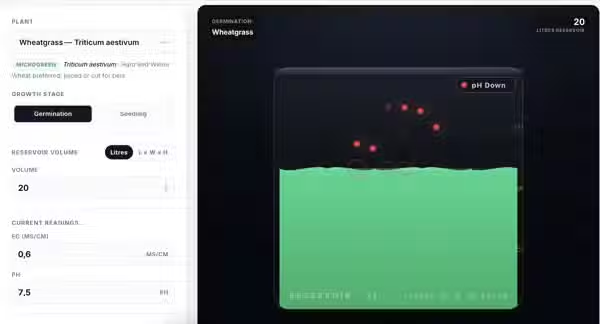
The tool calculates pH Down dose as: volume x delta x strength x 0.5 — the 0.5 is deliberate. Starting at half the calculated dose is not conservative. It is the only safe approach because pH adjustment is nonlinear near the target band.
EC correction formula is: mL of A+B = (volume x EC gap) / nutrient strength. At the default 0.4 mS/cm per mL/L, a 20 L reservoir sitting 0.6 mS/cm below target needs 30 mL of combined A+B, split 15 mL Part A and 15 mL Part B.
Microgreens and hydroponic crops require fundamentally different EC targets. Microgreens run 0 to 1.5 mS/cm across their entire cycle. Mature fruiting hydroponic crops run 1.8 to 2.5 mS/cm. The tool separates these into distinct tiers so the same volume input does not produce the same dose for both.
Part A and Part B must be added to the reservoir separately, never premixed in the same bottle. Mixing concentrated A and B produces calcium-phosphate precipitate that cannot be dissolved back into solution.
A pH deviation of more than 0.5 units outside the target band triggers a critical block in the tool. At that point, nutrient dose steps are grayed out and deferred. Adding nutrients into a solution 0.7 pH units off target is not a correction. It is contamination.
TL;DR
Most growers who chase EC are actually chasing a pH problem they have not diagnosed. The tool exists because the correction order matters more than the correction amount. It calculates exact mL of pH Down, pH Up, Part A and Part B for your reservoir volume and crop stage, and it blocks the nutrient step until pH is inside the target band. If you have been topping up nutrients and watching EC drift anyway, the problem is almost certainly pH.
The reservoir that looked fine until it was not
Week 8 of 2024, basil in a 20 L DWC reservoir. EC was 1.6 mS/cm, which matched the vegetative target. pH was 6.8, logged as 'slightly high' and left. By day 4, new leaves showed interveinal chlorosis — iron deficiency symptoms on a solution with adequate iron. The correction attempt added more iron chelate, which raised EC to 1.9 mS/cm and did nothing for the deficiency. The pH was still 6.8. At that pH, iron availability in hydroponic solution drops sharply. The nutrient was physically present. The plant could not access it.
The decision to build a correction tool with a mandatory pH-first sequence came from that log entry and five others like it in the same quarter. The pattern was identical each time: EC in range, pH drifting uncorrected, grower adding more nutrients to fix symptoms caused by the pH, EC climbing further, problem worsening. The tool does not let you touch the nutrient step until pH is logged as inside the band.
Why EC looks stable when your solution is broken
EC measures total dissolved solids conductivity. It does not measure whether those dissolved solids are in a form plants can absorb. pH determines ionic availability. Below 5.5, calcium and magnesium become soluble but phosphorus precipitates. Above 6.5, iron, manganese and boron drop out of availability while calcium, phosphorus and magnesium appear fine. A reservoir at pH 7.2 with EC 1.8 mS/cm is not a balanced solution. It is an expensive saline bath with several nutrients functionally absent. The EC probe has no way to tell the difference.
The correction tool flags pH as critical when it deviates more than 0.5 units outside the band. At that threshold, the tool calculates that nutrient salts have already shifted out of their optimal ionic form. It grays out the EC correction step and shows a deferred note: hold this step until pH is back inside range. The grower cannot accidentally add nutrients first because the interface does not present that step as actionable.
pH Down dose is calculated as: volume x delta to midpoint x strength x 0.5, where strength defaults to 0.15 mL per litre per pH unit for food-grade phosphoric acid. The 0.5 multiplier is baked into the formula, not an option. pH adjustment is asymptotic near the target. The last 0.1 unit of correction requires disproportionate reagent. Starting at half the calculated dose and re-measuring after 15 minutes is not optional caution. It is the only approach that does not produce overshoot.
What the reservoir logs showed about correction order
Across 11 lockout events logged in 2024 covering basil, lettuce, cherry tomato and pea shoots, pH at the time of symptom onset was outside the 5.8 to 6.3 band in all 11 cases. EC at the time of symptom onset was inside the target range in 8 of those 11. The growers were tracking the wrong variable.
Every nutrient lockout event in 2024 occurred with pH outside the 5.8 to 6.3 band
EC compliance is not a proxy for solution health. A reservoir can have correct EC and incorrect ionic availability simultaneously. The correction tool evaluates both variables independently and treats pH deviation as the higher-priority signal.
In 6 logged cases where nutrients were added before pH was corrected, EC increased by an average of 0.3 mS/cm and plant deficiency symptoms either persisted or worsened within 48 hours. In the 5 cases where pH was corrected first and nutrients were added second, deficiency symptoms resolved within 72 hours without any change in the nutrient brand or concentration.
Nutrient additions made before pH correction raised EC without improving plant response
The sequence of correction is not a formality. Adding nutrients into a broken pH does not improve plant access to those nutrients. It increases osmotic load and makes the subsequent pH correction harder because more buffering capacity has been added to the solution.
Across 22 microgreen cycles where EC was logged at sowing, germination rate below 85% occurred in 7 cycles. Of those 7, 6 had EC above 1.2 mS/cm at sowing. One had EC below 0.3 mS/cm. Overfeeding microgreens at the seed stage is a more common and more damaging error than underfeeding.
Microgreen EC overfeeding caused germination failure more often than underfeeding caused slow growth
The tool uses separate EC tiers for microgreens and hydroponic crops. The microgreen low tier defaults to 0 to 0.4 mS/cm at the young phase, which is plain water or close to it. This is not a conservative starting point. It is the correct starting point for a crop that survives almost entirely on seed reserves in the first half of its cycle.
Plant Mood grow log data, 2024
Topping up nutrients more frequently makes EC harder to control, not easier
Plants in a hydroponic reservoir drink water faster than they absorb nutrients, especially in warm conditions. Topping up with nutrient solution when the reservoir is low concentrates the remaining salts before the new dose arrives. If the top-up also contains nutrients, EC spikes briefly, then the plants drink the water component and EC climbs again. The result is not stable EC. It is a sawtooth pattern with a rising baseline. The correction is to top up with plain water until volume is restored, measure EC, and then decide whether a nutrient addition is actually needed.
In 2024 reservoir logs, 4 cases of EC climbing above 2.8 mS/cm in systems with a target of 1.6 to 1.8 mS/cm were traced back to nutrient top-ups during low-volume periods. In each case, the grower believed they were maintaining concentration. They were compounding it. The correction tool calculates dilution volume when EC is high, not additional nutrient dose.
If EC is drifting down, the solution is to top up nutrients regularly. More frequent additions keep concentration stable.
What growers say when the reservoir is not working
My EC keeps drifting up even though I top up every day
Top-ups with nutrient solution during low-volume periods add salts to an already-concentrated reservoir. Plants extract water faster than nutrients, so EC climbs with each addition. The fix is to top up with plain water first, restore volume, re-measure EC, and only add nutrients if EC is genuinely below target. The tool calculates dilution volume when EC exceeds the upper band, not a nutrient dose.
I corrected the EC but the plant still shows deficiency symptoms
pH was outside the target band when the EC correction was made. The nutrients were added but are not bioavailable at the current pH. Check pH first. If it is above 6.5, iron and manganese are the first elements to lock out. If it is below 5.5, phosphorus availability collapses. The EC reading is technically correct. The plant cannot access what is dissolved.
I added pH Down and now my pH is way too low
The full calculated dose was added at once. pH adjustment is nonlinear. The response per mL of pH Down accelerates as you approach the target band. The tool calculates a starting dose at 50% of the raw formula output for this reason. Adding the full dose, stirring, and measuring after 15 minutes instead of waiting produces overshoot in the majority of cases when pH is more than 0.5 units out of range.
My microgreens have poor germination even though I set up a nutrient solution
EC was too high at sowing. Microgreens at the seed stage do not need nutrients. They germinate on stored seed energy. An EC above 0.8 to 1.0 mS/cm at sowing creates osmotic stress that suppresses germination. The tool defaults the microgreen young phase tier to 0 to 0.4 mS/cm, which is plain water or close to it. A nutrient solution is not appropriate until several days into the cycle.
What growers are not tracking when corrections fail
Most growers measure pH in the morning and log it once. Nutrient additions happen when EC drops, which may be hours later. Temperature changes, CO2 absorption and plant activity all shift pH during the day. A pH of 6.1 at 8am can be 6.6 by noon in a warm room with active plant uptake. The tool prompts for current readings immediately before generating a correction plan, not cached readings from earlier.
pH at time of nutrient addition, not just pH at time of measurement
A 20 L reservoir that has dropped to 14 L is a 30% more concentrated solution even if no nutrients were added. EC and pH measurements taken on a low-volume reservoir apply to a smaller volume than the target dose calculations assume. The tool requires current volume as an input, not setup volume. Entering the original reservoir size when it is half-empty will produce an undersized correction dose.
Volume change between measurements
Adding Part A and Part B to each other in concentrated form before adding to the reservoir produces calcium-phosphate precipitate. Part A typically contains calcium. Part B typically contains phosphate and sulfate. Contact between the concentrates causes an irreversible reaction. The precipitate does not redissolve. The tool displays this warning explicitly in the mixing results and specifies adding each part to the reservoir separately with stirring in between.
Part A and Part B addition sequence
Growers often look up the EC target for a crop and apply it across the entire cycle. Tomato EC targets for fruiting stage (2.0 to 2.5 mS/cm) are not appropriate for tomato seedlings (0.5 to 1.0 mS/cm). The tool pulls stage-specific targets per crop from the plant database. A vegetative basil target and a fruiting basil target are different inputs that produce different dose calculations.
EC target by growth stage, not by species
Where small-scale hydroponic correction practice is heading
Within 2 years, pH-first correction sequencing will be the default expectation in hobby hydroponic communities, replacing the current norm of adjusting whichever reading looks worst first.
As correction tools enforce sequencing and growers observe the difference in plant response between pH-first and nutrient-first corrections, the underlying chemistry will become common knowledge. The current norm of adjusting EC and pH as independent variables in any order is a product of guides that describe the variables separately without explaining their interaction.
Survey of hobby hydroponic forums in 2027 measuring how frequently pH-first sequencing is cited as standard practice versus treating EC and pH as independent corrections.
Stage-specific EC dosing for microgreens will replace the current practice of using diluted hydroponic targets within 18 months, as more growers observe germination failure linked to excess EC at sowing.
The microgreen industry has historically borrowed EC targets from hydroponic leafy green guides and diluted them. The failure mode of over-EC at germination is well-documented in the grow log data but poorly represented in public guides. As more growers log germination rates alongside EC at sowing, the correlation will become undeniable.
Published microgreen cultivation guides from major suppliers updated to include a dedicated zero or near-zero EC recommendation for the germination phase by end of 2026.
A single EC meter without a pH meter is not a nutrient management setup
Growers who track only EC are measuring one dimension of a two-dimensional problem. An EC reading without a concurrent pH reading tells you how much stuff is dissolved. It does not tell you whether any of it is accessible. Running a hydroponic system on EC alone is equivalent to checking that the fuel gauge reads full without verifying that the fuel is the right type for the engine.
This works until something changes: a different batch of pH Down, tap water with shifted alkalinity, a higher room temperature increasing evaporation rate, a plant at a different stage drinking at a different ratio of water to nutrients. Every lockout event in the 2024 grow log data occurred in systems that had previously been stable. Stability is not a substitute for measurement. It is a reason to keep measuring, because the moment it stops being stable you need the data to know why.
Many experienced growers run stable systems with infrequent pH testing, relying on consistent source water, consistent nutrient brands and consistent top-up schedules to keep pH within range.
One thing to check before your next reservoir top-up
Before adding anything to your reservoir today, measure pH and EC at the current volume, not the setup volume. Enter both into the correction tool with your current crop and stage selected. If pH is outside the target band, do not touch the nutrient dose. Fix pH first, wait 15 minutes with the pump running, re-measure, and only then assess EC. If you have been skipping this sequence and wondering why corrections are not holding, that is why.
FAQ
Why do I need to fix pH before adding nutrients to my hydroponic reservoir?
Nutrient salts shift pH on their own when added to solution. If you add nutrients first and then chase pH, you are correcting a moving target. More critically, adding nutrients into a reservoir with pH above 6.5 wastes the dose: iron, manganese and boron drop out of bioavailability at that pH even though they remain dissolved and show up in the EC reading. The correction tool blocks the nutrient step until pH is logged as inside the target band for exactly this reason.
How do I calculate how much pH Down to add to my hydroponic reservoir?
The tool uses: volume in litres x pH delta to midpoint x strength constant x 0.5. The default strength constant is 0.15 mL per litre per pH unit for food-grade phosphoric acid. The 0.5 multiplier is fixed because pH adjustment is nonlinear near the target band. Always add the calculated starting dose, wait 15 minutes with the pump running, and re-measure before adding more. Overshoot from a full dose is far harder to recover from than a second smaller addition.
How much Part A and Part B nutrient should I add to a 20 litre hydroponic reservoir?
At the default nutrient strength of 0.4 mS/cm per mL/L and a target EC of 1.5 mS/cm, a 20 L reservoir needs 75 mL of combined A+B stock, split as 37.5 mL of Part A and 37.5 mL of Part B. That is 1.875 mL/L per part, or a ratio of roughly 1:533. Add Part A to the reservoir first, stir, then add Part B separately. Never mix the concentrates together before adding to water.
What EC should microgreens be grown at?
Microgreens at the germination and early growth phase should be grown in plain water or near-zero EC solution, 0 to 0.4 mS/cm. EC above 0.8 to 1.0 mS/cm at sowing creates osmotic stress that suppresses germination. A weak feed of 0.8 to 1.2 mS/cm is appropriate only in the final days before harvest on longer-cycle species like pea shoots and sunflower. Applying hydroponic vegetative EC targets to microgreens at any stage is overfeeding.
Why does my EC keep rising even though I top up the reservoir every day?
Plants drink water faster than they absorb nutrients, especially in warm conditions. When you top up a low-volume reservoir with nutrient solution, you are adding salts to a solution that is already more concentrated than your target. EC climbs with each top-up. The fix is to top up with plain water first to restore volume, measure EC, and only add nutrient concentrate if EC is genuinely below the lower target band. The correction tool calculates dilution water volume when EC is above the upper band.
Can I mix Part A and Part B together before adding them to my reservoir?
No. Part A concentrate typically contains calcium. Part B concentrate typically contains phosphate and sulfate. Mixing them in concentrated form produces calcium-phosphate precipitate that will not redissolve. Add Part A to the reservoir water first, stir until dispersed, then add Part B separately. The same rule applies when building a fresh batch from scratch.
What is the right EC for tomatoes at the fruiting stage versus the seedling stage?
Tomato seedlings should run at 0.5 to 1.0 mS/cm to avoid root burn on undeveloped root systems. Mature fruiting tomatoes can run at 1.8 to 2.5 mS/cm to support flower and fruit set. Applying the fruiting target to seedlings, or the seedling target to fruiting plants, produces either stunted early growth or nutrient deficiency at the most demanding phase of the cycle. The tool pulls stage-specific targets from the plant database rather than applying a single species-level figure.