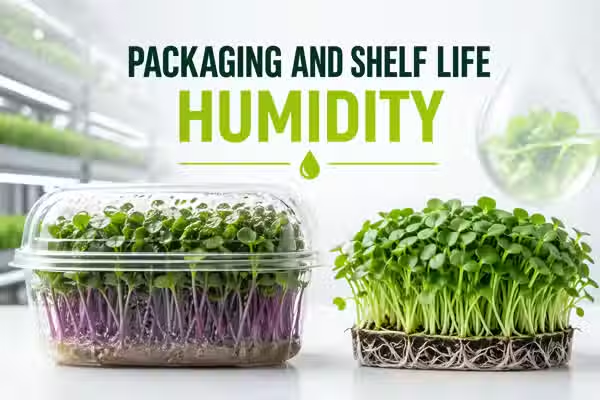
Key takeaways
Clamshell packaging retains the most moisture but creates condensation within 24 hours in Bangkok ambient humidity above 70%, which accelerates stem rot faster than weight loss alone predicts.
Flow wrap packaging with a 2-hour post-harvest dry-down before sealing produced the most consistent 5-day quality hold in our cycles -- but only when surface moisture was below visible wetness.
Unsealed poly bags lost an average of 8 to 12 percent of pack weight by day 3 in our trials, with pea shoots and sunflower showing the highest loss rate due to stem thickness and higher initial water content.
The grower assumption that more humidity inside the pack equals better freshness is wrong in a tropical climate: above 85% relative humidity inside the pack, mold onset moved from day 4 to day 2 in our sunflower cycles.
Pre-cooling at 16 degrees Celsius for 90 minutes before sealing any pack type reduced internal condensation by more than half across our test cycles (Plant Mood grow log data, 2024).
Radish and broccoli held quality across all three pack types through day 4; sunflower and pea showed clear divergence between pack types by day 2, making variety the biggest variable in packaging decisions.
TL;DR
Most microgreen packaging advice was written for 18-degree Celsius cold rooms, not Bangkok apartments. In a tropical climate, the enemy inside your pack is not dryness -- it is condensation and the mold it feeds. Clamshells look premium but trap humidity at levels that shorten shelf life in hot conditions. Flow wrap, sealed after a proper dry-down, gave us the cleanest results across five days. The packaging format matters less than what you do in the 2 hours before you seal it.
The pack that looked fine on day one
The clamshells went to the cafe on a Monday morning. They looked exactly right -- full, green, no yellowing, stems standing. By Wednesday the cafe messaged to say two packs had visible mold at the stem base. Not wilting, not yellowing. Mold. The packs had been refrigerated at the cafe the whole time. The sunflower had been harvested clean, rinsed, spun, and packed the same way it always was. Nothing had changed. Except Bangkok had been sitting at 82% ambient humidity for four days straight and the refrigerator at the cafe was a domestic unit that cycled between 6 and 14 degrees Celsius depending on how often the door opened.
That was the cycle that made me start logging what was actually happening inside the pack, not just what the pack looked like when it left. Temperature at seal time. Surface moisture. Ambient humidity in the grow room at harvest. Internal condensation at 24 hours. The problem was not the crop. The problem was that we were sealing ambient Bangkok humidity into the pack and then asking refrigeration to fix it.
Why condensation kills faster than dehydration in a tropical pack
When you seal a pack of microgreens in Bangkok at 30 degrees Celsius with surface moisture still present, you are trapping air that is already carrying 75 to 85 percent relative humidity. Once that pack hits a cold shelf, the temperature drops faster than the moisture can escape. The dew point inside the pack is crossed within hours. Water condenses on the inner surface of the packaging and on the stems closest to the pack walls. That standing water is not the same as the moisture inside the plant tissue -- it is free water sitting on organic matter at low but fluctuating temperatures. That is exactly the environment mold needs. The standard packaging advice says keep moisture in to prevent wilting. That advice is correct in a dry, temperate climate where the ambient humidity is 40 to 50 percent and refrigeration is stable. It is the wrong frame for Bangkok. Here, the question is not how to retain moisture -- it is how to manage the excess moisture you already cannot avoid.
In a clamshell sealed at 30 degrees Celsius with 80% ambient humidity, the internal relative humidity at seal time is effectively the same as ambient. At 6 degrees Celsius inside a refrigerator, the dew point for air at 80% RH is approximately 3 to 4 degrees Celsius -- which means any surface inside that pack colder than 3 degrees will condense free water. A domestic refrigerator running at 4 to 6 degrees sits right at that threshold. The condensation is not occasional. It is structural.
The mechanism is the same across all three pack types but the geometry changes the outcome. Clamshells create a large enclosed air volume that retains heat longer and condenses more. Flow wrap sits tight against the crop and has less air volume to condense from. Poly bags fall in between, but their loose structure means stems settle and compress, trapping micro-pockets of moisture at contact points.
What the numbers actually looked like across 5 days
Mold onset moved from day 4 to day 2 when internal pack humidity exceeded 85% RH at seal time in our sunflower cycles
Plant Mood grow log data, 2024. Measured across 18 sunflower cycles using a calibrated SHT31 sensor placed inside test packs during refrigerated storage at 6 to 8 degrees Celsius.
8 to 12 percent weight loss by day 3 in unsealed poly bags
Plant Mood grow log data, 2024. Measured across pea shoot and sunflower packs at ambient Bangkok room temperature of 28 to 31 degrees Celsius. Clamshells lost under 2 percent in the same period under refrigeration.
Pre-cooling to 16 degrees Celsius for 90 minutes before sealing reduced visible condensation at 24 hours from 9 out of 12 packs to 4 out of 12
Plant Mood grow log data, 2024. Tested on clamshell and flow wrap formats using sunflower and pea shoots. Condensation assessed visually at inner pack surface and stem base.
Flow wrap packs sealed after a 2-hour surface dry-down showed no visible mold through day 5 in 11 of 14 cycles
Plant Mood grow log data, 2024. Surface dry-down performed using a small fan at ambient temperature post-harvest. Packs held at 6 to 8 degrees Celsius in a dedicated mini-fridge with stable temperature cycling.
What our pack testing showed across varieties and formats
In every comparative cycle we ran, radish and broccoli held visual quality -- stem integrity, color, no sliminess -- across all three formats through day 4 under refrigeration. Sunflower and pea began showing stem softening and base discoloration by day 2 in clamshells, and by day 3 in flow wrap. The difference is stem water content at harvest. Sunflower and pea have substantially more stored moisture in the stem. That moisture migrates outward post-harvest and raises the internal pack humidity faster than low-moisture varieties do.
Sunflower and pea shoots diverged from radish and broccoli by day 2 regardless of pack type
Variety-specific packaging decisions are not optional in a Bangkok operation. Running one pack format for all crops will produce acceptable results on your hardiest varieties and early failures on your most moisture-dense ones. We now flow wrap sunflower and pea with a longer dry-down and clamshell broccoli and radish. The format does not change -- the pre-seal protocol does.
Our worst shelf life results -- mold by day 2 or 3 -- all occurred in clamshells delivered to venues with domestic or commercial refrigerators that were frequently opened and closed. The larger air volume inside a clamshell amplifies every temperature swing. Each time the refrigerator opens, warm ambient air enters, raises the dew point, and deposits more free water on the inner pack surface. Flow wrap, because it sits tight against the crop, is less affected by these swings because there is less air volume cycling through.
Clamshells failed fastest when cafe refrigeration was inconsistent
If you cannot control the refrigeration environment at the delivery point, clamshells are a liability in Bangkok conditions. They are the right choice for display and premium positioning. They are not the right choice for venues where cold chain discipline is uncertain. Knowing your customer's refrigeration setup is part of your packaging decision.
We tested sealing immediately after spin-drying, sealing after 30 minutes, and sealing after 2 hours with airflow. The 2-hour dry-down -- using a small USB fan pointed at spread-out harvest on a tray at room temperature -- consistently produced the lowest internal humidity at seal time. Measured with a SHT31 sensor inside test packs, surface-dried crops sealed at around 58 to 65% RH internally versus 78 to 84% RH for immediately-sealed packs. That 20-point difference in starting RH is the difference between reaching the condensation threshold inside a cold pack or not.
The 2-hour post-harvest dry-down before sealing was the single highest-impact intervention we found
Two hours of airflow costs nothing and changes the shelf life outcome more reliably than switching pack formats. We ran this comparison enough times to treat it as settled. If you are sealing wet crops because your harvest-to-pack window is short, you are solving the wrong problem.
Plant Mood grow log data, 2024
What Bangkok growers miss about their own packing environment
Most growers think about the refrigerator at the destination. Almost none log the ambient humidity in the room where they are packing. In Bangkok, that number varies from 65% on a dry season morning to 88% during an afternoon rainstorm in July. The crop going into the pack carries the air of the room it was packed in. A crop packed at 88% ambient humidity, regardless of how well it was spun and dried, starts its cold storage journey with a significant humidity handicap. Logging harvest room RH at pack time takes 30 seconds and explains a large share of the variance in shelf life outcomes that growers attribute to the crop itself.
Harvest room humidity at packing time
A grower who tests shelf life in their own refrigerator -- a dedicated unit at stable 6 degrees Celsius with consistent cycling -- will get results that do not transfer to a cafe's domestic refrigerator running at 8 to 14 degrees with the door opening 40 times a day. This is not a hygiene failure at the cafe. It is a cold chain reality. Your shelf life claim is only as valid as the weakest link in the refrigeration chain. Bangkok's food service refrigeration ranges from excellent to barely functional. If your packaging cannot handle the variance, the complaint comes back to you.
The difference between the fridge you test in and the fridge it ships to
Growers check the top of the crop. The mold starts at the bottom. The stem base, where the cut sits, is the highest-moisture point on a harvested microgreen. It is also the point in direct contact with whatever the crop is resting on inside the pack. In a clamshell with a paper liner that absorbed rinse water, the stem base is sitting in a microenvironment of near-100% RH from the first hour. Checking stem bases at 24 and 48 hours -- not canopy appearance -- is the honest quality read. Canopy can look fine while the base is already degrading.
Stem base as the earliest failure point
Refrigeration slows microbial activity. It does not stop it. At 6 degrees Celsius, the mold species that colonize microgreen stem bases -- primarily from the Botrytis and Fusarium families, documented in post-harvest vegetable research at multiple agricultural institutions -- slow but do not halt. If the conditions for mold establishment were created at packing time, refrigeration extends the timeline. It does not reset it. Growers who rely on the fridge to fix a wet pack are buying time, not quality.
The assumption that refrigeration is doing the preservation work
More ventilation holes in the pack made shelf life worse, not better
In Bangkok ambient conditions, perforations allow moisture exchange in both directions. When a refrigerator door opens and warm, humid air enters, a perforated pack draws that air in faster than a sealed one. The incoming air is warmer and more humid than the pack interior. It raises the internal dew point, deposits condensation on the crop, and then the door closes and the pack re-cools -- leaving free water behind that did not exist before the door opened. In a temperate climate with low ambient humidity, perforations release more than they absorb. In Bangkok, on a day with 80% ambient humidity, the ambient air you are venting in is more humid than the pack air you are venting out. The perforation works against you.
We tested perforated versus sealed clamshells across 12 cycles of sunflower in the rainy season. The perforated packs showed visible stem base condensation 18 to 24 hours earlier than sealed packs stored in the same refrigerator. The canopy on perforated packs did look marginally fresher at day 1 -- slightly less wilted appearance -- but by day 3 the stem base condition was worse across the board. The ventilation was exchanging the wrong things.
Adding small ventilation perforations to clamshells or poly bags allows excess moisture to escape, which should reduce condensation and extend shelf life. Several post-harvest handling guides for leafy produce recommend micro-perforation for exactly this reason, and the logic is sound in a controlled cold room environment.
How we sequence harvest to sealed pack for a 5-day hold
Harvest into a colander, not directly into the pack or a sealed container
Crop is loosely contained and breathing from the moment it is cut.
Allows airflow around the cut stems immediately. Any stem moisture released in the first 15 minutes after cutting needs somewhere to go. A sealed container traps it.
Rinse only if necessary, and do it cold
Minimum additional moisture introduced at this stage.
Rinsing adds water the dry-down has to remove. If the crop is clean and grown on a sterile medium, skip the rinse. If rinsing is needed, use cold water -- it closes the stomata and reduces water uptake into the stem tissue.
Spin-dry in two passes with the salad spinner
Surface moisture is visually absent. Stems feel dry to the touch.
One spin leaves more surface moisture than two. The second pass removes the water that migrated back to the surface after the first spin. This is not theoretical -- the second spin consistently produces drier output than the first.
Spread on a clean dry tray and point a USB fan at low speed for 90 to 120 minutes
Internal pack RH at seal time targets 60 to 65%. Measure with a small humidity sensor placed under the crop on the tray if you want to confirm.
This is the dry-down step. The fan does not need to be powerful. It needs to move air across the surface consistently. The goal is surface RH reduction, not dehydration. The crop should not look wilted at the end of this step.
Pre-cool the crop at 16 degrees Celsius for 60 to 90 minutes before sealing
Crop surface temperature is below 20 degrees Celsius before sealing. The pack goes into cold storage without carrying significant heat load.
Bringing the crop temperature down before sealing reduces the temperature differential between the crop and the cold shelf at destination. Less differential means less condensation drive inside the sealed pack.
Seal in the format appropriate to the variety and destination
Pack is sealed with the lowest achievable internal humidity and a pre-cooled crop. The refrigeration at destination maintains, not rescues, the condition.
Flow wrap for high-moisture varieties going to venues with variable refrigeration. Clamshell for lower-moisture varieties going to controlled cold storage or direct-to-consumer delivery. Poly bags for same-day delivery only -- they are not a 5-day format in Bangkok conditions.
What a clean 5-day pack protocol actually looks like in practice
Grower at harvest
Log ambient humidity in the harvest and packing room at the time of harvest. This takes 10 seconds with a wall-mounted sensor. It is the single most useful data point for explaining shelf life variance later.
A baseline record that connects packing conditions to shelf life outcomes over time. After 20 cycles of logging, patterns by season and weather become visible.
Grower at post-harvest
Do not rinse unless the crop visibly needs it. Spin twice. Fan-dry for a minimum of 90 minutes before any sealing step. This is non-negotiable for sunflower and pea in Bangkok. For radish and broccoli, 60 minutes is usually sufficient.
Surface moisture is eliminated before sealing. Internal pack RH at seal time stays below 70%.
Grower at packing
Match the pack format to the variety and the cold chain you can actually guarantee. Do not default to clamshells for premium positioning if the delivery destination has unreliable refrigeration. Flow wrap is not visually inferior -- it is just less familiar to buyers who have not been educated on it.
Format choice reflects actual cold chain conditions, not packaging aesthetics alone.
Grower at quality check
Check stem bases at 24 hours and 48 hours post-pack, not canopy. A clean canopy with a degrading base is a pack that will fail by day 3. Catching base degradation at 24 hours gives you the data to adjust the dry-down protocol, not a complaint from a customer on day 3.
Early detection of the failure point that actually ends shelf life in Bangkok conditions.
The pre-cool step before sealing. Most growers move directly from dry-down to sealing without reducing the crop temperature. In Bangkok, where room temperature is 28 to 31 degrees Celsius, sealing a room-temperature crop means the pack is carrying significant heat into refrigeration. The condensation that forms in the first 4 to 6 hours of cold storage is largely driven by this temperature differential. Ninety minutes at 16 degrees Celsius before sealing costs almost nothing and measurably changes the outcome.
What to change before the next harvest
Pick one pack type you are currently using and run a direct comparison this week. Seal half your packs immediately after spin-drying. Fan-dry the other half for 2 hours before sealing. Check stem bases at 24 and 48 hours. Write down what you see. You do not need sensors to run this test -- you need two batches, a fan, and enough honesty to record what the stems actually look like instead of what you hope they look like. That comparison, run once, will tell you more about your shelf life problem than any packaging guide written for a climate that does not exist in Bangkok.
FAQ
Why do my microgreens get moldy in the pack even when refrigerated?
The most common cause in Bangkok conditions is sealing ambient humidity into the pack at harvest time. If the crop is packed at 80% ambient RH without a proper dry-down, the internal pack humidity crosses the condensation threshold within hours in a cold refrigerator. Free water forms at the stem base and mold establishes there before the canopy shows any visible sign. A 90 to 120 minute fan dry-down before sealing reduces internal pack RH significantly and is the highest-impact single intervention for preventing refrigerated mold.
How long do microgreens last in a clamshell versus flow wrap?
In our cycles, flow wrap with a proper pre-seal dry-down produced more consistent 5-day quality holds than clamshells in Bangkok conditions. Clamshells retain more moisture but also trap more air volume, which amplifies condensation with every refrigerator door opening. Clamshells outperformed flow wrap only when the destination refrigerator was stable and dedicated. For venues with variable cold chain, flow wrap sealed after a 2-hour dry-down was the more reliable format across our test cycles (Plant Mood grow log data, 2024).
How much weight do microgreens lose after harvest?
In our poly bag tests at Bangkok ambient temperature of 28 to 31 degrees Celsius, pea shoots and sunflower lost 8 to 12 percent of pack weight by day 3. Under refrigeration in sealed clamshells, weight loss was under 2 percent in the same period. Weight loss itself is less damaging than condensation-driven mold in a tropical climate -- a pack that loses 5 percent weight but stays mold-free through day 5 is a better outcome than a pack that retains moisture but develops stem base rot by day 2.
Should I add ventilation holes to my microgreen packaging?
Not in Bangkok conditions. Perforated packs exchange air in both directions. When a refrigerator door opens and warm, humid Bangkok air enters, a perforated pack absorbs that humidity faster than a sealed one. In our 12-cycle comparison of perforated versus sealed clamshells during the rainy season, perforated packs showed visible stem base condensation 18 to 24 hours earlier than sealed packs stored in the same refrigerator. Ventilation works in low-ambient-humidity environments. In Bangkok, it accelerates the problem it is meant to prevent.
What is the best way to reduce condensation inside microgreen packs?
Two interventions combined work best: a 90 to 120 minute fan dry-down after spin-drying before sealing, and a 60 to 90 minute pre-cool at 16 degrees Celsius before sealing. The dry-down reduces the humidity of the air you are sealing into the pack. The pre-cool reduces the temperature differential between the crop and the cold shelf, which drives condensation in the first hours of refrigeration. Together, these steps reduced visible condensation at 24 hours from 9 of 12 packs to 4 of 12 in our clamshell and flow wrap trials (Plant Mood grow log data, 2024).
Which microgreens have the shortest shelf life after packaging?
In our cycles, sunflower and pea shoots showed the fastest quality decline across all three pack types, with visible stem softening and base discoloration beginning by day 2 in clamshells. Radish and broccoli held quality through day 4 across all formats under refrigeration. The difference is stem water content -- sunflower and pea have higher moisture density in the stem, which migrates outward post-harvest and raises internal pack humidity faster than lower-moisture varieties. These varieties require a longer pre-seal dry-down and benefit most from flow wrap over clamshell in Bangkok conditions.
Is it worth pre-cooling microgreens before packaging?
Yes, and it is the most commonly skipped step in the harvest-to-pack sequence. Sealing a Bangkok room-temperature crop at 29 to 30 degrees Celsius means the pack carries significant heat into cold storage. The condensation that forms in the first 4 to 6 hours is driven primarily by this temperature differential. Pre-cooling at 16 degrees Celsius for 60 to 90 minutes before sealing reduced visible condensation at 24 hours by more than half in our trials. The step costs only time and a small refrigeration space, and it addresses the condensation problem at its source rather than hoping the destination fridge corrects it.