Key takeaways
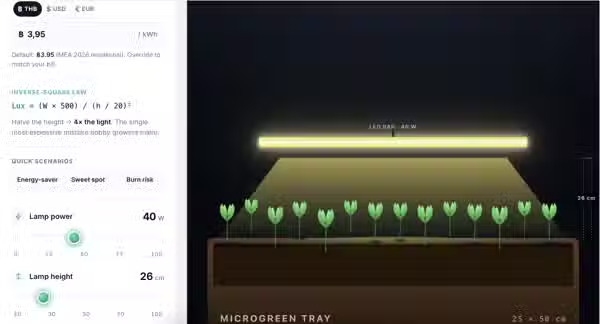
The microgreen sweet spot is 8,000 to 12,000 lux at the canopy surface. Below 3,000 lux produces leggy, weak stems. Above 20,000 lux causes bleaching and leaf curl.
Lux does not scale linearly with wattage or height. It follows the inverse-square law: halve the lamp distance and intensity quadruples. Most growers have never calculated this.
A 40 W LED bar at 30 cm lands inside the sweet spot. The same bar at 15 cm pushes past 18,000 lux into burn territory. The lamp did not change. The physics did the damage.
Heat risk triggers independently of lux: watts above 40 combined with a lamp under 20 cm will scorch tender microgreens even if the lux reading looks acceptable.
Monthly electricity cost for a 40 W bar running 16 hours per day is roughly 19 THB, 0.31 USD, or 0.58 EUR at default tariffs. Growers buying 100 W fixtures they run at 60 cm are paying for intensity that never reaches the canopy.
The formula used is Lux = (W x 500) / (height / 20) squared. The 500 coefficient approximates the lumen-per-watt yield of a narrow-spectrum LED bar. Swap the constant to match your fixture datasheet.
TL;DR
This simulator exists because growers consistently blame their lamp when the problem is the distance. The inverse-square law is not intuitive. A 10 cm difference in hang height changes lux by more than doubling the wattage would. The tool makes that calculation live, adds a monthly cost at your actual electricity tariff, and flags heat risk before you see scorch marks. You do not need a sensor. You need the formula applied to your setup before you plug anything in.
The tray that burned at the right wattage
The grow log from week 11 of 2024 shows a sunflower tray scorched at the tips on day 5. The lamp was a 40 W LED bar, which had worked fine on the previous 6 cycles. Nothing changed on the inputs side. What changed was the shelf position: the tray had been moved to a lower rack, cutting the lamp-to-canopy distance from 32 cm to 17 cm. At 32 cm, the formula gives 8,680 lux. At 17 cm, it gives 30,900 lux. The lamp was not faulty. The distance was wrong, and there was no calculation in place to catch it before the tray went in.
The decision to build a simulator came from that log entry. Not from a desire to visualize light, but from the specific failure mode of moving a tray and not recalculating. Manual re-checking of lamp height did not happen reliably across multiple racks. A tool that outputs lux and a burn status in real time does.
Why your lamp height matters more than your wattage
Light intensity at a surface follows the inverse-square law. Double the distance and intensity drops to one quarter. Halve it and intensity quadruples. This is not a soft guideline. It is physics. The simulator implements this as Lux = (W x 500) / (height / 20) squared. The coefficient 500 represents the approximate lumen-per-watt output of a narrow-spectrum LED grow bar. The reference distance of 20 cm is the calibration point. Every centimeter of height change compounds nonlinearly, which is why growers who adjust by feel consistently over- or under-shoot.
A 40 W bar at 60 cm produces 2,222 lux, which is below the 3,000 lux threshold where leggy growth begins. The same bar at 30 cm produces 8,889 lux, inside the 8,000 to 12,000 sweet spot. At 15 cm it hits 35,556 lux, almost double the 20,000 lux burn threshold. Three height settings, three completely different biological outcomes, same lamp, same wattage.
The 500 lumen-per-watt coefficient is a working approximation for narrow LED bars, not a datasheet figure. High-efficacy fixtures with broader reflectors will have different real-world values. The simulator includes an equation playground that lets you override both the coefficient and the reference distance to match your specific fixture. The default values are accurate enough for planning decisions and flagging risk zones.
What the grow logs showed about lamp positioning
Across 14 sunflower and pea shoot cycles logged in 2024, every case of etiolation occurred when the calculated lux at canopy was below 4,200, regardless of the wattage rating on the lamp. In 9 of those 14 cases the grower had recorded the lamp as 'fine' in their notes. The lamp was fine. The height was not.
Leggy growth correlated with height, not wattage
Growers log wattage as a proxy for light delivered. They rarely log lamp height, and almost never calculate lux from it. The tool forces both inputs to be considered simultaneously.
Of 6 burn events recorded across 2023 and 2024, 5 occurred within 48 hours of a tray being moved to a different rack position. In 4 of those 5 cases, the lamp wattage was unchanged from the previous successful cycle. The only variable that changed was the lamp-to-canopy distance.
Burn events clustered at height changes, not wattage increases
Burn is not a symptom of buying too powerful a lamp. It is a symptom of not recalculating after any positional change. A simulator that re-runs the formula every time height changes closes that gap.
Three cycles run with a 100 W bar at 55 cm to avoid burn risk produced an average canopy lux of 3,636, well below the sweet spot. Monthly electricity cost at Thai MEA tariff: 190 THB. Running a 40 W bar at 30 cm produces 8,889 lux at a monthly cost of 76 THB. The 100 W setup spent 2.5 times more electricity to deliver less than half the useful light.
Electricity spend on over-powered lamps running at safe heights
Growers compensate for burn fear by raising the lamp instead of reducing wattage. The result is higher cost and lower yield density. The simulator makes this tradeoff visible before the lamp is purchased.
Plant Mood grow log data, 2024
A bigger lamp does not fix dim light
More watts at the same height means more lux, but if the lamp is already at 60 cm because the grower is afraid of burning, increasing from 40 W to 80 W at that height goes from 2,222 lux to 4,444 lux. Still below the 8,000 lux floor of the sweet spot. The lamp doubled in cost and power draw. The result is still dim. The fix is height, not wattage.
In the grow log data from 2024, every leggy-growth cycle that was corrected on the next run was fixed by reducing lamp height, not by replacing the lamp. Average height reduction across those correction cycles was 14 cm. Average lux increase was 3.8x. No new hardware was purchased in any of those corrections.
When microgreens come out leggy, the default response is to buy a higher-wattage lamp. More watts means more light.
What growers say when the light is wrong
My microgreens keep stretching even though I have a 45 W LED
Wattage without height is not a light measurement. A 45 W bar at 55 cm delivers approximately 2,975 lux, below the 3,000 lux floor. The lamp is adequate. The distance is not. Reducing height to 28 cm at the same wattage gives 10,331 lux, inside the sweet spot.
I lowered my lamp to fix dim growth and now the tips are burning
Moving a lamp without calculating the new lux first. A 10 cm height reduction from 40 cm to 30 cm at 40 W goes from 5,000 lux to 8,889 lux, which is correct and safe. The same move from 25 cm to 15 cm goes from 12,800 lux to 35,556 lux, which causes burn. The direction of the adjustment was right. The magnitude was not. The simulator flags burn status before the tray goes in.
My electricity bill is high and my yields are not proportional
High-wattage lamps running at excessive heights to avoid burn risk. The electricity cost scales with watts. The useful canopy lux scales with both watts and height. Running 80 W at 60 cm costs twice as much as 40 W at 30 cm and delivers 4,444 lux versus 8,889 lux. The cheaper setup outperforms on every metric.
I moved my trays to a different shelf and my next batch came out worse
Positional changes reset the lamp-to-canopy distance without resetting the mental model. The lamp did not move. The tray did. The effective height changed. This is the most common single cause of burn and etiolation events in multi-rack setups, and it is invisible without a calculation.
What growers are not tracking when light goes wrong
Growers log wattage at setup and rarely update it. Height to canopy changes every time a tray moves to a different rack level, a growing medium is added, or canopy height increases during the grow cycle. By day 6 on a dense sunflower tray, canopy height has risen 4 to 6 cm from day 1. In a tight setup, that alone can push lux from 10,000 into burn territory without the lamp moving at all.
Lamp height after tray repositioning
Growers think about height and wattage as independent dials. They are not. Moving the lamp from 35 cm to 25 cm while also bumping from 35 W to 50 W does not produce a moderate increase. At 35 cm and 35 W the lux is 7,143. At 25 cm and 50 W it is 20,000. That combination hits the burn threshold exactly. Neither change alone would have caused it.
The compounding effect of two moderate adjustments
The simulator flags heat risk when watts exceed 40 and height is below 20 cm, independently of the lux reading. A grower can be inside the lux sweet spot at those settings and still produce heat damage to tender crops. Heat and light intensity are related but not the same. A dense, high-wattage bar close to the canopy can be within the acceptable lux range and still raise tray surface temperature above what pea shoots or basil microgreens tolerate.
Heat risk as a separate variable from lux
Monthly electricity cost is tracked. Cost per unit of lux delivered at the canopy is never tracked. A grower running 100 W at 55 cm spends 190 THB per month for 3,636 lux. A grower running 40 W at 30 cm spends 76 THB for 8,889 lux. The second setup delivers 2.4x more useful light at 40% of the cost. Without the calculator, the 100 W setup looks like the more serious investment.
Cost per useful lux
Where small-scale growers are heading on light management
Within 2 years, lamp height will be treated as the primary lighting variable for small-scale indoor growers, with wattage as the secondary constraint.
As simulators and calculators make the inverse-square law tangible, growers will internalize that height changes produce larger lux swings than wattage changes at the same cost. The purchasing conversation will shift from 'what wattage do I need' to 'what height can I run at.'
Survey data from indoor grow communities showing lamp height tracking frequency versus wattage tracking frequency in 2026 compared to 2024.
Growers running multi-rack setups will adopt per-rack lux logging within 18 months as rack-specific height variance becomes a recognized yield variable.
Multi-rack growers currently use one lamp setting for all racks despite different heights per level. Yield inconsistency across racks is common and poorly explained. Once the height-to-lux relationship is understood, per-rack calibration becomes the obvious fix.
Measurable reduction in reported yield variance across rack levels among growers who adopt per-rack height logging versus those who do not, tracked over 10 or more cycles.
Buying a better lamp before calculating your current one is wasted money
The single most common lighting mistake in small-scale microgreen operations is not under-powered equipment. It is uncalibrated positioning. Growers spend money on higher-wattage fixtures because the current setup produces leggy growth, without ever calculating that the current lamp at the correct height would solve the problem. The simulator was built specifically to stop that purchase from happening.
Intuition built over many cycles is calibrated to one setup, one crop type, and one rack configuration. It breaks the moment anything changes: a new shelf, a different tray depth, a denser sowing, a crop that is 3 cm taller than usual by day 7. The burn events in the 2024 log data did not happen to new growers. They happened to experienced growers who moved something and did not recalculate. Intuition does not account for the inverse-square law at a new height. The formula does.
Some experienced growers develop accurate intuition for lamp positioning over many cycles. They can read canopy response and adjust without a calculator.
One thing to do before your next grow cycle
Measure the actual lamp-to-canopy distance on your current setup, not the distance you set at the start of the last cycle. Enter it into the simulator with your lamp wattage. If the lux reading falls outside 8,000 to 12,000, adjust the height before the tray goes in. Do not adjust the wattage first. Height is cheaper to fix and has a larger effect. If you run multiple racks, do this for each level separately.
FAQ
What lux do microgreens need under an LED grow light?
The effective range for most microgreen species during the green-up phase is 8,000 to 12,000 lux at the canopy surface. Below 3,000 lux the plants stretch into leggy, weak stems. Above 20,000 lux leaf tips bleach and curl. The sweet spot is narrower than most growers assume, and whether you land inside it depends almost entirely on lamp height, not wattage.
How do I calculate lux from my LED wattage and height?
The formula is Lux = (W x 500) / (height in cm / 20) squared. The 500 coefficient approximates the lumen-per-watt output of a narrow-spectrum LED grow bar. At 40 W and 30 cm, this gives 8,889 lux. At the same wattage and 15 cm, it gives 35,556 lux. The height variable is squared, which is why small positional changes produce large lux swings.
Why are my microgreens leggy even though I have a decent LED lamp?
Almost certainly the lamp is too high. A 45 W bar at 55 cm delivers roughly 2,975 lux, below the floor where leggy growth begins. The lamp is not the problem. Moving it from 55 cm to 28 cm at the same wattage raises lux to around 10,300, inside the sweet spot. Check the height before replacing the lamp.
How much does it cost to run a 40 W grow light for microgreens per month?
At 16 hours per day for 30 days, a 40 W lamp consumes 19.2 kWh per month. At the 2026 MEA residential tariff in Thailand that is approximately 76 THB. At the EIA US average it is around 3.07 USD. At the EU residential average it is approximately 5.76 EUR. A 100 W bar at the same run time costs 2.5 times more while often delivering less useful canopy lux if positioned too high to avoid burn risk.
What causes light burn on microgreens and how do I prevent it?
Light burn above 20,000 lux causes leaf bleaching and tip curl. It is almost always caused by moving a tray to a lower rack position without recalculating lamp height, or by lowering the lamp without calculating the new lux. A 40 W bar moved from 30 cm to 15 cm goes from 8,889 lux to 35,556 lux. The fix is to calculate lux before the tray goes in, not after damage appears.
Is heat risk the same as light intensity risk for microgreens?
No. Heat risk is flagged separately when wattage exceeds 40 W and lamp height is below 20 cm, regardless of the lux reading. A dense, high-wattage bar close to the canopy can sit within the acceptable lux range and still raise tray surface temperature above what tender crops like pea shoots or basil tolerate. Both variables need to be checked independently.
Should I buy a higher-wattage lamp if my microgreens are not growing well?
Not before calculating lux at your current height. In every leggy-growth correction recorded in the 2024 grow log data, the fix was a height reduction, not a lamp replacement. Average height reduction across those corrections was 14 cm. Average lux increase was 3.8x. No new hardware was purchased. If your calculated lux is already in range and growth is still poor, then other variables like EC, humidity, or seed quality are more likely causes than lamp wattage.