Key takeaways
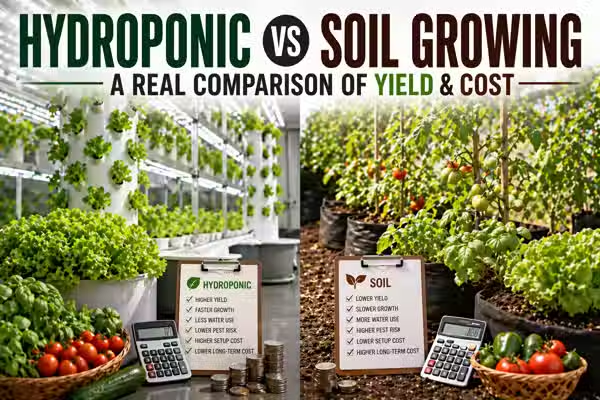
Hydroponics produces harvestable lettuce in 28 to 35 days from transplant in Bangkok conditions. Soil-grown lettuce in the same environment takes 45 to 55 days from direct sow to equivalent harvest weight. The hydroponic cycle advantage is real -- roughly 15 to 20 days per cycle -- but it requires reservoir temperature below 28 degrees Celsius to hold (Plant Mood grow log data, 2022-2024).
Soil growing costs less to start. A basic soil setup for four to six plants costs 300 to 600 THB in containers, potting mix, and seeds. An entry-level NFT or tower hydroponic system in Bangkok runs 1,500 to 4,000 THB before nutrients and pH management supplies. The soil cost advantage narrows over time as soil requires replacement or amendment every two to three cycles.
Hydroponics uses significantly less water than soil in a Bangkok apartment -- approximately 70 to 80 percent less per gram of harvestable yield in recirculating systems (Plant Mood grow log data, 2022-2024). Soil in containers requires more frequent watering in Bangkok heat and loses a higher proportion of water to evaporation from the growing medium surface.
Time investment diverges in where it concentrates, not in total hours. Soil demands daily watering checks and responds less predictably to missed days in Bangkok heat. Hydroponics demands more setup and calibration time per cycle but daily monitoring is faster once the system is running. Neither is genuinely low-maintenance in Bangkok conditions.
The most common reason hydroponic beginners in Bangkok switch back to soil is reservoir temperature management -- specifically, the cost and effort of keeping the reservoir below 28 degrees Celsius without a chiller. The most common reason soil beginners switch to hydroponics is fungus gnats, soil mold, and unpredictable watering outcomes in high-humidity conditions.
Yield per square metre favours hydroponics by a meaningful margin in vertical tower configurations -- approximately 3 to 4 times the harvestable weight per footprint compared to equivalent soil containers. On a flat shelf, the advantage is smaller: roughly 1.5 to 2 times, primarily from faster cycle time rather than higher plant density.
TL;DR
Hydroponics wins on cycle time, water efficiency, and yield per square metre. Soil wins on startup cost, simplicity, and tolerance for the kind of inconsistency that is normal in a first grow. Neither system is forgiving in Bangkok -- hydroponics punishes warm reservoirs and neglected pH, soil punishes inconsistent watering and poor airflow. The honest version of this comparison is not 'which is better' but 'which failure mode are you more likely to catch in time.'
Running both at the same time
For about eight months across 2022 and 2023, I ran soil containers and an NFT hydroponic channel side by side in the same space -- same light exposure, same ambient temperature, same seed varieties. It was not a controlled scientific trial. It was a practical comparison that came out of needing to fill space while a second NFT unit was on order, and deciding to plant soil containers in the gap rather than leave the shelf empty.
The lettuce in the hydroponic channel hit harvestable weight at day 31 from transplant. The same variety in soil containers hit equivalent weight at day 49. I was not surprised by that gap -- I expected hydroponics to be faster. What surprised me was where the soil actually performed better: consistency. Three of the hydroponic plants in that run showed tip burn from a calcium distribution issue I did not catch fast enough. All six soil plants came through clean. Soil is slower and less efficient, but it is also less reactive. Small mistakes stay small longer.
That run made me stop thinking about this as a question of which system is superior and start thinking about it as a question of which risks each system exposes you to. In Bangkok, the risks are different enough between the two that the right answer genuinely depends on the grower's situation -- how much time they have, what equipment they can afford, and how closely they can monitor a system that will tell them something is wrong only after it already is.
The myths that send growers toward the wrong system
Hydroponics always outperforms soil, and soil is only for beginners who cannot manage a real system.
Hydroponics outperforms soil when reservoir temperature is controlled, EC and pH are managed accurately, and the grower has time to catch problems within 24 to 48 hours. In Bangkok conditions without a chiller, a hydroponic system running above 29 degrees Celsius will underperform well-managed soil on root health, nutrient uptake, and final yield. 'Well-managed' is the operative phrase for both systems. A hydroponic system poorly matched to the grower's monitoring capacity will produce worse results than soil with basic consistent care.
The beginner-to-intermediate framing of soil versus hydroponics also obscures what experienced growers actually observe: soil is more tolerant of inconsistency but harder to diagnose when something goes wrong, because the problem is hidden in the medium. Hydroponics is less tolerant of inconsistency but more legible -- the reservoir data tells you what is happening if you read it. The system that is 'better' depends almost entirely on the grower's diagnostic style, not their experience level.
In eight months of parallel growing logged at Plant Mood, the hydroponic system outperformed soil on yield per cycle in five of eight runs. In three runs where reservoir temperature exceeded 29 degrees Celsius for more than three consecutive days, soil-grown plants in the same space outperformed the hydroponic system on final harvest weight. The temperature threshold, not the system type, determined the outcome (Plant Mood grow log data, 2022-2023).
Soil is not simpler -- it is just differently complicated
Soil is forgiving of some mistakes and completely unforgiving of others, and the ones it is unforgiving of are exactly the ones Bangkok conditions create. Inconsistent watering is the main one. In Bangkok heat, a container of potting mix that misses watering by a day can dry out enough to stress roots at the centre of the container while the surface still looks moist. The moisture gradient through a soil container in 32-degree ambient temperature is steep enough that visual checks are genuinely unreliable. Root zone moisture needs to be felt, not observed.
Soil in a Bangkok apartment also creates consistent biological challenges that have nothing to do with the grower's skill: fungus gnats, soil-surface mold in high-humidity conditions, and the decomposition of organic potting mix components in continuous heat accelerating faster than the feeding schedule accounts for. Potting mix that works well for the first cycle loses structure and nutrient-holding capacity by the second or third because the organic fraction breaks down faster in Bangkok heat than in the climate the product was formulated for.
Hydroponics is demanding but its demands are legible. EC and pH give you readable numbers. Reservoir temperature gives you a number. Root colour and texture tell you something specific. The failures are visible if you are watching. Soil failures are frequently invisible until the plant is already struggling -- the problem is underground, in the medium, and there is no reading you can take that tells you root zone moisture and biology are within range.
The growers who struggle most with soil in Bangkok are not beginners -- they are people who learned to grow in a temperate climate and brought their intuitions with them. Watering schedules that worked in a lower-temperature, lower-evaporation environment cause chronic under-watering or over-watering in Bangkok because the same medium dries and re-saturates at completely different rates. The intuition is calibrated to the wrong climate.
Soil growing is the easy option. Less equipment, less monitoring, less to go wrong. Most grow guides position it as the entry point before 'graduating' to hydroponics. The assumption is that soil is forgiving and hydroponics is demanding.
The real numbers across eight months of parallel growing
18-day average cycle time advantage for hydroponics over soil: 31 days versus 49 days to equivalent harvest weight
Measured across parallel runs of the same lettuce variety in the same growing space, same light source, same ambient temperature. Hydroponic system: NFT channel at EC 1.2 to 1.6 mS/cm, pH 5.8 to 6.2, reservoir temperature 24 to 27 degrees Celsius (actively managed with aquarium chiller). Soil system: commercial potting mix in 2-litre containers, watered to drainage when medium surface began to dry. Harvest weight threshold: 80 grams per plant. Plant Mood grow log data, 2022-2023.
Water use: approximately 0.8 litres per 100 grams of harvestable lettuce in recirculating hydroponics versus 3.2 to 4.0 litres per 100 grams in soil containers
Calculated from reservoir volume logs and top-up records for hydroponics, and from watering volume records for soil containers across the same crop cycles. Soil figure includes drainage loss and evaporation from medium surface. Recirculating hydroponic figure reflects net consumption -- evapotranspiration only, since reservoir water is recirculated. Plant Mood grow log data, 2022-2023.
Startup cost differential: 300 to 600 THB for soil versus 1,500 to 4,000 THB for entry-level hydroponic system in Bangkok
Soil figure includes containers, commercial potting mix, seeds, and basic pH test strips. Hydroponic figure includes NFT channel or basic tower, submersible pump, air pump, net pots, hydroponic nutrient solution starter kit, and pH meter. Neither figure includes lighting, which applies equally to both systems in a Bangkok apartment without adequate natural light. A chiller -- which Bangkok conditions make functionally necessary for reliable hydroponic performance -- adds 2,500 to 5,000 THB to the hydroponic figure.
What eight months of parallel growing actually showed
In three of the eight parallel crop cycles, ambient temperature in the grow space climbed above 32 degrees Celsius for extended periods, bringing reservoir temperature above 29 degrees Celsius despite partial cooling measures. In those three cycles, hydroponic final harvest weight averaged 67 grams per plant versus 74 grams per plant for soil. In the five cycles where reservoir temperature was maintained below 27 degrees Celsius, hydroponic harvest weight averaged 94 grams per plant versus 71 grams per plant for soil. The temperature management requirement is not optional for hydroponic performance -- it is the condition under which the yield advantage exists.
The hydroponic yield advantage collapsed at reservoir temperatures above 29 degrees Celsius
A grower choosing hydroponics in Bangkok without a plan for reservoir temperature management is not choosing the higher-yield system. They are choosing a system that requires active cooling infrastructure to deliver on its performance claims. The cost of that infrastructure should be part of the system cost comparison from the beginning.
Logged time-on-task across parallel cycles: soil containers averaged 12 to 15 minutes per day of active attention (watering, checking moisture, adjusting drainage). The hydroponic system averaged 6 to 8 minutes per day once the cycle was established, with higher time investment on setup days (reservoir mixing, EC and pH calibration) of 25 to 35 minutes. Total cycle time investment over a 35-day hydroponic run was approximately 280 to 350 minutes. Over a 49-day soil run to equivalent harvest, approximately 590 to 735 minutes. The hydroponic system required less total time but demanded more concentrated attention in specific technical tasks.
Soil required more total daily time across a crop cycle, concentrated in watering
Soil is more time-consuming overall but distributes that time in simple daily tasks. Hydroponics concentrates the technical demand in fewer, higher-stakes moments -- a missed pH correction or a two-day reservoir temperature spike has consequences that a missed watering day in soil does not. Which pattern fits better depends on the grower's schedule and tolerance for technical management.
Over eight months of parallel operation, fungus gnat infestations appeared in soil containers on three separate occasions and did not spread to the hydroponic system. Surface mold on potting mix appeared in two cycles during the wet season when ambient humidity stayed above 80 percent for extended periods. No fungal surface issues appeared in the hydroponic system across the same period. Root rot events occurred in the hydroponic system in two cycles (both during reservoir temperature spikes) and did not occur in soil.
Mold and pest events were exclusively soil-side across the entire parallel comparison period
The biological risk profiles are different, not equivalently balanced. Soil in Bangkok carries consistent pest and surface mold risk that intensifies in the wet season. Hydroponics carries root pathogen risk that intensifies when reservoir temperature is not managed. Neither system eliminates biological risk -- both relocate it.
Plant Mood grow log data, 2022-2023
Why each system responds to Bangkok conditions the way it does
Bangkok's combination of heat, humidity, and the indoor growing constraints of apartment spaces creates specific pressure points for both systems, and they are not the same pressure points.
For hydroponics, the mechanism is dissolved oxygen. Warm water holds less of it. At 30 degrees Celsius, the root zone is operating at the lower edge of the oxygen range that drives active nutrient uptake. Pythium and other water mould pathogens thrive at exactly the temperatures Bangkok produces without active cooling. The system is performing a continuous balancing act between the plant's need for warm air temperatures (which Bangkok provides without effort) and the root zone's need for cool, oxygen-rich water (which Bangkok makes difficult without equipment). When that balance fails, it fails fast -- within 48 to 72 hours of a temperature spike, as the root rot article documents in detail.
For soil, the mechanism is moisture gradient and biological activity. Bangkok heat accelerates evaporation from the container surface and from within the medium, creating a steep moisture gradient between the dry surface and the wetter root zone. This gradient misleads visual watering checks. At the same time, Bangkok's heat accelerates the decomposition of organic matter in potting mix, which is what makes a commercial potting mix feel light and well-structured when it is new but dense and water-repellent after two or three cycles. The soil is not the same medium it was at the start -- it changes under Bangkok conditions faster than it would in the climate it was designed for.
The high ambient humidity that is constant in Bangkok also means that the air gap between the soil surface and the leaf canopy stays moist. This reduces the vapour pressure deficit that drives transpiration, which slows nutrient distribution through the plant in exactly the way the previous article on calcium and tip burn describes. Soil-grown plants in Bangkok apartments with poor airflow show tip burn for the same reason hydroponic plants do -- not because of what is in the medium, but because the humid stagnant air above it is suppressing the transpiration stream.
A grower running basil in soil containers in a Bangkok kitchen -- north-facing, limited airflow, ambient humidity consistently above 75 percent -- reported healthy-looking plants that were significantly smaller than expected at six weeks. No obvious deficiency symptoms, no pest damage. Watering appeared correct by the feel-test. When the plants were pulled and the root zone examined, the roots were healthy but the medium had compacted enough around them to restrict new root extension. The organic matter had broken down, the structure had collapsed, and what looked like adequate potting mix from the surface was providing poor root zone conditions at depth. Two cycles in Bangkok had effectively used up what a temperate-climate grower would expect to last longer.
The rate of organic matter decomposition in soil is primarily driven by temperature and microbial activity. Both are elevated in Bangkok year-round compared to the temperate climates where most commercial potting mixes are formulated and tested. A product rated for a single season in a European growing climate may be functionally exhausted within two Bangkok crop cycles.
The frustrations growers bring from one system to the other
'I switched from soil to hydroponics and my yields got worse, not better.'
Almost always a reservoir temperature problem. Growers who move from soil to hydroponics expecting an immediate yield improvement without addressing cooling infrastructure are comparing a managed soil system to an unmanaged hydroponic one. Soil at ambient Bangkok temperatures is a functional growing environment. Hydroponics at ambient Bangkok temperatures without cooling is not -- the dissolved oxygen depletion that begins above 28 to 29 degrees Celsius means the root zone cannot absorb nutrients efficiently regardless of what the reservoir EC and pH show. The hydroponic system requires more environmental control than the soil it replaced, not less.
'Soil is so much easier to manage than everyone says hydroponics is.'
This is usually said in the first one or two cycles. Soil's apparent simplicity holds until the medium starts to degrade, fungus gnats establish in the moist organic surface layer, or an inconsistent watering week during travel or work pressure causes a moisture stress event that sets the crop back two weeks. Soil is genuinely lower-barrier to start. It is not genuinely easier to manage across multiple cycles in Bangkok conditions -- the biological and structural challenges accumulate in the medium in ways that are not visible until they are already affecting the crop.
'I cannot get consistent results from either system.'
Inconsistency in both systems in Bangkok traces back to the same root cause: ambient temperature variation and humidity fluctuation between seasons. The wet season and dry season in Bangkok produce different ambient conditions that affect both systems differently -- soil dries faster and medium degrades faster in dry season heat; hydroponics faces higher ambient temperatures and reservoir temperature management becomes harder. Growers who set up a protocol in one season and apply it unchanged through the year will see performance variation that looks like system inconsistency but is actually seasonal environmental variation.
'Hydroponics is too expensive to justify over soil for a small home grow.'
This is a legitimate concern and the data supports it at small scale with short time horizons. A single NFT channel growing six plants per cycle in Bangkok has a payback period of 12 to 18 months against equivalent soil setup costs if all goes well. Including a chiller, the payback period extends to 24 to 36 months. At very small scale -- under ten plants per cycle -- the economics of hydroponics over soil are hard to justify on cost alone. The justification shifts to cycle time, water efficiency, and lower biological complexity over multiple cycles, not to lower overall cost.
Hydroponic versus soil across the variables that matter in Bangkok
Yield per cycle and per square metre
Hydroponics: 28 to 35 days to harvestable lettuce from transplant, 80 to 100 grams per plant when reservoir temperature is managed below 27 degrees Celsius. Soil: 45 to 55 days from direct sow, 65 to 80 grams per plant in well-managed containers. Yield advantage for hydroponics depends entirely on temperature management -- without cooling, the gap closes and inverts in hot Bangkok months. Vertical tower hydroponics offers 3 to 4 times the yield per floor footprint; flat NFT channels offer approximately 1.5 to 2 times. Plant Mood grow log data, 2022-2024.
For a grower with space constraints and a chiller, hydroponics is the clear choice on yield per square metre. For a grower without cooling infrastructure, the yield advantage is conditional and may not materialise in Bangkok's warmer months.
Startup and ongoing cost
Soil: 300 to 600 THB initial setup. Medium replacement every two to three cycles at 150 to 300 THB per refresh. Pest management costs variable -- fungus gnat treatment 100 to 200 THB per event. Hydroponics: 1,500 to 4,000 THB for basic system, plus 2,500 to 5,000 THB for chiller if needed. Nutrient solution ongoing cost approximately 200 to 400 THB per cycle depending on system volume. pH management supplies 100 to 150 THB per month. Total annual operating cost for a six-plant hydroponic system with chiller: approximately 5,000 to 8,000 THB. Equivalent soil system: approximately 1,500 to 3,000 THB.
Soil costs less to run at every scale where the comparison is fair. The hydroponic cost argument only holds at larger scale where cycle time advantage and yield per square metre generate enough additional produce volume to offset the equipment and operating cost difference.
Recirculating hydroponics uses approximately 0.8 litres per 100 grams of harvestable lettuce. Soil uses 3.2 to 4.0 litres per 100 grams. The difference is primarily evaporation from the soil surface and drainage loss, both of which are higher in Bangkok heat. For a grower producing 500 grams per cycle, hydroponics uses roughly 4 litres versus 16 to 20 litres for soil. At Bangkok water costs, the direct financial difference is negligible -- the environmental argument is real but rarely the deciding factor for a home grower.
Water use matters practically in Bangkok mainly in terms of convenience -- soil containers require more frequent trips to water and more attention to drainage management in a condo context. The efficiency advantage of hydroponics is real but most Bangkok home growers will not feel it in their water bill.
Daily time investment and monitoring demand
Soil: 12 to 15 minutes per day, mostly watering, consistent across the cycle. Forgiving of a missed day in cool weather, not forgiving of a missed day in Bangkok dry season heat. Hydroponics: 6 to 8 minutes per day once established, plus 25 to 35 minutes on setup and reservoir change days. Higher consequence for a missed monitoring event -- EC drift, pH shift, or temperature spike can damage a crop within 24 to 48 hours without visible warning until the damage is done.
A grower who travels frequently or has unpredictable work schedules should weight soil's tolerance for inconsistency more heavily than the daily time comparison suggests. A grower who is present daily and comfortable with technical monitoring will find hydroponics less demanding overall once the setup routine is established.
Biological risk profile
Soil: consistent fungus gnat and surface mold risk in Bangkok humidity, higher in wet season. Root zone problems are slow to develop and slow to diagnose because they are hidden in the medium. Hydroponics: root rot risk concentrated in temperature spikes above 29 degrees Celsius, pathogen spread fast once established. Root zone problems are faster to develop and faster to diagnose because the roots are visible and the reservoir is measurable.
Neither system is biologically clean in Bangkok conditions. Soil biology is harder to monitor and slower to fail. Hydroponic biology is easier to monitor and faster to fail. The grower who checks their system daily and can respond within 24 hours is better matched to hydroponics. The grower who prefers a system that tolerates a few days of inattention is better matched to soil.
FAQ
Is hydroponics better than soil for growing food in a Bangkok apartment?
Hydroponics produces harvestable lettuce in 28 to 35 days versus 45 to 55 days for soil, uses approximately 75 percent less water, and yields more per square metre in vertical configurations. But those advantages require reservoir temperature below 28 degrees Celsius -- without active cooling, hydroponic performance in Bangkok heat drops below well-managed soil. At the same time, soil in Bangkok carries consistent fungus gnat and surface mold risk that hydroponics avoids. The better system depends on whether you can manage a chiller and daily monitoring, or prefer a slower system that tolerates inconsistency.
How much does it cost to start hydroponic growing versus soil growing in Bangkok?
A basic soil setup for four to six plants costs 300 to 600 THB in containers, potting mix, and seeds. An entry-level NFT or tower hydroponic system runs 1,500 to 4,000 THB before nutrients and pH supplies. Adding a chiller -- which Bangkok conditions make functionally necessary for reliable hydroponic performance -- brings the hydroponic startup cost to 4,000 to 9,000 THB. Annual operating costs are approximately 5,000 to 8,000 THB for a six-plant hydroponic system with chiller versus 1,500 to 3,000 THB for an equivalent soil system.
Does hydroponics really use less water than soil growing?
Yes, significantly. In Plant Mood parallel growing data, recirculating hydroponics used approximately 0.8 litres per 100 grams of harvestable lettuce versus 3.2 to 4.0 litres per 100 grams in soil containers. The difference comes from evaporation loss from the soil surface and drainage loss -- both higher in Bangkok heat. For a grower producing 500 grams per cycle, hydroponics uses roughly 4 litres versus 16 to 20 litres for soil.
Is soil growing easier than hydroponics for beginners in Bangkok?
Soil has a lower barrier to start and is more forgiving of small mistakes in the early cycles. But it is not genuinely easier across multiple cycles in Bangkok -- potting mix degrades faster in tropical heat, fungus gnats are a consistent risk in moist organic medium, and moisture gradients in containers make visual watering checks unreliable. The growers who struggle most with soil in Bangkok are often those who learned to grow in a temperate climate and brought watering and medium management intuitions calibrated to a different environment.
How much time does hydroponic growing take compared to soil in a Bangkok apartment?
Soil requires 12 to 15 minutes of daily attention across the crop cycle, mostly watering. Hydroponics requires 6 to 8 minutes per day once established, with 25 to 35 minutes on setup and reservoir change days. Total time investment over a 35-day hydroponic cycle is approximately 280 to 350 minutes versus 590 to 735 minutes over a 49-day soil cycle to equivalent harvest weight. Hydroponics is less time-consuming overall but concentrates its demands in higher-stakes technical tasks where a missed event has faster consequences.
Why did my hydroponic yields get worse after switching from soil?
Almost certainly reservoir temperature. Growers who move from soil to hydroponics without adding cooling infrastructure are comparing a working soil system to a hydroponics system running above 28 to 29 degrees Celsius -- the threshold where dissolved oxygen depletion begins to suppress root function. In Plant Mood parallel data, hydroponic harvest weight averaged 67 grams per plant in cycles where reservoir temperature exceeded 29 degrees Celsius, versus 94 grams per plant when temperature was held below 27 degrees Celsius. Soil-grown plants averaged 74 grams in the same warm cycles -- outperforming the hydroponics.
What are the biggest risks of soil growing in a Bangkok condo?
Three consistent ones from Plant Mood observations: fungus gnats (appeared in soil containers three times across eight months of parallel growing, never in hydroponics), surface mold in wet season humidity above 80 percent, and potting mix structural degradation after two to three cycles in Bangkok heat. Commercial potting mix breaks down faster in tropical conditions than it does in the temperate climates it was formulated for -- what feels well-structured in cycle one becomes dense and water-repellent by cycle three, restricting root extension without any visible surface indicator.