Key takeaways
A healthy hydroponic tower does not hold static values. pH rises 0.1 to 0.3 units across a light period and falls slightly overnight. EC drops 0.2 to 0.5 mS/cm per day during active growth. Both movements are signals, not problems. Absence of movement is the warning.
Water temperature above 28 degrees Celsius in a Bangkok hydroponic tower reduces dissolved oxygen availability enough to slow root uptake measurably. The symptom looks like a nutrient deficiency. The cause is thermal, not chemical.
A healthy tower in a Bangkok apartment loses 1.5 to 3 litres of reservoir water per day during peak growth phase, mostly to transpiration. A drop outside that range, without a reservoir change, is the first indicator of root zone or pump dysfunction. Plant Mood grow log data, 2024.
Lux and humidity move together in a predictable daily arc on a healthy tower. When they decouple, meaning humidity drops while lux stays high, transpiration stress is already affecting the canopy before wilting becomes visible.
EC that does not drop across 48 hours of established plant growth indicates the root zone is not absorbing nutrients, not that the reservoir is balanced. Flat EC in an active system is a dysfunction signal.
Growers checking pH and EC once a day miss the daily drift pattern that separates a healthy tower from one heading toward failure. The shape of the curve across 24 hours matters as much as the point-in-time reading.
TL;DR
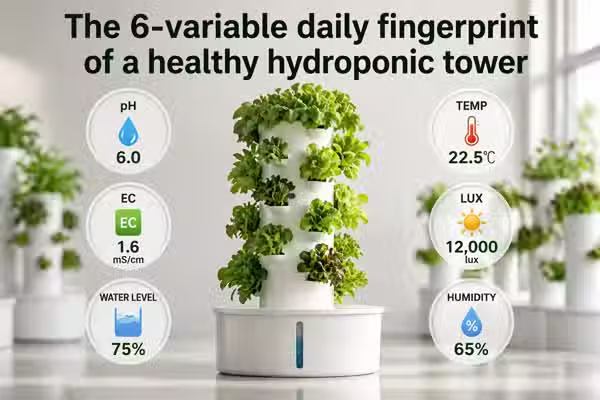
Six variables define whether a hydroponic tower is healthy: pH, EC, water level, temperature, lux, and humidity. None of them mean much as a single reading. What matters is how they move across the day and how they relate to each other. A system that has been running long enough produces a recognisable daily fingerprint. When that fingerprint changes shape, the system is telling you something is wrong before the plants do. Bangkok conditions make the temperature and humidity variables harder to manage than any grow guide written outside the tropics will acknowledge.
When the numbers looked right but the crop did not
The tower had been running for 11 days. Lettuce, standard NFT-style column, reservoir on a timer, nutrients mixed to spec. I checked pH and EC each morning and logged them manually. Both were within range every single day. pH sitting at 6.1, EC at 1.8 mS/cm. By the numbers, everything was correct.
By day 11 the lower third of the tower was showing the early signs of tip burn on the inner leaves and growth had visibly slowed in the middle channels. Nothing dramatic. The kind of thing you could attribute to genetic variation in the seedlings, or a bad seed batch, or just write off as normal variation. I had seen this pattern enough times to know it was not random.
I pulled the full sensor log for that tower going back to day 1. The morning pH readings had been fine. But I had not been logging temperature continuously. When I reconstructed the reservoir temperature from the data I did have, the afternoon readings were running at 30 to 31 degrees Celsius every day between 13:00 and 17:00. Not reflected anywhere in my manual morning check, which I always did before the room had heated up. The plants had been operating in a thermally stressed root zone for four hours every afternoon for eleven days, and every single manual check had missed it entirely.
That was the point where I stopped treating a single daily measurement of anything as meaningful. The reading at 08:00 tells you what the system was at 08:00. The pattern across 24 hours tells you what the system actually is.
What a daily check actually captures
A single daily manual check captures one data point out of the 24 hours a hydroponic system is running. In a Bangkok apartment where reservoir temperature can swing 4 to 6 degrees Celsius between morning and afternoon, that one reading can be taken in the coolest, most stable window of the entire day and reflect nothing about what the system experienced during peak heat hours.
0.3 to 0.6 pH units
The typical pH drift across a full light period in an active hydroponic tower running nutrient solution without a buffer. A morning reading of 6.0 and an evening reading of 6.3 to 6.6 is normal system behaviour, not equipment failure. Growers who check once and see 6.0 believe the system held steady all day. It did not. Plant Mood grow log data, 2024.
4 to 6 degrees Celsius
The typical reservoir temperature swing across a day in a Bangkok apartment with no active cooling. A system checked at 07:30 before the air conditioning turns off and the room heats up will show a reservoir temperature 4 to 6 degrees lower than the same system checked at 15:00. Dissolved oxygen at 28 degrees Celsius is approximately 7.8 mg/L. At 32 degrees it drops to approximately 7.0 mg/L. That gap is meaningful for root function over days and weeks.
The lag between a sensor pattern change and a visible plant symptom in our logged tower cycles. The fingerprint breaks first. The plant shows it later. Growers without continuous logging have no access to that 2 to 4 day early warning window.
Stable numbers do not mean a healthy system
If pH and EC are within the recommended range when you check them, the system is balanced and the plants are getting what they need. Consistency in your readings means consistency in the growing environment.
Stable point-in-time readings tell you the system hit the target at the moment you looked. They tell you nothing about what happened in the other 23 hours. More specifically, they tell you nothing about the daily movement pattern that distinguishes an actively healthy system from one that is stalled, stressed, or drifting toward failure.
In a healthy tower, EC drops measurably every day because plants are taking up nutrients. pH drifts upward during the light period because photosynthesis consumes CO2 and shifts the carbonate equilibrium of the solution. Water level falls at a predictable rate because transpiration is happening. These movements are the evidence of biological activity. A system where EC holds flat for 48 hours in an established crop, or where water level drops less than expected, or where pH does not drift at the expected rate, is a system where something has changed.
The myth is that stability means health. In a living hydroponic system, controlled movement is health. Real stability is stagnation.
Across 22 tower cycles logged with continuous sensors at Plant Mood, the cycles that showed the tightest day-to-day EC stability during weeks 2 and 3 of growth were disproportionately represented in the low-yield outcomes. Flat EC in an established system consistently predicted root zone problems or thermal stress reducing uptake, not a well-balanced reservoir. Plant Mood grow log data, 2024.
How the six variables interact across a single day
The six variables in a hydroponic tower do not operate independently. They form a coupled system where movement in one drives predictable movement in others. Understanding the coupling is what makes a daily fingerprint legible.
Lux drives the whole cycle. As light intensity rises in the morning, photosynthesis accelerates. Plants pull water and dissolved nutrients from the solution faster. Water level begins dropping. Transpiration increases, raising ambient humidity around the canopy. CO2 is consumed by photosynthesis, which shifts the pH of the nutrient solution upward because less dissolved CO2 means less carbonic acid in the water. EC begins to fall as ions are absorbed.
Temperature rises across the day, partly from ambient room heat and partly from the system running. Reservoir temperature follows ambient temperature with a lag of roughly 1 to 2 hours depending on reservoir volume and insulation. As reservoir temperature rises, dissolved oxygen falls. This is a physical property of water, not a system problem, but in a Bangkok apartment hitting 30 to 32 degrees by early afternoon, the effect is large enough to reduce root zone oxygen availability during the highest-demand period of the day, which is exactly when the plant is most actively growing.
Humidity behaviour depends on canopy density and ventilation. In a tower with a full canopy and no active airflow, transpiration moisture accumulates around the foliage. When ambient humidity is already high, as it frequently is in Bangkok's wet season, the differential between canopy humidity and ambient shrinks. Transpiration slows. Water uptake slows. The rate of EC drop slows. The whole system decelerates in a predictable cascade.
This is why lux and humidity need to be read together, not separately. High lux with high ambient humidity is a different growing condition than high lux with moderate humidity, even if the lux number is identical.
In a tower cycle logged in June 2024 during a wet-season week in Bangkok, ambient humidity held above 82 percent for six consecutive days. Lux was normal for the grow light setup. But EC drop rate fell from the expected 0.3 mS/cm per day to 0.1 mS/cm per day across those six days. Water level drop also slowed. The plants were not sick. They were transpiring less because the vapour pressure deficit had collapsed. The fingerprint changed shape. Without continuous logging, the slow EC drop would have been invisible until a manual check two or three days later showed EC higher than expected and prompted an unnecessary nutrient adjustment.
Vapour pressure deficit (VPD) is the mechanism linking temperature, humidity, and transpiration rate in this cascade. VPD is the difference between the amount of moisture the air can hold at a given temperature and how much it actually holds. High VPD drives transpiration. Low VPD suppresses it. Bangkok wet-season afternoons routinely push VPD below 0.5 kPa, which is at the lower boundary of what most hydroponic guides target for leafy greens. The interaction between lux, temperature, and humidity in VPD terms is not covered in most basic hydroponic resources because most of those resources were written for environments where humidity is the variable you add, not the one you try to reduce.
What the fingerprint looks like: healthy versus stressed
pH across the day
Healthy: rises 0.1 to 0.3 units from morning to evening, falls slightly overnight as photosynthesis stops and respiration continues. Stressed or stalled: holds flat all day, or jumps erratically without a directional pattern. Flat pH in a system with plants actively under light is the unusual reading, not the reassuring one.
If pH is identical at 08:00 and 18:00, the plants did not photosynthesize at the expected rate. Rule out light failure, root zone oxygen deficiency, and thermal stress before adjusting chemistry.
EC across the day
Healthy: drops 0.2 to 0.5 mS/cm per day during peak growth, more if canopy is large and temps are moderate, less if VPD is suppressed by high humidity. Stressed: flat or rising EC. Rising EC means water is evaporating faster than nutrients are being absorbed, which in Bangkok most often means the reservoir is too warm and roots are not functioning normally.
Rising EC in a Bangkok summer grow is more likely a temperature problem than a feeding problem. Check reservoir temp before adjusting nutrient concentration.
Water level drop rate
Healthy: 1.5 to 3 litres per day during peak growth for a standard 5-channel tower with full canopy, in Bangkok ambient conditions. Stressed: below 1 litre per day suggests suppressed transpiration or root zone dysfunction. Above 3.5 litres per day without a corresponding canopy size suggests evaporation from an uncovered reservoir or a pump leak.
Track water level drop in absolute litres per day, not just whether the reservoir needs topping up. The rate is the signal. Plant Mood grow log data, 2024.
Reservoir temperature across the day
Healthy manageable range: 20 to 26 degrees Celsius. Bangkok reality without intervention: 27 to 32 degrees by mid-afternoon. The gap between the healthy range and the Bangkok unaided range is where tip burn, slow uptake, and root zone oxygen deficiency live. A morning check showing 24 degrees is not evidence the system is in the healthy range all day.
Reservoir temperature management in Bangkok requires either active cooling, a deeply shaded and insulated reservoir, or accepting that the afternoon hours will push the system into marginal territory. Most apartment growers are running in marginal territory most of the time without knowing it.
Lux and humidity coupling
Healthy: humidity rises slightly as lux rises and canopy transpiration adds moisture to the air around the foliage. The two variables move together within a VPD range that supports active transpiration. Decoupled stress: lux rises but humidity drops sharply because an air conditioner is running, creating high-VPD conditions that drive excessive transpiration and water uptake faster than roots can supply. The opposite decoupling, humidity high while lux is high, produces low-VPD suppression of transpiration.
Air conditioning in Bangkok creates a specific decoupling problem that temperate-climate grow guides never address. Running aircon to control temperature is necessary, but the humidity drop it creates can push VPD above 1.5 kPa, which accelerates transpiration stress in leafy greens. Log both variables together and watch the ratio, not the individual numbers.
What the logs showed across our tower cycles
Across 18 tower cycles where we had both manual morning check data and continuous sensor logs, the morning manual check understated average daily reservoir temperature by 3.2 degrees Celsius on average. The check was done before the ambient room temperature peaked. This meant that growers relying on morning checks believed their reservoir temperature was in an acceptable range when the afternoon reality was consistently above the threshold where dissolved oxygen becomes limiting.
The 08:00 check systematically misrepresented thermal conditions
Morning-only temperature checks in a Bangkok apartment are structurally misleading. The window when most growers check is the coolest part of the day. Any temperature management decision made on morning data alone is made on the best-case reading of the worst-case variable.
In 7 of 9 tower cycles that produced below-expected yields, EC stopped its normal daily decline and held within 0.05 mS/cm over a 24-hour period at some point between days 10 and 18 of the growth cycle. In each case, this EC flatline preceded visible plant symptoms by 3 to 5 days. The cause varied across cycles: three were thermal (reservoir over 29 degrees), two were root zone oxygen-related, one was a pump flow reduction, and one remained ambiguous. The signal was consistent even when the cause was different.
EC flat-lining preceded yield reduction by 3 to 5 days
EC flatline in an established, actively growing tower is a reliable early warning signal regardless of the specific root cause. It warrants investigation immediately, not at the next scheduled check.
When we ranked our 22 logged tower cycles by final yield and compared the predictive power of individual sensor variables during weeks 2 and 3, daily water level drop rate showed the strongest correlation with yield outcome. Cycles where water dropped at 2 to 2.8 litres per day during peak growth produced the highest yields consistently. Cycles outside that band in either direction were overrepresented in low-yield outcomes.
Water level drop rate correlated with yield better than EC or pH alone
Water level is the most direct proxy for the integrated biological activity of the tower: it captures transpiration, uptake, and evaporation simultaneously. Growers who track it as a number to top up rather than a rate to monitor are missing the most reliable single indicator of system health. Plant Mood grow log data, 2024.
In three cycles where thermal stress was the primary documented problem, pH drift rate, measured as the change in pH between the 08:00 and 18:00 readings, dropped from the baseline 0.2 to 0.3 units per day to below 0.1 units per day in the 24 to 48 hours before tip burn or growth stall became visible. Photosynthesis was slowing, reducing the CO2 consumption that drives normal pH rise. The pH number at any single reading was within range. The rate of change was the signal.
pH drift rate slowed before visible symptoms in thermal stress events
A prediction: within the next three years, pH drift rate across the light period will become a standard diagnostic metric in serious small-scale hydroponic operations, in the same way that EC drop rate already is for experienced growers. The data to support it exists. The tooling to surface it automatically does not yet, in most setups. Confidence: medium. Falsifiable by the appearance of consumer hydroponic controllers that log and alert on drift rate rather than threshold breaches.
Plant Mood grow log data, 2024
The complaints that point to a fingerprint problem
My pH keeps drifting up and I am constantly having to correct it. The system will not hold stable.
pH rising during the light period is not drift. It is photosynthesis. The complaint misidentifies normal biological behaviour as a system problem. The actual issue is usually one of two things: either the grower is correcting pH at the wrong time of day and introducing unnecessary acid that compounds with the overnight natural recovery, creating oscillation rather than stability, or the buffer capacity of the solution is too low and the natural drift is going further than it should. Neither of these is fixed by more frequent pH correction. The first is fixed by correcting at a consistent time relative to the light cycle. The second is fixed by adjusting the nutrient solution alkalinity, not by chasing the pH curve.
My EC is going up even though I have not added nutrients. Something must be wrong with the solution.
Rising EC with no nutrient addition means water is leaving the system faster than ions are. In Bangkok, this almost always means the reservoir temperature is high enough that evaporation from any uncovered surface is significant, root uptake has slowed because of thermal or oxygen stress, or both. The instinct is to dilute the reservoir. The correct first response is to check reservoir temperature and cover any exposed water surface. Diluting a thermally stressed reservoir does not fix the thermal stress. It just postpones the EC symptom by a few days.
The plants look fine in the morning but by afternoon they look stressed and then recover overnight. I cannot figure out what is wrong.
This is the thermal arc complaint and it is extremely common in Bangkok grows. The morning-to-afternoon stress cycle maps almost exactly onto the reservoir temperature curve. Roots in water above 29 degrees Celsius in the afternoon cannot oxygenate efficiently. The plant shows transpiration stress not because humidity is wrong or light is wrong but because the root zone cannot supply water fast enough when dissolved oxygen is limiting. The overnight recovery happens as the room cools, the reservoir temperature drops, dissolved oxygen recovers, and root function returns. The fix is thermal management of the reservoir, not anything at the canopy level.
I check my system every day and I still lose crops unexpectedly. I do not understand what I am missing.
The check is a snapshot. The system is a time series. A daily manual check of six variables captures six data points out of the roughly 8,640 minutes in a six-day period. A Bangkok hydroponic tower in peak summer can move through thermal stress, dissolved oxygen deficit, and VPD excursion inside a four-hour afternoon window without any of it appearing in a morning check. The grower is not missing anything in the check itself. They are missing the 23 hours the check does not cover.
Building the fingerprint: what to log, when, and why
Any grower setting up continuous logging for the first time
Before tracking anything else, establish the temperature profile of the reservoir location across a full day. Log temperature every 30 minutes for 48 hours before the first nutrient solution goes in. This is the baseline that everything else is interpreted against. A grower who does not know that their reservoir location peaks at 31 degrees at 14:30 will misread every EC, pH, and water level signal that occurs during that window.
A temperature curve for the reservoir location that shows the daily minimum, maximum, and the time of peak heat. This single piece of data changes the interpretation of every other variable.
Growers using manual checks only
If continuous logging is not in place, take readings at two times instead of one: once within an hour of lights-on or 08:00, and once at peak heat, typically 14:00 to 15:00 in a Bangkok apartment. The two-point check captures the morning baseline and the afternoon stress window. It is not a replacement for continuous logging but it exposes the thermal arc that a single morning check hides entirely.
A meaningful gap between morning and afternoon temperature readings that gives a rough picture of daily thermal range. Any afternoon reservoir temperature above 28 degrees Celsius warrants active investigation.
All growers, from first nutrient fill
Log water level in litres, not just as a trigger for top-up. Record the absolute level at the same time each day and calculate the daily drop rate. During weeks 2 and 3 of growth, the expected range is 1.5 to 3 litres per day for a standard Bangkok tower with active canopy. Any reading below 1 litre or above 3.5 litres on a day without a manual reservoir change is a signal that warrants same-day investigation.
A daily water level drop figure that serves as the single most integrated indicator of system biological activity. A rate within range is evidence that transpiration, uptake, and evaporation are all functioning normally. A rate outside range is a prompt to check the other five variables for the cause.
Growers in Bangkok apartments without active reservoir cooling
Accept that afternoon reservoir temperatures will exceed 28 degrees Celsius on most days without intervention. The practical options in a Bangkok apartment without a chiller are: schedule the nutrient reservoir in the coolest available location and insulate the reservoir walls and base, use a reservoir volume large enough that thermal mass slows the temperature rise, or run the pump and flow continuously rather than on a timer to prevent standing water in the channels from heating during off-cycle gaps. None of these fully solves the problem, but each reduces peak temperature by 1 to 2 degrees, which matters for dissolved oxygen.
Afternoon reservoir temperature reduced by 2 to 4 degrees relative to an uninsulated, timer-run system in the same location. Not a solution to Bangkok heat. A meaningful reduction in how often the system crosses the threshold where root zone oxygen becomes limiting.
Growers interpreting EC and pH readings
Read EC and pH as rates of change across the day, not as point-in-time targets. The useful question is not whether EC is at 1.8 mS/cm right now. It is whether EC dropped by the expected amount since yesterday, and whether pH rose by the expected amount since morning. A reading that is within target range but not moving the way a healthy system moves is more informative than a reading that is slightly outside target but tracking normally.
A shift from threshold-based interpretation, where the number is checked against a target range, to pattern-based interpretation, where the movement of the number across the day is the primary signal. This reframe changes what constitutes an actionable reading.
Growers logging lux and humidity
Log lux and humidity as a pair and watch their relationship, not their individual values. Calculate an approximate VPD from temperature and relative humidity at least once per day during peak light hours. If VPD is above 1.2 kPa during the main light period, aircon-driven humidity suppression is likely driving excessive transpiration. If VPD is below 0.4 kPa, Bangkok wet-season humidity is suppressing transpiration and the expected EC drop rate and water level drop rate will both be lower than usual. Adjust expectations for those variables accordingly rather than interpreting the slower rate as a problem.
A contextualised reading of EC and water level behaviour that accounts for the day's VPD conditions. A tower that drops 1.8 litres on a high-humidity day is not underperforming relative to a tower that drops 2.4 litres on a low-humidity day. They may both be healthy. The VPD context is what makes the comparison meaningful.
The temperature profiling step before first use. Growers set up the tower, mix nutrients, and start growing before they have any picture of the thermal environment the reservoir will actually occupy across the day. The temperature baseline is the interpretive key for every other variable, and it is almost universally skipped.
FAQ
What should pH do across a day in a healthy hydroponic tower?
pH in a healthy tower rises 0.1 to 0.3 units during the light period as photosynthesis consumes CO2 and reduces carbonic acid in the solution, then falls slightly overnight as respiration continues without CO2 consumption. A pH reading that is identical at 08:00 and 18:00 is not evidence of stability. It is evidence that photosynthesis did not occur at the expected rate. Plant Mood grow log data, 2024.
Why is EC rising in my hydroponic tower even though I have not added nutrients?
Rising EC without nutrient addition means water is leaving the system faster than ions are being absorbed. In Bangkok, the most common cause is a reservoir running above 28 degrees Celsius in the afternoon, which reduces root zone oxygen and slows nutrient uptake while evaporation continues. The fix is reservoir temperature management, not dilution. Diluting the reservoir without addressing thermal conditions postpones the EC symptom without resolving the cause.
How much water should a hydroponic tower use per day?
A standard Bangkok tower with a full canopy during peak growth phase consumes 1.5 to 3 litres per day, mostly to transpiration. Below 1 litre per day suggests suppressed transpiration from high ambient humidity or root zone dysfunction. Above 3.5 litres per day without a canopy size explanation suggests uncovered reservoir evaporation or a pump or channel leak. The rate across multiple days is the useful signal, not the top-up volume at any single check. Plant Mood grow log data, 2024.
What does flat EC mean in an established hydroponic tower?
EC that does not drop across 48 hours in a tower with actively growing plants is a dysfunction signal, not evidence of a balanced reservoir. In 7 of 9 tower cycles that produced below-expected yields, EC flatlined 3 to 5 days before visible plant symptoms appeared. Flat EC means roots are not absorbing nutrients at the expected rate. Common causes in Bangkok are thermal stress above 28 degrees Celsius, root zone oxygen deficiency, or a flow or pump problem. Investigate same day.
Why do my hydroponic plants look stressed in the afternoon but recover overnight?
This pattern maps almost directly onto the reservoir temperature arc. Roots in water above 29 degrees Celsius cannot oxygenate efficiently, which limits water supply to the canopy during peak transpiration hours. As the room cools overnight and dissolved oxygen recovers, root function returns and plants recover. The problem is at the root zone, not the canopy. Checking and reducing afternoon reservoir temperature is the first intervention to try, ahead of any adjustment to lighting, nutrients, or humidity.
How do lux and humidity interact in a Bangkok hydroponic tower?
Lux drives transpiration, which raises canopy humidity. When ambient humidity is already high, as it frequently is in Bangkok's wet season, the vapour pressure deficit collapses below 0.4 kPa and transpiration slows. This reduces water uptake and EC drop rate across the day. When air conditioning suppresses humidity while lux is high, VPD can exceed 1.2 kPa, driving excessive transpiration. Both conditions are common in Bangkok and both change the interpretation of EC and water level readings. Log lux and humidity together and calculate VPD to contextualise the other variables.
What is the most important sensor variable to monitor in a hydroponic tower in Bangkok?
Reservoir temperature, logged continuously rather than checked once daily. It is the most systematically misrepresented variable in Bangkok grows because morning manual checks capture the coolest part of the day. A reservoir that reads 24 degrees at 08:00 may be at 30 to 31 degrees by 14:00. That afternoon range is where dissolved oxygen becomes limiting, root uptake slows, and the EC and pH patterns stop behaving normally. Every other variable is interpreted more accurately once the true daily temperature range is known.