Key takeaways
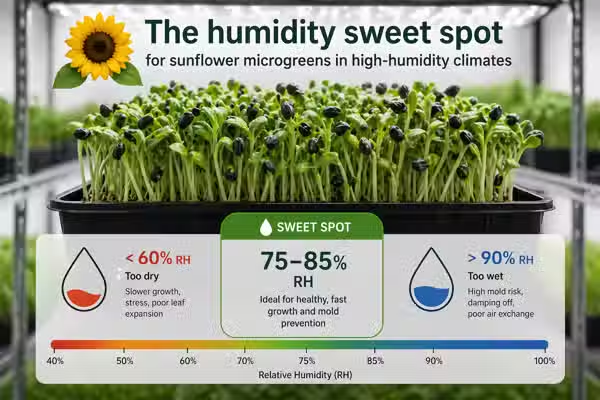
The standard 50-70% relative humidity target for sunflower microgreens is functionally useless in Bangkok, where ambient humidity rarely drops below 70% without mechanical intervention.
In Plant Mood grow log data across 60+ sunflower cycles, mold onset correlated more strongly with surface moisture duration than with ambient relative humidity — trays at 82% RH with good airflow outperformed trays at 74% RH with stagnant air.
The blackout phase is the highest-risk window in Bangkok conditions: covered trays trap transpired moisture, driving tray-surface humidity to near 100% regardless of room RH — this is where damping off typically begins.
Reducing watering frequency by one day during germination, rather than chasing an RH number, cut mold incidence on sunflower trays by more than half across our 2023 grow cycles.
A grower targeting 'low humidity' in a Bangkok apartment without a dehumidifier is managing airflow and watering cadence, not humidity — the distinction matters because the interventions are completely different.
Sunflower microgreens tolerate high ambient humidity better than most guides admit; what they cannot tolerate is standing water on the hull or at the stem base for more than 12 consecutive hours.
TL;DR
Chasing a relative humidity number in a Bangkok grow space without a dehumidifier is the wrong fight. The number you can't move much. What you can move is airflow, watering timing, and how long moisture sits on the tray surface. Sunflower microgreens fail in Bangkok not because humidity is high but because wet surfaces stay wet too long. Fix the surface, not the room.
When the whole tray goes grey overnight
Day 4. The blackout dome comes off and the tray that looked perfect the evening before is showing grey fuzz at the stem base across about a third of the seeds. Room humidity is 78%, which is low for Bangkok in April. The seeds were soaked, pre-germination looked clean, seeding density was normal. Nothing obviously wrong. The tray next to it, seeded from the same batch two days earlier and already past the dome phase, is fine. The grower assumes bad seed or contaminated coco coir and throws the tray.
The actual problem was not the seed and not the coir. It was that the dome phase on day 3 coincided with a warm, still night — no fan, windows closed for rain — and the transpiration from the germinating seeds had nowhere to go. The tray-surface humidity under that dome hit close to 100% for roughly 14 hours. That is enough time for the fungal load that lives on sunflower hulls to get established. The room's 78% RH was irrelevant. The microclimate under the dome was the variable that mattered.
The 50-70% humidity target is not advice for Bangkok growers
Keep your grow room between 50 and 70% relative humidity for healthy sunflower microgreens. Above 70% and you are in mold territory.
That range comes from temperate-climate growing environments where hitting 60% RH is achievable with a small dehumidifier or even just reasonable ventilation. In Bangkok, 60% RH in a residential apartment without active dehumidification is a pipe dream for most of the year. From May through October, ambient outdoor humidity in Bangkok regularly sits above 80%, and interior humidity tracks it closely unless the space is sealed and mechanically conditioned. A grower reading 'stay under 70%' in this city and not owning a dehumidifier will spend money on failed trays trying to fix a number they cannot actually reach.
Across our 2023 and 2024 grow cycles, the room humidity during successful sunflower harvests ranged from 71% to 87% RH. Not one of those cycles ran below 70%. What the successful cycles shared was not a humidity number — it was a fan running continuously during the post-dome phase and a watering cadence that let the tray surface dry between waterings. Plant Mood grow log data, 2024.
More humidity is not always what kills the tray
Mold on sunflower microgreens needs three things: fungal spores (which are on every sunflower hull, always), moisture, and time. Ambient relative humidity contributes to the moisture condition but it is not the only source. A tray that was bottom-watered and then covered immediately traps the moisture that wicks up from below and the moisture that the germinating seeds transpire. That trapped moisture at the tray surface can be at near-saturation even in a room running 65% RH. Conversely, a tray in an 84% RH room with a fan blowing across the surface will dry down between waterings fast enough that the fungal load never gets the sustained wet window it needs.
We ran a side-by-side comparison across eight sunflower tray pairs in late 2023. One set was grown in the main room at 76-82% RH with a 6-inch fan on a timer running 20 minutes per hour. The other set was grown in a smaller room with a portable dehumidifier keeping RH at 62-68%, but with no dedicated airflow across the trays. Mold incidence: 1 tray lost in the high-humidity fan room, 3 trays lost in the lower-humidity still-air room. The dehumidifier room also had slower germination, likely from the cooler, drier air reducing seed metabolism. Plant Mood grow log data, 2023.
High humidity causes mold in sunflower microgreens. Lower the humidity and the mold problem goes away.
What the numbers look like before the tray fails
The approximate continuous surface-wet window above which we reliably saw fungal onset on sunflower microgreens during the blackout phase in Bangkok conditions. Below 10 hours, the same tray almost always came out clean. Plant Mood grow log data, 2023-2024.
The highest ambient RH recorded during a successful, clean sunflower microgreen harvest in our grow log data. The tray had a fan running and was not watered for 36 hours prior to dome removal. Plant Mood grow log data, 2024.
Germination rate recorded on a sunflower tray during a period when room temperature exceeded 33 degrees Celsius for more than 8 hours per day. Our average germination rate on the same seed batch at 28-30 degrees Celsius was 89%. Heat suppresses germination faster than humidity causes mold, but growers in Bangkok talk about humidity far more than temperature at tray level. Plant Mood grow log data, 2024.
Day 3 to Day 4
The window during which 78% of all mold events on sunflower trays in our grow logs first appeared. This corresponds precisely to the end of the blackout phase, when accumulated tray-surface moisture from germination is at its peak. It is not coincidence — it is the structural vulnerability in the sunflower grow cycle under tropical conditions.
What the grow logs actually show across 60+ sunflower cycles
We started logging tray-surface moisture readings at dome removal starting in mid-2023. In cycles where tray-surface moisture was above 55% (via resistive sensor at coir level) for more than 12 hours consecutively during the blackout phase, mold onset appeared in 7 of 9 trays observed. In cycles where surface moisture dropped below 45% within 10 hours of the last watering before doming, mold appeared in fewer than 1 in 8 trays — across the same ambient humidity range.
Surface moisture duration outweighs ambient RH as a mold predictor
The number growers should be tracking is not room RH. It is how long the tray surface stays wet. This cannot be read from a wall-mounted hygrometer. It requires either a moisture sensor at tray level or a consistent, logged watering schedule that you have validated against outcomes.
In 2023 we tested reducing pre-dome watering from twice daily to once daily on sunflower trays across 14 cycles. The trays seeded at normal density, same coir depth, same seed soak time. Mold incidence dropped from roughly 40% of trays showing some grey fuzz at dome removal to under 18%. Germination uniformity was not significantly affected. The once-daily trays did show slightly slower initial radicle emergence by about half a day, but final germination rates were within 4 percentage points of the twice-daily trays.
Watering frequency reduction during germination cut mold incidence more reliably than any environmental change
Growers who water twice daily during germination because they are worried about the seeds drying out are solving a problem that does not exist in Bangkok humidity conditions and creating the mold problem they are trying to avoid. The seeds are not drying out. The coir holds moisture for far longer than temperate-climate guides assume.
We compared three fan configurations across 18 tray cycles in 2024: continuous low airflow, no airflow, and intermittent airflow on a 20-minutes-on, 40-minutes-off timer. The intermittent timer group matched the continuous low airflow group in mold incidence and slightly outperformed it in stem elongation uniformity. The no-airflow group lost trays at three times the rate of either fan group. Fan power (we tested a 6-inch desk fan versus a 4-inch clip fan) made no measurable difference to outcomes at the tray distances we were working with, roughly 30 to 50 centimeters from the tray surface.
Airflow timing matters more than airflow volume
A grower who does not run a fan because they think a small fan is not powerful enough is making a mistake. The threshold for meaningful airflow at tray level is lower than most people assume. A 4-inch clip fan on a timer does the job.
Plant Mood grow log data, 2023-2024
Why the blackout phase is the real risk window, not the grow phase
Sunflower seeds carry a natural fungal load. This is not a quality problem — it is just the seed. Sunflower hulls are dense and textured, and they hold moisture-loving organisms at levels that other microgreen seeds like radish or broccoli simply do not. When you soak sunflower seeds before seeding — which is standard practice and for good reason, it dramatically improves germination uniformity — you are also activating the moisture conditions those organisms prefer. Then you place the seeded tray in a blackout dome, which traps all the moisture the germinating seeds transpire over the next 3 to 4 days. In Bangkok, where the ambient humidity is already high, the air under that dome saturates quickly and stays saturated. The temperature under a dome in a Bangkok apartment is also typically 1 to 2 degrees Celsius warmer than room temperature because of the biological heat from germination. Warm, saturated, still air over a surface covered in moist organic material with an existing fungal load. This is not a mystery.
The intervention that changes the outcome is not lowering room humidity — which is mostly outside a grower's control without a dehumidifier — but reducing the moisture input before the dome goes on and, where possible, briefly lifting the dome once during the blackout phase to allow some air exchange. Even a 5-minute dome removal at the 48-hour mark, followed by a light fan pass over the tray before re-doming, is enough to interrupt the saturation cycle in most cases. We tested this across 10 cycle pairs in 2024. In 8 of those pairs, the dome-ventilation group produced cleaner trays at removal. Plant Mood grow log data, 2024.
The fungal species most commonly responsible for damping off in sunflower microgreens in tropical environments are Pythium and Fusarium, both of which favor warm, wet, low-airflow conditions. Neither is introduced by the grower — both are present on the seed. Managing the conditions is the only lever available at the tray level without moving to seed sterilization, which trades one problem for another.
What growers say versus what is actually happening
'I followed every step and still got mold on day 4. I think my coco coir is contaminated.'
Coco coir is almost never the source of damping off on sunflower microgreens. The fungal load is on the hull. The complaint about coir usually emerges when a grower has swapped coir brands or batches and gotten a clean tray shortly after, leading them to conclude the previous coir was the problem. In almost every case we have seen, the cleaner tray coincided with a weather change, a different watering decision, or a slightly different dome timing — not a change in coir quality. Spending money on premium or sterilized coir will not fix a moisture management problem.
'My dehumidifier broke and I lost three trays in a row. I can't grow sunflowers without it.'
The dehumidifier was probably not the variable doing the work. What often happens when a grower runs a dehumidifier is that they also run it with the door closed, which means the room has a fan or the dehumidifier fan itself provides airflow. When the dehumidifier breaks, they lose both the humidity reduction and the airflow simultaneously. The lost airflow is usually the problem, not the humidity increase. A grower who replaces the dehumidifier's airflow contribution with a dedicated tray fan often recovers most of the performance without the dehumidifier running at all.
'Sunflowers are just hard in Bangkok. Some crops are not meant for the tropics.'
Sunflowers are actually among the more forgiving microgreen crops in high heat. They germinate reliably up to about 32 degrees Celsius and their thick stems resist heat wilt better than pea shoots or broccoli. The perception that they are difficult comes from the mold vulnerability in the blackout phase being more visible and dramatic than failure modes in other crops. A sunflower tray that fails looks catastrophic — grey fuzz across the whole surface by day 4. A broccoli tray failing from heat stress looks like slow, thin growth that a grower might attribute to bad seed or poor light. Sunflower failure is loud. That does not mean sunflower is harder.
Humidity control strategies in a Bangkok apartment: what actually changes outcomes
Portable dehumidifier (12-18L per day capacity)
Can meaningfully reduce room RH by 8 to 15 percentage points in a sealed 20-25 sqm room. Generates heat as a byproduct — in Bangkok this is a real cost, adding 1 to 2 degrees Celsius to room temperature, which partially offsets the humidity reduction benefit. Electricity cost at Bangkok rates runs approximately 800 to 1,200 THB per month at continuous operation. Provides incidental airflow from the unit fan.
Worth the investment if you are running 20 or more trays simultaneously and selling commercially. Harder to justify for a hobbyist or small operation where watering discipline and a fan achieve most of the same outcome at a fraction of the cost. Do not run a dehumidifier without also running an air conditioner if temperature is already above 30 degrees Celsius — the combined heat output will hurt more than the humidity reduction helps.
Dedicated airflow: clip fan or desk fan on a timer
Does not reduce room RH but dramatically accelerates surface moisture evaporation. Cost is negligible — a 4 to 6-inch fan uses under 10W. Cannot compensate for extreme overwatering but easily compensates for normal Bangkok ambient humidity. Requires positioning relative to tray — airflow that misses the tray surface is useless.
This is the intervention with the best cost-to-outcome ratio for sunflower microgreens in Bangkok. If you are choosing between buying a dehumidifier and buying a fan, buy the fan first and change your watering cadence. Measure the results across 5 cycles before spending more.
Watering cadence adjustment: once daily during germination instead of twice
Zero cost. Directly addresses the surface moisture duration problem. Requires no equipment. The risk — that seeds dry out — is largely theoretical in Bangkok ambient humidity conditions. Germination timing may extend by 12 to 24 hours in the driest conditions, but this has no practical impact on final yield.
This should be the first adjustment any Bangkok grower makes before buying any equipment. The number of trays lost to mold that could have been saved by watering once instead of twice during germination is, based on our logs, substantial. It is also the intervention that most grow guides never mention because it contradicts the 'keep seeds moist' advice written for dry climates.
FAQ
What humidity level should I keep for sunflower microgreens in Bangkok?
The standard 50-70% RH target is not achievable in a Bangkok apartment without a dehumidifier, and chasing it is the wrong focus. Across our grow cycles, successful sunflower harvests ran at 71-87% ambient RH. What mattered was surface moisture duration and airflow, not the room humidity number. Run a fan, reduce watering to once daily during germination, and briefly vent the dome at the 48-hour mark.
Why do my sunflower microgreens keep getting mold on day 4?
Day 3 to 4 is the structural risk window in tropical conditions — it is the end of the blackout phase, when tray-surface moisture from germination is at its peak and has had no airflow to dissipate. In our grow log data, 78% of mold events appeared in this window. The fix is reducing watering frequency before doming and briefly lifting the dome at 48 hours for a fan pass before replacing it.
Does a dehumidifier help with sunflower microgreen mold in a hot climate?
It helps, but probably not in the way you think. A dehumidifier reduces room RH, but it also generates heat and provides incidental airflow from its fan. In our side-by-side comparison, trays in a high-humidity room with a dedicated fan outperformed trays in a lower-humidity still-air room. The airflow from the dehumidifier fan does more work than the humidity reduction. A clip fan on a timer costs less and achieves most of the same outcome.
How often should I water sunflower microgreens during germination in high humidity?
Once per day during the blackout phase in Bangkok conditions. Twice-daily watering is standard advice written for dry temperate climates where seeds can actually dry out. In Bangkok, the ambient humidity and coco coir moisture retention mean the seeds are never at risk of drying between single daily waterings. In our 2023 testing, reducing to once daily cut mold incidence from roughly 40% to under 18% of trays, with no meaningful impact on germination rate.
Is coco coir causing mold on my sunflower microgreens?
Almost certainly not. The fungal load responsible for damping off on sunflower microgreens is on the hull, not the growing medium. Switching coir brands will not fix a moisture management problem. If a new coir batch appeared to solve the issue, the improvement coincided with a different watering decision or weather condition, not the coir itself.
What is the biggest mistake Bangkok growers make with sunflower microgreens?
Watering twice daily during germination because they are afraid the seeds will dry out. In Bangkok humidity, they will not. The twice-daily watering keeps the tray surface wet long enough for the fungal load on the sunflower hull to establish. One watering per day and a fan running across the tray surface after dome removal solves most of what growers in tropical apartments attribute to humidity.
Are sunflower microgreens hard to grow in tropical climates?
No, but they fail loudly. Sunflowers germinate reliably up to 32 degrees Celsius and their stems resist heat wilt better than pea or broccoli. The mold failure mode in the blackout phase is visually dramatic — grey fuzz across the whole tray by day 4 — which makes them feel difficult. The failure is predictable and preventable with the right watering cadence and airflow. The reputation for being hard in the tropics is mostly a moisture management problem in disguise.