Key takeaways
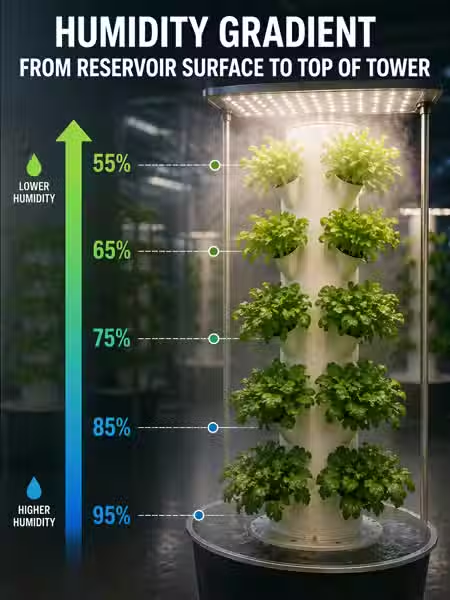
AHT20 readings at four heights across Plant Mood tower cycles show a consistent humidity gradient of 15 to 22 percentage points between reservoir surface level and the top of the tower — the base is always the wettest zone, but not always the highest mold-risk zone. (Plant Mood grow log data, 2024)
The highest mold pressure in Bangkok tower setups occurs at the mid-tower zone, roughly 60 to 90cm above the reservoir, where humidity is elevated and airflow is most restricted by overlapping canopy. Root-zone mold events trace to the base; stem and crown mold events trace to this mid-zone.
Bangkok's afternoon heat spike between 13:00 and 16:00 flattens the humidity gradient temporarily — the base-to-top differential compresses to as little as 6 percentage points — then rebounds sharply after sunset as the reservoir surface cools more slowly than the ambient air. The rebound window is when mold spore germination conditions are most favourable.
A single humidity reading taken at mid-tower canopy level underestimates reservoir-zone humidity by 15 to 22 points and overestimates base-zone airflow quality. Growers managing humidity from one sensor positioned for convenience are not managing the gradient — they are managing one point on it.
Passive airflow in a four-row tower without a circulation fan does not meaningfully reduce the base-to-top humidity differential. AHT20 logs show the gradient persists at 14 to 19 percentage points even with the growing environment door open. A directional fan positioned to create cross-tower airflow is the only passive-to-active intervention that consistently reduces the mid-zone humidity peak. (Plant Mood grow log data, 2024)
TL;DR
A hydroponic tower is not one humidity environment — it is three or four stacked on top of each other, each behaving differently across the day. The reservoir drives a persistent wet zone at the base. Bangkok's heat cycle compresses and then violently rebounds that gradient every evening. Most growers are measuring humidity in one place and drawing conclusions about the whole tower. The AHT20 data says that is the wrong tool used in the wrong position to answer the wrong question.
The mold that had no reason to be there
The crown rot showed up at row two. Not at the base, where the reservoir was sitting at 94 percent relative humidity most of the day. Row two — mid-tower, 70cm up, the position I had been least worried about because it had the best airflow of any row below the top. The crop above it was dense enough that the fan on the opposite wall was barely touching it. When I pulled the AHT20 logs for that height position across the previous five days, the reading at 22:00 each night was sitting between 88 and 91 percent. Not for a few minutes. For three to four hours after sunset, every night.
I had been watching the 09:00 reading — 74 percent at mid-tower, unremarkable for Bangkok, nothing that would have triggered concern. The problem was not what the air was doing when I checked it. It was what the air was doing for the four hours after the city cooled down and my grow room had not yet caught up. I had the data. I just had not been looking at the right timestamp.
Where this goes if growers do not start logging by height
Within two years, post-harvest pathogen testing in urban hydroponic operations will begin identifying tower mid-zone humidity stratification as a primary contamination driver, and single-point humidity monitoring will be flagged as inadequate for commercial certification.
Food safety frameworks for hydroponic produce are tightening globally, and testing methodology is getting more granular. Once lab data starts correlating contamination zones with specific tower height positions rather than whole-operation humidity averages, the gap between what a single sensor reports and what is actually happening in the mid-zone will become a compliance problem, not just a yield problem. Bangkok operations selling to hotels and restaurants are the first in this supply chain to face buyer-level auditing.
Any food safety audit framework published for hydroponic produce in Southeast Asia between 2025 and 2027 that specifies sensor placement requirements by grow zone height rather than per room or per system.
A grower-developed naming convention for tower humidity stratification zones will emerge in online growing communities within 18 months, driven by growers comparing AHT20 or SHT31 logs and discovering the gradient is consistent enough to have predictable sub-zones.
The pattern is real and reproducible. Once enough growers with multi-height sensor setups compare data, they will find the same three zones: a saturated base, a volatile mid-zone that responds most strongly to the daily heat cycle, and a relatively stable but still elevated top zone. Patterns that are consistent enough to name get named. The vocabulary does not exist yet because most growers are not logging at multiple heights.
Search for 'tower humidity zone' or equivalent terminology in major hydroponic growing forums producing zero structured discussion by mid-2026, which would suggest the logging behaviour is not spreading fast enough to generate the comparative data needed.
Reservoir cover designs that significantly reduce evaporative surface area will become standard practice in tropical tower setups within three years, driven by growers connecting reservoir humidity contribution to mid-zone mold events through logged data.
Right now, most tower reservoir lids have large cutouts for net pots and access. The evaporative surface area of an uncovered or partially covered reservoir in a 30-degree Bangkok room is the primary driver of base-zone humidity. Once growers can see the AHT20 delta between a covered and uncovered reservoir in their own logs, the design change is obvious. The barrier is not knowing the problem exists.
Commercially available hydroponic tower reservoir lids with greater than 80 percent surface coverage becoming a standard product category on Thai and Southeast Asian grow supply platforms by 2027.
Why the gradient forms and why it moves
The reservoir surface of a hydroponic tower is a constant evaporative source. Water at 26 to 30 degrees Celsius in a Bangkok grow room evaporates continuously, and the air immediately above it reaches saturation or near-saturation quickly when there is no airflow to carry that moisture away. AHT20 sensors positioned at reservoir level — approximately 5 to 10cm above the waterline — consistently log 88 to 95 percent relative humidity across our cycles regardless of ambient room conditions. That moisture does not disappear. It rises.
Warm, humid air is less dense than dry air at the same temperature, so the moisture-laden air above the reservoir moves upward through the tower structure. But it encounters two things on the way up: the crop canopy at each row position, which slows airflow and creates pockets of stagnant humid air, and the thermal gradient of the room itself, where air temperature typically drops slightly with height in a room without ceiling fans. The mid-tower zone is where the rising humid air meets the densest canopy restriction. Humidity accumulates there because airflow is most obstructed and the upward convection slows.
The daily heat cycle in Bangkok creates a second mechanism on top of this baseline gradient. During peak afternoon heat, the entire room warms, ambient relative humidity drops as warm air holds more moisture, and the base-to-top differential compresses. The reservoir is still evaporating, but the ambient air at mid and upper tower positions is warm enough that the relative humidity differential shrinks. After sunset — typically from 18:00 onward — ambient temperature drops faster than the reservoir temperature, because water has a higher thermal mass than air. The reservoir keeps evaporating at nearly the same rate while the ambient air cools and loses capacity to hold moisture. Relative humidity at mid and upper tower positions rises faster than it does at the base, where it was already near saturation. The gradient does not just return to its daytime level — it temporarily inverts in its rate of change, with the upper zones spiking faster than the base. This is the rebound window.
AHT20 logs from a four-row tower cycle in March 2024 show base humidity stable between 91 and 94 percent across the full 24-hour cycle. Mid-tower humidity at 70cm ranged from 73 percent at 14:00 to 89 percent at 23:00. Top-tower humidity at 160cm ranged from 67 percent at 14:00 to 81 percent at 23:00. The grower looking at the 14:00 reading would see a safe-looking mid-tower number. The grower logging at 23:00 would see a four-hour window every night where two of the four row positions were operating above 85 percent — the commonly cited threshold for Botrytis spore germination. (Plant Mood grow log data, 2024)
The AHT20 has a stated accuracy of plus or minus 2 percent relative humidity and plus or minus 0.3 degrees Celsius. For gradient work where the question is whether readings at two heights differ by 5 percentage points or 20, that accuracy is sufficient. For fine-grained threshold detection — specifically whether a reading is at 84 or 86 percent relative to an 85 percent mold threshold — the sensor should be calibrated against a reference and readings interpreted with the accuracy range in mind. We log to the nearest whole percentage point and treat any reading above 83 percent as functionally above threshold.
One sensor versus four: what you see and what you miss
Single AHT20 at mid-tower canopy height
This is the most common placement because mid-canopy is where growers interact with the crop most often and where intuition says 'the plants are.' It captures neither the reservoir-zone saturation at the base nor the evening spike at upper rows. On a typical Bangkok day it will read between 72 and 79 percent during active hours — a range that looks manageable and does not trigger concern. It will also miss the 23:00 spike at its own height if the grower is not logging continuously.
A grower using this setup will notice mold events after they are established and will not be able to connect them to a specific time window or height zone. Interventions will be reactive and will not address the mechanism driving the event.
Two AHT20 sensors — one at base, one at top
This setup captures the gradient endpoints and shows whether the base-to-top differential is widening or compressing across the day. It misses the mid-zone accumulation that is often the highest mold-risk position, and it cannot resolve where within the tower the daily cycle is causing the most volatile humidity swing. Better than one sensor but still blind to the most operationally important zone.
The grower can see that the tower has a gradient and can track whether ventilation changes are affecting the overall differential. Cannot identify which specific row position needs intervention.
Four AHT20 sensors — reservoir level, 60cm, 110cm, top of tower
This is the setup that produced the Plant Mood gradient data. Four sensors at consistent heights across cycles generate a profile that shows the gradient shape, the daily cycle behaviour at each zone, and the specific height where humidity peaks after sunset. Each sensor costs roughly 80 to 120 Thai Baht. The information gap between two sensors and four sensors is disproportionate to the cost difference.
A grower with this setup can identify the specific height zone generating the most mold risk, time ventilation interventions to the evening rebound window rather than running fans all day, and detect when a cycle is trending toward a high-risk gradient profile before mold establishes. Crop assignment decisions by row can incorporate humidity zone data alongside spectrum data.
Single thermohydrometer at room level, not tower-mounted
This is still the most common monitoring setup among small Bangkok tower growers. The room-level reading integrates ambient air that has mixed across the full space. It may read 68 percent while the reservoir zone of the tower reads 93 percent. The room reading has essentially no predictive value for mold events that originate at specific tower height zones.
The grower is measuring an average that does not represent any of the microenvironments their crops are actually living in. This setup produces the most common complaint pattern: 'my room humidity is fine but I keep getting mold.'
The numbers that changed how we position sensors
15 to 22 percentage point humidity differential between reservoir level and tower top, consistent across all logged cycles
This is not a spike or an anomaly. It is the baseline state of the tower's humidity environment whenever ambient airflow is not actively disrupting it. A grower whose single sensor reads 74 percent at mid-canopy is operating a reservoir zone at 89 to 93 percent simultaneously. (Plant Mood grow log data, 2024)
3 to 4 hours per night above 85 percent relative humidity at mid-tower during the post-sunset rebound window
85 percent is a commonly cited threshold for Botrytis cinerea spore germination and is referenced in controlled environment agriculture pathology literature. The mid-tower zone crosses this threshold most nights in Bangkok from roughly 20:00 to 23:00 without active ventilation. (Elad et al., 2004, Phytoparasitica; Plant Mood grow log data, 2024)
6 percentage point minimum differential during afternoon heat compression, versus 20 percentage point maximum during post-sunset rebound
The gradient is most variable — and most dangerous — in the evening, not during the growing day. Growers who check conditions once in the morning and once at midday are sampling the two least representative points in the daily cycle.
14 to 19 percentage point base-to-top gradient persists with room door open and no fan, versus 7 to 10 percentage point gradient with a directional circulation fan creating cross-tower airflow
Passive ventilation does not meaningfully flatten the gradient. The reservoir evaporation rate is high enough that natural convection alone cannot redistribute moisture fast enough to prevent accumulation at mid-tower. A fan is not optional in Bangkok tower setups — it is the only intervention that consistently works. (Plant Mood grow log data, 2024)
What the controlled environment research says about humidity stratification
Körner and Challa, 2003, Annals of Applied Biology
Humidity stratification in enclosed plant canopies creates microenvironments that differ significantly from ambient room measurements, with the highest pathogen infection pressure occurring in zones combining high relative humidity with restricted airflow rather than in zones with simply the highest absolute humidity.
The reservoir base of a tower is at highest absolute humidity but has some natural convective airflow from evaporation. The mid-tower zone, with elevated humidity and canopy-restricted airflow, matches the high-infection-pressure profile more closely. This explains why mold events in our towers trace to mid-canopy rows rather than the base row despite the base having higher absolute humidity readings.
Salazar-Gutierrez et al., 2014, HortScience
Leaf wetness duration, which is driven by humidity remaining above the dew point threshold at the leaf surface for extended periods, is a stronger predictor of Botrytis infection than peak relative humidity alone. Intermittent high humidity events that allow leaves to dry between them result in lower infection rates than sustained moderate humidity that keeps leaf surfaces continuously near saturation.
This reframes the Bangkok tower problem. The post-sunset rebound window creates a 3 to 4 hour period of sustained above-threshold humidity at mid-tower — long enough to maintain leaf surface near-saturation across multiple crop rows. Ventilation strategies that interrupt this sustained period even for short intervals are more effective than strategies targeting the absolute humidity peak.
van Leperen and van Meeteren, 2007, Journal of Horticultural Science and Biotechnology
Plant transpiration rate and stomatal conductance are sensitive to vapour pressure deficit rather than relative humidity alone, and vapour pressure deficit changes with temperature mean that identical relative humidity readings at different temperatures represent different physiological stress levels for the crop.
A reading of 85 percent relative humidity at 22:00 when the Bangkok grow room has cooled to 28 degrees Celsius is a different VPD environment than 85 percent at 14:00 when the room is 33 degrees. The evening rebound window combines high humidity with lower temperature, producing a lower VPD that reduces plant transpiration and keeps leaf surfaces wetter for longer. Growers who track only relative humidity are missing the temperature interaction that makes the evening window the highest-risk period, not just the highest-humidity period.
What tower growers are not tracking but the logs reveal
Most small-scale Bangkok growers check their grow environment in the morning before work and at midday or early evening. Both of those check times fall outside the highest-risk humidity window, which runs from roughly 20:00 to 23:00 in unventilated or poorly ventilated setups. Without continuous logging, the 3 to 4 hour post-sunset humidity spike at mid-tower is completely invisible. Growers are making ventilation decisions based on daytime readings that do not represent what their crops are experiencing overnight.
The evening rebound window
Growers think about the reservoir as a nutrient delivery system. Very few think about it as an evaporative humidity source. An uncovered or partially covered reservoir in a 30-degree room with 1,500 to 2,500 square centimetres of exposed water surface is generating a continuous moisture load into the base of the tower. Partial coverage of the reservoir surface with close-fitting net pot collars or a reservoir lid with minimal open area reduces the evaporative surface and measurably lowers base-zone humidity — but almost no commercially available tower design makes this easy, and most grow guides do not mention it.
Reservoir surface area as a humidity driver
Dense mid-tower canopy does two things simultaneously: it restricts airflow and increases transpiration surface area. Both raise local humidity. Growers who thin canopy to improve airflow are addressing the problem, but growers who allow mid-tower rows to reach maximum canopy density without any airflow compensation are creating the worst possible combination of high transpiration load and low air movement at the exact height zone where the humidity gradient is most volatile. This is the structural condition behind most mid-tower mold events we have seen.
Canopy density as a humidity trap
Where a sensor sits inside a tower determines what question it answers. A sensor mounted on the tower frame at 100cm because that was the convenient attachment point is answering the question 'what is the humidity at 100cm at the time I look at it?' It is not answering 'what is the humidity gradient across my tower and when is it most dangerous?' Sensor placement is a methodological choice that most growers make based on convenience rather than on what they actually need to know.
Sensor placement as a data quality decision
The complaints the logs can actually explain
'My room humidity is fine — I check it every day — but I keep getting mold at the same row position.'
The room-level reading and the mid-tower reading are not the same environment. A room averaging 70 percent relative humidity can sustain a mid-tower zone at 87 to 91 percent during the post-sunset window. The sensor placement is answering the wrong question. The mold is recurring at the same row position because that position is inside the highest-risk humidity zone on the tower, and the grower's measurement setup has never captured that zone accurately.
'I increased ventilation and the mold problem improved for a while but came back.'
Ventilation interventions that run during the day address the daytime humidity gradient, which is not when mold pressure is highest. If the fan timer or manual habit is to run ventilation during growing hours and reduce it overnight, the post-sunset rebound window is unaddressed. Mold improves temporarily because any increase in air movement helps, but the overnight window — where the gradient peaks — is still providing the sustained high-humidity conditions needed for pathogen establishment.
'The base of my tower always looks wet and I worry about root rot, but it's the middle of the tower where I actually lose crops.'
The base is saturated, but saturation at the base combined with the natural convective airflow from evaporation means conditions there are high-humidity but not stagnant. Root rot at the base is a separate irrigation and drainage management problem. The mid-tower mold events are a humidity stratification problem — elevated humidity meeting restricted airflow at the zone where canopy is densest. These are two different mechanisms and they need two different interventions.
'I tried adding a second fan and it didn't make much difference to my mold rate.'
A second fan positioned similarly to the first doubles airflow in the same direction but does not necessarily create cross-tower airflow through the mid-canopy zone where the gradient is worst. Fan positioning matters more than fan quantity. A single fan creating a horizontal cross-flow through the tower at mid-canopy height flattens the gradient more effectively than two fans moving air parallel to the tower face from the same side. AHT20 logs before and after repositioning a single fan confirm this — the gradient reduction at mid-tower from repositioning is larger than from adding a second unit in the same position.
Where humidity management in tower growing is heading
Integrated VPD management replacing relative humidity monitoring as the standard in commercial CEA
Commercial controlled environment agriculture operations are already shifting from relative humidity targets to vapour pressure deficit targets, because VPD integrates temperature and humidity into a single number that directly describes crop physiological stress. As this practice filters down from commercial greenhouses to urban tower growers through published guides and community discussion, growers who have only ever tracked relative humidity will need to add temperature-humidity logging at multiple heights to calculate meaningful VPD profiles. The AHT20 logs temperature and humidity simultaneously, making it already capable of this shift — the change is in how growers interpret the data, not in whether they need different hardware.
Affordable multi-sensor mesh logging becoming accessible to small-scale growers
The cost barrier to four-sensor tower monitoring is currently around 400 to 500 Thai Baht in hardware — less than the value of one crop cycle. As ESP32-based sensor mesh setups become better documented in grow communities and pre-assembled kits become available through Thai electronics suppliers, the gap between single-point and multi-height monitoring will close. The growers who build a multi-height data baseline now will have cycle-comparison data that single-point growers will not. That historical data is the most valuable output of early adoption.
Bangkok municipality and food safety bodies beginning to engage with urban CEA producers
Thai regulatory interest in urban food production is growing incrementally. As it does, the growers who can demonstrate environmental monitoring data — including humidity control across a grow structure, not just ambient room readings — will be better positioned for any certification or buyer audit process. The specific requirement for multi-height monitoring does not exist yet. But the direction of travel in food safety frameworks globally is toward more granular environmental data, and Bangkok tower growers who are already logging at multiple heights will not have to rebuild their monitoring setup when that requirement arrives.
One thing to do before your next cycle starts
Before you seed your next tower cycle, mount an AHT20 — or whatever sensor you already have — at the mid-tower position, 60 to 70cm above the reservoir, and set it to log continuously for the first five days. Do not check it in the morning. Pull the data at 23:00 on day three and look at what it read between 20:00 and midnight. If it is above 85 percent for more than two hours, you are running a mold window every night that your daytime checks have never shown you. That one reading does not fix the problem, but it tells you whether you have a gradient problem worth addressing before you commit another crop cycle to the same conditions.
FAQ
Why is humidity so high at the base of my hydroponic tower?
The reservoir surface is a continuous evaporative source. Water at Bangkok room temperatures of 26 to 30 degrees Celsius evaporates constantly into the air directly above it, pushing base-zone readings to 88 to 95 percent relative humidity regardless of ambient room conditions. An uncovered or partially covered reservoir with 1,500 to 2,500 square centimetres of exposed water surface is the primary driver. AHT20 logs at Plant Mood show this base-zone saturation is consistent across all cycles — it is the baseline state of the tower, not an event. (Plant Mood grow log data, 2024)
Where in a hydroponic tower is mold risk highest?
Not at the base, despite the base having the highest absolute humidity. AHT20 data from Plant Mood cycles shows mold pressure is highest at the mid-tower zone, roughly 60 to 90cm above the reservoir, where elevated humidity meets the most restricted airflow from overlapping canopy. This combination of high humidity and stagnant air matches the conditions described in pathology research as highest infection pressure. Root rot events trace to the base; stem and crown mold events trace to the mid-zone. (Plant Mood grow log data, 2024; Korner and Challa, 2003)
When is humidity highest inside a hydroponic tower in Bangkok?
Not during the day. AHT20 logs show mid-tower humidity peaks during a post-sunset rebound window from roughly 20:00 to 23:00. As Bangkok ambient temperature drops after sunset, the reservoir cools more slowly than the air and continues evaporating at nearly the same rate, while the air's capacity to hold moisture falls. Mid-tower humidity can rise from 73 percent at 14:00 to 89 percent at 23:00 in an unventilated setup. Growers checking conditions during the day are sampling the safest part of the daily cycle.
How many humidity sensors do I need for a hydroponic tower?
Four sensors at consistent heights give the most useful data: reservoir level (5 to 10cm above the waterline), mid-lower zone (around 60cm), mid-upper zone (around 110cm), and top of tower. The difference in information between two sensors and four is disproportionate to the cost — AHT20 units cost roughly 80 to 120 Thai Baht each. A single mid-canopy sensor misses the reservoir-zone saturation by 15 to 22 percentage points and cannot identify which height zone is generating the highest mold risk on any given night.
Does opening the door or window reduce the humidity gradient in a tower?
Not meaningfully. AHT20 logs at Plant Mood show the base-to-top gradient persists at 14 to 19 percentage points with the growing environment door open and no fan. The reservoir evaporation rate is high enough that natural convection cannot redistribute moisture fast enough to prevent mid-zone accumulation. A directional fan creating cross-tower airflow at mid-canopy height reduces the gradient to 7 to 10 percentage points and is the only consistently effective passive-to-active intervention for Bangkok tower setups. (Plant Mood grow log data, 2024)
What is the humidity threshold where mold risk becomes serious in a hydroponic tower?
85 percent relative humidity is commonly cited in controlled environment agriculture pathology literature as the threshold for Botrytis cinerea spore germination. Mid-tower AHT20 readings in Bangkok tower setups without active overnight ventilation regularly exceed this threshold for 3 to 4 hours after sunset. Research also shows that sustained duration above threshold matters more than peak value — a 3-hour window at 87 percent is higher risk than a short spike to 92 percent that quickly resolves. (Elad et al., 2004, Phytoparasitica; Plant Mood grow log data, 2024)
Why does my mold problem come back after I improve ventilation?
Most ventilation improvements address daytime conditions, which is not when mold pressure is highest. If fan timers or manual habits reduce airflow overnight, the post-sunset rebound window — when mid-tower humidity peaks for 3 to 4 hours — remains unaddressed. AHT20 data shows the gradient is most dangerous between 20:00 and 23:00, not during growing hours. Ventilation interventions need to cover the evening window specifically, not just run longer during the day. Fan positioning through the mid-canopy zone matters more than adding a second fan in the same position.