Key takeaways
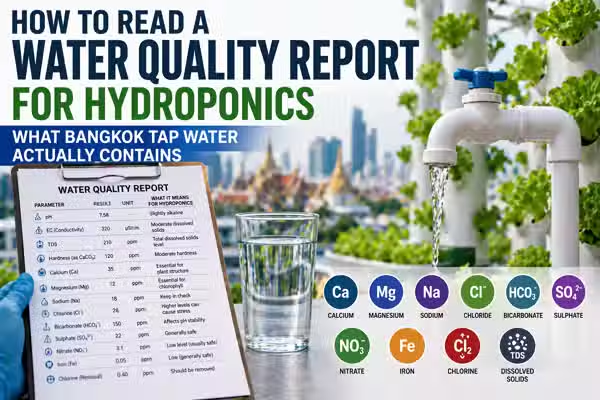
Bangkok MWA tap water averages pH 7.37, TDS 209 mg/L, and conductivity 341 µS/cm at the treatment plant — before building storage tanks and old pipes alter those numbers at your tap (MWA Consumer Confidence Report 2023).
Residual chlorine averages 0.70 mg/L in Bangkok tap water, high enough to inhibit beneficial microbial populations in organic hydroponic systems; off-gassing by leaving water uncovered for 30 to 60 minutes reduces but does not eliminate this.
Total hardness of 109 mg/L means Bangkok water contributes meaningful calcium and magnesium to your nutrient solution — growers who do not account for this are systematically over-dosing CalMag and creating antagonism with potassium uptake.
The MWA report measures water at the treatment plant exit, not at your tap; conductivity readings 20 to 80 µS/cm above the reported 341 µS/cm baseline are common in older Bangkok buildings due to pipe corrosion adding iron and mineral load.
Seasonal variation in Bangkok tap water is real: Chao Phraya source water quality shifts between dry and rainy season, which means your baseline TDS and pH are not fixed numbers — they drift across the year and so does your starting EC.
Building rooftop storage tanks in Bangkok introduce bacterial and sediment contamination risk; tap water that arrives at 0.70 mg/L chlorine may carry near-zero residual chlorine after sitting in an unmaintained tank, changing your off-gassing calculation entirely.
TL;DR
Most hydroponic growers in Bangkok treat tap water as a neutral input. It is not. The MWA publishes real numbers — pH 7.37, TDS 209 mg/L, hardness 109 mg/L, chlorine 0.70 mg/L — and those numbers have direct implications for EC drift, nutrient antagonism, and microbial management. The problem is not that the data is unavailable. The problem is that almost nobody reads it and applies it to what is actually happening in their reservoir.
When the EC reading stops making sense
In our third cycle running NFT lettuce, we started seeing EC creep that we could not account for from nutrients alone. We were adding solution, the reservoir level was dropping normally, but the EC was climbing about 0.3 mS/cm faster than the dosing math predicted. The obvious assumption was evaporation concentrating the solution. We logged temperature, we logged dosing volume, we cross-referenced top-up water volume. The drift was still there. What we eventually traced it back to was the source water itself. We had been using the reported MWA conductivity figure — 341 µS/cm, which is 0.34 mS/cm — as our baseline. But we had never actually measured our tap water. When we did, it read 0.41 mS/cm. That 0.07 mS/cm gap, compounded across 40 litres of top-up water per week, was the ghost in the data.
That measurement took thirty seconds. The MWA figure is a plant-exit average. By the time water moves through the building's distribution system — pipes that are often 20 to 40 years old, feeding a rooftop storage tank that may or may not have been cleaned in the last year — the actual conductivity at your tap can be meaningfully different. The report gives you a reference. It does not give you your number.
The grower who adjusts pH without reading the source water first
Bangkok tap water carries 109 mg/L of total hardness, which represents calcium and magnesium carbonate compounds already dissolved in the water before you add a single millilitre of nutrient solution. At standard hydroponic feed ratios, a grower running 40 to 60 litres of reservoir volume is adding the equivalent of a partial CalMag dose through source water alone every time they top up. The problem is not that the calcium and magnesium are bad — most crops need both. The problem is that the bicarbonate alkalinity associated with that hardness actively buffers pH upward. You adjust pH down to 5.8, walk away, and the buffering capacity in the water pushes it back toward 6.5 within 12 to 24 hours. Growers chase pH constantly and never understand why it keeps climbing. They assume they are doing something wrong with dosing. The root cause is the source water chemistry.
Once we started accounting for Bangkok tap water alkalinity in reservoir management — specifically by using a slightly lower initial pH target of 5.6 to 5.7 to allow for drift — pH stability across 48-hour windows improved noticeably. The adjustment window was consistently narrower. The chasing stopped. This is not a nutrient formulation fix. It is a source water understanding fix.
Most growers starting hydroponics in Bangkok assume the water quality problem is mainly pH — that you test it, adjust it, and move on. The TDS and hardness figures get ignored because they sound like drinking water concerns, not grow concerns.
What the MWA report actually says, parameter by parameter
341 µS/cm conductivity, 209 mg/L TDS, pH 7.37
These are the 2023 MWA annual averages for Bangkok tap water at the treatment plant exit point. For hydroponics, conductivity is the number that matters most — it is your starting EC before any nutrients are added. 341 µS/cm equals approximately 0.34 mS/cm, or an EC contribution of 0.34 that you need to subtract from your target EC when calculating dosing. Source: MWA Consumer Confidence Report 2023.
109 mg/L total hardness
This is moderate hardness by international standards — not soft water, not hard water. For hydroponics it means your source water is already contributing calcium and magnesium, and the associated bicarbonates will create pH buffering. Growers using RO water or rainwater as a comparison baseline will find Bangkok tap water behaves very differently in reservoir pH management. Source: MWA Consumer Confidence Report 2023.
0.70 mg/L free residual chlorine
This is the treatment plant average. The MWA specification range is 0.2 to 2.0 mg/L. At 0.70 mg/L, the chlorine is well within range for drinking water safety but is relevant for hydroponics if you are running any organic or biological system where microbial populations matter. Straight nutrient salt systems are largely unaffected at this concentration, but growers using beneficial bacteria or mycorrhizal products should account for it. Source: MWA Consumer Confidence Report 2023.
0.08 mg/L iron, 0.008 mg/L manganese
Both within MWA specification limits. Iron at 0.08 mg/L is close to levels where it becomes visible as tint in water and can interact with phosphate in nutrient solution, forming precipitates that cloud reservoirs and reduce phosphate availability. Manganese at this concentration is agronomically irrelevant unless it compounds with what you are adding through nutrients. Source: MWA Consumer Confidence Report 2023.
150 to 350 mg/L TDS range by neighbourhood and season
The MWA average of 209 mg/L hides seasonal and geographic variation. Dry season concentrates solutes in the Chao Phraya source water. Older pipe networks in inner Bangkok add mineral and particulate load. Your actual tap water TDS may be 40 to 100 mg/L above or below the published average depending on district and time of year. Source: TapWaterScan Bangkok profile, 2026.
How source water chemistry moves through a hydroponic reservoir
When you fill a reservoir with Bangkok tap water, you are not starting with a blank slate. You are starting with a solution that already has a defined ionic load — approximately 0.34 mS/cm of conductivity, a pH trending toward 7.4, bicarbonate alkalinity from calcium and magnesium carbonates, residual chlorine, and trace iron. Every one of these parameters interacts with your nutrient solution in a different way and at a different timescale.
The chlorine interaction is the fastest. At 0.70 mg/L, free residual chlorine will begin reacting with organic compounds in the water and with any biological material in your system within minutes. In a clean inorganic NFT or DWC system, this largely dissipates through normal aeration over 30 to 60 minutes. In a system with any organic substrate, root exudate buildup, or biological inoculants, the reaction is more complex and the effective concentration at the root zone will depend on how much organic matter is available to consume it.
The alkalinity interaction is slower but more consequential for most growers. Bicarbonate ions in solution act as a pH buffer. When you dose acid to bring pH down, you are neutralising bicarbonate. Until those bicarbonates are consumed, the solution will resist pH change and then drift back upward as the buffer reasserts. The higher the source water hardness, the stronger this buffer and the more acid you need to burn through it before pH holds stable. At Bangkok's 109 mg/L hardness, the buffer is real but manageable. Growers who switch to a different water source — say, collected rainwater or RO permeate — and apply the same acid dosing protocol will overshoot pH dramatically because the buffer is gone.
The EC interaction is the one most growers discover by accident. Every litre of top-up water you add carries approximately 0.34 mS/cm of background EC. In a 50-litre reservoir that evaporates 3 to 5 litres per day in Bangkok conditions, you are adding that background EC load continuously. A nutrient management approach that targets 2.0 mS/cm without accounting for source water contribution is actually targeting 1.66 mS/cm of nutrient-derived EC. For most crops at most growth stages, this difference is minor. For EC-sensitive crops in late cycle or during heat stress periods when uptake patterns shift, the error compounds.
We tracked this explicitly across eight reservoir fill cycles for hydroponic basil running in a 60-litre DWC system. Fresh tap water at fill measured 0.41 mS/cm consistently at our tap (above the MWA plant-exit average of 0.34). After adding nutrient solution to target 1.8 mS/cm reservoir EC, the actual opening reading was 1.79 mS/cm — within margin. But after 72 hours without top-up, EC climbed to 2.06 mS/cm despite no additional dosing, driven by evaporative concentration of both nutrients and the background mineral load from the source water. Plant Mood grow log data, 2024.
Growers wanting to eliminate source water alkalinity entirely can use a small RO unit to strip the tap water before nutrient dosing, which brings background EC below 0.05 mS/cm and removes bicarbonate buffering. This gives you full control over reservoir chemistry but also removes the calcium and magnesium contribution from the source water, so calcium nitrate and magnesium sulfate supplementation becomes mandatory rather than partially handled by the source. In Bangkok's tap water context, treating the source water as a partial CalMag contributor and factoring it into formulation is often more efficient than stripping it out entirely.
What our reservoir logs showed across Bangkok tap water cycles
Across 12 reservoir fill measurements taken from our Bangkok apartment tap over a six-month period in 2024, our source water conductivity averaged 0.41 mS/cm against the MWA reported average of 0.34 mS/cm. Measurements ranged from 0.37 to 0.47 mS/cm, with the higher readings concentrated in February and March — the deep dry season when Chao Phraya source water is under greater salinity pressure from reduced upstream flow.
Tap water EC at the point of use consistently exceeded MWA plant-exit figures
If you are using the MWA published figure as your source EC baseline, you are probably underestimating your starting mineral load. Measure your own tap water. The MWA figure is a useful reference point, not a substitute for a 30-second measurement with a calibrated EC pen.
When we filled a clean reservoir with fresh tap water at pH 7.4 and dosed nutrients to bring it to 6.0, the pH climbed back to between 6.4 and 6.7 within 18 hours in every case. In reservoirs that had been running for two or more weeks, the same acid dose held more stable, drifting only to 6.1 to 6.2 over the same window. The pattern held across lettuce, basil, and kale cycles. Plant Mood grow log data, 2024.
pH drift in new reservoir fills was faster and more consistent than in established reservoirs
The first 48 hours after a fresh reservoir fill in Bangkok require more active pH management than subsequent days. The bicarbonate alkalinity in the source water needs to be worked through before the pH stabilises. Growers who set pH on day one and check it three days later are operating blind during the highest-drift window.
We ran a comparison across four reservoir fills, measuring residual chlorine using a pool test kit at 0, 30, 60, and 120 minutes after filling. Covered reservoirs with no aeration showed chlorine reduction from approximately 0.6 mg/L to 0.3 mg/L after 60 minutes. Uncovered reservoirs with an air stone running showed reduction to below 0.1 mg/L in the same window. The difference matters specifically for systems where biological products are being used. Plant Mood grow log data, 2024.
Chlorine dissipation in covered versus uncovered reservoirs showed a measurable difference
If you are adding beneficial bacterial inoculants and wondering why they do not establish, run the water through an air stone for 60 minutes before inoculating. In Bangkok's heat, off-gassing is faster than in temperate climates, but a covered reservoir kills the advantage.
Plant Mood grow log data, 2024
The complaints that trace back to unread source water data
'My pH keeps climbing no matter how much I dose down. I am adjusting it twice a day.'
This is alkalinity buffering from calcium and magnesium bicarbonates in Bangkok tap water. The grower is neutralising the buffer with every dose, but not eliminating it. Until the bicarbonates are consumed, pH will keep reasserting. The fix is not more frequent dosing — it is understanding that the first acid additions in a fresh reservoir fill are consumed by the buffer before they change pH, and dosing accordingly. Some growers pre-acidify their top-up water before adding it to the reservoir to avoid constantly re-loading the buffer with fresh alkalinity.
'My EC is always higher than I calculated. I think my pen is drifting.'
The pen is usually fine. The source water EC is higher than the grower assumed because they used the MWA published figure rather than measuring their own tap. In older buildings or during dry season, the gap between published and actual can exceed 0.10 mS/cm. Across a grow cycle, this accumulates into a meaningful systematic error. Calibrate the pen, then measure the source water before assuming the pen is the problem.
'I added mycorrhizal products but they never seemed to do anything. Complete waste of money.'
Mycorrhizal fungi and beneficial bacterial inoculants are sensitive to chlorine. Bangkok tap water at 0.70 mg/L residual chlorine is enough to significantly reduce inoculant viability when added directly to a freshly filled reservoir. The product is not useless — it was added to water that was not ready to receive it. Off-gas the chlorine before inoculating. Or use RO water for the inoculant itself and add it to a reservoir that has been running for at least 48 hours.
'My reservoir gets cloudy after a few days even though I clean it between cycles.'
Iron at 0.08 mg/L in Bangkok tap water will react with phosphate in nutrient solution to form iron phosphate precipitates. These are white to light brown and form faster in warmer water — which Bangkok provides constantly. The cloudiness is not contamination in the harmful sense, but it does represent phosphate leaving solution. In high-phosphate feeding programs, this can contribute to phosphate deficiency symptoms in fast-growing crops. Filtering source water through a sediment filter reduces iron load and slows precipitate formation.
What hydroponic growers in Bangkok consistently miss in the source water data
The MWA measures water at the treatment plant exit, and the Consumer Confidence Report 2023 explicitly notes that building-level rooftop storage tanks are a known contamination pathway. A grower in a Bangkok condo who has never had their tank inspected is not working with 0.70 mg/L chlorine water. They may be working with near-zero chlorine water that has been sitting in a warm tank for days, potentially with bacterial colonisation. The pH, EC, and chlorine figures in the MWA report do not apply to that water. This changes chlorine off-gassing calculations, microbial risk, and pH baseline assumptions all at once.
The building storage tank problem
Bangkok tap water composition is not static across the year. The Chao Phraya River — source for Bankhen, Samsen, and Thonburi treatment plants — carries higher dissolved solids and greater salinity risk during dry season when upstream flow drops. MWA adjusts treatment chemistry accordingly, but the grower who set up their nutrient program in October and has not re-measured source water in February may be working from a baseline that has shifted by 30 to 60 mg/L TDS. That is not a catastrophic shift, but it is enough to throw off a tightly calibrated EC target.
Seasonal variation in source water
The MWA report covers the parameters relevant to drinking water safety. It does not report silicon content, sodium adsorption ratio, boron concentration, or specific carbonate versus bicarbonate alkalinity fractions — all of which are relevant to hydroponic reservoir chemistry. Sodium at 21 mg/L is within drinking water limits but accumulates in recirculating systems over time, particularly during high evaporation periods in Bangkok's heat. Growers running the same reservoir for more than three to four weeks without partial water changes in Bangkok conditions are building up sodium that does not show on a standard EC reading.
What the report does not measure for hydroponics
A grower running a 20-tray hydroponic operation in a Bangkok condo, buying nutrients from a local shop and following a generic EC and pH guide, is almost certainly calibrating their system against an assumed source water baseline that they have never verified. The pH guide says target 6.0. They dose to 6.0. pH climbs to 6.5 by morning. They redose. The EC target says 1.8. They hit 2.1 after a week. They reduce dosing. The plants look slightly off but not obviously sick. They assume it is the variety, the lights, or the temperature. It is the water. This failure is structurally inevitable given the combination of generic grow guides and unmeasured Bangkok source water.
The first-year grower who never measures source water
How to actually use the MWA report data before your first fill
All hydroponic growers in Bangkok
Measure your tap water EC and pH before your first reservoir fill and at the start of each new grow cycle. Use a calibrated EC pen and pH meter. Do this at the tap you actually use, not at a sink in a different part of the building. Record the number. This is your source baseline — not the MWA figure.
You will have an actual starting EC and pH to work from. In most Bangkok apartments, expect tap EC of 0.35 to 0.50 mS/cm and pH of 6.9 to 7.6. This number goes into your nutrient dosing calculation as the starting point, not zero.
Growers using biological inoculants or organic systems
Run tap water through an air stone for a minimum of 60 minutes before adding any biological products. Do not cover the vessel during this window. In Bangkok's ambient temperature, off-gassing at 28 to 32 degrees Celsius is faster than in cooler climates, but 60 minutes remains the reliable minimum at typical Bangkok chlorine levels of 0.5 to 0.8 mg/L.
Residual chlorine drops below 0.1 mg/L, creating a viable environment for inoculant establishment. If you are adding mycorrhizal products or beneficial bacteria and skipping this step, the results will be unreliable regardless of product quality.
All growers managing pH in Bangkok tap water systems
Expect the first 24 to 48 hours after a fresh reservoir fill to require more active pH management than subsequent days. The bicarbonate alkalinity in Bangkok tap water (derived from the 109 mg/L total hardness) will buffer pH upward until the bicarbonates are consumed by your acid additions. Plan a pH check at 12 hours and at 24 hours post-fill, not just at setup.
pH stabilises faster once the initial bicarbonate load is neutralised. Growers who understand this manage the first two days actively and then step back to normal checking frequency. Growers who do not understand it chase pH continuously for the full cycle.
Growers in older Bangkok buildings or those uncertain of their building's plumbing
Do not assume your building's water matches the MWA plant-exit figures for chlorine, turbidity, or TDS. If your building has a rooftop storage tank — which most Bangkok apartment buildings do — the residence time in that tank, combined with tank maintenance history, will alter chlorine and potentially bacteria counts. If you can run water from a direct pressurised line rather than gravity-fed tank, do so. If not, consider a basic sediment and carbon filter at the point of use.
More predictable source water chemistry. Fewer unexplained EC and pH anomalies. If your tap water smells strongly of chlorine, the line is pressurised and residual is high. If it has no chlorine smell, the tank has likely consumed the residual — a different problem.
Growers building a CalMag supplementation program
Account for Bangkok tap water's existing calcium and magnesium contribution before dosing CalMag. At 109 mg/L total hardness, your source water is not negligible as a calcium and magnesium source. Use a water hardness test kit or a total alkalinity test to quantify the contribution, then subtract it from your CalMag target. Do not dose CalMag as if starting from zero or RO water — you will systematically overdose and create antagonism with potassium.
More accurate calcium and magnesium management. Reduced risk of potassium suppression from excess calcium. This step is the one growers who switched from RO water to tap water reliably miss.
Measuring source water EC and pH at the actual tap before the first reservoir fill. Growers read the MWA report or assume water quality is fine, use a generic baseline of zero or 0.2 mS/cm from a temperate-climate grow guide, and then spend weeks troubleshooting EC and pH issues that trace directly to an unmeasured starting point.
One thing to do before your next fill
Get your EC pen and pH meter, open the tap you use for reservoir water, and take a reading. Write it down. That number — whatever it is — replaces every assumption you have been using as a baseline. If it reads 0.45 mS/cm and pH 7.5, your system has been fighting those numbers without knowing it. You cannot manage what you have not measured, and in Bangkok, the source water is interesting enough to deserve 30 seconds of attention before every fill.
FAQ
What is the EC of Bangkok tap water for hydroponics?
The MWA 2023 annual report shows Bangkok tap water conductivity averaging 341 µS/cm (0.34 mS/cm) at the treatment plant. At the actual tap, especially in older buildings or during dry season, Plant Mood measurements consistently read 0.37 to 0.47 mS/cm. Always measure your own tap rather than relying on the published figure.
Does Bangkok tap water pH affect hydroponic nutrient solution?
Yes. Bangkok tap water averages pH 7.37 and carries 109 mg/L total hardness, which creates bicarbonate alkalinity that buffers pH upward after dosing. Expect pH to drift from 6.0 back toward 6.4 to 6.7 within 18 hours of a fresh reservoir fill until the bicarbonate load is neutralised by acid additions.
Is Bangkok tap water chlorine a problem for hydroponic systems?
At the MWA average of 0.70 mg/L, residual chlorine is largely irrelevant for standard inorganic nutrient salt systems. For systems using beneficial bacteria, mycorrhizal inoculants, or any organic biological product, it is a real concern. Run tap water through an air stone for 60 minutes before adding biological inoculants to bring chlorine below 0.1 mg/L.
Should I use a CalMag supplement with Bangkok tap water in hydroponics?
Bangkok tap water already contributes calcium and magnesium via its 109 mg/L total hardness. Growers dosing CalMag as if starting from zero or from RO water are systematically overdosing. Test your tap water hardness, quantify its contribution, and subtract it from your CalMag target. Overdosing calcium creates antagonism with potassium uptake.
How does Bangkok tap water quality change between dry and rainy season?
The Chao Phraya River, which supplies most Bangkok treatment plants, carries higher dissolved solids and greater salinity pressure during dry season when upstream flow drops. TDS at the tap can vary by 30 to 60 mg/L across seasons. A nutrient program calibrated from an October source water reading may be working from a noticeably different baseline by February.
Why does my reservoir EC keep climbing in Bangkok?
The most common cause is unaccounted source water EC. Bangkok tap water carries 0.34 to 0.47 mS/cm before any nutrients are added. In a 50-litre reservoir losing 3 to 5 litres per day to evaporation and being topped up with tap water, this background EC accumulates continuously. Measure your source water EC and subtract it from your target nutrient EC in dosing calculations.
How do I read the MWA water quality report for hydroponics use?
Focus on four parameters from the MWA Consumer Confidence Report: conductivity (341 µS/cm — your EC baseline), total hardness (109 mg/L — your alkalinity buffer and CalMag source), residual chlorine (0.70 mg/L — relevant for biological systems), and pH (7.37 — your starting point before adjustment). Treat the MWA figures as plant-exit averages, then measure your actual tap for the number that applies to your system.