Key takeaways
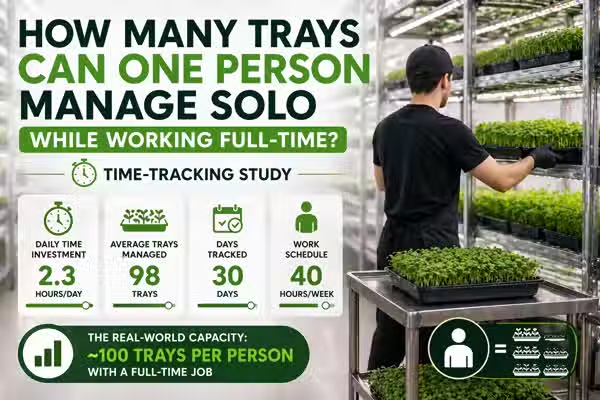
Across 14 weeks of timestamped labour logging in a Bangkok apartment microgreen operation, the sustainable solo tray ceiling for a grower with a full-time job was 24 trays in active cycle — not the 40 to 60 trays commonly cited in online guides — Plant Mood time-tracking data, 2024.
The task that most frequently caused schedule failure was not seeding or harvest. It was the daily check — averaging 4.8 minutes per tray at 20 trays, it consumed 96 minutes on days requiring any intervention, against an available window of 75 minutes on workday mornings.
Harvest and pack-out averaged 11.3 minutes per tray and could be batched; daily checks could not. The non-batchable nature of daily monitoring was the binding constraint on tray count, not total weekly hours.
At 24 active trays, total weekly labour averaged 6.4 hours — inside the sustainable window. At 32 trays, weekly labour averaged 9.1 hours including interventions, with 3 of 14 tracked weeks exceeding 11 hours during wet-season humidity events.
The hidden time cost was wet-season intervention: in Bangkok's October humidity peak, intervention checks added an average of 2.3 minutes per tray per day across at-risk cycles, pushing the daily check window past the available time on 11 of 30 October mornings — Plant Mood time-tracking data, 2024.
Staggered seeding schedules — no more than 6 new trays seeded per week — reduced peak labour variance by 38% compared to batch seeding 12 or more trays in a single weekend session.
TL;DR
The number of trays one person can manage solo while working full-time is not a fixed answer — it depends on which tasks fall on workday mornings, what season it is, and whether the schedule can absorb a wet-season intervention week without dropping trays. After 14 weeks of logging every minute spent on the operation, the honest ceiling in Bangkok is 24 active trays in normal conditions. Push past it and the schedule holds until it does not, and the week it collapses is always a week that already had something else in it.
What 14 weeks of time logs actually showed
Before logging, the assumption was that total weekly hours would be the limiting factor — that a grower with 8 available hours per week could support a proportional number of trays. The data showed a different structure. Weekly totals mattered less than what happened on weekday mornings between 6am and 7:15am. The available window before work was 75 minutes. At 20 trays, a normal daily check consumed 48 minutes. Any watering decision, mold check, or tray adjustment pushed that to 65 to 80 minutes. At 28 trays with any intervention, the window was already broken before the task list was complete.
Daily checks were the binding constraint, not weekly totals
Tray capacity for a solo full-time grower is constrained by the shortest available daily window, not the total weekly hours. A grower who calculates capacity from weekly hours available will overestimate the ceiling. The binding constraint is the 75 minutes before work, not the 8 hours across the week.
Seeding, harvest, and pack-out are batchable — they can be grouped into a Saturday morning without affecting the grow cycle. Daily checks, watering decisions, and intervention responses are not batchable. They happen when the tray needs them, which is every morning regardless of what else is on the schedule. In the logged data, batchable tasks accounted for 41% of total weekly labour but almost none of the schedule failures. Non-batchable daily monitoring accounted for 59% of weekly labour and every single schedule failure in the 14-week period.
Batchable and non-batchable tasks behave completely differently at scale
Guides that calculate microgreen labour as a weekly total and divide by seven are obscuring the structural difference between tasks that can wait and tasks that cannot. A solo grower needs to calculate daily non-batchable time first, then add batchable tasks on top. The capacity ceiling is set by the daily window, not the weekly sum.
In dry-season weeks, daily checks ran close to the 4.8-minute-per-tray average. In October, when overnight humidity stayed above 84% at tray level, checks that would normally take 4 minutes took 6 to 8 minutes because each tray required assessment for early mold indicators, hull moisture, and airflow adequacy. The check itself became more complex, not just longer. On 11 of 30 October mornings, the daily check at 20 active trays consumed more than the available 75-minute window. Trays did not fail immediately when checks were shortened — they failed two days later, by which point the cause was no longer obvious.
Wet-season months inflated non-batchable time without warning
A tray capacity that is sustainable in April can become unsustainable in October without the grower changing anything. The schedule that worked in the dry season is the same schedule that fails in the wet season. A solo grower who sets their tray count based on dry-season performance will find out the limit exists when the humidity peaks, not when they planned to test it.
In the first six weeks of the tracked period, seeding was done in batches — 10 to 14 trays seeded over a single weekend. This created a harvest cluster 8 to 10 days later that consumed 4 to 5 hours in a single weekend session. In weeks seven through fourteen, seeding was capped at 6 new trays per week in two sessions of 3. Harvest spread across the week instead of clustering. Peak weekly labour in the batch-seeding period averaged 9.8 hours. In the staggered period it averaged 6.1 hours with lower variance. Total output was comparable. The distribution of labour was not.
Staggered seeding reduced peak labour variance by 38%
Batch seeding feels efficient. It is not efficient for a solo grower with a fixed available schedule. It compresses labour into peaks that exceed the sustainable window, then creates quiet weeks where capacity is underused. Staggered seeding at a weekly cap trades the satisfaction of a big seeding session for a schedule that does not collapse under its own peaks.
Plant Mood time-tracking data, 2024
The week 24 trays became 32 and the schedule fell apart
It was week nine. A buyer had asked for more volume and I had seeded an extra eight trays the previous weekend, reasoning that the additional harvest would cover three weeks of the increased order and the seeding itself had only taken an extra forty minutes. What I did not account for was that eight additional trays in early germination in October meant eight more trays requiring close daily monitoring during the highest-humidity window of the year. By Wednesday morning of that week I had 32 trays in active cycle, a 7am meeting I could not move, and a daily check that the log showed was going to take 102 minutes if nothing unusual happened. Something unusual happened: humidity at tray level had climbed to 91% overnight on the sunflower trays and three of them needed immediate airflow adjustment and a watering skip decision. I was 25 minutes late to the meeting. The three trays I had to skip checking that morning showed early mold by Friday.
I did not lose all three trays. I caught two of them on Thursday evening when I had more time. But the week showed me something the weekly-hours calculation had hidden: the ceiling is not about whether you have the hours across the week. It is about whether the most demanding day of the week fits inside the most constrained window of that day. On an October Wednesday morning with 32 trays and a 7am meeting, it did not.
The numbers that set the real ceiling
The sustainable active tray count for a solo Bangkok grower with a full-time job, derived from 14 weeks of timestamped labour data. Not 40, not 60, not 'it depends on the variety' — 24, in normal conditions, with a 75-minute morning window and no wet-season intervention events. The ceiling drops to approximately 18 trays in October's peak humidity weeks — Plant Mood time-tracking data, 2024.
Daily check time at 20 active trays on a day requiring any intervention — a watering skip, an airflow adjustment, an early mold assessment. Against a 75-minute available morning window, this is already 21 minutes over before anything unexpected is added. Intervention days at 20 trays are manageable. Intervention days at 28 trays are not.
11 of 30 October mornings
The number of mornings in October 2024 where the daily check at 20 active trays exceeded the 75-minute window due to wet-season humidity complexity. Each overrun was absorbed by cutting the check short on lower-risk trays. Two of the three tray failures in October were traced to trays that received shortened checks during window overruns.
38% reduction in peak weekly labour variance
The improvement from switching from batch seeding of 10 to 14 trays per weekend to a staggered cap of 6 new trays per week. Peak weekly hours dropped from an average of 9.8 hours in the batch period to 6.1 hours in the staggered period at comparable output volume — Plant Mood time-tracking data, 2024.
Harvest is not the hard part
Harvest is batchable and therefore manageable. A harvest session of 12 trays on a Saturday morning takes longer than a session of 6 trays, but it is still a Saturday morning. It does not break a Monday-to-Friday work schedule. The daily check breaks the work schedule. It happens every morning, it cannot move, and it scales with every tray added in a way that is not optional. Adding 8 trays adds 8 more daily checks for the next 8 to 10 days. Those checks land on workday mornings in the window between waking up and leaving for work. That window is fixed. The checks are not.
In the logged data, no schedule failure was caused by a harvest session running long. Every schedule failure — and there were six across 14 weeks — was caused by a daily check overrunning the morning window. Two of those six failures involved trays that had been added specifically because the grower calculated that the harvest workload was manageable. It was. The daily monitoring workload was not.
Most growers think about tray capacity in terms of harvest workload. The image of growing too many trays is a harvest day that takes too long. Online discussions about solo tray limits almost always centre on how long it takes to cut and wash the yield. Harvest is the visible labour spike, so it becomes the proxy for capacity.
Why the daily check is the lever nobody plans for
The daily check in a microgreen operation is not a single task. It is a tray-by-tray assessment of moisture state, germination progress, canopy condition, and mold risk — each of which requires a different response. On a good day, most trays pass the check in under 3 minutes: look, feel the substrate, confirm the canopy is upright, move on. On a day where humidity has been elevated overnight, each tray requires longer assessment: examine the stem base, check the hull moisture in sunflower, consider whether airflow needs adjustment before leaving for work. The check time is not fixed — it is a function of how many trays are in the at-risk window and what the previous night's conditions were. In Bangkok, the at-risk window expands in the wet season without any action from the grower.
In October, three sunflower trays in days four to six post-blackout required an average of 7.2 minutes of check time each, compared to 3.8 minutes during a dry-season week with equivalent grow stage. The additional 3.4 minutes per at-risk tray was not dramatic — it was looking more carefully at the stem base, deciding whether the substrate felt dry enough to skip the morning water, adjusting the fan angle before leaving. Each decision took under a minute. Together, across three at-risk trays, they added 10 minutes to the morning before anything unusual had actually happened. At 20 trays in a mixed grow stage, three to five of them are typically in the highest-risk window at any point in October. The extra time is structural, not exceptional.
The relationship between tray count and daily check time is not linear in Bangkok conditions. At low tray counts — under 12 active trays — the check is fast because the at-risk trays are few and spaced across the cycle. As tray count increases, the probability that multiple trays are simultaneously in the highest-risk grow stage increases, and the check time grows faster than the tray count. A grower going from 16 to 24 trays does not add 50% to the check time — they may add 70% to 80% if the additional trays happen to be seeded on a staggered schedule that clusters day-four to day-six trays in the same week. The ceiling is not just about total trays. It is about how many trays are in the critical window simultaneously.
What solo growers say is hard and what the log shows instead
'I run out of weekend time and have to rush the harvest.'
Batch seeding is the cause, not tray count. When 12 to 14 trays are seeded over a single weekend, they mature within two to three days of each other and harvest clusters into a single session. The problem is not the number of trays — it is the seeding schedule that created simultaneous maturity. Staggering seeding to 6 new trays per week at most distributes harvest across the week and removes the single-session bottleneck without reducing monthly output.
'Some weeks I barely have time to check the trays properly and then I lose one.'
The active tray count has exceeded the morning window without the grower realising it, because the overrun only becomes visible during high-intervention weeks. In normal weeks the checks just barely fit. In a wet-season week, or any week where two or three trays are simultaneously in the high-risk post-blackout window, the same tray count that felt manageable last week exceeds the available time. The tray lost is usually one that received a shortened check during an overrun, two days before it became a visible problem.
'I thought I had enough time but then a busy week at work hit everything at once.'
The tray count was calibrated against a normal workweek, not a demanding one. A solo operation running at the edge of its time budget has no buffer for an unexpected work deadline, a sick day, or anything that compresses the morning window below its normal 75 minutes. The ceiling is not just 'what can I manage on a normal week' — it is 'what can I manage on the worst week I will have this month.' In Bangkok, the worst week is usually an October week where both work and humidity peak simultaneously.
'I want to scale up but every time I add trays it feels unmanageable after two weeks.'
The new trays are being added to the active cycle without adjusting the seeding schedule to keep the simultaneous high-risk tray count flat. Adding 8 trays seeded in the same weekend adds 8 trays to the daily check window simultaneously for the most demanding 4 days of the cycle. If that addition pushes the concurrent high-risk tray count past the morning window capacity, the operation will feel unmanageable during those 4 days regardless of how comfortable it felt in the weeks before or after.
The 40-tray solo ceiling is not a real number
Forty trays is frequently cited as the upper limit for a solo microgreen grower, with some guides reaching 60 or even 80. The figure comes from calculating total weekly labour — seeding, watering, harvest, pack-out — dividing by available weekend and evening hours, and concluding the arithmetic works. Growers new to the operation read this number and plan their setup around it.
The arithmetic works because it counts batchable weekend tasks and divides by total available hours. It does not count non-batchable daily tasks or divide by the available morning window on a workday. A solo grower with a full-time job cannot do 40 trays of daily checks in a 75-minute morning window. At 4.8 minutes per tray in normal conditions, 40 trays requires 192 minutes of daily check time. Before a single intervention, before any adjustment, before any unusual observation, that is two hours and twelve minutes every morning. The arithmetic does not work. The guides that produce the 40-tray figure are not counting the right task.
Plant Mood time-tracking data, 2024. 14 weeks of timestamped daily check logs at tray counts ranging from 14 to 32 active trays. At 24 trays in normal dry-season conditions, daily checks averaged 71 minutes — inside the 75-minute window with minimal buffer. At 32 trays, daily checks averaged 94 minutes before any intervention. No week at 32 active trays in October fit inside the available morning window without cutting at least one tray's check short.
What solo capacity management looks like in two years
Solo microgreen growers who track time per task rather than time per week will converge on lower active tray counts than the current community consensus, and will have lower loss rates as a result.
The 40-tray figure persists because nobody logs the daily check separately from total weekly hours. Once growers start separating batchable from non-batchable labour and measuring against the morning window rather than the weekly total, the ceiling becomes visible and the number comes down. The loss rates of time-tracking growers will be demonstrably lower because they are operating within the constraint rather than against it. As more Bangkok growers log at this resolution — which the availability of cheap sensor and time-tracking tools makes increasingly accessible — the data will accumulate and the published ceiling will revise downward.
A published dataset from three or more independent solo Bangkok growers showing sustainable tray counts above 30 with full-time employment and logged daily check times below 75 minutes per morning, without elevated loss rates.
Within 18 months, wet-season capacity adjustment — deliberately reducing active tray count in October and November to account for extended daily check times — will be recognised as standard practice among experienced Bangkok microgreen operators, not as a concession but as a scheduling tool.
Every experienced Bangkok grower who has run through a wet season has encountered the check-time overrun. Currently it is treated as an anomaly or a personal failure of organisation. As the pattern becomes better documented — through logs like this one and through shared experience in growing communities — the response will shift from 'I need to manage my time better' to 'I need to reduce my October tray count by 4 to 6 trays.' The adjustment is small, it protects loss rate, and it is consistent with how any other seasonal business accounts for capacity variation. The mental shift from anomaly to planned adjustment is what takes 18 months.
Survey data from Bangkok microgreen operators showing that more than 40% explicitly reduce active tray count during wet-season months as a deliberate scheduling practice rather than a reactive response to tray failures.
FAQ
How many microgreen trays can one person manage while working full-time?
Based on 14 weeks of timestamped labour logs from a Bangkok apartment operation, the sustainable ceiling for a solo grower with a full-time job is 24 active trays in normal dry-season conditions. This drops to approximately 18 trays during Bangkok's wet-season humidity peak in October and November. The commonly cited figure of 40 trays is based on weekly hour totals that do not account for the daily check window constraint on workday mornings — Plant Mood time-tracking data, 2024.
How long does it take to check microgreen trays every day?
In our logged operation, daily checks averaged 4.8 minutes per tray in normal dry-season conditions and 6 to 8 minutes per tray during wet-season weeks when humidity required closer assessment for mold risk, hull moisture, and airflow decisions. At 20 active trays, a normal daily check consumed 48 minutes. Any intervention pushed that to 65 to 96 minutes. Against a 75-minute available window before work, 20 trays with interventions already exceeds the constraint — Plant Mood time-tracking data, 2024.
Is it better to seed microgreens in batches or staggered throughout the week?
Staggered seeding at a maximum of 6 new trays per week reduced peak weekly labour variance by 38% compared to batch seeding 10 to 14 trays in a single weekend session, at comparable monthly output. Batch seeding creates harvest clusters that compress into a single long session. Staggered seeding distributes harvest across the week and prevents the simultaneous peak in daily monitoring that batch seeding creates when multiple trays hit the high-risk post-blackout window at the same time — Plant Mood time-tracking data, 2024.
What is the hardest part of managing microgreens solo with a full-time job?
Daily monitoring — not harvest. Every schedule failure across 14 weeks of logged data was caused by the daily check overrunning the available morning window, not by a harvest session running long. Harvest is batchable and can shift to weekends. Daily checks cannot move — they happen every morning, take longer during high-humidity periods, and scale with every tray added. A solo grower who plans capacity around harvest workload will consistently underestimate the binding constraint.
How does Bangkok's wet season affect solo microgreen tray capacity?
It reduces it by approximately 4 to 6 trays. During October's humidity peak, daily check time per tray increased from 4.8 minutes to 6 to 8 minutes because each tray required closer mold assessment, hull moisture evaluation, and airflow decisions. At 20 active trays, this pushed the daily check past the 75-minute morning window on 11 of 30 October mornings. Two of three October tray failures were traced to trays that received shortened checks during window overruns — Plant Mood time-tracking data, 2024.
Can I manage 40 microgreen trays by myself with a full-time job?
Not based on the daily check constraint. At 4.8 minutes per tray in normal conditions, 40 trays requires 192 minutes of daily check time before any intervention — more than two hours every weekday morning. The 40-tray figure cited in grow guides is calculated from total weekly hours divided across batchable tasks like seeding and harvest. It does not account for non-batchable daily monitoring against the fixed available morning window. In our 14-week log, no week at 32 active trays during October fit within the available time without cutting at least one tray's check short.
Should I reduce my microgreen tray count in the wet season?
Yes, by 4 to 6 trays if you are already close to your dry-season ceiling. Bangkok's wet-season humidity extends daily check times structurally — not because of a change in technique but because each tray in the high-risk post-blackout window requires longer assessment when overnight humidity has been above 84%. A tray count that fits the morning window in April will exceed it in October without the grower changing anything. Treating wet-season capacity reduction as a planned seasonal adjustment rather than a reactive response to tray failures protects both yield and schedule.