Key takeaways
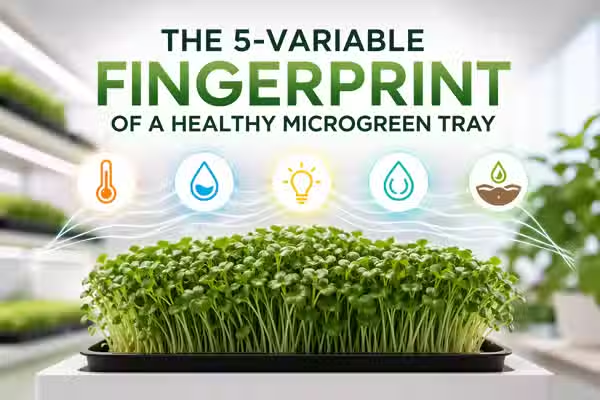
A healthy microgreen tray in Bangkok conditions follows a 5-variable fingerprint across its growth cycle: tray surface temperature staying within 1.5 degrees Celsius of ambient, canopy humidity dropping from 90 to 95 percent during blackout to 65 to 75 percent once uncovered, lux at canopy level between 8,000 and 15,000 lux for most varieties from day four onward, substrate moisture holding at 55 to 65 percent volumetric content through mid-cycle, and stem temperature matching or sitting 0.5 degrees Celsius below ambient at any reading after day three. Plant Mood grow log data, 2024.
The earliest detectable deviation in a failing tray is almost always moisture -- not appearance. Substrate moisture above 70 percent volumetric content on day four correlates with mold onset within 48 hours in Bangkok humidity above 75 percent RH. The tray looks fine at that reading. Plant Mood grow log data, 2024.
Lux and temperature interact. A tray running correct lux but at ambient temperature above 34 degrees Celsius will show elongation and pale colour consistent with low-light stress, because heat accelerates respiration faster than photosynthesis can compensate at the same light level. The fingerprint requires all five variables -- none of them reads correctly in isolation.
Canopy humidity during the blackout phase should hold above 88 percent. A reading below 85 percent on day two indicates insufficient dome seal or cover, which will delay germination uniformity by 12 to 24 hours and produce uneven emergence that compresses the harvest window.
Substrate moisture and ambient humidity are different readings that are often confused. Substrate moisture is measured at the growing medium. Ambient humidity is measured in the air above the canopy. In Bangkok wet season, ambient humidity can read 80 percent while substrate moisture is 45 percent and the tray is underwatered. Managing by ambient humidity alone produces consistent over- and under-watering errors.
TL;DR
Every variable in a microgreen grow has a number it should be at on a given day. Temperature, humidity, lux, and moisture each follow a predictable arc from seeding to harvest, and in Bangkok conditions that arc is different from what temperate-climate guides describe. The fingerprint is not complicated -- it is five numbers checked at the right time. What makes it useful is that when one number is wrong, the pattern in the others usually tells you what caused it. That is worth more than any single sensor reading on its own.
The tray that looked perfect until day six
Sunflower tray, day four. Canopy looked exactly right -- dense, uniform, cotyledons just splitting open, colour a strong yellow-green that would deepen once it had a day under the lights. I had uncovered it on schedule, humidity in the room was at 72 percent, temperature at 31 degrees Celsius. Nothing I could see suggested a problem. I did not check the substrate moisture because the tray felt heavy and the visual was good. Day five, the back-left quadrant showed the first grey fuzz. By day six it had spread across 30 percent of the tray. I pulled it.
I checked the substrate moisture log for that tray retroactively -- I had a sensor on a neighbouring tray of the same variety seeded the same day, and the grow space conditions were close enough to use as a reference. Day three moisture reading: 74 percent volumetric content. Day four: 71 percent. The tray was sitting at the upper boundary of safe moisture for two days before the mold appeared, in conditions where ambient humidity was already at 72 percent. The visual gave me nothing. The moisture number, had I been looking at it on day three, would have told me to stop watering and increase airflow 48 hours before the first grey spore appeared. I was not looking at it. I was looking at the canopy.
Where microgreen monitoring is heading in the next two years
Within 18 months, a meaningful fraction of serious small-scale microgreen growers will adopt at least one tray-level moisture sensor as standard equipment -- not because sensors become cheaper, but because mold losses in tropical climates become too expensive to absorb without data.
The moisture variable is the one that produces the most costly failures in Bangkok growing conditions, and it is also the one most amenable to cheap sensor solutions. Capacitive soil moisture sensors accurate enough for substrate monitoring now cost under 200 baht. The knowledge gap is not hardware cost -- it is that growers do not yet think of substrate moisture as a daily number rather than a feel-based judgment. Once one documented mold event is traced back to a moisture reading that was logged and ignored -- or not logged at all -- the calculus changes. This pattern is already visible among growers who have been at it for two or more years.
Survey of active Bangkok-based microgreen growers at the 18-month mark: if fewer than 20 percent report using any form of substrate moisture measurement beyond manual feel, the prediction is wrong.
The 5-variable fingerprint approach -- treating temperature, humidity, lux, moisture, and stem temperature as a daily diagnostic profile rather than independent spot checks -- will be named and described as a formal growing methodology in at least one widely read urban farming publication within 24 months.
The concept is not new to growers who have been logging data across enough cycles to see the inter-variable patterns. What is new is the framing: that these variables have predictable day-specific expected values, that deviations are diagnostic rather than just alarming, and that the variables interpret each other. The framing is distinct from generic 'monitor your grow space' advice and specific enough to be teachable. It will get named because the growing community needs vocabulary for this level of precision, and because the sensor hardware to support it is now cheap enough for hobbyist growers.
Search of urban farming publications, newsletters, and widely-followed growing channels at the 24-month mark for explicit mention of multi-variable daily profiling as a named methodology distinct from individual sensor monitoring.
Stem temperature as a tray health indicator will be adopted as a diagnostic metric by commercial microgreen operations before it appears in any consumer growing guide.
Stem temperature below ambient indicates active transpiration and healthy water movement through the plant. Stem temperature at or above ambient suggests transpiration is suppressed -- either because the plant is stressed, the humidity is too high, or airflow is too low. This is measurable with an infrared thermometer that costs under 500 baht, takes five seconds to check, and produces a reading that no visual inspection replicates. Commercial operations looking for non-destructive quality checks will find this before guides written for home growers do, because commercial growers have more at stake per tray and are more likely to be trialling diagnostic tools systematically.
Appearance of stem temperature as a recommended diagnostic check in any commercially oriented microgreen production guide or food-safety audit framework within 36 months.
Why the five variables cannot be read independently
Each of the five variables affects the others, and that interdependence is what makes the fingerprint useful as a diagnostic tool rather than just a checklist. Temperature drives transpiration rate, which determines how fast the substrate loses moisture. Transpiration rate, combined with canopy density, determines how fast canopy humidity builds. Canopy humidity above a threshold suppresses further transpiration, which slows cooling and allows stem temperature to rise toward ambient. Lux drives photosynthesis, which consumes CO2 and produces sugars, but at high temperatures the respiration rate increases faster than photosynthesis, burning reserves that would otherwise go to growth. Substrate moisture at the wrong level changes how effectively the root system can deliver water to the stem and leaves, which feeds back into transpiration rate and canopy humidity. Pull any one variable out of its expected range and at least two others will respond. That is why a tray running too hot will also show lower canopy humidity than expected (heat increases vapour pressure deficit, pulling moisture out faster), and why a tray running too wet will show elevated canopy humidity, suppressed stem cooling, and eventually lux uptake that looks adequate but produces pale, elongated growth because the plant is allocating energy to staying alive rather than to leaf expansion.
The lux and temperature interaction is the one that produces the most misdiagnosed trays. A grower who measures lux at the canopy, confirms it is within range, and then cannot explain why the tray is pale and leggy has usually not measured temperature at the same time. In Bangkok dry season at ambient above 34 degrees Celsius, 10,000 lux produces different plant outcomes than 10,000 lux at 28 degrees Celsius. The light level is the same but the plant is running a different metabolic balance. Respiration climbs exponentially with temperature -- roughly doubling for every 10-degree Celsius increase in the relevant range -- while photosynthesis has a flatter temperature response curve that actually declines above 30 to 35 degrees Celsius in many leafy varieties. The plant under 10,000 lux at 34 degrees Celsius is burning more than it is building. The lux reading looks fine. The tray does not.
The fifth variable -- stem temperature relative to ambient -- works as a summary signal for how well the other four are balanced. A stem reading 0.5 to 1.5 degrees Celsius below ambient indicates active transpiration cooling, which requires adequate substrate moisture, manageable canopy humidity, and a functional root-to-leaf water pathway. A stem reading at ambient or above ambient indicates that transpiration cooling has stopped. The cause could be excess canopy humidity suppressing the vapour pressure gradient, inadequate substrate moisture removing the water supply, heat-induced stomatal closure, or root stress from overwatering or EC issues. The stem temperature reading does not tell you which of these is the cause. But it tells you in five seconds that something in the balance has shifted, before the tray shows any visual sign.
The fingerprint by growth phase: what each variable should read
Blackout phase (days 1 to 3, most varieties)
Tray surface temperature: within 1 degree Celsius of ambient, typically 28 to 32 degrees Celsius in Bangkok. Canopy humidity under the dome or cover: 88 to 95 percent -- below 85 percent indicates an inadequate seal and will show as uneven germination by day three. Lux: zero or near-zero, the tray should not be receiving significant light. Substrate moisture: 60 to 70 percent volumetric content at seeding, declining no more than 5 percent per day during blackout without additional watering. Stem temperature: not yet a useful reading at this stage as the hypocotyl is just emerging.
The only variable that typically requires intervention during blackout is substrate moisture. A tray seeded too wet (above 72 percent) entering a high-humidity Bangkok environment during wet season is already at the upper boundary of mold risk before the first sprout appears. The dome compounds this by trapping humidity. If moisture at seeding is above 68 percent and ambient RH is above 75 percent, do not dome the tray -- or dome it with a gap to allow some vapour exchange.
Early light phase (days 3 to 5, most varieties)
Temperature: same ambient target but now the interaction with lux matters -- under grow lights, tray surface temperature can read 1 to 2 degrees Celsius above ambient due to radiant heat from the fixture. Canopy humidity: should drop to 70 to 80 percent within 12 hours of uncovering; if it stays above 80 percent after uncovering, airflow is insufficient. Lux at canopy: 5,000 to 10,000 lux. Substrate moisture: 55 to 65 percent, declining toward the lower end of this range through the period. Stem temperature: should begin reading 0.5 degrees Celsius below ambient by day four as transpiration establishes.
Day four is the most important checkpoint in the cycle for catching problems before they become losses. Moisture above 68 percent, canopy humidity above 78 percent after airflow, stem temperature at ambient rather than below it, or lux below 5,000 -- any single one of these is a caution signal. Two or more in the same tray is a near-certain predictor of yield or quality loss within 48 hours in Bangkok conditions.
Maturation phase (days 5 to harvest, most varieties)
Temperature: same ambient target; at this stage the canopy is dense enough to trap heat, so tray surface temperature can read 1.5 to 2 degrees Celsius above ambient on hot days even without radiant fixture heat. Canopy humidity: 65 to 75 percent is the target; above 78 percent at this stage with a dense canopy is mold risk. Lux: 10,000 to 15,000 lux for most varieties; below 8,000 will produce the pale, elongated phenotype that reduces both yield and shelf life. Substrate moisture: 50 to 60 percent -- the crop is pulling water faster now and under-watering risk increases relative to earlier phases. Stem temperature: 0.5 to 1.5 degrees Celsius below ambient is the target; a reading at ambient is a signal that something in the system has suppressed transpiration.
Under-watering risk increases in the maturation phase but growers who have been conditioning themselves to watch for mold are often under-correcting because they are still thinking of wet as the primary risk. A substrate moisture reading below 48 percent in the maturation phase with ambient temperature above 32 degrees Celsius will produce tip burn and uneven development in leafy varieties before the tray looks visibly dry. The tray will look stressed before it looks dry.
What the numbers show when a tray goes wrong
In 7 of 9 mold-affected trays reviewed across 2024 grow cycles, substrate moisture exceeded 68 percent volumetric content on day three or four -- 36 to 48 hours before visible mold appeared
Plant Mood grow log data, 2024. The trays looked healthy at the moisture reading that preceded the mold event. In no case did visual inspection on the day of the elevated moisture reading flag a problem. The moisture number was the only available signal before the loss.
Canopy humidity above 80 percent at day five correlated with mold incidence in 6 of 8 dense-canopy trays tracked during Bangkok wet season months
Plant Mood grow log data, 2024. Ambient RH was 74 to 82 percent across these cycles. The canopy was amplifying ambient humidity by 6 to 10 percentage points, pushing conditions at the plant surface into the range where Botrytis and Pythium species establish. Airflow intervention at the point of that canopy reading would have dropped canopy humidity below the threshold within two hours.
Trays receiving below 6,000 lux at canopy level during the maturation phase showed an average stem elongation of 18 percent above the baseline for the same variety under correct lux, with a 22 percent reduction in measured fresh weight at harvest
Plant Mood grow log data, 2024. The elongation is the plant stretching toward light it is not receiving. The fresh weight reduction comes from lower cell density in the stem and smaller cotyledon development. Both are irreversible once the maturation phase is underway -- raising lux at day six recovers some colour but does not recover the structural deficit.
Stem temperature at or above ambient on day five was recorded in 4 of 4 trays that subsequently showed early senescence or post-harvest yellowing within 24 hours of cut
Plant Mood grow log data, 2024. Stem temperature at ambient indicates suppressed transpiration. In each of these four cases, the mechanism was different -- two were overwatered, one had inadequate airflow, one was running in ambient above 35 degrees Celsius with stomatal closure -- but the stem temperature reading was consistent across all four. It is a summary signal for multiple failure modes.
Germination uniformity -- measured as percentage of seeds visibly sprouted by 48 hours -- dropped from 87 percent average in trays with blackout-phase canopy humidity above 88 percent to 61 percent in trays where canopy humidity fell below 82 percent during blackout
Plant Mood grow log data, 2024. A 26-percentage-point difference in germination uniformity driven entirely by dome seal quality during the first 48 hours. Both groups were seeded identically. The only variable that differed was how well the cover held humidity over the tray surface.
What recent research says about multi-variable monitoring in small-scale crop production
Kozai et al., Plant Factory: An Indoor Vertical Farming System for Efficient Quality Food Production, Academic Press, 2022
In controlled environment agriculture, the interaction between vapour pressure deficit and substrate water potential is a stronger predictor of crop transpiration rate and fresh weight outcome than either variable measured alone. Systems monitoring both variables in combination detected stress conditions an average of 18 hours earlier than systems monitoring single variables.
For Bangkok microgreen growers, this formalises what tray-level observation already suggests: ambient humidity and substrate moisture are related but distinct, and managing only one of them while ignoring the other produces consistent errors. A high-humidity Bangkok apartment does not mean the substrate is adequately moist. A wet substrate in a well-ventilated room does not mean the canopy humidity is acceptable. Both need to be in range simultaneously.
Pennisi et al., Agronomy, 2020 -- Optimal Light Intensity and Quality for Microgreens Production
For most brassica and sunflower microgreens, photosynthetic efficiency per unit of lux was highest between 8,000 and 12,000 lux at temperatures between 20 and 24 degrees Celsius. At temperatures above 28 degrees Celsius, photosynthetic efficiency at the same lux levels declined by 15 to 28 percent depending on variety, with the greatest sensitivity in the 5 to 8 day growth window.
The lux targets in temperate-climate microgreen guides are calibrated for temperatures that Bangkok does not achieve without active cooling. A grower in a Bangkok apartment hitting 12,000 lux at 32 degrees Celsius ambient is not achieving the photosynthetic output that 12,000 lux produces at 22 degrees Celsius. Either lux needs to go up to compensate, temperature needs to come down, or the expected outcome needs to be adjusted. Guides that give a single lux number without a temperature qualifier are not written for this climate.
Bulgari et al., Frontiers in Plant Science, 2021 -- Microclimatic Conditions in Indoor Crop Production
Canopy microclimate -- the temperature and humidity conditions at the plant surface rather than in the surrounding room -- diverged from room conditions by 2 to 4 degrees Celsius and 8 to 15 percent relative humidity in dense microgreen canopies, with the largest divergence occurring in the final two days before harvest when canopy density was highest.
The room sensor is not reading what the plant is experiencing. In a dense microgreen tray in the final days before harvest, canopy humidity is meaningfully higher and canopy temperature is meaningfully higher than the room readings suggest. A room sensor reading 74 percent RH may correspond to canopy conditions of 82 to 88 percent RH -- above the mold risk threshold -- without any reading in the grow space indicating a problem. Taking a canopy-level reading rather than a room-level reading is not optional for accurate monitoring in the maturation phase.
The measurements most growers are not taking
Almost no home or small-commercial microgreen grower measures stem temperature as a standard crop health check. An infrared thermometer costs under 500 baht and takes five seconds to use. The reading -- stem temperature relative to ambient -- integrates transpiration status, root function, canopy humidity balance, and heat stress into a single number that no visual check replicates. The grower who squints at a tray and says it looks a bit pale and the grower who points an infrared thermometer at the stems and reads 32 degrees Celsius ambient against 32.1 degrees Celsius stem temperature are looking at the same information, but one of them has a number. The stem is not cooling. Something is wrong. That is a same-day intervention signal.
Stem temperature as a routine check
A room sensor mounted on the wall reads room conditions. A dense microgreen canopy in the final days before harvest creates its own microclimate -- warmer and more humid than the room -- that the wall sensor does not capture. The grower who sees 70 percent RH on the wall sensor and concludes the grow space is fine may be running 80 to 85 percent RH at the tray surface, which is above the mold risk threshold for most varieties. Taking a reading at canopy level with a handheld humidity sensor once per day during the maturation phase costs almost nothing and produces information the wall sensor cannot.
Canopy-level humidity versus room-level humidity
Day three is when most growers are watching for germination emergence and assessing cover performance. Almost nobody measures substrate moisture at day three because the tray has not been watered since seeding and the assumption is that it is fine. In Bangkok conditions, where ambient humidity is high enough to slow substrate drying during the blackout phase, a tray seeded with correct moisture can still be at 68 to 72 percent on day three -- above the mold risk threshold -- without having been watered again. The tray looks fine. The moisture number is a problem. Day three is the last point at which airflow intervention can prevent a mold event that will materialise on day five. After day five, the intervention required is usually tray removal.
The day three moisture check as a non-negotiable step
Lux output is typically measured at the fixture or quoted by the manufacturer at a fixed distance. The number a grower remembers -- 20,000 lux, 15,000 lux -- is not the number the canopy is receiving. Lux falls off with distance and with the angle of the fixture relative to the tray. A fixture rated at 20,000 lux at 15 centimetres may deliver 9,000 lux at the canopy of a tray sitting 30 centimetres away. The only number that matters for the fingerprint is the one at canopy level, measured with a lux meter at the tray surface, not the manufacturer specification or the fixture reading.
Lux measurement at canopy level rather than fixture level
The complaints that are fingerprint failures in disguise
My trays look healthy all the way to day five and then mold appears from nowhere. I can't predict it.
Mold does not appear from nowhere on day five. The substrate moisture and canopy humidity conditions that allow mold to establish are present on day three or day four -- before any visual signal. The tray looks healthy because the plant is healthy. Mold is a surface and substrate event that the plant canopy does not immediately reflect. The substrate moisture reading on day three is the predictive check. If that number is above 68 percent in Bangkok ambient humidity above 70 percent RH, the mold event is already in progress below the surface. The grower who does not have that reading cannot predict the loss. The grower who does can intervene.
My sunflower microgreens are pale and leggy even though I have a good grow light. I increased the light timer but it didn't help.
Pale and leggy under adequate light hours almost always means one of two things: lux at canopy level is lower than the fixture specification suggests, or ambient temperature is high enough that photosynthetic efficiency at the available lux is insufficient for productive growth. Measure lux at the tray surface with a meter, not at the fixture. If canopy lux reads above 10,000 and the tray is still pale and leggy, measure ambient temperature. In Bangkok conditions above 33 degrees Celsius, photosynthetic efficiency at 10,000 lux can drop to the equivalent of 7,000 to 8,000 lux in a cooler environment. The plant is not getting enough effective light, even though the fixture looks adequate.
My trays dry out too fast and I end up watering more often than the guides say I should. But when I water more, I get mold.
This is the Bangkok humidity paradox. Ambient humidity is high enough that growers assume the growing environment is moist, but high ambient RH does not slow substrate drying below 30 to 32 degrees Celsius ambient temperature -- it just makes the air feel heavy. The vapour pressure deficit at 32 degrees Celsius and 75 percent RH is still high enough to drive significant evaporation from the substrate surface. The substrate is drying fast for real reasons. The correct response is not to water more frequently but to water more accurately: bring substrate moisture to 58 to 62 percent per watering rather than 70 to 75 percent, which stays within the safe zone without pushing into mold territory. Frequent small waterings outperform infrequent heavy ones every time in Bangkok conditions.
I get tip burn on my pea shoots and lettuce microgreens in the last two days before harvest and I don't know why.
Tip burn in the final days is almost always a transpiration issue, not a calcium deficiency in the substrate. Calcium moves through the plant via the transpiration stream -- it is delivered to leaf tips by water flow, not by root uptake alone. When transpiration is suppressed -- by high canopy humidity, inadequate airflow, or stomatal closure from heat -- calcium delivery to fast-growing leaf tips slows below what the tissue needs, and the tissue dies at the margin. The fix is airflow and canopy humidity management, not more calcium in the substrate. Check canopy humidity at tray level in the final two days. If it reads above 78 percent, the transpiration mechanism is partially suppressed and tip burn is the expected outcome.
What is coming for small-scale microgreen monitoring
Sub-100-baht capacitive moisture sensors with Wi-Fi logging are already available from electronics distributors in Bangkok and are being adopted by data-oriented hobbyist growers
The hardware barrier to tray-level moisture monitoring is already gone. What remains is the knowledge barrier -- growers do not yet know what a good moisture reading looks like on day three versus day five, or what the intervention should be when the number is wrong. As that knowledge spreads, moisture monitoring will become standard in serious small-scale operations the same way EC monitoring became standard in hydroponics. The growers who build the daily fingerprint habit now will have two to three years of logged data when the broader community is still learning what to measure.
Miniature infrared array sensors capable of canopy temperature mapping across a tray are available at consumer price points and are beginning to appear in DIY grow monitoring builds
Stem temperature as a spot check is useful. Canopy temperature as a spatial map is substantially more informative -- it can identify the quadrant of a tray where transpiration has suppressed before any other sensor or visual check detects a difference. Early-stage mold events, waterlogged substrate zones, and light gradient effects all produce detectable thermal signatures across the tray surface before they produce visual signatures. A grower who can map canopy temperature daily has a lead time of 24 to 48 hours on every major failure mode. This is not speculative -- the hardware exists. The missing piece is software that interprets the map for a microgreen context rather than a greenhouse context.
Bangkok-specific microgreen growing data is being systematically logged by a small number of growers for the first time, rather than adapted from temperate-climate research
Every guide written for microgreen growing until recently was calibrated for 20 to 24 degrees Celsius ambient, 50 to 65 percent RH, and controlled-environment agriculture with active cooling. The Bangkok condition -- 30 to 34 degrees Celsius ambient, 60 to 85 percent RH cycling with the season, no climate control -- is a different growing environment that requires different targets for every variable in the fingerprint. As local logged data accumulates, the targets will become Bangkok-specific rather than adapted from elsewhere. The growers building that dataset now are writing the guide that does not yet exist.
FAQ
What temperature, humidity, lux, and moisture should a healthy microgreen tray have?
In Bangkok conditions, a healthy microgreen tray follows this fingerprint through its cycle: tray surface temperature within 1.5 degrees Celsius of ambient (typically 28 to 32 degrees Celsius), canopy humidity dropping from 88 to 95 percent during blackout to 65 to 75 percent once uncovered, lux at canopy level between 8,000 and 15,000 lux from day four onward, substrate moisture at 55 to 65 percent volumetric content through mid-cycle, and stem temperature reading 0.5 to 1.5 degrees Celsius below ambient after day three. Plant Mood grow log data, 2024.
What substrate moisture level causes mold in microgreen trays?
In Bangkok growing conditions with ambient humidity above 70 percent RH, substrate moisture above 68 percent volumetric content on day three or four is the threshold most consistently associated with mold onset. In 7 of 9 mold-affected trays reviewed across 2024 cycles, this threshold was exceeded 36 to 48 hours before visible mold appeared. The tray looks healthy at that reading. The moisture number is the only available early signal. Plant Mood grow log data, 2024.
Why are my microgreens pale and leggy even with a good grow light?
In Bangkok conditions above 33 degrees Celsius ambient, photosynthetic efficiency drops significantly at the same lux level compared to cooler climates. A tray receiving 10,000 lux at 34 degrees Celsius is effectively photosynthesising at the equivalent of 7,000 to 8,000 lux in a 22-degree Celsius environment, because respiration rate climbs faster than photosynthesis can compensate. First, measure lux at canopy level with a meter -- not at the fixture. If canopy lux reads correctly, measure ambient temperature. High temperature at correct lux produces pale, leggy growth that looks identical to low-light stress.
How do I know if my microgreen tray has enough humidity during blackout germination?
Canopy humidity under the dome or cover should hold above 88 percent during the blackout phase. A reading below 85 percent on day two indicates an inadequate dome seal, which will produce uneven germination and delay the emergence window by 12 to 24 hours. Germination uniformity -- percentage of seeds sprouted by 48 hours -- dropped from an average of 87 percent in well-sealed trays to 61 percent in trays where blackout-phase canopy humidity fell below 82 percent. Plant Mood grow log data, 2024.
What does stem temperature below ambient mean in a microgreen tray?
Stem temperature 0.5 to 1.5 degrees Celsius below ambient indicates active transpiration -- the plant is moving water from root to leaf and evaporative cooling is occurring at the leaf surface. This is the expected reading for a healthy tray from day four onward. Stem temperature at or above ambient means transpiration has suppressed, which can be caused by excess canopy humidity, inadequate substrate moisture, stomatal closure from heat, or root stress. All four outcomes produce the same stem temperature reading, which makes it a fast summary signal that something in the variable balance has shifted.
Why do my microgreens get tip burn before harvest?
Tip burn in the final days before harvest is almost always a transpiration failure, not a calcium deficiency in the substrate. Calcium is delivered to leaf tips through the transpiration stream -- when transpiration suppresses, delivery stops and the fast-growing tip tissue dies at the margin. Transpiration suppresses when canopy humidity is above 78 percent, airflow is inadequate, or heat causes stomatal closure. Check canopy humidity at tray level in the final two days. If it reads above 78 percent in Bangkok conditions, airflow intervention will resolve the tip burn in subsequent cycles.
How often should I water microgreens in Bangkok to avoid both drying out and mold?
Water to a substrate moisture target of 58 to 62 percent volumetric content per watering rather than watering on a fixed schedule. In Bangkok conditions, high ambient humidity makes the air feel moist but does not prevent substrate drying at temperatures above 30 degrees Celsius -- vapour pressure deficit at 32 degrees Celsius and 75 percent RH is still high enough to drive significant evaporation. Frequent small waterings to the 58 to 62 percent target consistently outperform infrequent heavy waterings that push moisture above 68 percent. The mold risk zone starts above 68 percent in high-humidity conditions.