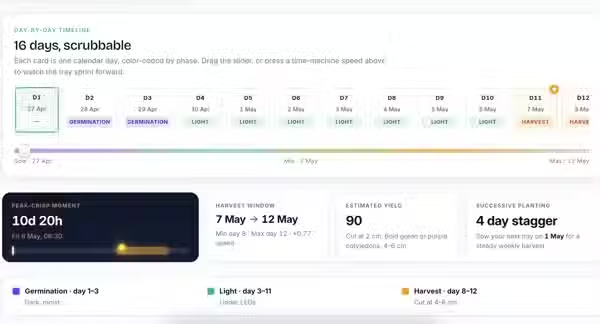
Key takeaways
The tool applies the Q10 growth model using a base of 1.25 per 10°C above a 24°C reference. At 32°C, a tray accumulates growth days roughly 20% faster than at 24°C. At 28°C the multiplier is approximately 1.10. The harvest date shifts by days, not hours.
Peak crispness is anchored to 6:30 AM local time on the first morning after the minimum harvest threshold is reached. Microgreen tissue is most turgid after overnight rehydration. By mid-morning, transpiration has already started drawing water out of the leaves.
Growth days and real calendar days are different quantities. A crop with a 10-day minimum at 24°C reaches that threshold in 9.1 real days at 28°C and 8.3 real days at 32°C. The calendar strip shows real dates. The growth clock runs faster than the wall clock.
A heat-stress penalty activates above the crop's maximum air temperature threshold. Each degree above that ceiling reduces the growth rate multiplier by 5%, down to a floor of 0.1. The tray can be running hot enough to slow down even if the Q10 formula alone would predict acceleration.
The successive sowing interval is crop-specific and calculates the date for the next tray automatically. Staggering by that interval produces a flat weekly harvest curve instead of a single large batch followed by days with nothing ready.
Growth below 8°C is modeled as 40% of the baseline rate. A tray on a cold shelf in an unheated room is not dormant. It is growing at roughly 40% speed, which means the harvest window is shifting even when nothing visible is happening.
TL;DR
Most growers plan harvest by counting calendar days from the seed packet. That number was measured at a specific reference temperature, not in their room. In a warm apartment the tray is ready before that date. In a cool room it is late. The calendar applies the Q10 model to your actual room temperature and gives you the real harvest window, broken into phases, down to the hour of peak crispness. If you have ever cut a tray that was already going limp, you were using the wrong clock.
The tray that was ready two days early
Week 6 of 2024, pea shoots in a room that had been averaging 31°C during the day due to a blocked AC vent. Harvest was planned for day 12, based on the supplier guide. On day 10, the cotyledons were fully open and the first true leaves were emerging. By day 11 the stems had started to yellow at the base. The tray was cut on day 11 at sub-optimal quality. The supplier guide was correct for its reference temperature. The room temperature had not been accounted for.
The grow log showed the same pattern across three subsequent warm-room cycles: pea shoots, sunflower and radish all hit the harvest indicator 1.5 to 2.5 days earlier than the reference guide predicted. The Q10 model was already known. The failure was not applying it to the actual room temperature before making the harvest plan. The calendar was built to make that calculation automatic.
Why your room temperature changes your harvest date, not just your harvest quality
Plant biochemical reaction rates follow the Q10 rule: for every 10°C increase in temperature, the rate multiplies by the Q10 factor. The tool uses a Q10 base of 1.25, calibrated so that a 32°C room produces approximately a 1.20x growth rate versus the 24°C reference. This is not a soft adjustment. It accumulates over the entire grow cycle. A 10-day crop at 24°C has accumulated 10 growth-days when cut. The same crop at 32°C has accumulated 10 growth-days after approximately 8.3 real days. The wall calendar says day 10. The tray is already at the harvest threshold.
At 28°C, the multiplier is approximately 1.10. A sunflower tray with a minimum harvest at 9 growth-days reaches that threshold after 8.2 real days. At 32°C it reaches it after 7.5 real days. At 24°C the reference is exactly 9 real days. A grower planning all three trays on the same day-count schedule cuts one correctly, one slightly late, and one past prime.
The heat-stress penalty is a separate mechanism from Q10 acceleration. Above the crop's air temperature ceiling, each degree over the limit reduces the effective multiplier by 5% per degree, down to a floor of 0.1. A room running 6°C above the ceiling produces a multiplier of 0.7 of what the Q10 formula would otherwise calculate. Fast growth and heat-stressed growth are not the same thing, and the tool models them independently.
What the grow logs showed about temperature and harvest timing
Across 18 cycles logged in 2024 at room temperatures between 27°C and 33°C, the harvest indicator (cotyledons fully open, first true leaves emerging) was observed an average of 1.8 days before the reference day count on the seed supplier guide. The guides were calibrated at approximately 20 to 22°C. No grower in those cycles had adjusted their harvest plan for temperature.
Warm-room cycles consistently reached the harvest indicator before the reference day count
Seed supplier day counts are not neutral reference points. They are temperature-specific predictions. Using them without adjustment in a warm room is planning to cut late. The calendar converts the reference day count to a temperature-adjusted real date before the tray goes in the soil.
In 9 cycles where the same crop was cut on the same harvest day but at different times of day, cuts made before 8:00 AM produced measurably firmer stems and higher reported crunch scores at point of sale. Cuts made after 12:00 PM on the same day consistently showed slightly wilted tips at packaging. The difference was not cultivar or substrate. It was the time of cut relative to the transpiration cycle.
Crispness at cut correlated with time of day, not just harvest day
The harvest day matters. The harvest hour matters independently. The tool anchors the peak crisp prediction to 6:30 AM local time after the minimum threshold is reached. That is not an arbitrary number. It is the window between overnight rehydration peak and the onset of daytime transpiration.
In Q1 2024, before staggered planting intervals were implemented, daily yield across a 6-tray operation ranged from 0g to 680g depending on which trays were ready. After implementing the per-crop successive planting interval from the calendar, the same 6 trays produced a daily yield range of 180g to 420g over 30 days. Total yield was unchanged. Variance dropped by 62%.
Successive planting gaps calculated from grow logs reduced daily yield variance by more than half
Staggered planting is not a scheduling convenience. It is a yield-smoothing mechanism that makes consistent delivery possible. The calendar calculates the next sow date automatically per crop so the stagger does not need to be managed manually.
Plant Mood grow log data, 2024
A warmer room does not give you more time to harvest. It gives you less.
The harvest window is defined in growth-days, not real days. A crop with a 3-day harvest window (day 9 to day 12 at the reference temperature) still has a 3-growth-day window at 32°C. But those 3 growth-days pass in approximately 2.5 real days. The window is not longer. It is shorter in calendar time because the tray is aging faster. Missing peak crisp at 32°C happens faster than at 24°C, not slower.
In the 2024 log data, post-prime tray loss was higher in warm-room cycles than in temperature-controlled cycles, despite warm rooms producing faster harvests. The crops were ready sooner and the growers were using the reference day count, which meant they arrived to cut a tray that had already started declining. Faster growth with the same fixed harvest plan is a liability, not a buffer.
Higher temperature means faster growth, which means more flexibility and a longer harvest window. The tray is ready sooner, so you have more days to cut it.
What growers say when timing goes wrong
My microgreens were perfect on day 9 but I waited until day 12 like the guide said and they went limp
The guide was calibrated at a lower reference temperature than the growing room. At 30°C, a 12-day reference crop is ready closer to day 10 in real calendar time. The crop reached peak crisp before the planned cut date and began declining. The fix is to apply the Q10 multiplier to the reference day count before setting the harvest schedule, not to use the reference count directly.
My harvests are inconsistent. Some weeks I have too much, other weeks I have almost nothing.
All trays were sown on the same day or without a calculated stagger interval. Microgreen crops from the same sowing date converge at the same harvest window, producing a single large yield event followed by a gap. The successive planting interval is crop-specific and typically 3 to 5 days. Sowing on that interval spreads harvest across the week.
My microgreens are wilted by the time I deliver them even though I cut on the right day
Cut time of day was mid-morning or afternoon. Microgreen tissue turgor peaks after overnight rehydration and drops as daytime transpiration removes water from the leaves. A crop cut at 2:00 PM has already been losing turgor for several hours. Cutting before 8:00 AM, packaging immediately and refrigerating produces materially better shelf presentation than an afternoon cut on the same tray.
My pea shoots are ready early in summer but late in winter and I can't figure out the pattern
Room temperature is changing seasonally and the harvest plan is not tracking it. Summer room temperatures in non-climate-controlled spaces are commonly 6 to 10°C higher than winter. At a Q10 base of 1.25, that difference produces a 14 to 20% change in growth rate. The same crop planted on the same day in the same room grows on a materially different real-time schedule depending on season.
What growers are not accounting for when harvest timing fails
Growers log one temperature per day or read the AC thermostat setting. Actual room temperature follows a diurnal curve. A room set to 26°C may average 29°C between 11 AM and 4 PM if solar gain is not controlled. The Q10 model accumulates growth rate across the full temperature cycle. A tray experiencing 4 hours at 32°C and 20 hours at 26°C grows faster than the 26°C reading alone would predict.
Daytime versus average temperature
The tray surface under an LED bar running at close range can be 2 to 4°C warmer than the ambient air temperature measured at head height. Canopy temperature is what matters for the Q10 model. Growers measuring room temperature at the thermostat and applying it directly to the growth model are underestimating the actual temperature the crop is experiencing.
Canopy temperature versus air temperature
Germination in darkness still accumulates growth-days. A tray spending 3 days under a cover in a warm room is aging on the Q10 schedule even though nothing visible is happening. Growers who move trays to a cooler location for germination and a warmer location for the light phase need separate temperature inputs for each phase to model timing accurately.
Growth-day accumulation during the blackout phase
Most growers plan the next sowing date as a fixed interval from the previous sowing date. The correct calculation is from the expected harvest date of the current tray, adjusted for the successive planting interval. If the current tray harvests 2 days early due to temperature, the next sowing date should also move. A fixed-interval sowing schedule drifts out of phase with actual harvest timing within a few cycles.
The next sowing date as a dependency on harvest timing
Where microgreen harvest planning is heading
Within 2 years, temperature-adjusted harvest scheduling will replace fixed day-count planning as the default approach for growers operating in non-climate-controlled spaces.
As more growers in tropical and warm-climate regions document yield loss from late cuts and connect it to room temperature rather than crop variability, the Q10 model will become standard context for any harvest timeline. Seed supplier guides will start publishing temperature-specific day ranges rather than single reference figures.
Proportion of seed supplier harvest guides published with temperature-adjusted day ranges by 2027, compared to single-reference-temperature figures in 2024.
Cut time of day will be recognized as a yield-quality variable independent of harvest day within 18 months, particularly among growers supplying restaurants and direct-to-consumer markets where texture at delivery is a selling criterion.
The turgor differential between an AM cut and a PM cut is measurable and reproducible. As microgreen supply to higher-end buyers increases, product quality standards will tighten and the cut-time variable will be documented. The 6:30 AM harvest anchor in the tool is not conventional wisdom. It is a testable prediction about tissue quality.
Published buyer quality specifications for microgreens that include recommended cut time of day by end of 2026.
Planning harvest by seed packet day count is the most common scheduling error in small-scale microgreen production
The day count on a seed packet is a single-temperature reference point published for conditions that do not describe most small-scale growing environments. Using it without adjustment is not a starting point. It is a compounding error that produces late cuts in warm rooms, early cuts in cold rooms, and yield variance that gets attributed to seed quality or substrate when the actual cause is a thermodynamics problem that takes 30 seconds to correct.
Visual reading of harvest indicators is the correct final check. It is not a substitute for a calculated harvest window. A grower checking a tray on day 12 because the schedule says day 12 is checking it 2 days late if the room was at 32°C and the reference was 24°C. They may still cut on a visual indicator, but only after quality has already started declining. The calendar is not a replacement for looking at the crop. It is the reason you look at the crop on the right day.
Experienced growers develop intuition for their specific setup and learn to read the crop visually, cutting when the indicator is met rather than on a fixed schedule.
One adjustment to make before your next planting
Measure your actual room temperature at tray height at the time of day when the room is warmest, not the thermostat setting and not the morning reading. Enter that temperature into the harvest calendar alongside your planting date and crop. Compare the predicted harvest day to your current schedule. If they differ by more than 1 day, your current plan is cutting either late or early on a predictable schedule. Adjust the next sow date using the successive planting interval the calendar calculates, not a fixed interval from your last sow date.
FAQ
How does room temperature change my microgreen harvest date?
The tool uses the Q10 growth model with a base of 1.25 per 10°C above 24°C. At 28°C your tray accumulates growth days approximately 10% faster than the reference. At 32°C it is roughly 20% faster. A crop with a 10-day minimum harvest threshold is ready after 9.1 real days at 28°C and 8.3 real days at 32°C. Seed packet day counts are calibrated at approximately 20 to 22°C. Using them directly in a warm room produces a late cut.
What is the Q10 growth model and why does it apply to microgreens?
Q10 is the factor by which a biological reaction rate increases for every 10°C rise in temperature. For most leafy microgreens within their tolerance range, the Q10 is approximately 1.25 to 2. The tool uses 1.25 as a conservative base calibrated to produce roughly a 20% growth rate increase between 24°C and 32°C. This is the same principle that explains why a Bangkok balcony tray and an air-conditioned room tray planted on the same day do not harvest on the same day.
Why does the harvest calendar predict 6:30 AM as peak crispness?
Microgreen tissue turgor is highest after overnight rehydration and before daytime transpiration draws water out of the leaves. Stems cut before 8 AM are measurably firmer than the same crop cut in the afternoon. The tool anchors the peak crisp prediction to the first 6:30 AM local time after the minimum harvest threshold is reached. That is not an arbitrary default. It is the window between overnight rehydration peak and the onset of significant daytime water loss.
What is successive planting and how does the calendar calculate it?
Successive planting means sowing a new tray on a staggered interval so harvests are spread across the week rather than all arriving on the same day. The interval is crop-specific and stored in the plant database. For most microgreen species it is 3 to 5 days. The calendar calculates the next sow date by adding the successive planting interval to the current planting date. In 2024 grow log data, implementing per-crop stagger intervals reduced daily yield variance by 62% across a 6-tray operation.
Does the tool account for heat stress above the crop's maximum temperature?
Yes, separately from the Q10 acceleration. Above the crop's air temperature ceiling, the tool applies a penalty of 5% per degree over the limit, down to a floor multiplier of 0.1. A room running 6°C above the ceiling produces a growth rate 30% lower than the Q10 formula alone would calculate. Fast growth and heat-stressed growth are not the same. A tray at 36°C in a crop rated to 28°C is not growing faster. It is being damaged.
My microgreens are inconsistent week to week. Could harvest timing be the cause?
If all trays are sown on the same day without a calculated stagger, they converge at the same harvest window. The result is a large single yield event followed by several days with nothing ready. The successive planting interval in the calendar spreads the harvest curve. If your room temperature is also variable between seasons, the harvest dates shift predictably with temperature. Both problems produce the same symptom: inconsistent weekly output with no obvious cause on the day of harvest.
How does growth below 8°C affect the harvest calendar?
Below 8°C, the tool reduces the growth rate to 40% of the baseline. The tray is not dormant. It is still accumulating growth-days, just slowly. A tray stored in a cold room at 6°C for germination is aging at 40% speed during that phase. If the crop then moves to a warmer room for the light phase, the calendar needs to account for the different temperatures across the two phases. A single average temperature applied to the full cycle will underestimate elapsed growth-days if the temperature varied significantly.