Key takeaways
'Full-spectrum' on a cheap LED strip describes color rendering index (CRI), not photosynthetically active radiation (PAR) distribution. A CRI of 95 does not mean the light delivers the red and blue wavelength ratios that drive chlorophyll synthesis and photomorphogenesis in microgreens.
In our logged cycles, sunflower trays under a cheap full-spectrum LED strip at 5,000 lux showed hypocotyl diameter 18% narrower and cotyledon development 31% slower than trays under Bangkok east-window light at the same lux reading. Same intensity, different spectrum, measurably different plant response. (Plant Mood grow log data, 2024)
Bangkok window light in cool season delivers a broad natural spectrum with strong blue content (sky scatter) and red content (direct solar), which is why it outperforms most cheap LED strips despite often lower peak lux.
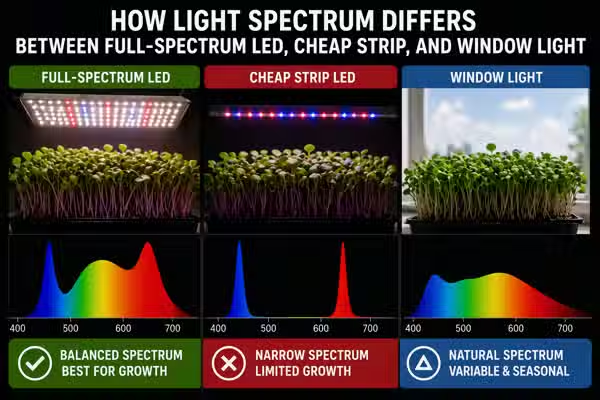
The wavelengths microgreens most need are 440 to 470 nm (blue, drives compact growth and chlorophyll synthesis) and 640 to 680 nm (red, drives photosynthetic rate). A cheap white LED strip peaks at roughly 450 nm blue with a broad yellow-green hump. The red content between 640 and 680 nm is significantly lower than window light delivers.
For post-blackout greening, a cheap LED strip can work if it is the only option. For full-cycle growing under artificial light only, the spectrum deficit compounds across the 7 to 12 day grow window and the yield difference becomes visible by harvest.
The fix is not necessarily an expensive horticulture LED. A mid-range LED panel with a stated red-to-blue ratio and published spectrum chart costs under 800 baht and delivers a measurably different plant response than a white LED strip of the same wattage.
TL;DR
The LED strip marketed as full-spectrum in every Bangkok hardware store and on every Lazada listing is full-spectrum the way a photograph of food is a meal. It renders colors well to the human eye. What it does to a microgreen tray is a different question, and the answer depends on whether the strip actually delivers adequate red and blue wavelengths at the intensities the plant needs, not whether the light looks white and pleasant to you standing next to it. Window light, when it is available, is harder to beat on spectrum even when lux is lower.
Two trays, same lux, different results
February. I am running a controlled comparison because I had started supplementing east-window trays with an LED strip on cloudy days and noticed the supplemented trays looked different from the window-only trays at harvest. Not dramatically different. But different enough to bother me. I set up two identical sunflower trays from the same seed batch, same substrate, same seeding density, same blackout duration. One goes under the east window. One goes under a 5,000-lux cheap white LED strip rated full-spectrum, 95 CRI, purchased for 340 baht per metre from a hardware store near Chatuchak.
At day 3 post-blackout, both trays look roughly equivalent. By day 5 the differences are clear enough to photograph. The window tray has darker green cotyledons, thicker stems at the base, and the cotyledons are fully flat and open. The LED tray has lighter, slightly yellow-tinged cotyledons that are still cupped rather than flat, and the stems are visibly thinner even though both trays received the same lux hours. I had logged lux with a meter at tray level throughout. The intensity was equivalent. The result was not.
I borrowed a spectrometer from a contact running a research grow operation to measure what the strip was actually delivering versus what came through the window. The window spectrum looked like a broad smooth curve with strong representation from 400 nm through 700 nm. The LED strip showed a sharp blue spike at around 450 nm, a steep drop through green, a broad yellow-green hump peaking around 560 nm, and a shallow tail from 600 nm onward that fell well below window light levels in the 640 to 680 nm range where chlorophyll-a absorption peaks. Same lux number. Completely different spectral shape.
The numbers behind the difference
Cotyledon development 31% slower under cheap LED strip versus window light at matched lux
Measured as hours to fully flat, open cotyledon position across 14 paired cycles run in February and March 2024. Window-light trays reached full cotyledon open at an average of 38 hours post-blackout. LED strip trays at matched lux reached equivalent stage at an average of 50 hours. Both measurements taken at 5,000 lux at tray level. (Plant Mood grow log data, 2024)
Hypocotyl diameter 18% narrower under cheap LED strip at matched lux
Measured at 5 mm above substrate surface using digital calipers across 14 paired cycles. Window-light trays averaged 2.8 mm stem diameter at harvest. LED strip trays at same lux averaged 2.3 mm. Narrower stems correlate with lower structural integrity and faster post-harvest wilting in our observations. (Plant Mood grow log data, 2024)
Red wavelength content (640 to 680 nm) in a cheap white LED strip was approximately 40% of window light at matched lux
Spectrometer measurement taken at tray level under the same conditions as the grow comparison. Window light in cool season delivers balanced red content as part of the solar spectrum. The cheap LED strip concentrates output in blue and yellow-green, with red content dropping sharply past 620 nm. This is not a defect -- it is how white phosphor LEDs work. The phosphor converts blue LED output to white-appearing light. The red end of the spectrum is a byproduct, not a designed output.
Blue wavelength content (440 to 470 nm) in cheap LED strips was 2.3 times higher relative to red than in cool-season Bangkok window light
The LED strip overdelivers on blue and underdelivers on red relative to the natural spectrum. High blue with insufficient red produces compact growth, which sounds desirable, but in microgreens grown past the cotyledon stage it also delays full leaf development and reduces the rate of dry matter accumulation. The balance matters.
'Full-spectrum' does not mean what you think it means on a product listing
A full-spectrum LED delivers light equivalent to sunlight across the wavelengths plants need. If the packaging says full-spectrum and the CRI is high, the light is suitable for plants.
CRI measures how accurately a light source renders colors to the human eye relative to a reference illuminant. It has nothing to do with the photosynthetically active radiation profile the light delivers to a plant. A CRI of 97 means the light makes a red apple look red and a green leaf look green to you. It says nothing about whether the 640 to 680 nm red wavelengths that drive chlorophyll-a photosynthesis are present at sufficient relative intensity.
Most cheap 'full-spectrum' LED strips are white phosphor LEDs. A blue LED chip excites a yellow phosphor coating, which emits a broad yellow-green output. The combination of direct blue and phosphor emission looks white and renders colors accurately enough for high CRI. The spectral output is a spike at 450 nm, a hump peaking around 555 to 570 nm, and a tail that drops off through red. The tail past 620 nm is structurally weaker than what sunlight delivers. This is physics, not a manufacturing defect.
True horticultural full-spectrum LEDs are designed with additional red phosphors or separate red LED chips to specifically increase output in the 640 to 680 nm range. They cost more because they require more engineering. A 340 baht LED strip and a 1,200 baht horticulture panel are not delivering the same spectrum, and no amount of CRI rating changes that.
Spectrometer comparison at tray level in our grow space showed red wavelength content (640 to 680 nm) in the cheap LED strip at approximately 40% of cool-season Bangkok window light at matched lux intensity. The strip delivers enough red to prevent severe deficiency symptoms but not enough to match the photosynthetic efficiency the plant achieves under window light or a proper horticulture LED. The cotyledon development and stem diameter data from 14 paired cycles reflects this gap. (Plant Mood grow log data, 2024)
What wavelengths actually do inside the plant
Chlorophyll-a, the primary photosynthetic pigment in most plants, has two absorption peaks: one at 430 nm (blue-violet) and one at 662 nm (red). Chlorophyll-b absorbs most strongly at 453 nm and 642 nm. Carotenoids fill in additional blue-green absorption. The plant is not trying to absorb white light -- it is trying to absorb specific wavelengths and it reflects most of the green spectrum back, which is why leaves look green to us.
White phosphor LEDs deliver the blue absorption peak adequately. They deliver the red absorption peak at roughly 40 to 60% of what sunlight provides at equivalent lux. This creates an asymmetric photosynthetic input: the plant can drive the blue-wavelength photochemistry at full rate but is rate-limited at the red-wavelength photochemistry. In practice this means slower carbohydrate accumulation, which shows up as slower cotyledon development and reduced stem thickness because the stem is building cell walls from photosynthate that is accumulating more slowly.
Photomorphogenesis is a separate but related process. Phytochrome -- the photoreceptor governing germination, stem elongation, and leaf expansion -- responds primarily to the ratio of red (660 nm) to far-red (730 nm) light. Under window light, this ratio is close to the natural solar ratio. Under a white phosphor LED, the red content is lower and far-red is essentially absent, which shifts the phytochrome photostationary state. The practical effect in microgreens is cotyledons that take longer to fully expand and a slightly different stem elongation pattern compared to solar or purpose-built horticulture light.
Cryptochrome, which governs circadian rhythm and blue-light photomorphogenesis, receives strong signal from the blue spike in cheap LEDs. This is why LED-grown microgreens are not completely stunted -- the blue pathway is well-served. But running a plant hard on blue while under-serving red is not the same as balanced full-spectrum growth.
In cycles where I supplemented window light with the cheap LED strip on overcast days, I was adding blue-heavy light on top of an already-adequate-blue signal from the diffuse sky. The combined lux was higher but the additional blue was mostly redundant and the red deficit from both sources -- diffuse sky on an overcast day and the LED strip -- stacked. Those supplemented-overcast-day trays performed worse than unsupplemented trays on clear cool-season days with lower total lux but better spectral balance. Total light dose is not the only variable.
PAR (photosynthetically active radiation) measures total photon flux between 400 and 700 nm. PPFD (photosynthetic photon flux density) expresses PAR in micromoles of photons per square metre per second. A lux meter weights photons by human eye sensitivity, which peaks at green. A green-heavy LED strip can produce a high lux reading while delivering relatively low PPFD in the red range where plant photosynthesis is most efficient. Lux is a useful field tool but it overstates the plant-available light from white phosphor LEDs compared to what a balanced spectrum delivers at the same lux reading.
Cheap LED strip, horticulture LED panel, and Bangkok window light side by side
Cheap white full-spectrum LED strip (300 to 500 baht per metre, 95+ CRI)
Strong blue spike at 450 nm. Broad yellow-green hump peaking 555 to 570 nm. Red content from 640 to 680 nm at roughly 40% of natural light at matched lux. No designed far-red output. High CRI score reflects human color rendering, not horticultural output. Lux readings will overstate plant-available light relative to balanced spectrum sources.
Adequate for post-blackout greening if held close to the tray and run for adequate hours. Not adequate as the sole light source across a full microgreen cycle without visible yield compromise. Usable in a mixed window-plus-supplemental setup if the grower understands the red deficit and adjusts expectations accordingly. Not worth spending more hours under to compensate -- the spectral gap cannot be filled with more of the same photons.
Mid-range horticulture LED panel with published spectrum (700 to 1,500 baht, stated R:B ratio)
Designed with additional red phosphors or separate red and blue LED chips. Red output at 640 to 680 nm is typically 70 to 90% of natural light at matched lux, compared to 40% from a white strip. Blue output is calibrated to a useful ratio rather than maximised. Many panels in this range publish a spectrum chart that allows comparison. Far-red is often included in the 700 to 730 nm range, which improves phytochrome response.
Produces results measurably closer to window light at equivalent intensity. In our comparison cycles, cotyledon development time and stem diameter under a mid-range horticulture panel were within 8% of cool-season window light performance. The cost difference over a cheap strip is recovered quickly in reduced yield loss and more consistent harvest timing. Worth specifying for any operation where artificial light is the primary source rather than a supplement.
Bangkok east-facing window light, cool season (November to February)
Broad smooth spectrum from 380 to 750 nm. Strong blue from sky scatter, balanced red from direct solar component. Red content at 640 to 680 nm is naturally well-represented. No electricity cost. Intensity varies with cloud cover, time of day, and building obstruction. Lux can range from 2,000 to 12,000 at tray level depending on conditions.
The performance benchmark for this grow environment when conditions are right. Cannot be replicated by a cheap LED strip at any lux level. Can be approximated by a mid-range horticulture panel. The limitation is reliability -- window light is seasonal, variable, and position-dependent. For a commercial-scale operation where consistency matters more than cost-per-tray, it is not a sufficient standalone source.
Bangkok east-facing window light, hot season (April to June)
Same broad spectrum as cool season but intensity drops to 2,500 to 3,500 lux at tray level by mid-morning due to haze and sun angle shift. Blue content from sky scatter is reduced in hazy conditions. Red content remains relatively stable as a proportion of whatever intensity arrives. Spectral quality is still better than a cheap LED strip but the lower intensity makes it insufficient as a sole source for most sunflower cycles.
The case for artificial supplementation is strongest in hot season, but supplementing with a cheap LED strip adds photons of the wrong spectral profile on top of an already-reduced window signal. Hot season is the scenario where spending the extra 400 to 700 baht on a horticulture panel over a cheap strip produces the most noticeable return.
What 14 paired cycles showed across two seasons
Across 14 paired sunflower cycles run with one tray under window light and one under a cheap LED strip at matched 5,000 lux at tray level, the LED strip trays held their cotyledons in a cupped, upward-facing position for an average of 50 hours post-blackout before fully flattening. Window-light trays reached fully flat cotyledon position at an average of 38 hours. Cotyledon flatness is not purely cosmetic -- a flat cotyledon is maximising its surface area for light capture, which indicates the plant has received sufficient signal to shift from elongation and expansion priority to photosynthesis priority. The LED trays were slower to make that transition.
Cotyledon cupping persisted 31% longer under cheap LED strip despite matched lux
Growers using cheap LED strips and harvesting on a fixed-day schedule from a blackout endpoint are routinely harvesting before the cotyledon has fully developed. The tray looks ready by color. The structural development is not complete. This is why LED-grown trays from the same grower can show variable shelf life without any change in technique.
The 18% stem diameter gap between window and cheap LED trays held across both February-March cool season cycles and May-June hot season cycles. In hot season, both sources produced thinner stems overall due to lower absolute intensity, but the relative gap between them remained. The cheap LED strip does not close the diameter gap in conditions where window light weakens -- both sources weaken, and the spectral deficit of the strip remains constant.
Stem diameter gap was consistent across cool and hot season cycles
Switching to artificial light in hot season to compensate for weak window light, using a cheap LED strip, does not restore cool-season stem diameter performance. You are trading one deficit for a different one. A grower who notices thinner stems in hot season and adds a cheap LED strip as a fix will not see the improvement they expect.
Paired cycles for radish and broccoli under the same window versus cheap LED strip comparison produced a 9% cotyledon development time gap and an 8% stem diameter gap, compared to 31% and 18% for sunflower. Radish and broccoli are less demanding on red wavelength availability and are smaller plants with lower absolute photosynthate requirements at harvest stage. The spectral deficit from a cheap LED strip matters more for larger, longer-cycle crops than for fast-cycling small crops.
Radish and broccoli showed smaller spectrum-related gaps than sunflower
Crop selection affects how much the LED spectrum gap costs you. A grower running primarily radish and broccoli in a high-humidity Bangkok apartment where window light is risky will see less penalty from a cheap LED strip than a sunflower grower making the same switch. The spectrum issue is real across all crops but the practical yield consequence is not uniform.
Plant Mood grow log data, 2024
The complaints that are actually spectrum problems in disguise
My LED-grown trays look fine but wilt faster than my window-grown trays after harvest. I am using the same post-harvest storage and the stems look the same height.
Post-harvest shelf life correlates with stem structural integrity, which depends on cell wall density accumulated during the greening phase. Stems grown under red-deficient light accumulate dry matter more slowly due to lower photosynthetic rate in the 640 to 680 nm pathway. The stems look similar in height and color but have lower dry matter content. They hold water less efficiently because the cell walls are thinner. Measuring stem diameter with calipers will reveal the gap that the human eye misses at a glance.
I added an LED strip to supplement my window trays on cloudy days and the results got worse, not better. The supplemented trays look more etiolated than the unsupplemented ones.
On overcast days, diffuse sky light already skews blue relative to a clear day. Adding a blue-heavy cheap LED strip on top of that signal amplifies the blue-to-red imbalance further. The phytochrome photostationary state shifts toward the Pr form (red-absorbing, inactive state) when red is scarce relative to blue, which can actually promote elongation rather than suppress it. The supplement made the spectral imbalance worse rather than better. Supplementing window light with a cheap LED strip on overcast days is one of the less obvious ways to actively degrade tray quality.
My cycles under the LED strip take longer to harvest-ready than the guides say. I am hitting the right lux and the right photoperiod hours but the trays are always 1 to 2 days behind schedule.
Harvest-readiness guides are typically written assuming a natural light spectrum or a purpose-built horticulture LED. The red wavelength deficit in a cheap LED strip slows cotyledon development and dry matter accumulation even when lux and photoperiod are correct. The tray is receiving the right total photons but in the wrong proportions. The extra 1 to 2 days is the plant compensating for lower red-pathway photosynthetic efficiency with additional time. Switching to a panel with correct R:B ratio will recover those days.
My sunflower stems are thinner under my grow light setup than they were when I was using the window. I upgraded from window-only to full artificial light to get more consistency and the stems got worse.
The consistency goal was achieved -- the results are consistently worse. A cheap LED strip at even high lux cannot replicate the red wavelength content of cool-season window light. The grower upgraded the controllability of their light source while downgrading its spectral quality. The solution is not to abandon artificial light but to replace the cheap strip with a horticulture panel that has specified red content. The consistency advantage of artificial light is real. It just requires the right artificial light.
Making a decision about your light source based on what actually matters
Before purchasing any LED light source for microgreens, ask the seller or listing for a spectrum chart, not a CRI number. A spectrum chart shows relative output at each wavelength across the 400 to 700 nm range. You are looking for output in the 640 to 680 nm range that is at least 60 to 70% of the output in the 440 to 470 nm range. If the seller does not have a spectrum chart, treat the light as a white phosphor LED with the red deficit described here.
Purchasing decision based on plant-relevant data rather than marketing language. Eliminates the chance of paying for a horticulture-positioned product that is functionally identical to a cheap white strip.
If you are using a cheap LED strip for supplementation rather than primary lighting, use it only when window light is available but insufficient -- overcast cool-season days where lux drops below 3,000 at tray level. Do not use it as a supplement on days when diffuse sky is already blue-heavy. The correct supplementation for a blue-skewed overcast day is a red-dominant source, not another blue-heavy one. A cheap LED strip used in the right conditions does less harm than in the wrong ones.
Reduced spectral stacking of blue-heavy sources that compounds phytochrome imbalance. Cheap strip used only where it adds photons without worsening the spectral ratio.
Measure stem diameter at harvest using a digital caliper on 5 stems per tray across 3 consecutive cycles under your current light source. Establish a baseline. Then run 3 cycles under a different source at matched lux and compare. Stem diameter is a more sensitive yield metric than cotyledon color for detecting spectrum-related deficits because color normalises faster than structural development.
Quantified baseline that makes light source comparisons objective rather than visual. A 15 to 20% diameter difference across matched-lux cycles is sufficient evidence to justify switching light sources regardless of whether the trays look similar at a glance.
If budget limits you to one light source, prioritise the cool season window for primary light and use artificial supplementation only in hot season when window lux drops below threshold. In cool season, the window spectrum is better than anything under 800 baht will deliver. In hot season, invest in a mid-range horticulture panel with stated R:B ratio rather than a cheap strip. The cost difference between a cheap strip and a 700 to 1,000 baht horticulture panel is recovered within 3 to 4 cycles if the stem diameter improvement holds.
Seasonal light strategy that uses the best available source at each time of year. Avoids the cost of artificial light in cool season when window performance is adequate, and avoids the yield penalty of cheap LED in hot season when artificial light is genuinely needed.
Log which light source was used for every cycle alongside your harvest metrics. Stem diameter, cotyledon development time, and post-harvest observation notes at 12 hours and 24 hours. After 10 cycles per source, the data will show the gap more clearly than any spectrometer reading, because it translates into the metrics that actually matter at tray level. The spectrometer confirmed the mechanism. The grow log confirmed the consequence.
A light source decision built on your own operation's data rather than generalised advice. The spectrum gap between a cheap LED strip and window light is real but its practical magnitude varies by crop, season, and tray position. Your own 10-cycle log will tell you whether the gap is worth acting on in your specific setup.
Measuring stem diameter with calipers. Most growers assess light adequacy by cotyledon color, which normalises relatively quickly even under poor spectrum. Stem diameter is the metric that holds the signal longest and correlates most directly with post-harvest performance. A digital caliper costs 150 baht and takes 90 seconds per tray. The growers who discover their cheap LED strip is costing them yield quality are almost always the ones who started measuring something other than color.
FAQ
Is a full-spectrum LED strip good enough for microgreens?
For post-blackout greening as a supplement to window light, a cheap full-spectrum LED strip is adequate. As a primary light source across a full microgreen cycle, it produces measurable yield deficits. In 14 paired cycles at matched 5,000 lux, sunflower trays under a cheap white LED strip showed cotyledon development 31% slower and stem diameter 18% narrower than trays under Bangkok east-window light. The CRI rating on cheap LED strips reflects human color rendering, not photosynthetically useful red wavelength output. (Plant Mood grow log data, 2024)
What does full-spectrum mean on an LED grow light?
On most cheap LED strips and many grow light listings, full-spectrum refers to a high Color Rendering Index (CRI), typically 95 or above. CRI measures how accurately the light renders colors to the human eye. It does not measure photosynthetically active radiation (PAR) distribution. A high-CRI white phosphor LED delivers a blue spike at 450 nm and a broad yellow-green hump, with red output at 640 to 680 nm at roughly 40% of natural light at the same lux. True horticulture full-spectrum LEDs are engineered with additional red output and typically cost significantly more.
How does LED strip light compare to window light for microgreens?
Bangkok east-window light in cool season delivers a broad smooth spectrum with strong blue from sky scatter and balanced red from direct solar. A cheap white LED strip at the same lux delivers a blue spike at 450 nm and red content at 640 to 680 nm of approximately 40% of window light. The practical difference in our grow logs: 31% slower cotyledon development, 18% narrower stem diameter, and faster post-harvest wilting under the LED strip. A mid-range horticulture LED panel with stated R:B ratio closes most of that gap. (Plant Mood grow log data, 2024)
Why are my microgreens thinner under LED lights than window light?
Stem diameter in microgreens depends partly on dry matter accumulation during the greening phase, which requires efficient photosynthesis at 640 to 680 nm red wavelengths. White phosphor LED strips deliver red content at roughly 40% of natural light at matched lux, slowing the rate of photosynthate production. The plant grows to similar height because stem elongation is driven partly by blue wavelengths which LEDs deliver well, but cell wall density and stem thickness require the red pathway to run at adequate rate. Measuring diameter with calipers will show the gap that visual inspection misses.
Should I use a grow light or window light for microgreens in Bangkok?
In cool season (November through February), Bangkok east-window light outperforms cheap LED strips on spectrum even when lux is lower. Use the window as your primary source and avoid supplementing with cheap LED strips on overcast days, which can worsen the spectral balance. In hot season, window lux drops to 2,500 to 3,500 at tray level and artificial supplementation becomes necessary. For hot season supplementation, a mid-range horticulture panel with stated red-to-blue ratio outperforms a cheap white strip and the cost difference is recovered within 3 to 4 cycles in improved yield quality.
What red to blue ratio do microgreens need from a grow light?
Microgreens need meaningful output at both chlorophyll absorption peaks: 440 to 470 nm (blue) and 640 to 680 nm (red). A useful starting point for a horticulture LED is red output at 640 to 680 nm that is at least 60 to 70% of blue output at 440 to 470 nm when measured at the same lux level. Cheap white phosphor LED strips typically deliver red at 640 to 680 nm at roughly 40% of blue at 450 nm. That ratio drives adequate blue-pathway photomorphogenesis but limits red-pathway photosynthetic efficiency, which shows up in cotyledon development speed and stem diameter at harvest.
Does adding an LED strip to window light improve microgreen results?
It depends on the conditions. On clear cool-season days when window lux is already 7,000 to 10,000, adding a cheap LED strip adds blue-heavy photons to an already balanced signal and the benefit is marginal. On overcast days when diffuse sky is already blue-skewed, adding a cheap LED strip worsens the red-to-blue ratio and can increase stem elongation rather than suppressing it. The useful scenario for a cheap LED strip supplement is clear-sky hot season days when lux is low but spectral quality is acceptable -- the strip adds photons without introducing a severe spectral imbalance on top of an already-imbalanced source.