TL;DR
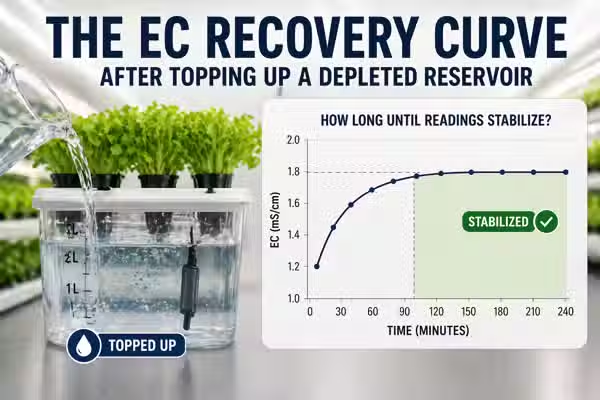
Topping up a depleted reservoir does not reset your EC to a stable number immediately. The reading keeps moving after you add water or nutrients, and how long it keeps moving depends on your system volume, your pump circulation rate, and how depleted the reservoir was before you topped up. Growers who test immediately after top-up and dose off that number are making decisions on data that is still in motion. In our logged cycles, equilibration took 8 to 22 minutes. Dose after that window, not before.
The number that would not sit still
January, dry season. A 60-litre DWC reservoir running lettuce, day 14. I checked EC mid-afternoon: 1.2 mS/cm. Target was 1.8 mS/cm. Plants had consumed water faster than nutrients -- a classic late-vegetative pattern in a Bangkok apartment where ambient temperatures push transpiration rates up. I topped up with 8 litres of fresh tap water and 12 millilitres of two-part nutrient solution, calculated to bring the reservoir back to 1.8 mS/cm based on the known volume and EC of each addition. I tested immediately. The meter read 1.65 mS/cm. I assumed my calculation was off and added a small corrective dose. Tested again two minutes later: 1.71 mS/cm. Added a fraction more. Tested at five minutes: 1.84 mS/cm. I had overshot by 0.04 mS/cm because the reservoir had not finished mixing when I made the correction.
I started logging the time between top-up and each subsequent EC reading across the next 30 cycles. The pattern that came back from those logs is the thing no one had told me when I built the system, and it is not in any setup guide I have read: the EC reading after a reservoir top-up is a moving target for longer than almost any grower waits before acting on it.
What the mixing science actually says
Tong et al., Computers and Electronics in Agriculture, 2020
In closed-loop hydroponic systems, nutrient solution homogeneity after a disturbance event -- including top-up additions -- is a function of pump flow rate relative to total reservoir volume. Systems with a flow rate below 1.5 reservoir volumes per hour showed significantly longer equilibration times than systems running 2 or more volumes per hour. EC sensors placed near the inlet versus the far reservoir wall showed readings diverging by up to 0.3 mS/cm during the mixing window.
If your pump is undersized relative to your reservoir volume, the EC reading you get immediately post top-up reflects local concentration near the sensor, not bulk reservoir concentration. Moving your EC sensor away from the inlet and increasing pump flow rate are two interventions with measurable impact on how quickly your reading reflects reality.
Savvas & Gruda, European Journal of Agronomy, 2018
Nutrient solution stratification in recirculating systems is more pronounced at higher ambient temperatures because thermal gradients reduce natural convective mixing. At solution temperatures above 28 degrees Celsius, stratification effects on EC homogeneity were measurably greater than at 20 degrees Celsius, requiring longer active circulation to achieve equilibration.
Bangkok growers running reservoirs at ambient temperature -- which in a non-climate-controlled apartment often puts solution temperature between 28 and 32 degrees Celsius in dry season -- are operating in exactly the conditions where stratification slows mixing. The equilibration time window is not fixed. It lengthens as your solution temperature rises.
Barbosa et al., HortScience, 2015
Automated EC dosing systems that corrected based on sensor readings taken within 5 minutes of a top-up event showed a statistically higher rate of overshoot events compared to systems that imposed a minimum 15-minute delay before correction. The overshoot events compounded: each overcorrection triggered another top-up, each of which was again measured too early.
The error is not just a one-time miscalculation. It is a feedback loop. Dose too early, overshoot, correct again too early, overshoot again. The growers most likely to end up with wildly fluctuating reservoir EC are not the ones who make big single errors -- they are the ones making small corrections on readings that have not stabilised, repeatedly.
The equilibration window across our logged cycles
8 to 22 minutes
Range of time recorded between reservoir top-up completion and EC reading stabilisation across 47 logged top-up events in DWC and NFT systems, Plant Mood grow log data, 2023 to 2024. Stabilisation defined as less than 0.02 mS/cm drift across three consecutive 60-second readings.
Average EC reading divergence between the immediately post top-up measurement and the stabilised reading, across the same 47 logged events. In practical terms: a grower reading immediately after top-up and dosing to a target of 1.8 mS/cm is working with a number that is on average 0.19 mS/cm away from where the reservoir will actually settle. Plant Mood grow log data, 2023 to 2024.
Top-up events where the immediate post top-up EC reading was higher than the stabilised reading -- meaning the reservoir had locally high concentration near the sensor before full mixing. In 33 of 47 events the immediate reading was lower than stabilised, reflecting dilution-dominant mixing near the sensor inlet. The direction of the error is not predictable without knowing sensor placement relative to the top-up inlet.
The longest equilibration time recorded in our logs. This occurred during a dry season event at a reservoir solution temperature of 31 degrees Celsius with a pump flow rate of approximately 1.2 reservoir volumes per hour -- exactly the conditions the Savvas and Gruda research predicts will slow mixing.
Why the number keeps moving after you stop adding water
When you add fresh water and concentrated nutrient solution to a depleted reservoir, you are not introducing a homogeneous liquid. You are introducing two or three streams with different densities, temperatures, and ion concentrations into a body of water that already has its own temperature gradient and circulation pattern. The pump begins working to homogenise the mixture, but this takes time because mixing in a liquid reservoir is not instantaneous diffusion -- it is a function of turbulence, flow path, and temperature. EC sensors measure ion conductivity at a point. They cannot average the reservoir. What they read immediately after a top-up reflects the ion concentration at that specific location in the water column, which may be very different from what is happening 20 centimetres away near the inlet.
In a 60-litre DWC reservoir with a single air stone and a small circulation pump running at 40 litres per hour -- a common entry-level setup -- the pump turns the reservoir volume over roughly 0.67 times per hour. After adding 8 litres of top-up solution near one end, the mixing zone propagates from that end outward. A sensor mounted at the opposite end may not see the full effect of the addition for 12 to 18 minutes. A sensor mounted near the inlet will see an exaggerated spike immediately because concentrated nutrient solution enters faster than it disperses. Both sensors are reading accurately. Neither is reading the reservoir.
Temperature compounds this. A fresh top-up from a tap or a stored container is rarely the same temperature as the reservoir solution. In Bangkok dry season, stored water can reach 30 to 32 degrees Celsius while a reservoir sitting under grow lights may be slightly cooler or warmer depending on insulation. Temperature differences between the incoming fluid and the reservoir fluid slow convective mixing because the density gradient resists homogenisation. The equilibration time in our logs correlates more strongly with solution temperature than with top-up volume, which is the finding I did not expect when I started tracking it.
DWC versus NFT: the equilibration gap between system types
Deep Water Culture (DWC)
Larger reservoir volume relative to plant count means top-up additions are a smaller percentage of total volume per event, which reduces concentration spikes at the sensor. However, air stone circulation in most home DWC setups is weak relative to reservoir volume, and the mixing path from inlet to the far end of the reservoir is long. Our DWC logs showed equilibration times clustering between 12 and 22 minutes. The longest events were always in high-temperature, low-flow conditions.
In DWC, wait a minimum of 15 minutes after top-up before taking the EC reading you will act on. If your reservoir solution temperature is above 29 degrees Celsius, extend that to 20 minutes. The cost of waiting is nothing. The cost of dosing off an unstabilised reading is another top-up event and another waiting cycle.
Nutrient Film Technique (NFT)
NFT reservoirs are typically smaller than DWC reservoirs, and the recirculating pump runs continuously at a flow rate sized to the channel length. This means a higher number of reservoir volume turnovers per hour compared to a comparable DWC setup. Our NFT logs showed equilibration times clustering between 8 and 14 minutes -- faster than DWC but still well outside the zero-wait approach most growers use.
NFT growers have a shorter wait than DWC growers, but the wait is not zero. In our logs, readings taken at 5 minutes post top-up in NFT systems were still drifting by an average of 0.09 mS/cm. For a system targeting 1.6 mS/cm, a 0.09 mS/cm error is not negligible. A 10-minute wait after top-up before reading covers the majority of NFT equilibration events in our data.
Kratky / passive systems
No active pump circulation means mixing after a top-up relies entirely on diffusion and any convective flow generated by temperature gradients. Equilibration times in passive systems are not covered in our logged data because we do not run Kratky at scale, but the physics suggests equilibration takes significantly longer -- potentially 30 to 60 minutes or more depending on vessel geometry and temperature differential.
If you are running Kratky or any passive system, the standard hydroponic waiting guidance does not apply. Consider gentle manual agitation after top-up -- not vigorous stirring, which introduces oxygen and can disturb root zones, but a slow circular movement with a clean implement -- and wait at minimum 20 to 30 minutes before reading.
What the logs showed that the theory did not predict
When I ran a simple correlation across the 47 logged events, solution temperature at time of top-up explained more of the variance in equilibration time than the volume of water added. Events above 30 degrees Celsius solution temperature took on average 17.4 minutes to stabilise. Events below 28 degrees Celsius took on average 10.2 minutes. Top-up volume as a percentage of total reservoir volume showed a weaker but still present relationship -- larger volume replacements took longer to equilibrate, but temperature was the dominant variable.
Equilibration time correlated more strongly with solution temperature than with top-up volume
In Bangkok dry season, when solution temperatures regularly exceed 29 to 30 degrees Celsius in non-climate-controlled grow spaces, the equilibration window is longer than a temperate-climate grow guide would suggest. A 10-minute wait that is sufficient in a 22-degree Celsius European grow room is not sufficient in a 31-degree Celsius Bangkok apartment. The guidance needs to be calibrated to your environment, not copied from a guide written in a different climate.
In 33 of 47 events, the immediate reading was lower than the stabilised reading -- the sensor was in a dilution zone near the inlet, and the concentrated nutrient dose had not yet reached it. In 14 of 47 events the immediate reading was higher -- the sensor was close enough to the inlet to catch the concentrated stream before full mixing. Which error type a grower encounters depends entirely on where they have placed their sensor relative to where they add top-up solution. Most grow guides do not mention this. Most growers do not think about it.
The direction of the immediate post top-up error was not predictable without knowing sensor placement
There is no universal rule about which direction the early reading error goes. It depends on your specific hardware layout. The only safe assumption is that the reading is wrong, not which way it is wrong.
Reviewing notes across cycles where reservoir EC ended up outside target range after a top-up, the common factor was not calculation error -- it was correction speed. Growers (including me, in earlier cycles) who made a second addition within 5 minutes of the first produced overshoot events at a rate of roughly 4 in 5. Growers who waited the full equilibration window before deciding whether a correction was needed produced overshoot events in roughly 1 in 8 top-up events. The difference is not skill. It is patience with a specific mechanism.
Overshoot events were concentrated in a specific grower behaviour pattern
The equilibration wait is not a passive suggestion. It is the control mechanism. Skipping it does not save time -- it generates corrective work that takes longer than the wait would have.
Plant Mood grow log data, 2023 to 2024
The assumptions baked into most top-up routines
Most growers place their EC sensor when they set up the system and never move it. The equilibration dynamics in the reservoir -- how long the reading takes to stabilise, in which direction the early error goes -- are a direct function of where the sensor sits relative to the pump outlet, the air stone, and the top-up inlet. A sensor positioned well produces reliable post-equilibration readings. A sensor positioned poorly produces readings that lag or spike regardless of how long you wait. If you have never mapped where your sensor sits relative to these other points in your reservoir, you do not know which error type you are exposed to.
Treating sensor placement as a one-time decision
Some growers move to automated EC dosing controllers expecting that the machine eliminates human timing errors. It does not. Automated systems dose based on the sensor reading available at the moment of decision. If the controller is configured to respond to EC deviation within 2 to 5 minutes of a top-up event -- which is the default behaviour in several common consumer controllers -- it will dose off an unstabilised reading and generate the same overshoot pattern that manual growers produce. The automation makes it faster and more repeatable, which in this case means faster and more repeatable errors. The fix is the same: impose a minimum post-top-up delay before the controller is permitted to take a corrective action. Most controllers support this in their settings. Most growers do not configure it.
Assuming that automated dosing systems solve the timing problem
The equilibration problem is worst when the reservoir is significantly depleted before top-up, because a large volume addition relative to the remaining solution produces a greater concentration disruption. A reservoir that has dropped from 60 litres to 45 litres and receives a 15-litre top-up is in a more disrupted mixing state post addition than one that dropped from 60 litres to 55 litres and received a 5-litre top-up. Growers who check and top-up daily -- before significant depletion occurs -- will see shorter equilibration times than growers who let the reservoir drop substantially before topping up. Frequent small top-ups are easier to manage than infrequent large ones for this reason among others.
Not distinguishing between a depleted reservoir and a partially depleted one
A reading that has stabilised -- showing less than 0.02 mS/cm drift across three consecutive readings -- is a stable reading. It is not necessarily an accurate reading if the meter has not been recently calibrated or if the probe is coated with mineral deposits. Several cycles in our logs showed stabilised readings that were consistently offset from the expected value by 0.1 to 0.15 mS/cm, which we eventually traced to probe fouling rather than actual EC drift. Stability and accuracy are two different properties. Waiting for stabilisation solves the timing problem. It does not solve the calibration and probe maintenance problem.
Conflating EC stability with EC accuracy
Where this problem goes as Bangkok growing scales up
Within three years, consumer-grade automated EC dosing controllers sold into Southeast Asian markets will begin including a configurable post-top-up delay as a standard feature rather than a buried setting, driven by documented overshoot complaint patterns from tropical climate users.
The overshoot problem in automated systems is not a Bangkok-specific failure -- it appears in temperate climates too. But the failure rate is higher in tropical conditions because higher solution temperatures extend the equilibration window beyond what the default controller behaviour assumes. As more growers in Thailand, Vietnam, and Malaysia adopt automation and encounter systematic overshoot, the pressure on manufacturers to address it as a default configuration will build. The complaint pattern is already visible in grower forums. It has not yet reached product teams in a way that changes defaults.
A major consumer hydroponic controller brand releases a firmware update or new product version that includes a labelled post-top-up stabilisation delay in the primary EC dosing configuration menu, with documentation that mentions tropical climate as a use case.
A growing share of Bangkok hydroponic hobbyists running systems without climate control will discover that their summer dry season crop failures are traceable to the EC equilibration problem rather than the nutrient brand or formula changes they blamed at the time.
Dry season in Bangkok pushes solution temperatures into the range where equilibration times are longest -- above 30 degrees Celsius. This is also the season when transpiration is highest, top-up frequency increases, and growers are making more frequent EC corrections. The conditions that produce overshoot events accumulate in exactly the months when growers are already under the most crop stress. Most will not log top-up timing data and will never identify the mechanism. The ones who do log it will see a pattern that points directly at correction speed, not nutrient chemistry.
A documented case study or forum thread from a Bangkok grower showing that switching nutrient brands in dry season resolved a crop failure that was subsequently identified as an EC overshoot pattern -- which would indicate the failure was not actually traceable to equilibration timing.
FAQ
How long does EC take to stabilize after topping up a hydroponic reservoir?
Based on Plant Mood grow log data across 47 top-up events in DWC and NFT systems in Bangkok, EC stabilization took between 8 and 22 minutes. Stabilization was defined as less than 0.02 mS/cm drift across three consecutive 60-second readings. DWC systems clustered between 12 and 22 minutes; NFT systems between 8 and 14 minutes. Solution temperature was the strongest predictor of how long equilibration took.
Why does my EC reading keep changing after I add water to my reservoir?
Because the reservoir has not finished mixing. EC sensors read ion conductivity at a single point, not across the full reservoir volume. After a top-up, the incoming water and nutrient solution mix unevenly through the reservoir depending on pump flow rate, sensor placement, and solution temperature. The reading reflects local concentration near the sensor, which may be significantly higher or lower than the bulk reservoir EC until mixing completes.
What happens if I dose nutrients before EC stabilizes after a top-up?
You are likely to overshoot your target EC. In Plant Mood's logged cycles, growers who made a second addition within 5 minutes of the first produced overshoot events in roughly 4 of 5 attempts. The reading at 5 minutes post top-up was still drifting by an average of 0.09 mS/cm in NFT systems and more in DWC. Dosing off that number and then correcting generates a compounding series of top-up events, each measured too early.
Does solution temperature affect how long EC takes to stabilize?
Yes, significantly. Across 47 logged top-up events, equilibration time correlated more strongly with solution temperature than with top-up volume. Events above 30 degrees Celsius solution temperature took an average of 17.4 minutes to stabilize. Events below 28 degrees Celsius took an average of 10.2 minutes. Bangkok growers in non-climate-controlled spaces running dry season temperatures of 29 to 31 degrees Celsius in the reservoir should expect the longer end of the equilibration window.
Do automated EC dosing controllers fix the equilibration timing problem?
Not by default. Automated controllers dose based on the sensor reading at the moment of decision. If the controller responds to EC deviation within 2 to 5 minutes of a top-up -- which is typical default behaviour -- it will dose off an unstabilised reading and generate the same overshoot pattern as manual dosing. Most controllers support a configurable post-top-up delay. Most growers do not configure it. Setting a minimum 12 to 15-minute delay before the controller is permitted to take a corrective action resolves the problem.
Does sensor placement affect EC readings after a top-up?
Directly. In 33 of 47 logged top-up events, the immediate post top-up reading was lower than the stabilized reading because the sensor was in a dilution zone near the inlet. In 14 events it was higher, because the sensor was close to the concentrated incoming stream. Which error direction you encounter depends on where your sensor sits relative to the pump outlet and top-up inlet. There is no universal rule -- the reading is wrong in both cases until equilibration completes.
Is the EC equilibration problem worse in hot climates like Bangkok?
Yes. Research by Savvas and Gruda (European Journal of Agronomy, 2018) found that solution stratification is more pronounced above 28 degrees Celsius because thermal gradients resist convective mixing. Plant Mood's own data showed the longest equilibration times -- up to 22 minutes -- occurring at solution temperatures above 30 degrees Celsius with low pump flow rates. Guidance written for temperate climates typically assumes a 10-minute wait. In Bangkok dry season conditions, that window is often insufficient.