Key takeaways
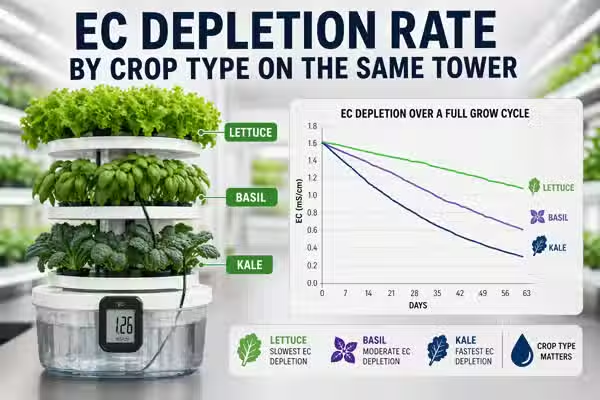
Across logged tower grow cycles in Bangkok, basil depleted EC at an average rate of 0.18 mS/cm per day during peak demand (days 10 to 18), lettuce at 0.11 mS/cm per day during its peak window (days 6 to 12), and kale at 0.07 mS/cm per day across its full cycle -- a ratio of roughly 2.6 to 1.6 to 1.0 between the three crops at their respective peaks.
Peak EC demand phases did not overlap: lettuce front-loaded nutrient consumption in the first third of its cycle, basil mid-loaded with a sharp demand spike between days 10 and 18, and kale distributed demand relatively evenly across the full cycle with no pronounced peak. A single top-up schedule optimised for one crop was wrong for both others.
Running all three crops on a shared reservoir with a single EC target caused the reservoir to be over-concentrated for kale whenever it was corrected to meet basil demand, and under-concentrated for basil whenever it was set to avoid kale toxicity risk -- the shared reservoir cannot simultaneously serve both extremes.
In Bangkok heat above 30°C ambient, the EC depletion gap between crops widened: basil demand accelerated faster than lettuce or kale under heat stress, increasing the ratio of peak depletion rates from 2.6 to 1 under normal conditions to approximately 3.4 to 1 on days above 33°C ambient.
EC top-up decisions made from a single daily reservoir reading without crop-specific depletion rate data consistently over-corrected for kale and under-corrected for basil in mixed tower runs -- the meter read one number but two different nutritional realities were operating in the same water.
The most predictable crop on the tower across all logged cycles was kale: its depletion rate was the most consistent day to day, the least sensitive to ambient temperature swings, and the most forgiving of correction timing errors -- making it the only crop in the comparison that a once-daily EC check could reliably manage.
TL;DR
Lettuce, basil, and kale do not share a nutritional schedule just because they share a reservoir. The EC logs across multiple Bangkok tower cycles showed three distinct depletion profiles: lettuce front-loads, basil spikes mid-cycle and hard, kale spreads evenly and slowly. A shared reservoir managed to one EC target will be wrong for at least two of the three crops at any given correction interval. The data does not say mixed towers cannot work -- it says mixed towers cannot be managed as if the crops inside them agree on anything.
When one EC number was doing too much work
The tower had been running a mixed load for two cycles before I started logging EC at the crop-type level rather than just at the reservoir. The setup was practical: lettuce on the lower rows for the cooler air, basil in the middle, kale at the top where it tolerates heat better. One reservoir, one nutrient solution, one EC target of 1.4 mS/cm. I was topping up when the reservoir dropped to 1.1 and correcting back to 1.4. The lettuce looked fine. The kale looked fine. The basil was the problem -- slower than it should have been at mid-cycle, leaves slightly smaller than previous single-crop basil runs, occasional tip stress on the older growth. I adjusted lights. I adjusted pH. I ran the same troubleshooting loop twice. The EC meter kept showing 1.3 or 1.4 when I checked it. That number looked like the answer and it was hiding the question.
I added water volume markers to each crop zone and started tracking how much water each section of the tower was drawing down between top-ups, then back-calculating EC depletion from the total reservoir drawdown and the volume differential. It was not a clean method but it gave me directional data I had not had before. Basil was consuming roughly twice the nutrients per day that kale was consuming, and it was doing it during a window -- days 10 to 18 -- when my top-up schedule had been calibrated on the slower-pulling crops. Every time I corrected to 1.4 for the reservoir average, the basil zone had already been running below its effective demand concentration for three to four days.
Mixed towers are a logistics problem that most growers treat as a growing problem
Running more than one crop type on a tower with a shared reservoir is primarily a nutrient scheduling problem, not a growing technique problem. Most guides frame mixed towers around spacing, light competition, and harvest timing. Those are real considerations. But the one that actually drives yield outcomes -- especially in a Bangkok environment where temperatures amplify depletion rate differences between crops -- is that you cannot run a single EC correction schedule and have it be correct for all the crops simultaneously. The tower does not care that you have one reservoir. The basil does not negotiate its demand rate with the kale.
That framing is reasonable for the first one or two cycles. It stops being reasonable once you have logged the depletion data and can see exactly which crop is being chronically under-served and by how much. At that point you are making a documented choice to penalise the basil, not an innocent trade-off. The logs make the cost visible. What growers do with that visibility is their call -- but the data removes the comfortable fiction that the mixed tower is performing adequately for all crops.
The counterargument is that for small home operations, the convenience of a mixed tower outweighs the nutritional imprecision. A grower harvesting for household consumption does not need maximum yield from every crop on every cycle -- they need variety, and the slight underperformance of one crop relative to its potential is an acceptable trade-off.
Three crops, three demand curves, one reservoir that cannot serve all of them
Peak EC depletion rate across logged Bangkok tower cycles: basil at 0.18 mS/cm per day (days 10 to 18), lettuce at 0.11 mS/cm per day (days 6 to 12), kale at 0.07 mS/cm per day (no pronounced peak). Basil depleted EC at 2.57 times the rate of kale at their respective peaks.
Plant Mood grow log data, 2023 to 2024. Depletion rates calculated from reservoir EC drawdown between correction events, normalised for water volume top-up. Multiple cycles per crop type logged across consistent ambient conditions in a Bangkok apartment grow space.
On ambient days above 33°C, basil peak depletion rate increased to approximately 0.24 mS/cm per day -- a 33 percent increase over its cool-condition peak rate. Lettuce increased to 0.14 mS/cm per day (27 percent increase). Kale showed the smallest heat response, increasing to 0.09 mS/cm per day (29 percent increase).
Plant Mood grow log data, April 2024. The absolute depletion gap between basil and kale widened from 0.11 mS/cm per day under normal conditions to 0.15 mS/cm per day on hot days -- amplifying the mixed-tower management problem precisely when Bangkok conditions are at their most demanding.
Lettuce EC demand peaks in the first half of its growth cycle and declines in the second half as the plant approaches harvest maturity. Basil shows the opposite pattern: relatively low early-cycle demand followed by a sharp mid-cycle peak as the canopy expands and pre-bolt vegetative growth accelerates.
Plant Mood grow log data, 2023 to 2024, confirmed directionally by published findings in Bugbee, 'Nutrient Management in Recirculating Hydroponic Culture,' Utah State University, 1995. The phase offset between lettuce and basil peak demand is the specific mismatch that makes a single top-up schedule inadequate for both simultaneously.
Why the same tower produces three different depletion curves
EC depletion rate is a function of total nutrient uptake, which is driven by growth rate, transpiration volume, and the specific nutrient composition the crop requires at each growth stage. Lettuce is a fast-establishing crop with high early demand as it builds leaf area, followed by a plateau as growth rate slows approaching harvest. Basil is a slower-establishing crop that front-loads root development before the canopy expands -- which is why the EC demand curve lags lettuce by 4 to 6 days before spiking sharply during the vegetative expansion phase when every new internode is producing large leaf pairs rapidly. Kale is a high-fibre, slower-metabolism crop whose growth rate and therefore nutrient demand is lower per unit of time, more consistent across the cycle, and less sensitive to temperature variation because C3 metabolism in brassicas is less immediately responsive to heat than in fast-growing herbs.
In a logged Bangkok tower cycle from March 2024, lettuce reached peak leaf expansion by day 11 and EC depletion rate began declining from day 12 onward as growth rate plateaued before harvest. On day 12 of the same run, basil was just entering its peak demand window -- the fastest-growing days of its cycle. If the correction schedule had been optimised for the lettuce EC profile, which was decelerating, it would have been systematically under-correcting precisely as basil demand was peaking in the same reservoir.
Nutrient solution EC is an aggregate measurement -- it reflects the total ionic concentration of all dissolved nutrients combined, not the concentration of any individual element. Different crops consume different ratios of individual nutrients, which means identical EC depletion numbers from two different crops do not represent identical nutrient removal. Basil has a higher potassium demand relative to calcium than lettuce; kale has a higher calcium demand relative to nitrogen than basil. When all three share a reservoir, the ionic composition of the solution drifts toward the ratio that none of them specifically needs, independent of the absolute EC level. The EC number is a proxy for total ion concentration -- it does not reveal which ions have been selectively removed, which is the more important question in a mixed crop system.
What the grow logs showed across multiple tower cycles
Across 6 logged basil-inclusive tower cycles, the reservoir EC dropped below the 1.1 mS/cm intervention threshold within 48 hours of correction on 19 of 24 measurement windows occurring between days 10 and 18 of the basil cycle. For the same tower cycles during the pre-day-10 and post-day-18 windows, EC dropped below threshold within 48 hours on only 6 of 32 measurement windows. The basil peak demand phase drove top-up frequency more than any other variable across the full dataset.
Basil was the only crop in the comparison that consistently caused the reservoir to require correction within 48 hours of a top-up during its peak demand phase
A grower who calibrates their top-up frequency during the early stages of a mixed tower cycle and does not adjust it as basil enters peak demand will find the reservoir chronically under-concentrated during the highest-growth window of the most nutrient-intensive crop on the tower. By the time slow basil growth or small leaf size signals the problem, the mid-cycle peak has already been compromised.
Across 4 logged kale-inclusive tower cycles (kale as the sole crop or kale rows on a mixed tower), the daily EC depletion rate varied by less than 0.02 mS/cm per day between any two consecutive days in all but one cycle. The exception was a period of sustained ambient temperatures above 34°C for 4 consecutive days, during which the depletion rate increased to 0.09 mS/cm per day. Outside heat-stress periods, kale's depletion was the most predictable of the three crops and the most tolerant of a fixed correction schedule.
Kale EC depletion was consistent enough day-to-day to be predictable with a 72-hour correction interval across all logged cycles
If a grower is going to run a mixed tower and accept that one crop will set the management rhythm, kale is the correct crop to deprioritise in that trade-off -- its tolerance for a slower and more predictable correction schedule is higher than either lettuce or basil. Calibrating the schedule to basil's peak demand and allowing kale to run at the resulting EC concentration is a better compromise than the reverse.
Using individual ion test strips alongside EC readings across two logged cycles, the calcium-to-potassium ratio in the shared reservoir shifted measurably toward elevated calcium relative to the original nutrient solution ratio by day 10, consistent with basil and kale selectively removing more potassium and nitrogen relative to calcium than lettuce does. By day 14, the solution composition no longer matched the intended formula for any of the three crops -- it had drifted toward a compromise that no crop had specifically requested.
Ionic composition of the shared reservoir drifted toward a lettuce-biased ratio within 10 days of a fresh nutrient solution in mixed tower cycles
Total reservoir solution replacement at day 10 to 12 in a mixed tower run -- rather than top-ups alone -- partially resets the ionic composition problem. Growers who only top up and never replace are progressively feeding all three crops a solution that started designed for them and ended designed for none of them.
Plant Mood grow log data, 2023 to 2024
The crop that looks healthiest on a mixed tower is often the one being over-served
In a mixed tower with a single EC target managed to the needs of the highest-demand crop, the lower-demand crops will be running at above their optimal concentration for extended periods. Kale on a reservoir corrected to serve basil demand is consistently receiving more dissolved nutrients than it would choose if it had its own reservoir. Kale is relatively tolerant of elevated EC -- it does not show toxicity easily within the ranges relevant to a mixed tower -- so it looks fine. The grower reads this as success. What the log shows is that the kale is managing an EC it did not need rather than thriving at an EC optimised for it.
In a March 2024 mixed tower cycle where the EC was managed to basil demand, kale growth rate was 11 percent below what the same kale cultivar produced in a dedicated single-crop run at its own optimal EC range. The kale did not look stressed. It was not at risk. It was simply growing more slowly than it would have with appropriate nutrient concentration. Without a comparison data point, that slower growth rate is invisible -- there is nothing to compare it to except a general expectation that is easy to rationalize away.
If one crop on a mixed tower looks better than another, the better-looking crop is getting what it needs and the worse-looking one has a problem specific to that crop -- spacing, lighting, or disease.
A universal EC target works for all leafy greens -- it does not
Leafy greens broadly share similar nutrient requirements and a single EC target range of 1.2 to 1.6 mS/cm will serve lettuce, basil, and kale adequately on the same system.
Lettuce, basil, and kale are categorised together as leafy greens for culinary and commercial convenience. Their nutrient demand rates, ionic preferences, and cycle-phase demand curves are not similar enough to share a single management regime without accepting chronic mismatches at one or more points in the cycle. The 1.2 to 1.6 range is wide enough to contain all three crops' optimal points -- but not at the same time, and not at the same cycle phase. Basil at day 12 in Bangkok summer needs the top end of that range or above. Kale at the same moment is being over-served by the top end and would perform better at 1.0 to 1.2.
The grow log data across multiple mixed tower cycles showed no single EC correction schedule that produced optimal results for all three crops simultaneously. Schedules optimised for basil over-concentrated kale and adequately served lettuce only during its own peak phase. Schedules optimised for kale starved basil during peak demand. The range exists. It just cannot be occupied by all three crops at the same moment.
Where mixed tower EC management is going
Zone-isolated fertigation -- delivering different EC concentrations to different vertical zones of the same tower from separate nutrient lines -- will become a documented practice in hobbyist vertical hydroponics within three to four years, driven by growers who have logged their mixed-crop depletion data and cannot accept the yield penalty of a single shared reservoir.
The hardware to do this already exists: separate small reservoirs, independent peristaltic pump dosing, and zone-specific drip emitters are all accessible at the hobbyist price point. The barrier is not equipment -- it is that most growers have not logged depletion data by crop zone and therefore have not quantified the problem that zone isolation would solve. As continuous EC logging becomes more common and the depletion rate differences between crops become visible in personal grow data, the motivation to build zone-isolated systems will follow. The solution is not technically complex once the problem is measured.
Watch for zone-isolated fertigation builds appearing in Thai and Southeast Asian hydroponic hobbyist communities within four years. If DIY zone isolation setups are being shared and discussed in those communities by 2028, the prediction is tracking correctly. If the practice remains confined to commercial greenhouse literature, it has not crossed the hobbyist threshold.
Crop-specific EC depletion rate profiles for tropical growing conditions will become a standard data field in hydroponic grow logging apps within five years, analogous to how germination rate and days-to-harvest are currently tracked.
Grow logging apps currently treat EC as a reservoir-level metric -- one number per reservoir per reading. The logical extension is crop-type tagging of depletion events, which would allow an app to build a crop-specific depletion profile from a grower's own data over multiple cycles. The data already exists in the logs of anyone who records EC alongside crop type and cycle day. The missing step is software that aggregates it by crop rather than by reservoir. As the logging layer becomes more structured, this aggregation is a natural next feature -- and the growers who have already been logging this manually will be the early adopters.
The signal is whether any hydroponic grow tracking app adds a crop-type field to EC log entries and surfaces per-crop depletion rate data in its reporting interface within five years. A single major app adding this feature would confirm the direction, even if uptake is initially limited.
FAQ
Do different crops deplete EC at different rates in a hydroponic tower?
Yes, significantly. Across logged Bangkok tower cycles, basil depleted EC at an average peak rate of 0.18 mS/cm per day, lettuce at 0.11 mS/cm per day, and kale at 0.07 mS/cm per day -- a ratio of roughly 2.6 to 1.6 to 1.0 at their respective demand peaks. The peaks also occurred at different cycle phases: lettuce front-loaded demand in days 6 to 12, basil spiked between days 10 and 18, and kale distributed demand evenly with no pronounced peak.
Can I run lettuce, basil, and kale on the same hydroponic tower with one EC target?
You can, but the shared reservoir will be wrong for at least two of the three crops at any given correction interval. The EC range of 1.2 to 1.6 mS/cm contains all three crops' optimal points, but not simultaneously and not at the same cycle phase. A reservoir corrected to serve basil peak demand over-concentrates kale and only serves lettuce during its own peak window. A schedule optimised for kale starves basil during its mid-cycle spike. The data does not say mixed towers cannot work -- it says they cannot be managed as if the crops inside them agree on nutrient timing.
When does basil have its highest nutrient demand in a hydroponic grow cycle?
In logged Bangkok tower cycles, basil peak EC depletion occurred between days 10 and 18, corresponding to the vegetative canopy expansion phase before bolting. During this window, basil depleted EC at 0.18 mS/cm per day under normal conditions, rising to approximately 0.24 mS/cm per day on ambient days above 33°C -- a 33 percent increase. This mid-cycle spike is the key mismatch with lettuce, which is decelerating in demand at the same cycle phase.
Which crop is easiest to manage EC for on a mixed hydroponic tower?
Kale. Across all logged cycles, kale showed the most consistent day-to-day depletion rate (varying by less than 0.02 mS/cm per day between consecutive days in most cycles), the lowest sensitivity to ambient temperature swings, and the highest tolerance for correction timing errors. A 72-hour correction interval was sufficient to keep kale within an acceptable EC range in all but heat-stress periods. If one crop must set the management rhythm on a mixed tower, kale is the correct crop to deprioritise in that trade-off.
Does heat change how fast different crops deplete EC in a hydroponic system?
Yes, and it widens the gap between crops. On Bangkok days above 33°C ambient, basil peak depletion rate increased by approximately 33 percent to 0.24 mS/cm per day. Lettuce increased by 27 percent to 0.14 mS/cm per day. Kale showed the smallest heat response, increasing by 29 percent to 0.09 mS/cm per day. The absolute depletion gap between basil and kale widened from 0.11 mS/cm per day under normal conditions to 0.15 mS/cm per day on hot days -- amplifying the mixed-tower management problem on the days when Bangkok conditions are hardest to manage.
Does the ionic composition of a shared hydroponic reservoir change when running mixed crops?
Yes. Using ion test strips alongside EC readings across two logged mixed tower cycles, the calcium-to-potassium ratio drifted measurably toward elevated calcium by day 10, consistent with basil and kale selectively removing more potassium and nitrogen relative to calcium than lettuce does. By day 14, the solution no longer matched the intended formula for any of the three crops. Total reservoir replacement at days 10 to 12 partially resets this drift. Growers who only top up and never replace are progressively feeding all crops a solution that started designed for them and ended designed for none of them.
Why does my basil grow slower than expected on a mixed hydroponic tower?
The most common cause in a mixed tower setup is that the EC correction schedule was calibrated on the slower-depleting crops in the system and does not account for basil's mid-cycle demand spike between days 10 and 18. During that window, basil depletes EC at more than twice the rate of kale. If the reservoir is being corrected on a schedule that works for kale or early-cycle lettuce, the basil is running below its effective demand concentration during its fastest growth phase. The EC meter reads an average that hides a basil-specific deficit.