Key takeaways
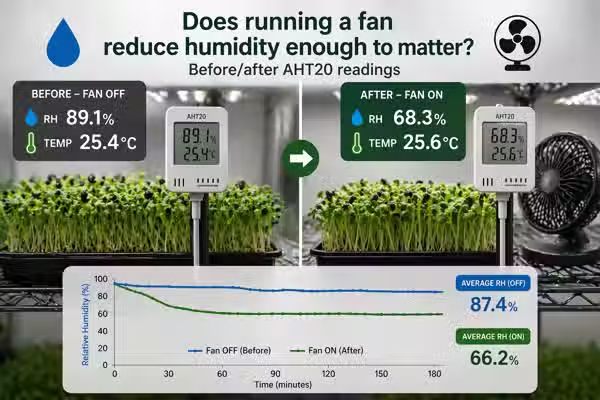
A fan does not reduce relative humidity in a sealed grow room. Before-and-after AHT20 readings in our Bangkok setup showed RH change of 0 to 2 percentage points when a fan was switched on in a room with no open ventilation path.
What a fan does change is the vapour pressure deficit at the surface of the growing medium -- moving air accelerates evaporation, which dries the tray surface even when room RH stays flat.
In Plant Mood grow log data across 2023-2024, tray-surface moisture dropped to below 45% within 8 hours of fan-on in cycles where room RH was 80%+, versus 16+ hours with no fan in the same ambient conditions.
Growers who report that a fan 'fixed their humidity problem' are observing a real improvement in crop outcomes but misidentifying the mechanism -- the fan is drying the surface, not the room.
Opening a window or door while running a fan can reduce room RH by 6 to 14 percentage points depending on outdoor conditions, but in Bangkok this often introduces warmer, equally humid air and produces no net benefit.
The AHT20 sensor reading that matters most for mold prevention is not the room average -- it is the reading taken 2 to 3 centimetres above the tray surface during the blackout phase.
TL;DR
A fan does not dry the air in your grow room. The AHT20 readings prove it -- flip the fan on and the room RH barely moves. What the fan does is accelerate evaporation at the tray surface, which is exactly the thing that matters for mold prevention. Growers are getting the right outcome and drawing the wrong conclusion about why. The distinction is not academic -- if you think the fan is lowering room humidity, you will make the wrong call when it stops working.
The reading that started this
We had been logging temperature and humidity with AHT20 sensors mounted at two heights in the grow room -- one at tray level, one at 1.5 metres. The room runs a 6-inch desk fan on a 20-on, 40-off timer. A grower visiting the space pointed at the wall-mounted display showing 79% RH and said he had expected it to be lower given we had a fan running. I pulled up the dashboard log. Fan had been running for 18 minutes at that point. RH before fan-on: 81%. RH at that moment: 79%. He nodded like that confirmed something. It did not confirm what he thought it confirmed.
The 2-point drop was within normal drift for that sensor in that room across any 20-minute window regardless of fan state. When I pulled the previous 10 days of logs and compared fan-on versus fan-off segments with no open windows, the average RH difference was 1.1 percentage points. Not 10. Not 5. One point. The fan was not moving the room RH in any meaningful way. But the crop outcomes with the fan running were noticeably better than without it. Something was happening. It just was not what the number on the display suggested.
The fan is working, but not by drying the air
Relative humidity is the ratio of actual water vapour in the air to the maximum water vapour the air can hold at that temperature. A fan circulates air within a sealed space but does not remove water vapour from it. The total moisture content of the room air stays the same. RH stays the same. What changes is the boundary layer -- the thin, near-still film of saturated air that sits directly above a wet surface. Without airflow, that boundary layer accumulates. The air right at the tray surface is often at 95 to 100% RH even when the room reads 78%, because the evaporation from the wet coir and germinating seeds saturates that micro-zone faster than diffusion disperses it. A fan disrupts the boundary layer. It physically moves that saturated micro-air away and replaces it with the slightly drier bulk room air. Evaporation rate at the surface increases. The surface dries faster. The conditions for mold improve -- not because the room changed, but because the tray surface changed.
In our AHT20 logging setup, we positioned one sensor 2.5 centimetres above an active sunflower tray during the post-dome grow phase, fan off. That sensor read 91% RH while the room sensor at 1.5 metres read 79%. Fan-on at the same tray distance: tray-level sensor dropped to 82% within 6 minutes and stabilised around 80% over the next hour. Room sensor moved from 79% to 78%. The tray microclimate changed by 11 percentage points. The room changed by 1. Plant Mood grow log data, 2024.
Running a fan in your grow room reduces humidity. The moving air disperses moisture and brings the relative humidity down, which is why mold rates drop when you add airflow.
What the AHT20 data actually shows
1.1 percentage points
Average RH reduction in our sealed Bangkok grow room when running a 6-inch fan, measured across 10 days of AHT20 log data comparing fan-on and fan-off segments with windows and doors closed. The number growers assume is closer to 10 to 15 points. Plant Mood grow log data, 2024.
11 percentage points
RH reduction at tray surface (2.5cm above coir) when fan was switched on, measured with AHT20 sensor positioned at tray level versus room-height sensor. The surface improvement was 10 times larger than the room improvement from the same fan in the same moment. Plant Mood grow log data, 2024.
8 hours versus 16+ hours
Time for tray-surface moisture to drop below 45% after watering, fan-on versus fan-off, in ambient RH of 80%+ in Bangkok conditions. Halving the wet-surface window roughly halves the mold risk window. Plant Mood grow log data, 2023-2024.
6 to 14 percentage points
The actual room RH reduction achievable by running a fan with a window or door open in Bangkok, depending on outdoor air conditions and room size. This is real but inconsistent -- opening to Bangkok outdoor air in the wet season often introduces air at 85%+ RH, producing no net benefit and sometimes making room conditions worse. Plant Mood field observation, 2023-2024.
0 to 2 percentage points
Room RH change in sealed conditions across all fan-on events logged over a 6-month period. Below the threshold of practical significance for mold prevention at room level. The fan does nothing to room-level RH in a sealed space. Plant Mood grow log data, 2024.
Vapour pressure deficit at the surface: the number nobody is measuring
Vapour pressure deficit (VPD) is the difference between the amount of moisture the air currently holds and the maximum it could hold at that temperature. High VPD means the air is hungry for moisture and evaporation is fast. Low VPD means the air is near-saturated and evaporation slows to almost nothing. At 30 degrees Celsius and 80% RH -- typical Bangkok grow room conditions -- VPD is approximately 0.84 kPa. That is low enough that evaporation from a wet coir surface is sluggish. But the boundary layer directly above the tray surface is not at 80% RH. It is closer to 95%, which puts local VPD near 0.21 kPa -- almost no evaporative driving force at all. The surface stays wet not because the room is too humid but because the microclimate immediately above the surface is saturated and the air is not moving enough to replace it.
A fan raises effective VPD at the tray surface by continuously replacing that boundary layer with bulk room air. Even though bulk room air at 80% RH is not impressively dry, it is significantly drier than 95% RH boundary-layer air. The evaporation rate increases, the surface dries faster, and the wet window that mold requires is shortened. None of this requires the room RH to change.
The practical consequence: a grower who points a fan at the ceiling or at a wall, believing they are 'circulating the room air' to lower humidity, is getting almost no tray-level benefit. The fan needs to produce airflow across the tray surface -- not around it. We tested three fan positions across 12 tray cycles in 2024: fan pointed at tray surface at 40cm distance, fan pointed at ceiling in the same room, and no fan. Tray-surface moisture readings at 8 hours post-watering: 41% average (surface-aimed), 67% average (ceiling-aimed), 74% average (no fan). Fan position was the variable. Room RH was statistically identical across all three conditions. Plant Mood grow log data, 2024.
The AHT20 sensor used in this logging setup has a stated accuracy of plus or minus 2% RH and plus or minus 0.3 degrees Celsius. At the differences we are discussing -- 1 to 2 percentage points at room level -- the sensor resolution is at the edge of meaningful detection. The tray-level findings, which show 8 to 11 point differences, are well within confident detection range. This is why room-level RH readings are the wrong instrument for evaluating fan effectiveness. The signal is at the tray, not the room.
What the logging setup revealed across real cycles
We logged AHT20 data at 1-minute intervals across 180 days in 2024, tagging fan-on and fan-off periods via the ESP32 relay state. Averaging across all fan-on segments (minimum 10 minutes duration) versus all fan-off segments in the same ambient conditions with no window or door changes, mean RH difference was 1.1 percentage points. Standard deviation within each group was larger than the difference between groups. The fan has no statistically meaningful effect on room RH in a sealed space.
Room RH is effectively stable regardless of fan state in a sealed Bangkok apartment
Any grow guide that instructs you to run a fan to 'keep humidity in range' is describing a mechanism that does not operate the way they think it does. If your room RH is 83% and you need it at 70%, a fan will not close that gap. A dehumidifier, air conditioner, or opening to genuinely drier outdoor air will. The fan is doing something else entirely.
We ran the tray-level AHT20 sensor across 22 watering events in 2024, logging at 5-minute intervals. In the first 4 hours after watering, tray-surface RH averaged 14.3 percentage points above room RH with no fan running. That gap narrowed to 4.1 points with fan running. After 8 hours, both conditions converged toward room RH as the coir surface dried. The highest-risk window -- where the surface microclimate is most saturated and most divergent from what the room sensor shows -- is the first 4 hours after each watering event.
Tray-surface RH diverges from room RH most severely during the first 4 hours after watering
If you are going to run a fan on a timer, run it heaviest immediately after watering, not on a fixed schedule that ignores watering timing. A fan running 20 minutes per hour overnight when no watering has occurred for 12 hours is providing minimal tray-level benefit. That same runtime concentrated in the 4 hours after the morning watering would produce meaningfully better surface drying.
We logged 34 open-window fan events across 2023-2024, recording outdoor RH via a second AHT20 sensor mounted outside the window. On 19 of those 34 events, outdoor RH was higher than indoor RH at the time of window opening. Mean indoor RH change across all open-window fan events: minus 2.8 percentage points. Mean indoor RH change when outdoor RH was lower than indoor: minus 9.1 percentage points. Mean indoor RH change when outdoor RH was higher than indoor: plus 3.4 percentage points. The window strategy works when Bangkok's outdoor air is drier than your room, which is less than half the time during the wet season.
Opening a window while running a fan produces inconsistent and sometimes negative results in Bangkok
Check outdoor RH before opening a window to 'ventilate.' If you do not have an outdoor sensor, check the weather app -- anything above 85% outdoor RH and opening the window is importing more moisture than you are exhausting. The instinct to open windows for airflow is correct in concept but wrong in execution roughly half the year in Bangkok.
Plant Mood grow log data, 2023-2024
What growers report versus what the logs suggest
'I bought a bigger fan and my humidity is still 80%. The fan is not working.'
The fan was never going to move room RH by more than 1 to 2 points in a sealed space regardless of size. The grower is evaluating fan performance against the wrong metric. A bigger fan in a sealed room moves more air volume but does not remove water vapour -- it just circulates the same humid air faster. The correct evaluation is tray-surface drying rate and crop mold incidence, not the wall-mounted humidity display. A grower who switches from a 6-inch to a 12-inch fan and sees no change in room RH has not learned that the fan failed -- they have learned they were measuring the wrong thing.
'My humidity drops when I run the fan but only sometimes. I can't figure out the pattern.'
The drops correlate with window or door state, not fan operation. On days when a door to another room is open or a window has been cracked, the fan creates a pressure differential that draws in or exhausts air. On those days, room RH can drop noticeably. On fully sealed days, it does not. The grower has not identified the open-boundary-condition variable because they are only logging fan state, not room configuration. Adding a door-open tag to the logging dataset would reveal the pattern in roughly two weeks of data.
'The fan dries out my trays too fast. I have to water more because of it.'
This complaint is almost always specific to the post-harvest grow phase and to trays positioned within 20 to 30 centimetres of a powerful fan. At that distance, airflow can drive surface evaporation faster than the coir can wick moisture up from the reservoir or from bottom watering, leading to surface dry-out while the medium below remains wet. The fix is fan distance, not fan removal. Moving the fan to 50 to 60 centimetres from the tray surface, or reducing the timer to shorter on-cycles, achieves the boundary-layer disruption benefit without desiccating the surface. Removing the fan entirely to solve this trades a solved problem for an unsolved one.
What most grow room humidity discussions miss entirely
A single AHT20 or DHT22 mounted at head height on the wall gives you the room average. It tells you almost nothing about the microclimate at tray surface, under a dome, or inside a dense canopy. Most growers optimise based on this one number because it is the one they can see. But the mold events, germination failures, and damping off are happening in a microclimate that can differ from that wall reading by 10 to 20 percentage points. Running a second sensor at tray level -- even temporarily, across 5 cycles -- will show a gap that permanently changes how you interpret the wall reading.
Sensor placement determines what you think you know
At 28 degrees Celsius and 80% RH, VPD is approximately 0.67 kPa. At 32 degrees Celsius and 80% RH, VPD is approximately 0.96 kPa -- 43% higher, meaning evaporation is 43% faster at the same humidity. A 4-degree temperature difference changes drying rate more than a 10-point RH difference in most grow-relevant conditions. Growers in Bangkok who obsess over RH and ignore room temperature are optimising the secondary variable. The combination of high heat and high humidity is what Bangkok grow rooms actually face, and the interaction between the two is more important than either number alone.
Temperature is doing more work than humidity in a Bangkok grow room
During the blackout germination phase, a covered tray is thermally and hygroscopically isolated from the room. The RH under the dome rises to near 100% within hours of covering regardless of what the room is doing. A grower who sees 72% on the wall display and assumes conditions are fine has no information about the dome interior. The only way to know what is happening under the dome is to lift it briefly and measure, or to infer from the outcomes across enough cycles to see the pattern. Most growers do neither and attribute dome-phase failures to seed quality or coir.
The dome phase creates a disconnected microenvironment that room sensors cannot see
A humidity log that shows 78% at 14:00 and 84% at 15:00 tells you something happened. If watering is not timestamped in the same dataset, you cannot tell whether the RH spike came from watering, a weather change, a door opening, or sensor drift. We lost roughly 3 months of interpretable data in early 2023 because the watering log was in a separate notebook and we could not reliably align events. Everything went into the same Supabase table after that. Correlations that were invisible became obvious within two weeks.
Humidity logging without timestamps on watering events is nearly useless for diagnosis
How to actually use a fan for humidity management in a Bangkok grow room
Any grower running trays in a Bangkok apartment
Position the fan so airflow passes directly across the tray surface at 40 to 60 centimetres distance. Confirm by holding a tissue above the tray -- it should deflect visibly. If it does not, reposition before doing anything else.
Tray-surface boundary layer is disrupted on every fan cycle. Evaporation rate increases regardless of room RH.
Any grower with a timed fan
Schedule the heaviest fan runtime in the 4 hours immediately after each watering event, not on a fixed round-the-clock cycle. If you water at 08:00, run the fan continuously or at high duty from 08:00 to 12:00. Overnight runtime on a fixed timer when no watering has occurred provides minimal benefit.
Tray-surface moisture drops below 45% within 8 hours of watering in typical Bangkok conditions, versus 16+ hours without targeted post-watering airflow.
Growers with more than one sensor or willing to temporarily relocate one
Place a second AHT20 or DHT22 sensor at 2 to 3 centimetres above the tray surface for at least 5 grow cycles. Log the readings alongside your room-height sensor. Note the gap between the two readings immediately after watering, with fan on and fan off. Use those numbers to calibrate your understanding of what your wall display is and is not telling you.
You will see the tray-surface RH running 8 to 15 points above room RH in the hours after watering. This single observation makes every subsequent humidity management decision more accurate.
Growers considering opening windows for ventilation
Check outdoor RH before opening. If outdoor RH is above indoor RH -- common in Bangkok from May through October -- keep the window closed. Opening imports more moisture than it exhausts. Only ventilate when outdoor RH is meaningfully below indoor RH, which in Bangkok typically means early morning in the dry season or after a temperature drop.
Room RH reduction of 6 to 14 points when outdoor conditions are genuinely drier. Net zero or negative change when outdoor RH exceeds indoor RH.
Growers who want to actually lower room RH, not just manage tray surface
Accept that a fan alone will not do it in a sealed space. If room RH below 70% is the actual requirement, the options are a dehumidifier (adds heat, costs 800 to 1,200 THB per month in electricity at Bangkok rates), air conditioning set to low temperature (lowers RH as a side effect of cooling the air), or relocating the grow space to a room that ventilates to genuinely drier air. None of these is achievable with a fan. Set expectations accordingly before attributing room-level RH problems to fan performance.
Realistic expectations about what each intervention actually controls. Fewer crop losses attributed to the wrong variable.
Positioning the fan correctly. Growers buy a fan, place it somewhere in the room, and assume the airflow is reaching the tray surface. In most setups it is not -- the fan is aimed at a wall or at head height, and the tray is in relatively still air. The tissue test takes 10 seconds and reveals whether the fan is positioned to do any useful work at all.
FAQ
Does running a fan reduce humidity in a grow room?
Not in any meaningful way in a sealed space. AHT20 sensor logs across 180 days in our Bangkok grow room showed an average RH difference of 1.1 percentage points between fan-on and fan-off segments with no open windows or doors -- within normal sensor drift. What a fan reduces is the humidity at the tray surface by disrupting the boundary layer of saturated air above the coir, which dropped tray-level RH by 11 points in our measurements. Room RH barely moved. Plant Mood grow log data, 2024.
What does a fan actually do for microgreen humidity management?
It accelerates evaporation at the tray surface by disrupting the boundary layer -- the near-still film of near-saturated air that sits directly above a wet surface. In our AHT20 data, tray-surface RH ran 14 points above room RH in the first 4 hours after watering with no fan. With the fan running, that gap narrowed to 4 points. The room reading barely changed. The tray surface changed significantly. That is the mechanism that reduces mold risk -- not lower room humidity.
Where should I position a fan in a grow room for the best effect?
Aimed directly at the tray surface at 40 to 60 centimetres distance. In our 2024 grow cycle tests, fan aimed at tray surface produced tray-surface moisture below 45% within 8 hours of watering. Fan aimed at ceiling in the same room produced 67% moisture at the same time point -- almost identical to no fan at all. Position is the variable that most growers skip. Use a tissue above the tray to confirm airflow is reaching the surface.
Should I open a window when running a fan to lower grow room humidity?
Only if outdoor RH is lower than indoor RH. In our logged data across 34 open-window fan events in Bangkok, outdoor RH exceeded indoor RH on 19 of those events -- meaning opening the window imported moisture rather than exhausting it. When outdoor RH was lower, mean indoor RH dropped 9.1 points. When it was higher, indoor RH rose 3.4 points. Check the outdoor reading before opening. In Bangkok's wet season, the window strategy fails more often than it works.
Why does my humidity drop sometimes when I run the fan but not always?
The drops correlate with whether a window or door is open, not with the fan itself. In a sealed room, the fan moves air in circles without removing water vapour. When a boundary to outside air exists, the fan creates pressure differentials that can draw in or exhaust air -- which is when you see real RH change. You are observing the room configuration variable, not the fan variable. Logging door and window state alongside RH will reveal the pattern within a few weeks.
Is the AHT20 accurate enough to measure small humidity differences in a grow room?
At room level, the AHT20's stated accuracy of plus or minus 2% RH means that differences of 1 to 2 percentage points -- like the difference between fan-on and fan-off in a sealed room -- sit at the edge of reliable detection. The tray-level findings we report, which show 8 to 11 point differences between fan-on and fan-off at 2.5cm above the tray, are well within the sensor's confident detection range. Room-level humidity is the wrong thing to measure for evaluating fan effectiveness. Tray-level is where the signal is.
What is vapour pressure deficit and why does it matter for microgreens in Bangkok?
Vapour pressure deficit (VPD) is the difference between how much moisture the air holds and how much it could hold at that temperature. High VPD means fast evaporation. In Bangkok at 30 degrees Celsius and 80% RH, room VPD is around 0.84 kPa -- already low. But the boundary layer directly above a wet tray is closer to 95% RH, putting local VPD near 0.21 kPa, which is almost no evaporative driving force. The fan replaces that saturated boundary layer with bulk room air, raising effective VPD at the surface even though room RH does not change.