TL;DR
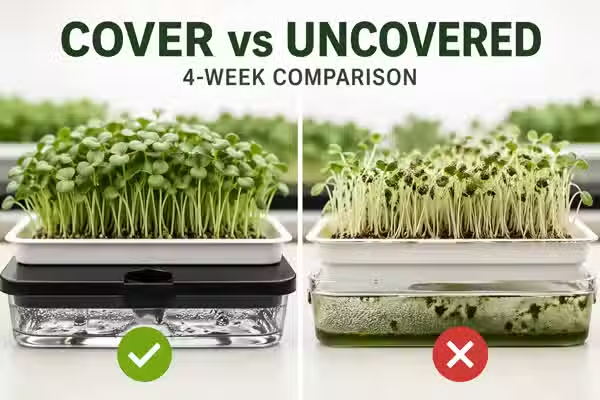
A covered reservoir wins on algae control and water retention. It helps with humidity but not enough to stop relying on ventilation. The tradeoff nobody mentions is that covering the reservoir makes it harder to catch problems early — root discolouration, pH drift, early biofilm — because you stop looking. Four weeks of comparison data did not change the conclusion that covering is better. It changed the reason why, and it surfaced a cost that no grow guide has ever mentioned.
What made me run the comparison in the first place
I had been covering reservoirs for two years before I questioned whether I actually knew what covering was doing. I knew it was supposed to reduce algae. I believed it reduced humidity. I assumed it slowed water loss. None of those things had ever been measured side by side in my own setup — I had taken them on faith from guides written by people who may or may not have measured them either. What pushed me to run the comparison was a conversation with a grower who covered nothing, had manageable algae, claimed her room humidity was no different from mine, and was topping up her reservoir on the same schedule. I had no data to argue with. So I built the trial instead.
Running both systems simultaneously for four weeks in the same room under the same ambient conditions was the only way to separate what covering actually does from what I had assumed it did. Some of the results confirmed what I expected. One of them — the water loss difference — was large enough that it changed how I think about the whole question.
Covering the reservoir does not solve your humidity problem
Covering the reservoir is commonly presented in hydroponic guides as a humidity management strategy. The logic is clean: less exposed water surface means less evaporation means lower room humidity. Some guides present it as a primary humidity intervention, placing it ahead of ventilation adjustments in the recommended sequence.
Covering the reservoir reduces the humidity contribution from that specific source. It does not remove it, and by week two of a tower cycle it is not the dominant moisture source anyway. In a Bangkok grow room where crop transpiration, ambient infiltration, and poor overnight ventilation are all operating simultaneously, a 5 to 8 percentage point reduction in ambient humidity from reservoir coverage does not bring the room into a controlled range on its own. Growers who cover the reservoir expecting it to resolve a humidity problem will see a partial improvement and spend the next month adjusting other variables wondering why the improvement did not hold.
Side-by-side ambient humidity logging in the four-week comparison trial showed the covered reservoir room averaged 6 percentage points lower than the uncovered reservoir room during weeks one and two. By week three, with canopy fully established in both towers, the differential had compressed to 2 to 3 percentage points — because transpiration was now the dominant humidity source in both rooms and the reservoir's relative contribution had decreased. Covering the reservoir moved the humidity number. Crop transpiration moved it back. (Plant Mood grow log data, 2024)
Four weeks of numbers from both systems
Water loss from the uncovered reservoir averaged 2.3 litres per day versus 0.9 litres per day from the covered reservoir across the four-week trial — a 61 percent reduction in evaporative water loss
This was the largest measured difference between the two systems and the one least discussed in standard reservoir management guides. In a Bangkok room running 30 to 33 degrees Celsius ambient temperature with 70 to 78 percent ambient relative humidity, the uncovered reservoir was losing nearly 1.5 litres per day to evaporation that the covered reservoir retained. Over four weeks that is approximately 42 litres of nutrient solution — water and dissolved minerals — lost to the air rather than available to the crop. (Plant Mood grow log data, 2024)
Visible algae coverage on uncovered reservoir interior surfaces reached 35 to 45 percent by day 14; covered reservoir interior surfaces showed less than 2 percent coverage at day 28
Algae growth in the uncovered reservoir was concentrated on the reservoir walls at and just below the waterline and on net pot stems. The covered reservoir showed trace algae only at the net pot collar edges where light penetration was imperfect. Both reservoirs were running the same nutrient solution, same pH range, and same water temperature. Light exclusion was the controlling variable. (Plant Mood grow log data, 2024)
EC in the uncovered reservoir drifted upward by an average of 0.3 mS/cm per day over weeks one and two as water evaporated and dissolved minerals concentrated
When water evaporates from a nutrient solution, the minerals stay behind. An uncovered reservoir losing 2.3 litres per day to evaporation is concentrating its nutrient solution continuously. Without daily EC monitoring and correction, the crop at the roots is experiencing a progressively stronger solution than the grower set at the start of the week. The covered reservoir showed an average EC drift of 0.1 mS/cm per day over the same period — slower drift, less correction required.
Ambient humidity differential between covered and uncovered reservoir rooms compressed from 6 percentage points at week one to 2 to 3 percentage points at week three
The humidity benefit of covering diminishes across the cycle as crop transpiration becomes the dominant moisture source. Covering the reservoir is most useful for humidity management in the first ten days before canopy establishes — after that, the canopy is doing more to ambient humidity than the reservoir. (Plant Mood grow log data, 2024)
What the four-week logs showed beyond the headline numbers
The 2.3 litres per day of evaporative water loss from the uncovered reservoir was not evenly distributed across the cycle. During Bangkok's afternoon heat peak — 13:00 to 16:00 — evaporation accelerated, losing an estimated 40 percent of the daily total in a three-hour window. This produced an EC spike in the afternoon that partially corrected overnight as the room cooled and evaporation slowed, but never fully returned to the morning baseline. By day 10, the uncovered reservoir required top-up and EC adjustment every morning to stay within range. The covered reservoir needed attention twice in the same period. The management time difference was real and added up across the crop cycle.
EC management in the uncovered reservoir required daily correction by week two; the covered reservoir required correction every three to four days
Water loss from an uncovered reservoir is not just a cost in litres — it is a cost in management time and nutrient accuracy. A grower who tops up imprecisely, adding plain water without recalculating mineral concentration, is inadvertently running a different EC than they intend across the full cycle. The covered reservoir made accurate EC management easier by removing the variable that was drifting fastest.
By day 14, the uncovered reservoir had visible green biofilm on three interior walls and on six of eight net pot stems. Root tips exposed to the reservoir showed some browning at the outermost layer consistent with light-induced oxidative stress and algae competition at the root surface — not root rot, but compromised root health that reduced the whiteness and density associated with healthy hydroponic root mass. pH stability in the uncovered reservoir was also lower: algae consume CO2 during photosynthesis, raising pH during daylight hours and allowing it to drop overnight as algae respire. The pH swing across a 24-hour period in the uncovered reservoir averaged 0.4 units versus 0.15 units in the covered reservoir.
Algae in the uncovered reservoir did not directly kill the crop but created a secondary management burden that compounded across weeks
Algae growth is not a cosmetic problem that only matters when it gets extreme. At moderate levels it is already affecting pH stability, root zone light exposure, and root surface condition. The uncovered reservoir did not produce a visible crop failure in four weeks, but it produced a root zone that was measurably worse than the covered reservoir by week two and would have been increasingly difficult to manage across a longer cycle.
In the uncovered reservoir, daily visual inspection of the water surface, root tips, and waterline condition was automatic — it happened whenever the reservoir was accessed for any reason. In the covered reservoir, root inspection required deliberate removal of the lid, which happened less frequently. In week three, early-stage root browning in the covered reservoir was caught four days later than a comparable event would have been noticed in the uncovered system. The delay was not catastrophic in that cycle, but it represented a real tradeoff: the covered reservoir improved the environment but reduced the spontaneous observation frequency that catches problems early.
The covered reservoir created a visibility problem that partially offset its management benefits
Covering the reservoir needs to be paired with a scheduled inspection protocol — not just a reminder to check when something looks wrong, but a committed routine of lid removal and root zone inspection at minimum twice per week. Without it, the covered reservoir trades one set of problems for another: less algae, less EC drift, but slower detection of root zone deterioration.
Plant Mood grow log data, 2024
The uncovered reservoir had more stable water temperature
In a Bangkok grow room running 30 to 33 degrees Celsius during the day and 26 to 28 degrees at night, the dominant thermal influence on reservoir water temperature is not the lid — it is the submersible pump. The pump runs continuously, generating heat that transfers directly into the water. An uncovered reservoir dissipates some of that pump heat through evaporative cooling at the water surface. A covered reservoir, with reduced evaporative surface, retains more of the pump heat. Measured water temperature in the covered reservoir averaged 0.8 degrees Celsius warmer than the uncovered reservoir during the daytime operating window. At the margin of 28 to 30 degrees Celsius — where dissolved oxygen levels begin declining meaningfully — that 0.8 degrees is not trivial.
Evaporative cooling is a real thermal management mechanism. Removing it by covering the reservoir, without accounting for the pump heat it was dissipating, makes the water temperature problem slightly worse rather than better in a hot Bangkok room.
Dissolved oxygen readings taken at midday showed the covered reservoir averaging 6.1 mg/L versus 6.8 mg/L in the uncovered reservoir during week two of the trial. Both values are within the functional range for hydroponic crops, but the covered reservoir was consistently lower, and the trend across weeks three and four was downward as pump runtime accumulated. The thermal management benefit of an uncovered reservoir surface is real and is absent from every reservoir cover recommendation I have read. (Plant Mood grow log data, 2024)
Covering the reservoir should produce a more stable internal environment — less exposure to ambient fluctuations, less light, less thermal variation. Growers who cover reservoirs for algae control often assume they are also getting more consistent water temperature as an additional benefit, because the lid acts as an insulating layer between the water and the warm room air.
What covering the reservoir actually controls and what it does not
A reservoir lid or cover intervenes at three points simultaneously: it reduces the light reaching the water surface, it reduces the water surface area in contact with open air, and it reduces the rate of gas exchange between the water and the room.
Light exclusion is the mechanism behind algae control. Algae require light to photosynthesize. A lid that reduces light penetration to the water surface to near zero stops algae growth at the source, regardless of nutrient concentration, water temperature, or any other variable. This is why coverage percentage matters — a lid that is 60 percent covered still allows enough light through the uncovered 40 percent to sustain algae growth near those openings. Effective algae control requires coverage above 90 percent of the water surface, with close-fitting seals around net pot openings.
Reduced water surface exposure is the mechanism behind both the humidity reduction and the water loss reduction. Less open water surface means a lower evaporation rate, which reduces both the moisture entering the room air and the volume of nutrient solution lost to that process. These two effects — lower room humidity contribution and slower water loss — are driven by the same physical change. They cannot be separated. A lid that reduces one reduces both.
The gas exchange reduction is the mechanism behind the dissolved oxygen dynamic. An uncovered reservoir exchanges gases freely with the room air — CO2 from the room enters the water, oxygen from the water leaves, and the evaporating surface provides some passive aeration. A covered reservoir reduces this exchange. Without an airstone or active aeration system, a covered reservoir will show lower dissolved oxygen over time than an uncovered one, because the passive exchange mechanism has been partially blocked. In Bangkok's warm water temperatures, where dissolved oxygen is already at the lower end of the functional range, removing passive aeration without replacing it actively is a problem.
In week three of the comparison, the covered reservoir showed a 24-hour pH swing of 0.15 units versus 0.4 units in the uncovered system. The algae in the uncovered reservoir were driving the wider swing through daytime photosynthesis and overnight respiration. The covered reservoir's pH stability was a direct result of light exclusion suppressing algae activity — not of any direct chemical action from the lid itself. pH stability and algae control are the same intervention expressed in two different measurements.
Water loss measurements were taken by weighing both reservoirs at 07:00 and 19:00 daily using a 5kg capacity scale with 1-gram resolution. Net pot stems and roots were dried before weighing to prevent root moisture from contributing to the measurement. Nutrient solution added during top-up was weighed separately and subtracted from the daily total. The 2.3 versus 0.9 litre-per-day figures are averages across the full four-week trial excluding top-up days.
What growers say about covered reservoirs and what is actually happening
'I covered my reservoir and my nutrient solution keeps going off faster than before — it smells different and the roots look worse than when I ran it open.'
Covering the reservoir without adding active aeration reduces dissolved oxygen in the water. In a warm Bangkok reservoir running at 28 to 30 degrees Celsius, dissolved oxygen is already limited. Removing the passive gas exchange at the water surface without replacing it with an airstone or diffuser creates anaerobic pockets near the roots where beneficial aerobic bacteria are outcompeted by anaerobic ones. The smell is hydrogen sulfide from anaerobic decomposition. The root deterioration is the same process at the rhizosphere. The cover is not the problem — the aeration gap it created is.
'I covered the reservoir and still get algae — just in different places.'
Coverage percentage is below the threshold needed for effective light exclusion. Algae establish wherever light penetrates — net pot collar gaps, lid seam gaps, the inner surface of translucent lid material. A lid that blocks 70 percent of the surface still gives algae 30 percent of the surface to work with, which is sufficient for a significant colony to establish and spread. The cover reduced algae but did not eliminate it because the light exclusion was incomplete. Effective control requires above 90 percent surface coverage with opaque material and close-fitting seals.
'My water temperature has gone up since I started covering the reservoir and I don't know why.'
Evaporative cooling from the open water surface was dissipating pump heat before the lid was added. Covering the reservoir removed that passive cooling mechanism. The pump continues generating heat into the water at the same rate, but the water no longer has a cooling pathway through surface evaporation. In a Bangkok room where ambient temperature is already pushing reservoir water toward the upper functional range, this shift is felt within a week of covering. The fix is either a more efficient pump that generates less heat, a reservoir chiller, or a covering approach that maintains some evaporative surface at a location where it does not generate light penetration — which is mechanically difficult.
'I missed a root rot event for nearly a week because the lid was on and I didn't look.'
This is not a complaint about covering failing — it is a complaint about the inspection routine failing to adapt to the covered setup. An uncovered reservoir encourages frequent visual inspection as a byproduct of normal access. A covered reservoir requires deliberate lid removal to inspect root zone and waterline condition. Without a scheduled inspection routine that accounts for this change, the covered reservoir reduces incidental observation frequency and slows problem detection. The grower is right that something went wrong, but the cause is habit, not the lid.
Covered versus uncovered: what the four weeks actually showed for each variable
Algae control
Uncovered reservoir reached 35 to 45 percent interior surface algae coverage by day 14. Covered reservoir showed less than 2 percent at day 28. The difference is not marginal — it is the most decisive result from the four-week trial. Light exclusion is the only variable that changed between systems and algae response was proportional to coverage percentage.
If algae management is the primary reason for considering a lid, covering works and works well above 90 percent coverage. Below that threshold, algae establish in the remaining light-exposed zones and the benefit is partial. The coverage percentage matters more than the lid material.
Water loss and nutrient concentration drift
Uncovered reservoir lost 2.3 litres per day versus 0.9 litres per day from the covered reservoir — a 61 percent reduction. EC drift in the uncovered system required daily correction by week two. Covered reservoir required correction every three to four days. This was the largest practical difference between the two systems in terms of daily management time and input cost.
The water loss difference is the most economically significant finding of the trial. In a commercial or semi-commercial operation where nutrient solution is mixed with precision, losing 42 litres more per month from evaporation represents real mineral input cost and real EC management burden. For a hobbyist running one tower, the number is smaller but the daily correction demand is still a time cost that compounds across cycles.
Ambient room humidity
Covered reservoir room averaged 6 percentage points lower ambient humidity during weeks one and two. Differential compressed to 2 to 3 percentage points by week three as canopy transpiration overtook reservoir evaporation as the dominant moisture source. The humidity benefit of covering is real in week one and largely irrelevant by week three.
Do not choose to cover or not cover primarily based on expected humidity reduction. The benefit is time-limited within a crop cycle and insufficient on its own to bring an uncontrolled Bangkok grow room into a target humidity range. Ventilation is the primary humidity tool. The reservoir cover is a supporting measure, not a solution.
Water temperature and dissolved oxygen
Covered reservoir averaged 0.8 degrees Celsius warmer during daytime than uncovered reservoir, due to loss of evaporative cooling from the water surface. Dissolved oxygen in the covered system averaged 6.1 mg/L versus 6.8 mg/L in the uncovered system at midday during week two. Neither value represents a crop failure threshold, but the covered system was trending in the wrong direction across weeks three and four.
Covering the reservoir without adding an airstone or diffuser accepts a dissolved oxygen tradeoff. In a Bangkok setup where water temperature already limits dissolved oxygen, this tradeoff is worth accounting for explicitly before covering. Adding active aeration alongside the lid resolves the dissolved oxygen decline and removes the downside without affecting algae control or water retention benefits.
Root zone visibility and problem detection speed
Uncovered reservoir provided automatic visual inspection of root tips and waterline with every access. Covered reservoir required deliberate lid removal for inspection, which happened less frequently in practice. Early-stage root discolouration was detected four days later in the covered system during week three than a comparable event would have been caught in the uncovered system.
Covering the reservoir changes the inspection habit required to maintain root zone awareness. This cost does not appear in any comparison of covered versus uncovered reservoir management. It is real, it matters in a warm Bangkok environment where root zone problems develop quickly, and it is entirely manageable with a scheduled inspection routine. It is not manageable by growers who rely on opportunistic observation.
How to cover a reservoir without creating the problems covering causes
Any grower transitioning from uncovered to covered reservoir
Add an airstone or diffuser to the reservoir before or at the same time as fitting the lid. Position it to run continuously. The evaporative gas exchange that the lid removes needs to be replaced with active aeration — not because aeration was unnecessary before, but because the passive mechanism that was providing it is now blocked. Size the airstone to the reservoir volume: a single medium airstone is sufficient for up to 20 litres; a two-airstone setup for 20 to 50 litres.
Dissolved oxygen levels in the covered reservoir that match or exceed the uncovered baseline, compensating for the loss of passive surface gas exchange. This also addresses the temperature-related dissolved oxygen risk in warm Bangkok water by maintaining active oxygen replenishment regardless of water temperature.
Grower building or modifying a reservoir lid
Target 90 percent or greater opaque surface coverage. Measure the total reservoir opening area and calculate how much is currently covered by the lid and net pot collars. Fit close-tolerance collars that reduce the annular gap around each net pot to 2mm or less. Use black or dark-coloured opaque material for the lid — translucent lids allow enough diffuse light through to sustain algae growth. Cover any remaining gaps with foam weather seal or black silicone.
Less than 5 percent interior algae coverage at day 28, based on Plant Mood trial results at this coverage threshold. Algae may establish at collar edges if collar fit is imperfect — inspect these specifically during weekly root checks and clean if needed. (Plant Mood grow log data, 2024)
Grower who has covered the reservoir and noticed water temperature increase
Measure reservoir water temperature at 14:00 on a typical Bangkok afternoon with a submersible thermometer or temperature probe. If reading is above 28 degrees Celsius, the evaporative cooling loss from covering is contributing to a dissolved oxygen risk. Options in order of cost: replace the submersible pump with a lower-wattage model that generates less heat; wrap the reservoir exterior with closed-cell foam insulation to reduce ambient heat gain; add a small aquarium chiller. Do not remove the lid to recover the evaporative cooling — the algae and water loss tradeoffs are worse than the temperature management challenge.
Reservoir water temperature at or below 27 degrees Celsius at peak afternoon heat, which maintains dissolved oxygen above 7 mg/L in aerated water and keeps root zone conditions within a functional range for the full cycle.
Any grower running a covered reservoir
Set a fixed inspection schedule: lid off, root zone and waterline visually inspected, twice per week minimum. Do it on the same days at the same time — not when something looks wrong, not when the reservoir needs topping up, but on a fixed schedule. In Bangkok's temperatures, root zone deterioration moves from early signs to established problem in three to five days. A twice-weekly inspection schedule keeps the detection window short enough to intervene before crop loss.
Early detection of root discolouration, biofilm at the waterline, or pump performance changes within two to three days of onset — comparable to the spontaneous detection frequency of an uncovered reservoir setup. The covered reservoir does not reduce problem frequency. It reduces the incidental observation that catches problems early, and a scheduled routine restores that function.
Grower in week two or later who covered the reservoir expecting a humidity reduction and is not seeing one
Stop adjusting the reservoir. By week two, canopy transpiration is the dominant ambient humidity source — the reservoir's contribution has been partially offset by the lid and is now minor relative to what four rows of established crop are transpiring. Shift the intervention to canopy airflow: position a fan to create horizontal cross-flow through mid-canopy at the height of the most established row. Log ambient humidity at 23:00 before and after the fan repositioning to confirm the intervention is addressing the actual source.
Ambient humidity reduction of 4 to 9 percentage points at mid-canopy height during the post-sunset window, where humidity peaks are highest and mold pressure is most concentrated. This is the intervention that matters in week two. The reservoir lid is doing its job — it is just no longer the relevant variable.
Adding active aeration when fitting the lid. Every guide that recommends covering the reservoir for algae control or humidity management fails to mention that the lid removes passive gas exchange from the water surface. Growers who cover without aerating are trading algae and water loss problems for a dissolved oxygen problem in warm Bangkok water — and they typically do not connect the declining root health to the lid they fitted two weeks earlier.
FAQ
Does covering a hydroponic reservoir reduce algae growth?
Yes, decisively above 90 percent surface coverage. In a four-week side-by-side comparison at Plant Mood, an uncovered reservoir reached 35 to 45 percent interior surface algae coverage by day 14. A covered reservoir with greater than 90 percent opaque coverage showed less than 2 percent algae at day 28. Light exclusion is the controlling mechanism — algae establish wherever light penetrates, so coverage percentage and seal quality at net pot openings determine effectiveness. A lid that covers 60 to 70 percent of the surface still allows enough light for meaningful algae growth in the uncovered zones. (Plant Mood grow log data, 2024)
How much water does an uncovered hydroponic reservoir lose to evaporation?
In a Bangkok room running 30 to 33 degrees Celsius ambient temperature, an uncovered reservoir lost an average of 2.3 litres per day to evaporation across a four-week comparison trial. A covered reservoir lost 0.9 litres per day — a 61 percent reduction. Over four weeks, the uncovered reservoir lost approximately 42 more litres than the covered system. That water loss also concentrates the nutrient solution, causing EC to drift upward by an average of 0.3 mS/cm per day without correction. The covered reservoir drifted at 0.1 mS/cm per day. (Plant Mood grow log data, 2024)
Does covering the reservoir lower room humidity in a hydroponic grow room?
It helps but is not sufficient on its own. A four-week comparison trial showed the covered reservoir room averaged 6 percentage points lower ambient humidity than the uncovered room during weeks one and two. By week three, with canopy fully established in both towers, the differential compressed to 2 to 3 percentage points as crop transpiration became the dominant humidity source in both rooms. The humidity benefit of covering is real and most useful in the first ten days before canopy establishes. After that, ventilation and canopy airflow management are the relevant interventions, not the reservoir lid. (Plant Mood grow log data, 2024)
Why did my water temperature increase after covering the reservoir?
Covering the reservoir removes evaporative cooling from the water surface. Before the lid was fitted, water evaporating from the surface was dissipating heat from the submersible pump into the room air. The covered reservoir retains that pump heat in the water instead. In a four-week comparison trial, the covered reservoir averaged 0.8 degrees Celsius warmer than the uncovered reservoir during daytime. In Bangkok where reservoir water already runs at 28 to 30 degrees Celsius, that shift matters for dissolved oxygen levels. Adding an airstone alongside the lid partially compensates for this by maintaining active oxygen replenishment despite the temperature increase. (Plant Mood grow log data, 2024)
Do I need an airstone if I cover my hydroponic reservoir?
Yes. Covering the reservoir reduces passive gas exchange at the water surface — the mechanism that was providing some dissolved oxygen replenishment and CO2 release without active aeration. A covered reservoir without an airstone showed dissolved oxygen averaging 6.1 mg/L versus 6.8 mg/L in an uncovered reservoir at midday during week two of a comparison trial, and the trend was downward across weeks three and four. In Bangkok's warm water temperatures where dissolved oxygen is already limited, removing passive surface exchange without replacing it actively accelerates root zone decline. A continuously running airstone sized to reservoir volume resolves the gap. (Plant Mood grow log data, 2024)
How often should I inspect roots in a covered hydroponic reservoir?
Twice per week minimum, on a fixed schedule. An uncovered reservoir provides automatic visual inspection with every access — the lid removes that incidental observation. In a four-week comparison trial, early-stage root discolouration in the covered reservoir was caught four days later than a comparable event would have been detected in the uncovered system, because lid removal happened less frequently than natural observation of an open reservoir. In Bangkok's temperatures, root zone deterioration moves from early signs to established problem in three to five days. A scheduled twice-weekly inspection with lid removal keeps the detection window short enough to intervene before crop loss.
What coverage percentage does a reservoir lid need to stop algae?
Above 90 percent opaque surface coverage with close-fitting seals around net pot openings. Below that threshold, algae establish in the remaining light-exposed zones — net pot collar gaps, lid seam gaps, or through translucent lid material. A lid covering 60 to 70 percent of the surface reduces algae but does not eliminate it. The seal quality at net pot openings matters as much as total coverage area: a collar gap of 15mm around each net pot can expose enough water surface for a significant algae colony even on an otherwise well-covered reservoir. Target a 2mm or smaller annular gap at each net pot position. (Plant Mood grow log data, 2024)