Key takeaways
Full production cost for home-grown hydroponic lettuce in a Bangkok apartment tower, including electricity, nutrients, seeds, substrate, and equipment depreciation over 3 years, runs approximately 180 to 220 THB per kilogram in cool season and 280 to 340 THB per kilogram in hot season, based on Plant Mood cost tracking data from 2024 to 2025.
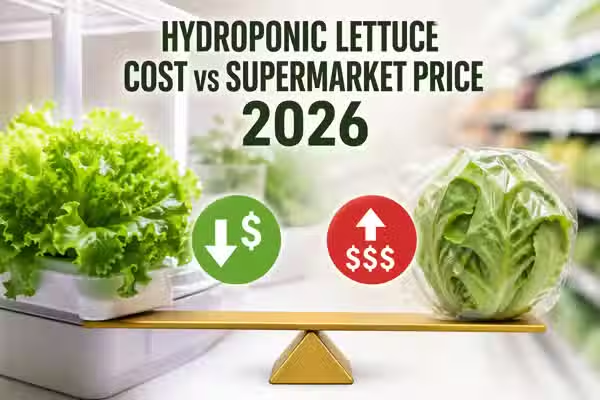
Imported hydroponic lettuce at Bangkok premium supermarkets including Villa Market and Tops retails at approximately 120 to 180 THB per kilogram in 2026, meaning home production costs more per kilogram than buying it at every season and at most realistic equipment depreciation assumptions.
The cost variable that most home growers omit from their calculations is equipment depreciation: a tower, pump, grow light, and pH and EC meters spread across their useful life adds approximately 35 to 55 THB per kilogram to production cost, enough to shift the economics from marginally competitive to clearly uncompetitive versus supermarket pricing.
Hot season cost per kilogram is 45 to 60 percent higher than cool season cost per kilogram not because inputs are more expensive in hot season but because yield drops 35 to 37 percent while fixed costs per cycle remain essentially constant, concentrating the same electricity and nutrient spend across fewer grams of harvest.
The economic case for home hydroponic lettuce in Bangkok is not cost saving. It is supply reliability, variety access, and the absence of cold chain quality loss. Growers who build their justification around cost savings will be disappointed by the numbers. Growers who build it around those other factors have a defensible position.
TL;DR
Growing hydroponic lettuce at home in Bangkok costs more per kilogram than buying it at a supermarket once you account for all the inputs correctly. The number that closes the gap is depreciation, which most home growers leave out of their cost model entirely. The number that widens the gap is hot season yield reduction, which most growers do not track precisely enough to see. None of this means home growing is irrational. It means the justification is not financial.
When the spreadsheet stopped being flattering
For the first year of running the tower, I did not have a complete cost model. I had a rough one. Electricity bill increase after adding the tower: approximately 250 THB per month. Nutrients: I was buying a two-part formula in bulk and estimated maybe 80 THB per cycle. Seeds were cheap enough that I had stopped tracking them precisely. Equipment was already bought and felt like a sunk cost. On that accounting, home-grown hydroponic lettuce was clearly cheaper than the 160 THB per kilogram I was paying at the supermarket. I was producing food for what felt like 60 to 80 THB per kilogram. I felt good about this. I told people about it.
Then I built the full model. Not the model I wanted to build, where I included only the variable costs that recurred monthly and excluded everything I had already spent. The real model, where I amortised the tower, pump, grow light, and meters across a realistic useful life, tracked nutrient consumption by measuring before and after each cycle, weighed every harvest, and recorded every input by cycle. The cost per kilogram in that model was 196 THB in my best cool season cycle. The supermarket price that week was 148 THB per kilogram for the imported hydroponic variety I was benchmarking against. The gap was not enormous. But it was real, and it ran in the wrong direction.
The idea that home hydroponics saves money on groceries
Growing lettuce at home with a hydroponic tower is cheaper than buying it at a Bangkok supermarket because you are cutting out the supply chain, packaging, and retail markup.
The supply chain markup on hydroponic lettuce at Bangkok supermarkets is smaller than most home growers assume, and the production cost of a single-tower home operation is higher than most home growers calculate. Commercial hydroponic producers in Thailand operate at scale that produces significantly lower per-kilogram input costs than a 28-port apartment tower. Their electricity cost per kilogram is lower because their yield density is higher. Their nutrient cost per kilogram is lower because they buy in bulk quantities that are not accessible to a home operator. Their equipment depreciation per kilogram is lower because fixed costs are spread across volumes that make the per-unit contribution trivial. The home grower is not competing with the supermarket price. The home grower is competing against it at a structural cost disadvantage that scale makes permanent.
In Plant Mood full cost tracking data from 2024 to 2025, the cheapest cool season cycle produced lettuce at 181 THB per kilogram including all inputs and depreciation. The most expensive cycle, a peak hot season run, produced at 334 THB per kilogram. The benchmark supermarket price for comparable imported hydroponic lettuce ranged from 120 to 180 THB per kilogram across the same period at Villa Market and Tops in Bangkok. Home production was above supermarket price in every single cycle. The closest the gap came to closing was a well-managed cool season cycle where supermarket price was at the upper end of its range and home cost was at the lower end of its range. Even then, the supermarket was cheaper.
The cost calculation errors that make home growing look cheaper than it is
I calculated my electricity cost from the tower spec sheet and it comes out to about 60 to 70 THB per month, which makes my lettuce very cheap to produce.
Spec sheet electricity estimates overstate pump wattage by 28 to 36 percent and understate grow light wattage by 5 to 15 percent based on Plant Mood measured energy monitor data. More importantly, electricity cost per month is not the same as electricity cost per kilogram. A 250 THB monthly electricity bill spread across a cool season yield of 1,870g is 134 THB per kilogram from electricity alone, not 60 to 70 THB. The monthly figure feels manageable. The per-kilogram figure reveals what that cost actually buys in harvest weight. The two numbers tell different stories about whether the tower is economical.
I do not count my equipment cost because I already bought it and it is a sunk cost now.
Sunk cost accounting is appropriate for personal financial decisions about whether to continue using something you already own. It is not appropriate for evaluating whether a production activity is economical. If the tower, pump, grow light, and meters cost 8,500 THB to set up and have a realistic useful life of 3 years across approximately 42 cycles, that is 202 THB of depreciation per cycle. Spread across a cool season yield of 1,870g, that is 108 THB per kilogram of depreciation cost alone. Excluding it from the cost model does not make the cost disappear. It makes the cost model wrong.
My nutrients cost almost nothing because I bought a large container and it lasts for months.
Large container purchase price divided by months of use is not the correct cost calculation. The correct calculation is nutrient solution volume consumed per cycle multiplied by cost per litre of prepared solution. A 28-port tower running a 20-litre reservoir topped up to compensate for evaporation and plant uptake consumes approximately 8 to 12 litres of prepared nutrient solution per week in cool season and 14 to 18 litres per week in hot season. At typical two-part formula concentrate prices in Bangkok, prepared solution costs approximately 4 to 7 THB per litre depending on target EC and formula brand. Nutrient cost per cycle runs 200 to 400 THB for a 25 to 30 day cycle, not the negligible figure that buying a large container once produces as a mental impression.
I compared my homegrown lettuce to the cheapest lettuce at the supermarket and it is clearly more expensive, but the quality is better so it is worth comparing to the premium imported stuff.
This comparison is valid but requires consistency. If you are comparing your home production cost to premium imported hydroponic lettuce, you need to use the premium imported price as the benchmark, which in Bangkok 2026 is 120 to 180 THB per kilogram at Villa Market and Tops. Home production at 180 to 340 THB per kilogram is still more expensive than that benchmark in every season. The quality argument is legitimate, but it is a quality argument, not a cost argument. Framing it as cost-competitive by selecting a low-quality benchmark and a high-quality home product is a comparison that does not reflect the actual economics.
The full cost model across 6 cycles
Plant Mood tower setup cost for a single operational unit: tower structure 2,200 THB, submersible pump 650 THB, grow light panel 2,800 THB, pH meter 850 THB, EC meter 750 THB, miscellaneous plumbing and net pots 450 THB. Total setup: 7,700 THB. Assumed useful life: 3 years, approximately 42 cycles. Depreciation per cycle: 183 THB. Across a cool season yield of 1,870g, depreciation contributes 98 THB per kilogram. Across a hot season yield of 1,240g, it contributes 148 THB per kilogram. These figures do not include probe replacement, which adds approximately 15 to 25 THB per cycle when amortised across probe lifespan.
Equipment depreciation adds 95 to 120 THB per kilogram to production cost and is the most consistently omitted input in home grower cost estimates
Equipment depreciation is the single cost input that most strongly separates a realistic cost model from a flattering one. Including it shifts the comparison from marginal versus supermarket prices to clearly above supermarket prices in all seasons. Any home grower who reports production cost without depreciation is reporting an incomplete number.
Nutrient consumption was tracked by weighing two-part concentrate used per cycle and recording reservoir top-up volume. Cool season cycles averaged 220 to 260 THB in nutrient cost per 25 to 26 day cycle. Hot season cycles averaged 310 to 380 THB per 29 to 30 day cycle due to higher evaporation rate requiring more top-ups and longer cycle length consuming more solution across the extended duration. At cool season yield of 1,870g, nutrient cost contributed 118 to 139 THB per kilogram. At hot season yield of 1,240g, it contributed 250 to 306 THB per kilogram.
Nutrient cost per cycle ran 220 to 380 THB across the 6 logged cycles, varying with season and cycle length
Hot season nutrient cost per kilogram is roughly double cool season nutrient cost per kilogram, not because hot season uses dramatically more nutrients per day but because yield drops while nutrient consumption per cycle stays similar or increases. This is a core reason why hot season economics are structurally worse than cool season economics and why a full-year average cost per kilogram is misleading as a planning figure.
Using Plant Mood measured energy monitor data from a previous cycle analysis: total tower draw at 94W average, monthly consumption approximately 67 kWh, monthly electricity cost approximately 250 THB at applicable MEA rate tier. Per 26-day cool season cycle: approximately 217 THB. Per 30-day hot season cycle: approximately 250 THB. At cool season yield of 1,870g: electricity cost 116 THB per kilogram. At hot season yield of 1,240g: electricity cost 202 THB per kilogram. Hot season electricity cost per kilogram is 74 percent higher than cool season despite total electricity consumption increasing by only 15 percent across the longer cycle.
Electricity cost per kilogram ran 108 to 196 THB across the 6 cycles when calculated at actual measured wattage and MEA progressive rates
Electricity cost per kilogram, like nutrient cost per kilogram, is driven more by yield variation than by consumption variation. Hot season does not cost dramatically more to run. It produces dramatically less per unit of input. The fixed energy draw runs at the same rate regardless of whether the harvest will be 1,870g or 1,240g.
Seed cost at standard Bangkok supplier prices: approximately 8 to 12 THB per cycle for loose-leaf lettuce. Substrate cost, rockwool cubes or coco coir plugs: approximately 10 to 16 THB per cycle. Total seed and substrate: 18 to 28 THB per cycle. In hot season cycles with 71 to 84 percent germination rates, 4 to 8 ports required replanting, consuming an additional seeding round. Effective seed and substrate cost in a hot season cycle with replanting ran 30 to 45 THB. Small in absolute terms. But germination failure also means 4 to 8 ports are unproductive for 10 to 14 days, reducing effective tower utilisation during the highest-cost portion of the cycle.
Seed and substrate cost was the smallest input category at 18 to 28 THB per cycle but hot season germination failure created a hidden cost multiplier
Seed and substrate are not the cost category to optimise. They are the smallest input by a significant margin. The cost reduction available by switching seed sources or substrate type is 5 to 10 THB per cycle at most. The cost reduction available by improving hot season germination rates is larger, measured in recovered port productivity rather than direct input cost.
Plant Mood cost tracking and grow log data, 2024 to 2025
Why single-tower economics cannot match commercial scale
The cost disadvantage of a home hydroponic operation relative to commercial production and supermarket pricing is structural, not operational. It persists even when the home grower manages every variable competently, because the underlying economics of fixed costs and scale do not respond to better management. A commercial hydroponic lettuce producer in Thailand running a greenhouse with hundreds of channels spreads equipment depreciation, labour, and facility cost across a yield volume that makes the per-kilogram contribution of each fixed cost trivial. A home grower spreads the same categories of fixed cost across a yield that is three to four orders of magnitude smaller. The cost per kilogram of depreciation on a 7,700 THB setup across 42 cycles cannot compete with the depreciation per kilogram on a 2,000,000 THB greenhouse across thousands of cycles. The ratio of fixed cost to yield is the mechanism. Better growing does not change it.
Consider the grow light as a single component. A 2,800 THB LED panel amortised across 3 years of home operation contributes approximately 67 THB per cycle and approximately 36 THB per kilogram of cool season lettuce yield. A commercial producer running the same style of LED lighting at higher plant density, with better light distribution, and across a much larger yield volume might see a light cost contribution of 3 to 8 THB per kilogram. The home grower's light cost per kilogram is four to twelve times higher not because the light is worse but because the yield it illuminates is a fraction of what a commercial installation produces from equivalent fixture cost. This ratio applies across every fixed cost category in the operation.
The one area where home growing does achieve genuine cost parity or advantage over commercial supply chains is cold chain loss. Commercial hydroponic lettuce sold in Bangkok supermarkets has typically been harvested 2 to 5 days before purchase, transported under refrigeration, and stored in a retail cold chain that nonetheless produces measurable quality degradation and some waste. A home grower harvesting on demand has zero cold chain loss and can harvest to exact quantity needed. The value of this is not captured in a cost per kilogram comparison but it is real and measurable in terms of usable food produced per seed planted.
Adding a second tower does not halve your cost per kilogram
The fixed costs that benefit from scale in a home operation are limited to setup costs that are genuinely shared across multiple towers: the pH and EC meters, any monitoring hardware, any shared infrastructure. These represent a portion of total fixed cost but not the majority. Each tower still requires its own pump, grow light, and structural hardware. Each tower still consumes its own electricity and nutrients proportional to its yield. Doubling from one tower to two towers reduces the per-kilogram contribution of shared equipment from approximately 15 to 25 THB to approximately 8 to 12 THB. It does not reduce electricity cost per kilogram, nutrient cost per kilogram, or the per-tower depreciation contribution of the non-shared hardware. Total cost per kilogram for a two-tower operation drops modestly, not by half.
In Plant Mood cost modelling for a hypothetical two-tower expansion based on actual single-tower tracked costs, the estimated cool season cost per kilogram for a two-tower operation ran approximately 162 to 185 THB versus 181 to 220 THB for a single tower. A meaningful reduction but not a transformation. At two towers, home production approaches the lower end of Bangkok supermarket pricing for premium hydroponic lettuce in good cool season cycles. It does not beat it. And the hot season two-tower cost per kilogram of approximately 240 to 280 THB still sits above the supermarket price range for comparable product.
Scaling up from one tower to two towers cuts production cost per kilogram roughly in half because you are spreading fixed costs across twice the yield.
Home tower cost versus Bangkok retail options side by side
Home hydroponic tower, cool season, full cost model
Total production cost per kilogram including electricity, nutrients, seeds, substrate, and equipment depreciation: 181 to 220 THB. Yield basis: 1,800 to 1,920g per 25 to 26 day cycle. Cycle freshness: harvested on demand, zero cold chain loss. Variety control: full. Labour not included in cost figure. Time to first harvest from setup: 25 to 26 days.
Cool season home production comes closest to supermarket price parity but does not reach it on a full cost basis. The gap is approximately 20 to 60 THB per kilogram above the premium supermarket price range. The non-financial advantages, freshness, variety control, zero cold chain loss, are real in cool season and may justify the cost premium for households that value them. The financial case does not stand alone.
Home hydroponic tower, hot season, full cost model
Total production cost per kilogram including all inputs: 280 to 340 THB. Yield basis: 1,100 to 1,300g per 29 to 30 day cycle. Cycle freshness: same on-demand harvest advantage as cool season. Tip burn and quality issues require more trimming, reducing effective usable yield below gross harvest weight. Labour not included.
Hot season home production costs 55 to 90 percent more per kilogram than supermarket alternatives for comparable quality product. The freshness and variety advantages persist but the cost premium is difficult to justify on any financial basis. Hot season is the period when the case for home hydroponic lettuce is weakest economically and where a grower who has not tracked season-specific costs is most likely to be unaware of how unfavourable the numbers are.
Imported hydroponic lettuce, Villa Market and Tops, Bangkok 2026
Retail price range: 120 to 180 THB per kilogram depending on variety, packaging format, and store location. Product sourced from commercial hydroponic operations in Thailand and imported from regional producers. Cold chain transit of 2 to 5 days from harvest to retail shelf. Quality at point of purchase variable depending on cold chain management. No variety customisation available beyond what is stocked.
Supermarket premium hydroponic lettuce is cheaper per kilogram than home production in every season and at every realistic home production cost assumption. The quality differential is real: home-harvested lettuce on the same day is genuinely better than 4-day-old supermarket product. But the cost comparison runs consistently against home production, which means the purchase decision for a financially-motivated grower should be the supermarket.
Local Thai lettuce, wet market and Makro, Bangkok 2026
Retail price range: 40 to 80 THB per kilogram for locally-grown soil-based lettuce at wet markets and Makro wholesale. Significantly cheaper than both home hydroponic production and supermarket imported hydroponic product. Grown in field conditions with pesticide use that varies by producer. No traceability for most wet market product.
If the comparison benchmark is wet market local lettuce rather than premium imported hydroponic, home production costs three to six times more per kilogram. This is the comparison that most definitively closes the financial case for home hydroponic growing as a cost-saving activity. The growers for whom home hydroponic production makes financial sense against this benchmark are those producing varieties not available at wet markets, or those with documented health reasons to prefer pesticide-free produce and a willingness to pay the premium.
The costs that do not appear until the second year
pH probes have a functional lifespan of approximately 12 to 18 months with regular use and proper storage in a Bangkok environment where temperature and humidity accelerate electrode degradation. A replacement pH probe costs 400 to 800 THB depending on quality. EC probes last longer but also require periodic replacement or recalibration. Spread across their lifespan, probe replacement adds approximately 15 to 30 THB per cycle to production cost. This cost does not appear in the first year of operation because the original probes are still functional, which makes first-year cost models systematically lower than second and third year reality.
pH and EC probe replacement
Submersible pumps running continuously in a Bangkok environment with hard water and variable power supply have a realistic operational life of 18 to 30 months before flow rate degradation or failure requires replacement. A mid-range replacement pump costs 500 to 900 THB. The first pump failure typically arrives in year 2 and is experienced as an unexpected capital cost rather than a predictable operating expense, because it was not in the original cost model. Amortised correctly across pump lifespan, pump replacement contributes approximately 12 to 22 THB per cycle to production cost.
Pump replacement and maintenance
Daily tower management, including pH and EC checks, top-ups, visual inspection, and harvest and replanting activities, takes approximately 15 to 25 minutes per day in a well-organised setup, or 7 to 12 hours across a 26 to 30 day cycle. None of the cost figures in this analysis include time. At the Thai minimum wage of approximately 350 THB per day in 2026, which represents the floor valuation for an adult's time, a 10-hour cycle time contribution adds approximately 437 THB per cycle and 234 THB per kilogram in cool season. Including time at minimum wage produces a true cost of approximately 415 to 454 THB per kilogram in cool season and 550 to 620 THB per kilogram in hot season. These numbers are cited not to suggest anyone values their hobby time at minimum wage, but to make visible the scale of the cost that the financial model conventionally leaves out.
Time cost at any non-zero valuation
Hydroponic nutrient solution prepared with Bangkok tap water requires either RO filtration or purchased RO water to avoid chlorine interference and the TDS variability of tap water across seasons. RO water purchased at local fill stations costs approximately 1 to 2 THB per litre. A 28-port tower consuming 8 to 18 litres of solution per week uses 35 to 80 litres per cycle from top-ups and solution changes. Water cost adds 35 to 160 THB per cycle depending on whether tap water, fill station RO, or a home RO system is used. Growers using tap water directly are introducing a variable that affects nutrient formula accuracy rather than eliminating a cost.
Water cost and RO system if applicable
FAQ
How much does it cost to grow hydroponic lettuce at home in Bangkok per kilogram?
Based on Plant Mood full cost tracking data from 2024 to 2025, home hydroponic lettuce production in a Bangkok apartment tower costs approximately 181 to 220 THB per kilogram in cool season and 280 to 340 THB per kilogram in hot season, including electricity, nutrients, seeds, substrate, and equipment depreciation. Time cost is excluded from these figures. The hot season cost is 45 to 60 percent higher than cool season not because inputs cost more but because yield drops 35 to 37 percent while fixed costs per cycle remain essentially constant.
Is growing hydroponic lettuce at home cheaper than buying it at a Bangkok supermarket in 2026?
No, based on Plant Mood cost tracking data. Imported hydroponic lettuce at Bangkok premium supermarkets including Villa Market and Tops retails at approximately 120 to 180 THB per kilogram in 2026. Home production on a full cost basis runs 181 to 220 THB per kilogram in cool season and 280 to 340 THB per kilogram in hot season. Home production costs more per kilogram in every season. The closest the gap comes to closing is a well-managed cool season cycle when supermarket prices are at the upper end of their range.
What is the biggest hidden cost in home hydroponic lettuce production?
Equipment depreciation. A standard Bangkok apartment tower setup including tower structure, pump, grow light, pH meter, and EC meter costs approximately 7,700 THB. Amortised across 3 years of operation and approximately 42 cycles, depreciation adds approximately 183 THB per cycle and 95 to 148 THB per kilogram depending on season. Most home growers exclude this from their cost model because the equipment is already purchased. Including it shifts the economics from marginally competitive to clearly above supermarket pricing in all seasons.
Why does hydroponic lettuce cost more per kilogram in Bangkok hot season?
Hot season cost per kilogram is higher because yield drops while fixed costs stay constant. In Plant Mood cost data, hot season cycles produced 1,100 to 1,300g of lettuce versus 1,800 to 1,920g in cool season, a 35 to 37 percent reduction. Electricity consumption per cycle increased by only about 15 percent due to the longer cycle length. The same nutrient and electricity spend is divided across significantly fewer grams of harvest, raising cost per kilogram from approximately 181 to 220 THB in cool season to 280 to 340 THB in hot season.
Does growing two hydroponic towers instead of one significantly reduce cost per kilogram?
Modestly, not significantly. In Plant Mood cost modelling, a two-tower operation reduces cool season cost per kilogram from approximately 181 to 220 THB to approximately 162 to 185 THB by spreading shared fixed costs like pH and EC meters across double the yield. Each tower still requires its own pump, grow light, and structural hardware, so non-shared depreciation and per-tower operating costs do not reduce with the second tower. At two towers, cool season cost per kilogram approaches but does not beat the lower end of Bangkok supermarket pricing for premium hydroponic lettuce.
How much do nutrients cost per hydroponic lettuce cycle in Bangkok?
Based on Plant Mood tracked cost data, two-part nutrient concentrate for a 28-port tower cycle costs approximately 220 to 260 THB in cool season and 310 to 380 THB in hot season. The higher hot season figure reflects longer cycle length and higher evaporation rate requiring more solution top-ups. At cool season yield of approximately 1,870g, nutrient cost contributes 118 to 139 THB per kilogram. At hot season yield of approximately 1,240g, it contributes 250 to 306 THB per kilogram.
If home hydroponic lettuce costs more than supermarket lettuce, why grow it at home?
The defensible reasons are supply reliability, variety access, and harvest freshness, not cost saving. Home-harvested lettuce on the day of use is meaningfully better quality than supermarket product that has been in cold chain for 2 to 5 days. Home growing allows variety selection not available in Bangkok retail. And for households with documented reasons to prefer pesticide-free produce, home production provides traceability that supermarket product does not. None of these are financial arguments. Growers who justify home hydroponics on cost saving grounds will find the full cost model does not support that justification.