Key takeaways
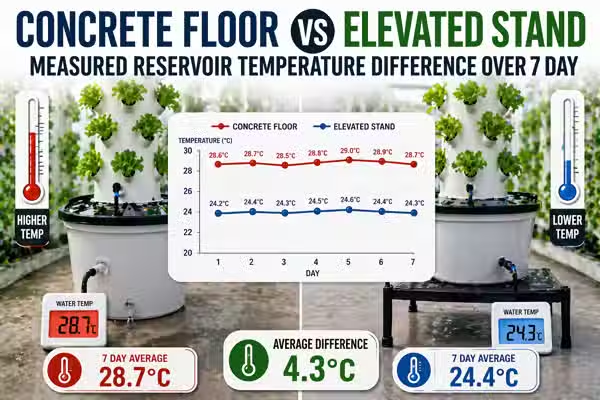
Over a 7-day logging period in a Bangkok room without air conditioning, a reservoir sitting directly on concrete averaged 1.8°C warmer than an identical reservoir on a 30cm timber stand -- because Bangkok concrete floors absorb and re-radiate daytime heat into the evening, they are not the cool surface most growers assume.
The temperature gap between floor and stand placement was smallest in the morning (0.4°C at 7am) and largest between 8pm and 11pm (up to 2.6°C), when the concrete was still releasing stored heat and the elevated reservoir had already begun equilibrating with cooler ambient air.
A 1.8°C average reservoir temperature increase reduces dissolved oxygen by approximately 0.5 mg/L at the relevant range -- enough to push a borderline reservoir below the 6 mg/L threshold where active nutrient uptake begins to slow.
Elevating a reservoir does not meaningfully reduce heat gain during peak daytime hours (11am to 3pm) when ambient room temperature is the dominant heat source. The benefit is concentrated in the evening and overnight window when concrete re-radiation is the primary driver.
Growers who place reservoirs on concrete because they believe concrete is cooler than ambient air are operating on a thermal assumption that inverts after approximately 6pm in a Bangkok apartment. The floor becomes a heat source, not a heat sink.
The practical fix -- a 30cm timber or PVC stand with air gap underneath -- costs under 200 THB in materials and produces a measurable overnight temperature reduction without any active cooling.
TL;DR
Bangkok concrete floors store heat during the day and release it at night. A reservoir sitting on concrete is not being cooled by the floor -- it is being warmed by it, specifically during the hours when ambient air has cooled enough that the thermal gradient finally matters. Seven days of paired sensor data put the average gap at 1.8°C between floor and stand placement. That is not trivial. At 30°C to 32°C reservoir temperatures, 1.8°C is the difference between a system that is marginal on dissolved oxygen and one that has already crossed the line.
The assumption that seemed too obvious to test
When I first set up the grow space, I put the reservoirs on the floor. Concrete floors feel cool underfoot in the morning. The logic wrote itself: cooler surface, cooler reservoir. It is the kind of assumption you make once and never revisit because it seems self-evidently correct. I ran three crop cycles on the floor before I started logging reservoir temperature as a separate channel from ambient room temperature. Once I had both channels running continuously, I noticed the overnight behaviour did not match what I expected. Ambient air temperature was falling after sunset. Reservoir temperature was not following it down at the same rate. It was staying elevated -- sometimes for hours after the room had cooled -- and the floor was the only candidate explanation.
I moved one reservoir onto a timber stand I had built for a different purpose and left the other on the floor. Same room, same ambient sensor, same nutrient solution, same pump heat load. I logged both for seven days without changing anything else. The gap that appeared in the evening data was larger than I expected. It was also precisely timed -- it widened between 6pm and 11pm and narrowed through the early morning hours. Concrete does not behave like a static temperature baseline. It has a charge-and-discharge cycle, and in a Bangkok apartment, that cycle runs warm.
What this pattern implies for how Bangkok growers will fail next
As affordable aquarium chillers become more common in Bangkok hobby hydroponic setups, a new failure pattern will emerge: growers who install a chiller but leave the reservoir on concrete will find the chiller working significantly harder than its rated capacity implies, with shorter compressor life and higher electricity draw than expected.
A chiller rated for a 100L reservoir at 26°C ambient is rated against an assumed ambient -- not against a floor that is radiating 30°C to 32°C directly into the reservoir base. Concrete contact heat gain works against the chiller continuously during the evening hours when the floor is warmest. Growers will blame the chiller unit or assume it is undersized when the actual variable is reservoir placement.
Chiller compressor run-time logs comparing identical setups with floor vs elevated placement. A chiller working against floor heat gain will show longer continuous run cycles and higher daily power draw.
Within two to three years, reservoir placement -- specifically floor contact vs air-gap elevation -- will become a documented variable in tropical hydroponic troubleshooting guides, in the same way pH and EC are currently treated. Right now it appears in almost none of them.
The problem is invisible without simultaneous paired temperature logging, which most hobbyist growers do not do. As low-cost sensor hardware and data logging become more accessible, the pattern will be rediscovered independently by enough growers that it enters the shared knowledge base. The mechanism is not obscure -- it is just under-measured.
The signal to watch is whether reservoir placement appears as a variable in troubleshooting flowcharts or setup guides published by high-volume tropical hydroponic communities within three years of this article. It currently does not appear in any guide I have found.
Seven days of data, two reservoirs, one variable
Over 7 continuous days of paired logging, the floor-placed reservoir averaged 1.8°C higher than the stand-placed reservoir across all hours. The evening peak differential reached 2.6°C between 9pm and 10pm on the warmest days.
Plant Mood sensor log data, May 2024. Both reservoirs were identical 60L totes with identical pumps, aeration, and nutrient solutions. The only variable was placement: one directly on concrete, one on a 30cm timber stand with open air underneath. Ambient room temperature was logged from a single sensor positioned at mid-height between both units.
At 7am, the temperature gap between floor and stand reservoirs averaged 0.4°C across the 7-day period. By 9pm, the same gap averaged 2.3°C.
Plant Mood sensor log data, May 2024. The morning convergence reflects overnight equilibration. The evening divergence reflects concrete re-radiation after a full day of heat absorption. The gap is not constant -- it has a daily cycle that tracks the thermal behaviour of the floor, not the air.
Dissolved oxygen solubility drops by approximately 0.27 mg/L per 1°C increase in water temperature in the range of 26°C to 34°C.
Source: standard dissolved oxygen solubility tables, Engineering Toolbox. Applied to the observed 1.8°C average gap: floor placement costs approximately 0.5 mg/L of dissolved oxygen capacity relative to elevated placement, in the same room, with no other variables changed.
Concrete thermal diffusivity is approximately 0.75 x 10^-6 m²/s, which means a Bangkok apartment floor absorbs heat from daytime ambient air throughout the afternoon and continues releasing it for 4 to 6 hours after ambient temperature begins dropping.
Source: Incropera et al., 'Fundamentals of Heat and Mass Transfer,' 7th edition. This is the physical basis for the evening re-radiation effect observed in the sensor data. The floor is a thermal capacitor, not a thermal constant.
Why concrete warms your reservoir at the time it least should
Concrete has high thermal mass. It absorbs heat slowly and releases it slowly. In a Bangkok apartment, the floor spends the daylight hours -- roughly 10am to 6pm -- absorbing heat from warm ambient air, from sunlight transmitted through walls and windows, and from any equipment running in the room. By late afternoon, the concrete surface temperature can be 2°C to 4°C above the ambient air temperature, depending on room construction and ventilation. After sunset, ambient air cools faster than the concrete can discharge its stored heat. For a period of 4 to 6 hours, the floor is warmer than the air above it. A reservoir in contact with that surface is receiving conducted heat from below during precisely the window when you might expect the room to be helping cool it down.
In the May 2024 logging period, ambient room temperature peaked around 34°C at 2pm and had dropped to approximately 30°C by 9pm. At 9pm, the floor-placed reservoir was at 31.4°C -- warmer than the ambient air above it. The stand-placed reservoir was at 28.8°C, equilibrating with the air. The floor was still net-positive on heat output at that hour. The reservoir was sitting on a radiator.
The contact area between a flat-bottomed reservoir tote and a concrete floor is nearly the entire base footprint -- typically 0.2 to 0.4 square metres for a 60L to 100L container. Conductive heat transfer scales with contact area and temperature differential. Even a 1°C floor-to-reservoir differential across a 0.3 square metre base produces a meaningful continuous heat input to the water. Elevating the reservoir replaces conductive transfer from the floor with convective transfer from ambient air -- a much less efficient heat transfer pathway when the air-to-reservoir differential is small.
What the 7-day log actually showed, hour by hour
Plotting hourly averages across the 7-day period, the floor reservoir was cooler than the stand reservoir only between approximately 6am and 12pm -- the window when overnight concrete cooling had discharged and ambient air was beginning to warm for the day. From roughly 12pm onwards, both reservoirs tracked ambient air temperature closely. After 6pm, the floor reservoir decoupled upward while the stand reservoir continued tracking ambient air. The inversion persisted until early morning.
The floor-reservoir temperature advantage reverses after sunset and stays reversed until approximately 2am to 3am
The assumption that concrete is a cooling surface is only true for a narrow morning window. For the majority of the daily cycle -- including the entire evening period when most hobbyist growers are in the space and observing their plants -- the floor is a net heat source for the reservoir.
Both reservoirs ran identical 8W submersible pumps continuously. Pump heat input to the water was therefore equal between the two setups. However, the floor-placed reservoir showed a faster rate of temperature rise during the afternoon hours, suggesting that floor heat gain and pump heat load were compounding rather than the pump being the dominant variable.
Pump heat load was additive to floor heat gain, not independent of it
Growers who attribute high reservoir temperature primarily to pump heat load are probably correct that the pump contributes -- but they may be underestimating floor contact as a concurrent input. Switching to a lower-wattage pump without addressing floor placement will produce a partial improvement at best.
Night-time ambient temperature dropped to approximately 27°C on those two nights, which is relatively cool for Bangkok in May. The stand reservoir tracked close to ambient and benefited from the cool air. The floor reservoir showed continued heat input from the concrete and did not reach the same low point.
On the two coolest nights of the 7-day period, the stand reservoir reached 26.8°C by 5am while the floor reservoir was still at 28.4°C
The benefit of elevated placement is largest on the nights when ambient cooling is actually available. Bangkok's coolest overnight temperatures -- which occur in December through February -- would likely show a larger absolute gap between placements than the May data. Growers running through the cooler months are leaving the most effective passive cooling available on the table if the reservoir is on the floor.
Plant Mood sensor log data, May 2024
Elevating the reservoir does not help during the hours you think it does
The sensor data does not support this. Between 11am and 5pm, both the floor and stand reservoirs tracked ambient room temperature closely. During peak daytime heat, ambient air is the dominant heat source for both -- the floor has not yet accumulated enough heat above air temperature to make a meaningful difference, and the stand reservoir has no meaningful advantage. The benefit of elevation is almost entirely an evening and overnight phenomenon, when the concrete floor has charged and begins discharging stored heat faster than the ambient air is releasing it.
On 5 of 7 days in the logging period, the temperature gap between floor and stand reservoirs at 2pm -- peak heat -- was under 0.5°C. On those same days, the gap at 10pm was between 2.1°C and 2.6°C. If you are trying to solve afternoon heat, elevation is not the tool. If you are trying to solve the overnight baseline that your crop is sitting in for 10 to 12 hours per day, elevation is exactly the tool.
Getting the reservoir off the floor reduces heat gain throughout the day, so the reservoir stays cooler all day and especially during peak afternoon heat.
What most growers are not logging when they should be
Most growers with a temperature probe log reservoir temperature as a single value -- one reading per day, usually at check time, usually in the evening. The 7-day continuous log showed that a single daily reading captures a point on a curve that varies by up to 4°C across 24 hours. A grower who checks at 8pm and sees 31°C has no information about whether the reservoir was at 29°C at 6am or 33°C at 3pm. Both those values drive different decisions, and the single reading cannot distinguish between them. Continuous logging, or at minimum morning and evening paired readings, is the only way to characterise reservoir thermal behaviour rather than just sampling it.
Single-point reservoir temperature logging
No Bangkok hydroponic guide I have read lists floor surface temperature as a variable to monitor. It is not an expensive measurement -- a cheap infrared thermometer reads it in two seconds. But without it, the relationship between floor placement and reservoir temperature is invisible. A grower who measures floor temperature at 9pm on a warm May evening and finds it at 33°C has a concrete explanation -- literally -- for why the reservoir will not cool below 31°C despite ambient air being at 30°C. Without that measurement, they are guessing.
Floor surface temperature as a separate variable
Growers optimise around peak daytime temperature because that is when the heat is most visible and most uncomfortable. But plant roots in a DWC or NFT system are in contact with the reservoir continuously, including overnight. If the reservoir temperature stays at 30°C to 31°C through the night because floor re-radiation is sustaining it, the roots have had no recovery period. A 34°C day followed by a 28°C reservoir overnight is a very different situation than a 34°C day followed by a 31°C reservoir overnight. The overnight floor heat gain is the variable that decides which one you have.
Overnight temperature as the biologically relevant window
A 60L reservoir has significant thermal mass. It does not respond instantly to changes in ambient temperature or floor temperature -- it lags by hours. This means the floor heat gain during the evening is not immediately visible in the reservoir reading. A grower who checks at 6pm, finds the reservoir at 29°C, and assumes it is stable is probably watching a reservoir that has not yet finished absorbing the evening floor discharge. By 10pm, the same reservoir may be at 31°C. The lag is not a small effect -- in the May data, peak reservoir temperature consistently occurred 2 to 3 hours after the ambient room temperature peaked.
Thermal mass of the reservoir itself as a buffer variable
What to actually build and measure this week
Any Bangkok grower with a reservoir on a concrete floor
Measure your floor surface temperature at 9pm with an infrared thermometer. Compare it to your reservoir temperature at the same moment and to the ambient air temperature at mid-height. If the floor reads higher than the air, you have active heat input from below. This single measurement tells you whether the problem exists before you build anything.
In a Bangkok apartment without air conditioning during April through October, the floor will almost certainly read warmer than ambient air at 9pm. The measurement confirms the mechanism and gives you a baseline to compare against after you elevate.
Growers who confirm floor heat gain above 1°C relative to ambient at 9pm
Build or source a simple stand that raises the reservoir base at least 20cm to 30cm off the floor with open air underneath. Timber offcuts, PVC pipe legs, or a wire shelving unit all work. The critical requirement is that air can circulate freely beneath the reservoir base -- a solid shelf that conducts heat upward from the floor defeats the purpose. Materials cost under 200 THB from any hardware shop.
Based on the 7-day paired sensor data, expect a 1.5°C to 2.5°C reduction in evening and overnight reservoir temperature. The reduction is not immediate -- the reservoir's thermal mass means it takes 3 to 4 hours to equilibrate to the new thermal environment after placement change.
Growers setting up continuous temperature logging
Log reservoir temperature and ambient room temperature as separate channels, continuously, for at least 7 days. A single ESP32 with two DS18B20 waterproof probes costs under 300 THB in components and logs to a spreadsheet or dashboard with basic firmware. The point is to see both channels on the same timeline so you can identify whether the reservoir is tracking ambient air or decoupling from it. Decoupling upward in the evening is the floor heat gain signature.
You will have actual data on your specific setup rather than an assumption. The floor heat gain effect varies by room construction, floor thickness, and whether the building has underground parking or a lower floor. Some Bangkok apartments show a larger effect than the 1.8°C average in the May data. Some show less. The only way to know is to measure.
Growers running a chiller or planning to buy one
Elevate the reservoir before sizing or installing the chiller. The chiller workload is directly affected by heat input from the floor. A reservoir on concrete in a Bangkok room during May will demand more from a chiller than the same reservoir elevated -- potentially enough to push the required capacity up one unit size. Fixing the passive heat gain first means you can correctly size and operate the active cooling without overpaying for capacity you only need because of floor placement.
Chiller run cycles shorten, electricity draw decreases, and compressor life extends. The stand is not a substitute for a chiller in hot-season Bangkok conditions, but it is a prerequisite for operating a chiller at its rated efficiency.
Growers who want to validate the fix without continuous logging
Take reservoir temperature readings at two fixed times every day: 7am and 10pm. Log both alongside the date. Do this for 7 days before elevating and 7 days after. The 10pm reading is where the floor heat gain effect is strongest. The 7am reading shows the overnight low -- how far the reservoir cooled while ambient air was at its coolest. The difference between before and after at both timepoints is your measured result for your specific room.
A clear before-and-after comparison that is specific to your setup, your floor, and your month. Two readings per day for 14 days is 10 minutes of work total and produces more actionable information than any general guide can, because your concrete is not the same as anyone else's.
Measuring floor surface temperature directly. Every grower measures reservoir temperature and ambient air temperature. Almost none measures the floor. Without that number, the floor's role as a heat source is invisible -- you can see the effect in the reservoir data but you cannot confirm the cause. An infrared thermometer costs 200 to 400 THB and takes two seconds to use. It is the one measurement that makes the mechanism visible instead of inferred.
FAQ
Does placing a hydroponic reservoir on concrete keep it cooler in a Bangkok apartment?
No -- and the sensor data shows the opposite pattern in the evening. Over a 7-day paired logging period in May 2024, the floor-placed reservoir averaged 1.8°C warmer than an identical reservoir on a 30cm timber stand. Bangkok concrete floors absorb heat during the day and re-radiate it from approximately 6pm to 2am. During that window, the floor is a heat source, not a heat sink. The assumption that concrete is cool is accurate for early mornings only.
How much cooler is a reservoir on an elevated stand compared to one on a concrete floor?
In Plant Mood's 7-day May 2024 sensor log, the average gap was 1.8°C across all hours. The gap was smallest at 7am (averaging 0.4°C) and peaked between 9pm and 10pm (averaging 2.3°C to 2.6°C on the warmest days). The benefit of elevation is concentrated in the evening and overnight window when concrete re-radiation is active -- not during peak afternoon heat, when both setups track ambient air temperature similarly.
Does elevating a reservoir help during the hottest part of the day?
Not significantly. Between 11am and 5pm, both floor and stand reservoirs tracked ambient room temperature closely, with gaps under 0.5°C on most days. During peak daytime heat, ambient air is the dominant heat source for both setups. Elevation helps most in the evening and overnight -- the window when floor re-radiation is active and ambient air has begun to cool. If your primary problem is afternoon heat, elevation alone will not solve it.
What is the practical impact of a 1.8°C reservoir temperature difference on dissolved oxygen?
At the relevant temperature range of 26°C to 34°C, dissolved oxygen solubility drops by approximately 0.27 mg/L per 1°C. A 1.8°C average increase from floor placement therefore costs roughly 0.5 mg/L of dissolved oxygen capacity. If a stand-placed reservoir holds 6.5 mg/L overnight, the same solution on the floor holds approximately 6.0 mg/L. At reservoir temperatures already near the threshold where active nutrient uptake slows, that margin is not trivial.
How do I build an elevated stand for a hydroponic reservoir in Bangkok?
Any structure that raises the reservoir base 20cm to 30cm off the floor with open air underneath will work. Timber offcuts, PVC pipe legs cut to equal length, or a wire shelving unit are all suitable. The critical requirement is that air circulates freely beneath the reservoir base -- a solid shelf that conducts heat upward from the floor defeats the purpose. Materials are available at any Bangkok hardware shop (HomePro, Global House) for under 200 THB.
How do I know if my concrete floor is contributing to reservoir heat gain?
Measure floor surface temperature with a cheap infrared thermometer at 9pm and compare it to ambient air temperature at mid-height. If the floor reads higher than the air, you have active conductive heat input to any reservoir in floor contact. In a Bangkok apartment without air conditioning during April through October, the floor almost always reads warmer than ambient air at that hour. The measurement takes two seconds and confirms whether the mechanism applies to your specific room.
If I have a chiller, does reservoir placement still matter?
Yes. A chiller works against all heat inputs to the reservoir -- ambient air, pump heat load, and floor conduction. Floor contact heat gain during Bangkok evenings forces the chiller to run longer cycles to maintain target temperature, increasing electricity draw and compressor wear. Elevating the reservoir before installing or sizing a chiller reduces the total heat load the chiller must overcome, which can mean the difference between correctly sizing a unit and having to go up one capacity tier.