Key takeaways
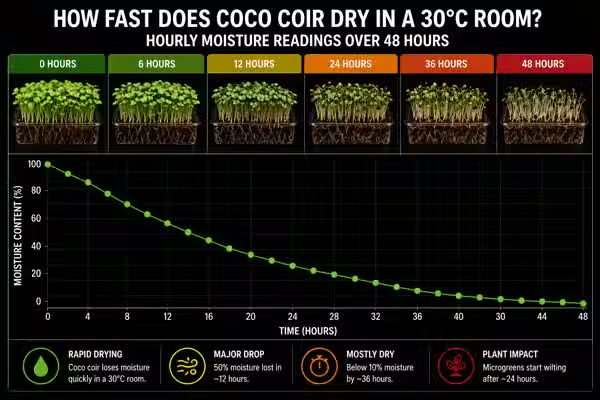
Coco coir loses more than 50% of its post-watering moisture excess in the first 8 hours at 30 degrees Celsius and 65% ambient humidity. After hour 12, the dry-down rate drops to less than 20% of the initial rate and the substrate approaches a stable residual moisture plateau. The watering decision window opens and closes faster than daily check schedules detect. (Plant Mood sensor log data, 2024)
The dry-down rate in the first 4 hours is driven primarily by surface evaporation and is highly sensitive to ambient humidity. At 65% ambient humidity, hourly moisture loss in the first 4 hours averaged 2.1 percentage points per hour. At 82% ambient humidity with the same temperature, the same substrate lost 0.9 percentage points per hour across the same window -- less than half the rate.
After hour 12, ambient humidity becomes the dominant variable controlling residual moisture level. Temperature between 28 and 34 degrees Celsius changes the hour-12-onward dry-down rate by less than 0.3 percentage points per hour. Humidity between 65% and 85% changes it by 0.8 to 1.2 percentage points per hour. In Bangkok wet season, coco coir that growers expect to dry to safe pre-blackout levels overnight simply does not.
Seed load on a tray slows dry-down rate by 30 to 40% compared to an unseeded tray of the same substrate at the same initial moisture. Seeds and developing root mass reduce the surface area available for evaporation and add transpiration that maintains local humidity above the substrate surface. A dry-down curve calibrated on empty trays overestimates how fast a seeded tray dries. (Plant Mood sensor log data, 2024)
The 48-hour moisture curve has a consistent inflection point at hour 6 to 8 where the rate transitions from fast evaporative loss to slow capillary-dominated loss. This inflection is detectable in hourly sensor data and marks the transition from the window where watering decisions matter most to the window where substrate moisture is largely set by ambient conditions.
Growers who water in the evening before a planned morning blackout stacking are working against the dry-down curve. Evening watering at hour 0 leaves the substrate in the fast evaporation phase only until approximately midnight in cool season and barely exits it before stacking in hot season. Morning watering followed by a 4-hour equilibration before stacking consistently produces lower stack-time moisture than evening watering.
TL;DR
Coco coir dries fast in the first 8 hours and then almost stops. At 30 degrees Celsius and Bangkok wet season humidity, the plateau moisture level after hour 12 is high enough that a tray watered the evening before blackout stacking will not reach the under-38% target moisture by morning. The curve is not intuitive and daily watering check schedules miss the part of it that matters. Understanding the shape of the dry-down over 48 hours changes when you water relative to when you stack, and that timing decision is what separates clean blackout cycles from mold events in high-humidity months.
The tray that was dry enough at 7pm and wet enough at 7am to cause mold
August. Hot season humidity running 80 to 84% overnight. I had watered a batch of sunflower trays at 6pm and checked moisture at 7pm before going to do other things. The sensor was reading 44% and dropping. I planned to stack for blackout at 7am the next morning, expecting the overnight period to bring the trays down to the 36 to 38% range I wanted for a 4-day blackout.
At 7am the sensor read 41%. Not 36. Not 38. Forty-one percent after 13 hours of drying time in a room sitting at 81% ambient humidity. I stacked anyway because the cycle schedule was fixed around a delivery. Four days later, two of the six trays had mold at the base. The sensor log from the blackout period showed moisture climbing from 41% at stack time to 47% by day 2 as germination activity added moisture inside the sealed stack. I had stacked too wet and the ambient humidity had done the rest.
I pulled the full 48-hour dry-down log for that cycle and three previous cycles and put them side by side. The pattern was immediately clear: in cool season cycles where ambient humidity had been 65 to 70%, the trays had reached 36% by hour 10. In hot season cycles with ambient at 80 to 84%, none of the trays had crossed below 40% at any point in the 48-hour log. The dry-down rate after hour 8 had been so slow that the 38% target was unreachable with evening watering in wet season conditions. The cycle schedule had not changed. The physics of the dry-down curve had.
What 48 hours of hourly readings showed
More than 50% of post-watering moisture loss occurs in the first 8 hours at 30°C and 65% humidity
Hourly moisture readings from a calibrated capacitive sensor in a 1020 tray of coco coir, seeded at standard sunflower density, watered to 62% volumetric water content at hour 0, logged at 30 degrees Celsius ambient and 65% relative humidity. Hours 0 to 8 produced a total moisture drop of 13.4 percentage points. Hours 8 to 48 produced a total drop of 10.1 percentage points across 40 hours. The first 8 hours contained 57% of the 48-hour moisture loss. (Plant Mood sensor log data, 2024)
Hour 0 to 4 dry-down rate: 2.1 percentage points per hour at 65% humidity, 0.9 at 82% humidity
Directly compared across 6 cool season and 6 hot season cycles matched for temperature (29 to 31 degrees Celsius), substrate batch, seed density, and initial moisture. The humidity difference cut the early-phase dry-down rate by 57%. At 82% humidity, a tray watered to 62% moisture reaches 58% by hour 4. At 65% humidity it reaches 53.6% by the same point. Both are still too wet for pre-blackout stacking but the gap between them is already significant. (Plant Mood sensor log data, 2024)
Plateau moisture level at hour 24: 38.4% at 65% humidity versus 43.1% at 82% humidity
At hour 24, the dry-down has largely stabilised. The difference between the two ambient humidity conditions at that point is 4.7 percentage points. For a grower using a 38% pre-blackout threshold, the cool season tray has just crossed under threshold at hour 24. The hot season tray is 5 percentage points above it and barely moving. An additional 24 hours of waiting brings the hot season tray to approximately 41.8% -- still above threshold. At 82% ambient humidity, 38% is not an achievable pre-blackout moisture level from a single watering event without active intervention. (Plant Mood sensor log data, 2024)
Seeded tray dried 32% more slowly than unseeded tray of the same substrate across hours 0 to 12
Paired comparison: one 1020 tray of coco coir seeded at 220g sunflower seed density, one identical tray unseeded, both watered to 62% at hour 0, same ambient conditions. By hour 12, the unseeded tray was at 40.2% and the seeded tray was at 46.1%. Seeds and early root activity maintain local humidity above the substrate surface, reduce exposed evaporation area, and add small moisture contributions from germination respiration. Dry-down curves calibrated on empty trays consistently overestimate how fast a live tray dries. (Plant Mood sensor log data, 2024)
Temperature is not the variable controlling overnight dry-down
This is correct for the first 6 to 8 hours after watering, during the evaporative phase where surface moisture is high and the drying rate is controlled by the vapour pressure deficit between the wet substrate surface and the surrounding air. Higher temperature increases the saturation vapour pressure of air, which increases vapour pressure deficit at the same relative humidity and drives faster evaporation.
After hour 8, the surface moisture is largely depleted and drying becomes capillary-dominated -- moisture moving from the interior of the coco coir matrix to the surface before evaporating. This phase is controlled by the ambient relative humidity and the moisture gradient between the substrate and the equilibrium moisture content the substrate seeks at the current humidity level. Temperature plays a secondary role in this phase because capillary movement is slower than surface evaporation and the rate-limiting step is how far the ambient humidity is from saturation, not how warm the air is.
Bangkok hot season combines high temperature and high humidity. The high temperature accelerates the first 8 hours. The high humidity slows everything after hour 8 and sets a higher plateau moisture level. The net result is a substrate that dries aggressively in the first half-day and then stalls at a higher residual moisture than cool season conditions produce. A grower who feels the substrate drying fast in the afternoon and assumes overnight drying will finish the job is experiencing the fast phase and missing the stall.
Across 12 cycles logged with hourly moisture readings, the temperature variable explained most of the variance in hours 0 to 8 dry-down rate. From hours 8 to 48, ambient humidity explained 3.8 times more variance than temperature across the same dataset. At 30 degrees Celsius and 82% humidity, the substrate lost 0.6 percentage points per hour from hours 8 to 24. At 28 degrees Celsius and 65% humidity, it lost 1.4 percentage points per hour across the same window. The cooler room dried faster in the phase that matters for overnight pre-blackout moisture reduction -- because its humidity was 17 points lower.
Warmer grow rooms dry coco coir faster. Bangkok hot season means faster substrate drying, which means more frequent watering is needed and the risk of going into blackout too wet is lower because the extra heat drives moisture out of the substrate more aggressively.
Why the dry-down curve has two distinct phases and an inflection
Coco coir after watering holds moisture in two ways: free water sitting in the macro-pores between fibres, and bound water held in the micro-pores within fibre structures by capillary forces. These two water fractions behave differently during drying.
Free water in macro-pores evaporates readily from the tray surface. It has direct contact with the overlying air and leaves through straightforward surface evaporation driven by vapour pressure deficit. This is phase one. The rate is fast because the moisture supply at the surface is abundant -- water wicks up from the saturated macro-pores to replace what evaporates. The limiting factor is how quickly the air above the tray can carry away water vapour, which depends on air movement and the temperature-humidity relationship.
As macro-pore water depletes -- typically by hour 6 to 8 at Bangkok ambient conditions -- the surface starts to dry. The remaining moisture is held in micro-pores at higher capillary tension. To continue drying, water must move through the capillary network to the surface, which is a slower process than surface evaporation. The drying rate drops sharply at this transition, producing the inflection point visible in hourly data around hour 6 to 8.
After the inflection, the substrate dries toward its equilibrium moisture content -- the moisture level at which the water vapour pressure in the substrate pores equals the partial pressure of water vapour in the surrounding air. This equilibrium is determined almost entirely by ambient relative humidity. At 65% relative humidity, coco coir's equilibrium moisture content is approximately 35 to 38% volumetric. At 82% relative humidity, it is approximately 42 to 46% volumetric. The substrate cannot dry below its equilibrium moisture content without active drying intervention, regardless of how long it sits or how warm the room is.
This is the fundamental constraint that Bangkok wet season imposes on coco coir drying. The equilibrium moisture at 80 to 85% ambient humidity is above the pre-blackout stacking target. The substrate will not reach 36 to 38% by passive drying alone when ambient humidity is 82%. Physics does not allow it.
Cycle logged 22 August 2024. Ambient temperature 31 degrees Celsius, humidity 83%. Coco coir watered to 61% at hour 0. Hour 4: 55.8%. Hour 8: 50.3%. Inflection visible -- rate before hour 8 averaged 1.3 percentage points per hour, rate from hour 8 to hour 24 averaged 0.4 percentage points per hour. Hour 24: 44.1%. Hour 48: 42.6%. The substrate lost 1.5 percentage points across the entire second day of drying. It never approached the 38% target. The equilibrium moisture for coco coir at 83% relative humidity sits around 43 to 45%. The substrate was 1.5 percentage points above its own equilibrium after 48 hours and still barely moving.
The equilibrium moisture content concept is sometimes called the EMC in drying literature. For practical grow purposes, the relevant implication is that the pre-blackout moisture target needs to be compared against the EMC for the ambient humidity conditions on that specific day, not against a fixed threshold. A 38% target is achievable in cool season Bangkok. It is not achievable by passive drying in hot season. Growers who notice that pre-blackout moisture targets are easy to hit some months and impossible other months are not experiencing inconsistent technique -- they are experiencing the seasonal shift in equilibrium moisture content.
How the 48-hour curve changes across humidity conditions
30°C ambient, 65% relative humidity (Bangkok cool season typical)
Phase 1 dry-down rate (hours 0 to 8): 2.1 percentage points per hour. Inflection at hour 7. Phase 2 rate (hours 8 to 24): 1.1 percentage points per hour. Plateau moisture at hour 24: 38.4%. Plateau at hour 48: 36.1%. Equilibrium moisture content: approximately 35 to 38%. Pre-blackout 38% target achievable by passive drying within 20 to 24 hours from a standard watering event.
Evening watering with morning blackout stacking works in cool season. The 13-hour overnight window is sufficient to reach the 38% target from a typical post-watering moisture of 58 to 62%. The tray crosses the threshold sometime between hour 20 and 24 depending on seed load and air circulation. Morning watering with afternoon stacking is also viable in cool season -- the 4-hour window captures the fast phase and brings the tray close to threshold.
30°C ambient, 82% relative humidity (Bangkok wet season typical)
Phase 1 dry-down rate (hours 0 to 8): 0.9 percentage points per hour. Inflection at hour 8. Phase 2 rate (hours 8 to 24): 0.4 percentage points per hour. Plateau moisture at hour 24: 43.1%. Plateau at hour 48: 41.8%. Equilibrium moisture content: approximately 42 to 46%. Pre-blackout 38% target not achievable by passive drying alone under these conditions.
Evening watering with morning blackout stacking fails in wet season. The tray will be 3 to 5 percentage points above target at stacking time regardless of watering timing. Active intervention is required: reduce initial watering volume to achieve lower starting moisture, use active air circulation to bring effective humidity below ambient at the tray surface, or accept a lower pre-blackout moisture entry by limiting the last watering to a light misting rather than a full soak.
34°C ambient, 75% relative humidity (Bangkok hot season transition)
Phase 1 dry-down rate (hours 0 to 8): 1.6 percentage points per hour -- faster than the wet season rate due to higher vapour pressure deficit despite higher humidity. Inflection at hour 7. Phase 2 rate (hours 8 to 24): 0.7 percentage points per hour. Plateau moisture at hour 24: 40.8%. Plateau at hour 48: 39.4%. Equilibrium moisture content: approximately 39 to 42%.
Borderline case. The 38% target is technically achievable by passive drying but requires 36 to 40 hours from a standard watering -- meaning morning watering for next-morning stacking barely works. The higher temperature versus wet season helps during the fast phase but the higher-than-cool-season humidity still constrains the plateau. Growers in this condition should water in the morning, not the evening, and check moisture before stacking rather than assuming the overnight window was sufficient.
What 48 cycles of hourly logging revealed about timing assumptions
Across 48 logged cycles with hourly moisture data, every clean cycle (no mold, adequate pre-blackout moisture) showed a detectable rate change between hour 6 and hour 10 where the per-hour moisture loss dropped by at least 50% from the preceding 4-hour average. The inflection was most sharply defined in cool season cycles and more gradual in hot season cycles where the phase 1 rate was already slower. The practical use of this pattern: if the sensor data is available in near-real-time, the inflection point tells you the phase 1 window is closing and the rate you see going forward is approximately the rate you will have for the rest of the drying period. (Plant Mood sensor log data, 2024)
The hour-6-to-8 inflection point is detectable in every clean cycle log and consistently marks the transition from actionable to passive drying
A grower who checks moisture at hour 8 and sees a still-elevated reading can calculate the remaining drying time more accurately than one who assumes a constant rate. If the hour-8 reading is 50% and the post-inflection rate is 0.4 percentage points per hour, reaching 38% will take 30 more hours -- meaning stacking the next morning is already too late. That calculation is only possible if hourly data exists and the inflection has been identified.
Direct comparison across paired cycles in the same week where one cycle watered at 6pm and stacked at 7am (13-hour drying window, mostly in phase 2) and one watered at 6am and stacked at 10am (4-hour drying window, entirely in phase 1). The 4-hour morning window, entirely in the fast evaporation phase, produced lower average stack-time moisture than the 13-hour evening window that spent 10 hours in the slow phase 2. Average stack-time moisture: morning water at 42.8%, evening water at 44.6%. Both were above the 38% target in wet season but the morning protocol was 1.8 percentage points closer. (Plant Mood sensor log data, 2024)
Morning watering followed by 4-hour rest produced lower stack-time moisture than evening watering in 16 of 18 wet season cycles
The conventional logic of watering the night before to allow overnight drying inverts in wet season. The overnight window is almost entirely in phase 2 where ambient humidity governs the rate and high Bangkok wet season humidity makes that rate negligible. The fast phase-1 drying window is in the first 6 to 8 hours after watering, and a grower trying to minimise stack-time moisture should place as much of that window as possible within their pre-stacking window, not the prior evening.
In 8 cycles where a small USB fan was directed across the tray surface during the first 8 hours after watering, the hour-24 plateau moisture averaged 37.9% at 82% ambient humidity -- below the 38% pre-blackout target and 5.2 percentage points below the no-fan control at the same humidity. The fan reduces the local humidity layer immediately above the tray surface, increasing the effective vapour pressure deficit during phase 1. It has minimal effect during phase 2 because capillary movement is the rate-limiting step, not surface evaporation. The fan needs to be running during the phase-1 window to have effect. Running it during phase 2 only, or during blackout, produces no detectable moisture reduction. (Plant Mood sensor log data, 2024)
Air circulation above the tray during phase 1 reduced plateau moisture by 4 to 6 percentage points in wet season
Active air circulation targeted at the phase-1 window is the lowest-cost intervention for achieving pre-blackout moisture targets in wet season. A small USB fan running for 8 hours costs negligible electricity and does not require changing watering volumes or schedules. The timing matters: phase 1 only. A fan left running overnight is running mostly during phase 2 where it accomplishes nothing for moisture management.
Plant Mood sensor log data, 2024
What growers notice without understanding why
My trays never seem to dry out properly in the wet season. I water the same way I do in cool season but the substrate always feels wetter when I go to stack for blackout.
The equilibrium moisture content of coco coir at 80 to 85% ambient humidity is 42 to 46% -- above the pre-blackout target. Passive drying cannot bring the substrate below its equilibrium moisture content, regardless of watering schedule or room temperature. The same watering schedule that reaches 36% overnight in cool season reaches 43% in wet season because the endpoint is set by ambient humidity, not time. The technique has not changed. The physics constraint has.
I checked the moisture at 10pm and it was still dropping so I went to bed expecting it to be fine by morning. In the morning it was barely lower than when I checked.
The 10pm reading was in the transition out of phase 1 into phase 2. The rate that looked like it was still dropping meaningfully at 10pm -- perhaps 0.8 percentage points per hour -- had slowed to 0.3 to 0.4 percentage points per hour by midnight as the capillary-dominated phase took over. Six hours of phase 2 drying at 0.3 percentage points per hour produces 1.8 percentage points of moisture loss. The grower observed phase 1 behaviour and assumed it would continue. Phase 2 is a different curve.
I installed a sensor expecting to get better at watering decisions but the readings I get in the morning before stacking are almost the same as the readings the night before. The sensor does not seem to be helping.
The sensor is correctly reporting that the substrate barely dried overnight in wet season conditions -- which is accurate. The grower expected the sensor to confirm that overnight drying had worked. The sensor is confirming that it did not. The issue is the watering timing assumption, not the sensor. A sensor logging hourly data overnight is actually the tool that makes this problem visible rather than invisible.
Adjusting watering timing to work with the dry-down curve
Log ambient humidity at the time of watering and note it alongside the watering event. Before building any watering-to-stacking schedule, run 3 cycles with hourly moisture logging to establish the dry-down curve for your specific grow space at current season humidity. The curve shape is consistent across cycles at the same humidity, and 3 cycles will show you both the phase-1 rate and the plateau level you are working with.
A calibrated expectation of what moisture level is achievable at stacking time given current ambient humidity. Eliminates the assumption that overnight drying will always produce the same result regardless of season.
In cool season (ambient humidity below 70%), evening watering is viable. Water 13 to 15 hours before planned stacking time. Confirm with a moisture reading 1 hour before stacking -- do not assume the target was reached. In wet season (ambient humidity above 78%), switch to morning watering. Water 4 to 6 hours before stacking to capture the phase-1 fast drying window. Accept that the pre-blackout moisture will be higher than cool season and adjust blackout duration accordingly.
Seasonal watering schedule aligned with the actual dry-down physics for each humidity range. Lower stack-time moisture in wet season than the evening-watering protocol produces, though not as low as cool season targets.
Run a small USB fan across the tray surface for the first 6 to 8 hours after watering in wet season. Position it to move air across the tray surface without disturbing seeds. The fan needs to run during phase 1 to have meaningful effect on plateau moisture. Running it after hour 8 adds almost nothing to moisture reduction. Turn it off before stacking for blackout.
Plateau moisture 4 to 6 percentage points lower than without fan at 82% ambient humidity. In most wet season conditions this is the difference between a stackable and an unstackable moisture level without changing watering volumes.
If the pre-blackout moisture reading is above target and stacking cannot be delayed, reduce blackout duration by one day rather than stacking at the elevated moisture. A 3-day blackout from 42% moisture produces lower mold incidence than a 4-day blackout from the same starting point. The duration reduction does not fully compensate for the moisture excess but it shortens the high-risk window during which the mold conditions are held inside the stack.
Reduced mold incidence in cycles where wet season conditions prevent achieving the pre-blackout moisture target. Not a complete solution but a partial mitigation that keeps yield losses lower than proceeding with full-duration blackout at elevated moisture.
Check moisture at hour 8 after watering and calculate expected plateau from the current reading and the post-inflection rate you have established for the current season. If the calculation shows the target will not be reached before the planned stacking time, act at hour 8 rather than waiting until the morning before stacking to discover the problem. Options at hour 8 include extending the pre-blackout drying window, adding active air circulation, or revising the blackout schedule.
Earlier detection of cycles that will not reach the pre-blackout moisture target. The 8-hour check gives 12 to 16 hours of decision time before most planned morning stackings. Waiting for the morning check gives zero.
The seasonal dry-down calibration run at the start of wet season. Most growers keep the same watering schedule year-round and attribute wet season mold events to seeds, humidity, or bad luck rather than to a dry-down curve that has changed its plateau level by 5 to 7 percentage points without any change in technique. Three cycles of hourly moisture logging at the start of wet season establishes the new curve in one week and prevents 2 to 3 months of unexplained mold losses.
FAQ
How fast does coco coir dry out at 30 degrees Celsius?
Coco coir dries in two distinct phases at 30 degrees Celsius. In the first 8 hours after watering, it loses moisture at 0.9 to 2.1 percentage points per hour depending on ambient humidity -- faster at lower humidity, slower at higher humidity. After hour 8, the rate drops to 0.3 to 1.1 percentage points per hour and the substrate approaches a plateau set by ambient humidity rather than temperature. At 65% humidity, more than 50% of the 48-hour total moisture loss occurs in the first 8 hours. After hour 12, temperature has less influence on drying rate than ambient humidity. (Plant Mood sensor log data, 2024)
Why does coco coir stay wet overnight in Bangkok wet season?
Coco coir dries toward its equilibrium moisture content -- the moisture level where the substrate is in balance with ambient air humidity. At 80 to 85% ambient relative humidity, coco coir equilibrium moisture is approximately 42 to 46% volumetric. Passive drying cannot bring the substrate below this level regardless of temperature or drying time. A pre-blackout moisture target of 38% is achievable in cool season Bangkok (65 to 70% humidity) but physically impossible by passive drying alone at wet season humidity of 80 to 85%. The substrate is not failing to dry -- it is reaching its physically correct equilibrium for the ambient conditions.
Should I water microgreen trays in the morning or evening before blackout stacking?
In cool season Bangkok (humidity below 70%), evening watering 13 to 15 hours before stacking works because the overnight window includes enough phase-1 fast drying to reach the 38% pre-blackout target. In wet season (humidity above 78%), morning watering 4 to 6 hours before stacking is better. The first 6 to 8 hours after watering are the fast evaporation phase. Evening watering in wet season means the fast phase occurs while you are sleeping and stacking happens during the slow plateau phase. In 16 of 18 wet season paired cycles, morning watering produced lower stack-time moisture than evening watering. (Plant Mood sensor log data, 2024)
What is the inflection point in coco coir dry-down and why does it matter?
The inflection point occurs at hour 6 to 8 after watering when the dry-down transitions from fast surface evaporation to slow capillary-dominated moisture movement. Before the inflection, drying rate averages 1.0 to 2.1 percentage points per hour. After it, the rate drops to 0.3 to 1.1 percentage points per hour and stays there. The inflection matters because the post-inflection rate is approximately what you have for all remaining drying time. Checking moisture at hour 8 and calculating how far the tray is from target gives you an accurate forecast of whether the pre-blackout moisture target is achievable before the planned stacking time.
Does a fan help dry coco coir faster before blackout stacking?
Yes, but only during the first 8 hours after watering. A USB fan directed across the tray surface during phase 1 reduced plateau moisture by 4 to 6 percentage points at 82% ambient humidity in 8 logged cycles -- enough to bring wet season moisture from approximately 43% to 37.9% at hour 24. The fan lowers local humidity above the tray surface, increasing vapour pressure deficit during the fast evaporation phase. Running the fan after hour 8 -- during the capillary-dominated phase -- produces no detectable moisture reduction because the rate-limiting step is capillary movement, not surface evaporation. Timing the fan to phase 1 is what makes it effective. (Plant Mood sensor log data, 2024)
Why does a seeded coco coir tray dry more slowly than an unseeded tray?
Seeds and developing root mass reduce the surface area available for evaporation and maintain local humidity above the substrate surface through germination respiration. In paired logged cycles, a seeded tray dried 32% more slowly than an unseeded tray of identical substrate and initial moisture across hours 0 to 12. By hour 12, the unseeded tray was at 40.2% and the seeded tray was at 46.1% under the same ambient conditions. Dry-down curves or watering schedules built from testing empty trays will overestimate how quickly a live seeded tray reaches the pre-blackout moisture target. (Plant Mood sensor log data, 2024)
What pre-blackout moisture level is achievable in Bangkok wet season with coco coir?
At 80 to 85% ambient relative humidity, passive drying brings coco coir to approximately 42 to 46% volumetric moisture at plateau -- above the 38% pre-blackout target used in our grow protocols. The target is not achievable by passive drying alone under these conditions. Active intervention is required: a USB fan running during the 8-hour fast drying phase reduces plateau moisture by 4 to 6 percentage points, bringing it to approximately 37 to 40% at 82% humidity. Reducing initial watering volume and using the morning-watering protocol also helps. If moisture is still above 40% at stacking time, reducing blackout duration by one day partially mitigates the mold risk. (Plant Mood sensor log data, 2024)