Key takeaways
Factory calibration curves for capacitive soil moisture sensors are built on mineral soil. Applied to coco coir, peat, or hemp mat without recalibration, the ADC-to-water-content mapping can be wrong by 15 to 28 percentage points at the moisture levels that matter most for microgreen growing decisions. (Plant Mood sensor log data, 2024)
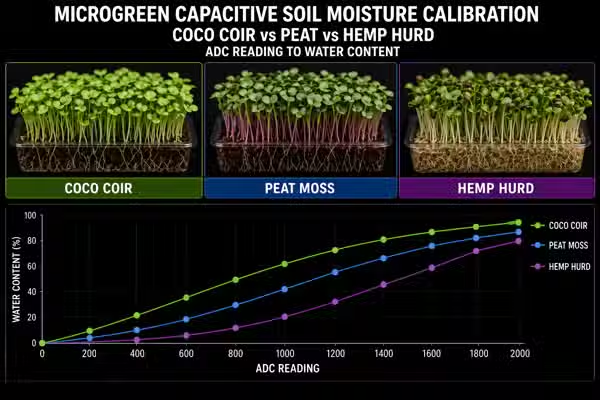
Coco coir and peat have significantly different dielectric properties at the same volumetric water content. A raw ADC reading of 2,350 corresponded to 41% volumetric water content in coco coir and 58% in peat in our calibration tests -- a 17-point difference from an identical sensor reading.
Hemp mat produces non-linear ADC response curves that make single-point calibration unreliable. The mat compresses under seed weight and stack pressure, changing the sensor-to-substrate contact geometry and shifting the ADC output independently of moisture content.
In Bangkok ambient humidity above 78%, uncalibrated capacitive sensors show a consistent upward drift of 80 to 140 ADC counts over 6 to 8 hours of continuous operation due to humidity ingress into the sensor body. Without a dry-air baseline correction, this drift adds a false wet signal that compounds the substrate calibration error.
Substrate-specific calibration requires only 4 reference points -- bone dry, field capacity, saturated, and one intermediate -- and takes under 2 hours per substrate. The calibration does not need to be repeated unless the substrate brand or formulation changes.
The grower action most often triggered by an incorrect moisture reading is premature rewatering. In logged cycles, premature rewatering based on uncalibrated ADC threshold crossing preceded mold onset by 18 to 36 hours in 6 of 8 affected trays. The sensor was not wrong about the ADC value. The ADC value was being compared to the wrong reference. (Plant Mood sensor log data, 2024)
Two trays, same number, completely different problems
I had been running moisture sensors across both coco coir and peat trays for about three months before the calibration problem became undeniable. The setup was the same for both: capacitive sensors pushed into the substrate at the same depth, same ADC threshold set for the rewatering alert. The threshold was 2,300 ADC, which I had arrived at empirically from the coco coir trays over the first month of logging.
In week 9, the peat trays started triggering the alert consistently two days earlier in the grow cycle than the coco coir trays. Same seed, same seeding density, same ambient conditions. I watered when the alert fired. The peat trays that week developed mold by day 5. The coco coir trays were fine. I ran the cycle again the following week with the peat trays and held the watering. Mold again, but earlier. I had not changed anything except responding differently to the same sensor number.
What I had not understood was that 2,300 ADC in peat was already describing a substrate at near-field-capacity moisture. The alert I had calibrated against coco coir behaviour was firing when the peat was already wet enough to support mold under blackout. The sensor reading was accurate. The threshold was wrong because I had never established what 2,300 ADC actually meant in peat.
I ran a bench calibration that weekend. Weighed samples of dry coco coir and dry peat. Added measured water volumes. Logged ADC at each moisture level. The curves were not parallel shifts of each other -- they had different shapes. Peat's ADC response to added water was steeper in the low-moisture range and flatter at high moisture. Coco coir's response was more linear across the full range. A single ADC threshold applied to both was guaranteed to be too wet for one and too dry for the other at some point in every cycle.
What the calibration curves showed across three substrates
ADC reading of 2,350 corresponded to 41% water content in coco coir and 58% in peat
Bench calibration using gravimetric water content measurement as reference. Substrate samples of 200g dry weight each, water added in 10ml increments, ADC logged at each increment after 5-minute equilibration. The 17-percentage-point difference at the same ADC reading spans the range between acceptable pre-blackout moisture and mold-risk moisture in microgreen growing. Operating with a shared threshold for both substrates means the threshold is wrong for at least one of them in every cycle. (Plant Mood sensor log data, 2024)
Uncalibrated factory curve error reached 28 percentage points at field capacity moisture in peat
Factory calibration curves for the sensor model tested assumed mineral loam soil as the reference material. At field capacity in peat (approximately 65% volumetric water content), the factory curve predicted 37% -- an underestimate of 28 percentage points. A grower using factory calibration and targeting 40% moisture in peat would be watering a substrate already at 68%, 3 points above field capacity. (Plant Mood sensor log data, 2024)
Bangkok ambient humidity above 78% caused ADC drift of 80 to 140 counts over 6 to 8 hours of continuous sensor operation
Sensors tested in open air at 82% ambient humidity with no substrate contact. ADC readings at hour 0 and hour 8 with no substrate change. Drift of 80 to 140 counts depending on sensor unit -- some units showed more humidity ingress than others from the same batch. At the moisture-sensitive ADC range around 2,200 to 2,500, 100 counts of drift corresponds to approximately 4 to 7 percentage points of apparent moisture increase. In Bangkok wet season this drift is not intermittent -- it is continuous. (Plant Mood sensor log data, 2024)
Hemp mat ADC readings shifted by up to 180 counts between unseeded and day-5 seeded conditions at identical moisture content
Hemp mat compressed under seed load and stack weight reduces the air gap between sensor face and mat material, increasing the apparent dielectric reading independently of water content. The 180-count shift at identical gravimetric moisture means any single-point hemp mat calibration made without seed load is predicting moisture in an unburdened mat, not the mat the seeds are actually growing in. (Plant Mood sensor log data, 2024)
A wetter-reading substrate is not always a wetter substrate
Capacitive moisture sensors measure the dielectric permittivity of the substrate, not water content directly. Water has a dielectric constant of approximately 80. Dry mineral soil has a dielectric constant of 2 to 5. Dry coco coir and dry peat have different dry dielectric constants from each other and from mineral soil, and they change at different rates as water fills the pore space.
Peat has a higher dry dielectric constant than coco coir because of its organic fibre structure and the retained mineral content in many commercial peat mixes. This means a dry peat substrate produces a higher ADC reading than equally dry coco coir. Add water to both and the peat ADC rises faster per unit of added water in the low-moisture range because water is filling smaller pores where the dielectric effect is amplified.
The result is that comparing ADC readings between substrates tells you almost nothing about relative moisture content. Peat reading 2,400 and coco coir reading 2,400 can be at completely different actual water contents. Peat reading 2,400 and coco coir reading 2,200 might actually have similar real moisture levels. The sensor is accurately measuring dielectric permittivity. Dielectric permittivity is a substrate-specific function of moisture content, not a universal one.
In a direct comparison bench test, coco coir at 45% volumetric water content produced an ADC reading of 2,410. Peat at 38% volumetric water content -- measurably drier by weight -- produced an ADC reading of 2,480. The peat tray was reading wetter on the sensor while being drier in reality. A grower using uncalibrated readings to decide which tray needed water first would have watered the drier-reading coco coir tray and left the higher-reading but actually drier peat tray. Both decisions wrong, from a comparison that felt intuitive.
A higher ADC reading means more moisture in the substrate. If the sensor reads higher in peat than in coco coir under the same watering volume, peat is holding more water. The sensor is giving you accurate relative information even if the absolute calibration is off.
What growers describe before they understand it is a calibration problem
My moisture sensor keeps triggering the rewater alert on peat trays way earlier than my coco coir trays. The peat must be drying out faster. I am watering more and the mold is getting worse.
The alert is not detecting faster drying. It is detecting a lower ADC reading in peat that corresponds to a wetter substrate than the same ADC reading in coco coir. Peat's steeper low-moisture ADC response curve means it exits the alert zone faster on the way up from dry -- but the substrate is still wet by coco coir standards. Watering in response to the early alert is adding water to a substrate that does not need it, then covering it with a blackout stack. The mold follows directly from this sequence.
My sensor readings drift upward through the day even when I have not watered. By evening the tray looks wetter on the sensor than it did at noon but the substrate feels the same.
Humidity ingress into the sensor body. In Bangkok ambient humidity above 75%, capacitive sensors that are not hermetically sealed absorb moisture through the PCB conformal coating over hours of operation. The absorbed moisture increases the sensor body's own dielectric contribution to the reading, producing a slow upward ADC drift that is independent of substrate moisture. The fix is a dry-air zeroing baseline taken in a sealed container with desiccant, used to correct for the drift offset in logged data. Not correcting for it means evening readings systematically overstate substrate moisture relative to morning readings.
I tried to calibrate my sensor by pushing it into dry substrate and wet substrate and the readings were inconsistent. Sometimes the dry reading is higher than a previous wet reading. I cannot build a reliable curve.
Substrate preparation inconsistency during calibration. Capacitive sensors measure the dielectric of the material in contact with the sensor face. If the substrate is not packed consistently against the sensor face -- same density, same contact pressure -- the air gap between sensor and substrate varies and produces inconsistent readings at the same moisture content. Bench calibration requires consistent packing density and the same insertion depth for every reference point. Most growers push the sensor in at different depths or different pressures across the calibration points and attribute the inconsistency to the sensor rather than the method.
I switched from coco coir to a coco-peat blend and now all my moisture thresholds are wrong. The trays that used to stay in range are constantly triggering alerts or never triggering at all.
A coco-peat blend has a different dielectric response curve than either pure substrate. The blend ratio determines where the curve sits between the two pure-substrate curves, and different commercial blends use different ratios. A calibration built on pure coco coir does not transfer to a 70-30 coco-peat blend. The calibration needs to be rebuilt for the blend as a new substrate. This is a 2-hour bench process, not a multi-day exercise, but it cannot be skipped when the substrate formulation changes.
Calibration curves and what they revealed about each substrate
Bench calibration across the 0 to 80% volumetric water content range showed coco coir ADC response within 8% of a linear fit across the full range. The near-linearity makes single-point and two-point calibration reasonably reliable for coco coir -- if you establish the dry and saturated endpoints, linear interpolation between them produces a usable moisture estimate across the operating range. This is the substrate behaviour most similar to the mineral soil assumption underlying factory calibration curves, which partly explains why coco coir users who never calibrate their sensors have better luck than peat or hemp mat users who follow the same practice. (Plant Mood sensor log data, 2024)
Coco coir produces the most linear ADC-to-moisture relationship of the three substrates tested
Growers using only coco coir can get away with a simplified two-point calibration. Growers who have concluded that capacitive sensors work reliably because their coco coir results looked reasonable should not assume that conclusion transfers to other substrates.
Peat calibration data showed ADC rising sharply from dry baseline through the first 35% of water content addition, then transitioning to a much flatter curve through 35 to 55%, and becoming nearly flat above 55%. The practical consequence: the sensor is most sensitive and most useful for detecting moisture changes in the low-moisture range in peat -- where germination risk from dryness is the concern -- and least useful for distinguishing between acceptable and dangerously wet conditions in the upper range where mold risk lives. A grower using a peat substrate and a single ADC threshold for the high-moisture alert is using the sensor in the range where it has the worst resolution. (Plant Mood sensor log data, 2024)
Peat shows a steep ADC response in the 0 to 35% moisture range and a flat response above 55%
Peat moisture management in the mold-risk zone (above 55% water content) benefits more from physical observation and timed watering protocols than from sensor thresholds, because the sensor cannot reliably distinguish between 55% and 70% in peat. The sensor is useful in peat for low-moisture early warning. It is not useful as a high-moisture ceiling detector.
Calibration of hemp mat under no load versus under a simulated seed load of 220g per 1020 tray showed ADC readings differing by 120 to 180 counts at identical gravimetric moisture. The compression of the mat under seed weight reduces the mat thickness, increases fibre density against the sensor face, and changes the dielectric reading independently of water content. The correction factor was not constant across moisture levels -- it was larger at intermediate moisture and smaller at the dry and saturated extremes. A single offset correction could not adequately account for the load-dependent shift across the full moisture range. (Plant Mood sensor log data, 2024)
Hemp mat requires load-corrected calibration and cannot be reliably calibrated from bench tests without simulated seed weight
Hemp mat moisture sensing with a capacitive sensor is fundamentally less reliable than coco coir or peat sensing because the calibration reference shifts with seed load. The practical approach is to calibrate the sensor in situ -- pushed into the mat after seeding with the normal seed load applied -- rather than from a bench calibration without seeds. Re-calibration is needed when seed density changes significantly.
Plant Mood sensor log data, 2024
Factory calibration is not a starting point you can adjust -- it is wrong in a structural way
Factory calibration curves are a reasonable starting point that you can offset or scale to match your substrate. If the sensor reads 5% too dry, add 5% to every reading. The curve shape is correct and you just need to shift it.
Factory calibration curves assume mineral soil as the reference material. The error introduced by applying a mineral soil curve to coco coir, peat, or hemp mat is not a fixed offset -- it changes across the moisture range. Shifting the curve up or down by a constant amount corrects the error at one moisture level and makes it worse at others.
In peat, the factory curve underestimates moisture by approximately 10 percentage points at 30% actual water content, 18 points at 50%, and 28 points at 65%. Adding a flat 15-point offset would overcorrect at low moisture and undercorrect at high moisture. The error is not a shift -- it is a shape difference between the factory curve and the real substrate response.
The correct approach is to build a substrate-specific lookup table from bench calibration reference points and interpolate between them. Four reference points -- bone dry, 30% water content, field capacity, and saturated -- are sufficient to capture the shape of the curve for coco coir and peat. Hemp mat requires more points in the intermediate range due to load sensitivity.
Applying a flat offset correction to the factory curve for peat -- using the mid-range error of 17 percentage points as the offset -- produced moisture estimates within 5 percentage points of actual in the 35 to 50% range but errors of 12 to 15 percentage points in the 55 to 70% range and 8 to 10 points in the 10 to 25% range. The offset correction was worse than the factory curve in the ranges it was not calibrated for. Substrate-specific multi-point calibration reduced error to under 4 percentage points across the full moisture range. (Plant Mood sensor log data, 2024)
Why substrate composition changes what the sensor reads at the same moisture level
A capacitive soil moisture sensor works by placing two conductive plates -- the sensor electrodes -- in contact with the substrate and measuring the capacitance between them. Capacitance depends on the dielectric permittivity of the material between the plates. Water has a dielectric constant of approximately 80 at room temperature. Air is 1. Dry mineral soil is 2 to 5. The sensor is designed around the principle that as water displaces air in soil pore space, the dielectric permittivity increases and capacitance rises, which the sensor converts to an ADC value.
Coco coir is a processed coconut husk fibre with a distinctive pore structure -- large inter-fibre pores and smaller intra-fibre pores. Dry coco coir has a dielectric constant in the range of 1.8 to 2.2, close to mineral soil. Water retention in coco coir is primarily in the inter-fibre pores, which fill progressively as moisture is added. The sensor sees a relatively uniform dielectric increase as pore space fills, producing the near-linear ADC response.
Peat is partially decomposed organic matter with a much finer pore structure and higher organic content. Dry peat dielectric constant is typically 2.5 to 3.5, higher than coco coir, partly due to residual mineral content and the more complex organic matrix. Peat also has a higher cation exchange capacity, meaning it holds ions that contribute to electrical conductivity and interact with the capacitance measurement. The finer pore structure means small additions of water fill many small pores simultaneously, producing the steep initial ADC response observed in calibration. At higher moisture, the larger pore spaces fill more slowly, flattening the curve.
Hemp mat is a woven or compressed natural fibre mat. Its dielectric behaviour depends on fibre density and weave geometry as much as moisture content. Compression under load changes the geometry of the fibre-air-water matrix the sensor is sampling, which is why the calibration shifts with seed weight. Hemp mat also dries unevenly -- the top surface dries faster than the bottom -- meaning a sensor placed at one depth in the mat is sampling a moisture gradient that may not represent the average moisture available to the root zone.
A direct demonstration: three sensors of the same model, pushed to identical depth in three substrate samples of identical weight, all dried to bone dry in an oven. ADC readings: coco coir 1,820, peat 1,960, hemp mat 1,740. All three are at zero water content. The sensor reads three different values for the same physical reality because it is reading substrate dielectric, not water. Any threshold or calibration that does not account for this starting difference is wrong before the first drop of water is added.
Temperature affects dielectric constant of water -- it decreases as temperature rises. In Bangkok grow spaces where ambient temperature ranges from 27 to 34 degrees Celsius across the day and seasons, this introduces a temperature-dependent drift in moisture readings of approximately 0.5 to 1.5 percentage points across the operating temperature range. Smaller than the substrate calibration error but worth logging alongside temperature if sub-5-percentage-point accuracy is required. Most grow decisions do not require that precision, but the temperature coefficient is the reason two readings taken on the same tray at different times of day can differ slightly without any actual moisture change.
Coco coir, peat, and hemp mat as sensor substrates
Dry ADC baseline approximately 1,820. Near-linear ADC-to-moisture response across the full operating range. Factory curve offset error of 8 to 12 percentage points at field capacity. Calibration with 4 reference points reduces error to under 4 percentage points. Humidity drift affects sensor body but not substrate dielectric significantly. Consistent pore structure makes repeat calibrations stable across substrate batches from the same supplier.
The most sensor-friendly of the three substrates. Simplest to calibrate, most reliable uncalibrated, and least affected by external variables. Growers who want to use moisture sensors productively without extensive calibration work should use coco coir as their primary substrate. The calibration effort is proportional to the accuracy required -- coco coir with a two-point calibration is adequate for most grow decisions.
Dry ADC baseline approximately 1,960, roughly 140 counts higher than coco coir at zero water content. Steep ADC response in low-moisture range, flat response above 55% water content. Factory curve error up to 28 percentage points at field capacity. Sensor is most useful for detecting low-moisture dry-down risk, least useful for high-moisture mold-risk detection. Batch variation between peat suppliers affects calibration -- a curve built on one brand may not transfer to another.
Use the sensor for low-moisture early warning in peat. Do not rely on ADC thresholds to detect overwatering risk -- the sensor resolution in the wet range is too poor. Supplement sensor data with physical observation and fixed watering intervals based on grow stage for the high-moisture management decisions.
Dry ADC baseline approximately 1,740, lowest of the three substrates. Non-linear response with load-dependent shift of 120 to 180 ADC counts between unseeded and seeded conditions. Cannot be calibrated reliably from bench tests without seed load simulation. Dries unevenly across mat depth. Sensor reading represents a point sample in a moisture gradient, not a tray-representative average.
Capacitive sensor moisture management is least reliable on hemp mat of the three substrates. If using hemp mat, calibrate in situ after seeding with a known water addition and gravimetric reference, not from a bench test on unsupported mat. Treat sensor readings as directional indicators of wet or dry trend rather than absolute moisture values. For hemp mat moisture management, timed watering protocols and physical weight assessment of the tray are more reliable than sensor thresholds.
Sensor data without calibration is false confidence
A moisture sensor that has not been calibrated for its specific substrate is not giving you information about your substrate. It is giving you a number. Those are different things. The number looks like information, it logs like information, it can trigger automations like information -- and it can send you in completely the wrong direction if the calibration that converts it to information does not exist.
I have a stronger opinion about this than about most measurement topics because the failure mode is invisible. A temperature sensor reading 3 degrees too high is obviously wrong when you put a thermometer next to it. A moisture sensor reading 17 percentage points too wet in peat looks like a normal moisture reading. There is nothing in the raw number that flags itself as miscalibrated. The first sign is usually a mold event that the sensor data did not predict, which the grower attributes to humidity or seeds or bad luck. The sensor was telling the wrong story the entire time.
Calibration takes 2 hours per substrate. It is the single highest-leverage hour spent in sensor setup, and it is the step most growers skip because the sensor seems to be working -- the numbers are changing when they water, the trend looks right, the automation fires at roughly the right time. Roughly the right time, on a miscalibrated substrate, is how you end up watering a wet peat tray into blackout.
This is true and I do not dismiss it as a method. Empirical threshold learning across 15 cycles will produce usable thresholds if the substrate, sensor depth, seeding density, and ambient conditions stay constant. What it cannot handle is a substrate change, a sensor replacement, or a grower sharing thresholds with another grower using different substrate. Every time the system changes, 15 cycles of empirical calibration resets to zero. A bench calibration curve transfers to any grower using the same substrate and sensor model. The bench calibration is the investment that makes sensor knowledge portable rather than locked to one setup.
The counterargument is that practical grow decisions do not require precise absolute moisture values. If you learn your substrate's behaviour empirically over 10 to 15 cycles -- learning that your peat trays need water when the ADC crosses 2,100 regardless of what that means in volumetric percent -- you arrive at correct thresholds without formal calibration. The sensor is being used as a relative indicator, not an absolute measurement, and relative indicators can be calibrated by outcome without bench work.
FAQ
Do I need to calibrate a capacitive moisture sensor differently for coco coir versus peat?
Yes, and the difference is significant enough to cause mold events if ignored. A raw ADC reading of 2,350 corresponded to 41% volumetric water content in coco coir and 58% in peat in bench calibration tests -- a 17-point difference from an identical sensor reading. Peat has a higher dry dielectric baseline and a steeper low-moisture response curve than coco coir. Applying a coco coir calibration threshold to peat produces watering triggers that fire when the peat is already near field capacity. Factory calibration curves make the same error at larger magnitude -- up to 28 percentage points off at field capacity in peat. (Plant Mood sensor log data, 2024)
Why does my moisture sensor read differently in peat than coco coir at the same moisture level?
Capacitive sensors measure dielectric permittivity, not water content directly. Peat and coco coir have different dry dielectric constants and different pore structures, so they produce different ADC readings at the same volumetric water content. Dry coco coir reads approximately 1,820 ADC and dry peat reads approximately 1,960 ADC on the same sensor model -- 140 counts apart at zero water content before any moisture is added. The curves then diverge further as water fills different pore geometries at different rates. Substrate-specific calibration with 4 reference points is the only way to convert ADC to accurate moisture content for each substrate. (Plant Mood sensor log data, 2024)
Can I use a flat offset to correct my moisture sensor calibration for a different substrate?
No. The error introduced by applying a mineral soil or coco coir calibration to peat is not a constant offset -- it changes across the moisture range. In peat, the factory curve error is approximately 10 percentage points at 30% water content, 18 points at 50%, and 28 points at 65%. A flat 15-point offset corrects the mid-range error and makes the low and high-range errors worse. The substrate response curves have different shapes, not just different positions. Substrate-specific multi-point calibration reduced error to under 4 percentage points across the full range. A flat offset correction could not achieve under 12 points at the extremes. (Plant Mood sensor log data, 2024)
Why does my moisture sensor reading drift upward during the day in Bangkok?
Humidity ingress into the sensor body. Capacitive sensors that are not hermetically sealed absorb moisture through their PCB conformal coating during continuous operation in Bangkok ambient humidity above 75%. The absorbed moisture increases the sensor body's own dielectric contribution to the reading, producing a slow upward ADC drift of 80 to 140 counts over 6 to 8 hours that is independent of substrate moisture. At the moisture-sensitive ADC range around 2,200 to 2,500, this drift corresponds to 4 to 7 apparent percentage points of false moisture increase. A dry-air zeroing baseline taken with the sensor in a sealed desiccant container allows drift correction in logged data. (Plant Mood sensor log data, 2024)
How do I calibrate a capacitive moisture sensor for coco coir microgreen trays?
Build a 4-point substrate-specific lookup table: bone dry, 30% water content, field capacity, and saturated. Weigh 200g dry coco coir, add measured water volumes in 10ml increments, pack consistently against the sensor face at the same insertion depth each time, wait 5 minutes for equilibration, log ADC. Use those 4 reference points to build a linear interpolation table for the operating moisture range. The calibration takes under 2 hours and reduces moisture estimate error from 8 to 12 percentage points on factory calibration to under 4 percentage points. Repeat only when the substrate brand or formulation changes.
Why is hemp mat harder to calibrate for moisture sensors than coco coir?
Hemp mat compresses under seed weight and stack pressure, changing the sensor-to-substrate contact geometry and shifting ADC output by 120 to 180 counts at identical moisture content. A bench calibration made without seed load does not represent the in-tray conditions the sensor actually operates in. Hemp mat also dries unevenly -- the top surface faster than the bottom -- so a point sensor reading represents a moisture gradient, not a tray average. Calibrate hemp mat sensors in situ after seeding with a known water addition, not from an unsupported bench test. Treat hemp mat sensor readings as directional trend indicators rather than absolute moisture values. (Plant Mood sensor log data, 2024)
What moisture sensor ADC threshold should I use for pre-blackout stacking in coco coir?
Below 38% volumetric water content is the target for a 4-day blackout, which corresponds to an ADC of approximately 2,180 to 2,220 on a calibrated sensor in coco coir based on our calibration curves. Take the reading 60 to 90 minutes after last watering, not immediately after. This ADC range is substrate-specific -- the same threshold number applied to peat corresponds to approximately 55% water content, which is already in the mold-risk zone for blackout stacking. Any pre-blackout moisture threshold must be referenced to a substrate-specific calibration curve, not transferred from a different substrate. (Plant Mood sensor log data, 2024)