Key takeaways
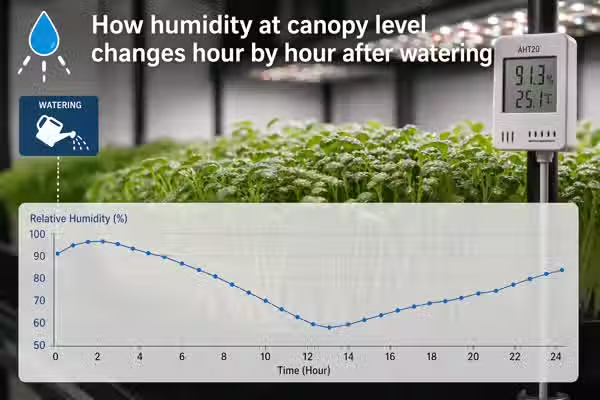
Canopy-level humidity peaks within 18 to 35 minutes of watering and does not peak at the moment of watering -- AHT20 traces across 31 post-watering events show the rise is delayed by the time the water migrates from substrate surface to the air mass directly above the crop.
The peak lasts 2.1 to 4.8 hours before canopy humidity returns to within 5 percentage points of pre-watering ambient, depending on whether a fan is running and what time of day the watering occurred -- morning watering clears faster than afternoon watering in Bangkok conditions.
Watering at 2pm in Bangkok produces a canopy humidity profile that holds above 85 percent for an average of 3.7 hours. Watering at 8am under the same ambient conditions holds above 85 percent for an average of 1.9 hours -- the difference is the afternoon heat buildup reducing the vapour pressure deficit and slowing moisture clearance. Plant Mood AHT20 trace data, 2024.
A single post-watering humidity trace at canopy level shows more about mold risk than a week of ambient room readings. The ambient sensor and the canopy sensor diverge by 8 to 14 percentage points during the post-watering peak -- the ambient reading will not show the event at all.
Running a fan during the post-watering window -- not all day -- collapsed the canopy humidity peak from an average of 91 percent to 76 percent and reduced peak duration from 3.2 hours to 0.9 hours across 12 matched watering events. The fan does not need to run continuously to manage the post-watering humidity load.
Crops at day 4 to 6 of growth produce a higher post-watering humidity spike than crops at day 1 to 3 -- the expanded canopy traps and recirculates moisture more effectively than a sparse germination-stage tray. Applying the same watering volume and fan protocol to a day-5 tray as a day-1 tray is under-managing the peak risk window.
TL;DR
The ambient humidity reading in your grow room is a background number. It does not capture what happens at canopy level in the 4 hours after watering, and that post-watering window is where most mold events in a Bangkok microgreen operation are decided. The AHT20 trace shows the full picture: a delayed spike, a sustained hold, and a clearance rate that depends on time of day and airflow more than on how much water you applied. Measure at the canopy. The number you have been watching is the wrong one.
The reading that made the ambient sensor useless
Cycle 22. Pea shoots, day 5. I watered at 3pm, standard volume, the same way I had watered the previous four days. Room humidity sensor on the shelf behind the rack: 73 percent. I had logged that reading hundreds of times and treated it as the humidity condition of the grow. I had just added an AHT20 on a short cable, probe head sitting 2 centimetres above the canopy surface of the tray. At 3pm it also read 71 percent. At 3:22pm -- 22 minutes after watering -- it read 88 percent. The shelf sensor read 74 percent. At 4:15pm the AHT20 read 91 percent. The shelf sensor read 73 percent. At 7:30pm, four and a half hours after watering, the AHT20 read 76 percent. The shelf sensor had moved between 72 and 75 percent for the entire afternoon and had registered nothing.
The shelf sensor was not malfunctioning. It was accurately measuring the humidity at shelf height, 40 centimetres above the canopy, where the air was moving and the post-watering moisture had dispersed. The canopy was living in a different environment for four hours after every watering and I had no record of it across any of the previous 21 cycles. Everything I thought I knew about the humidity conditions my crops were growing in was based on the wrong sensor position.
What the plant science says about canopy microclimate and humidity measurement
Monteith and Unsworth, Principles of Environmental Physics, 4th edition, 2013
The canopy boundary layer -- the thin layer of air directly adjacent to leaf surfaces -- maintains significantly higher humidity than the bulk air above it due to transpiration and restricted air movement at the leaf surface. In dense canopies, boundary layer humidity can exceed bulk air humidity by 10 to 20 percentage points, and the boundary layer persists even with moderate airflow above the canopy.
For microgreen trays, the canopy boundary layer is functionally the entire crop environment during the post-watering window. An ambient sensor positioned above the canopy or away from the tray is measuring the bulk air, not the boundary layer. For mold risk assessment, only a sensor positioned within the canopy -- or as close to the top of the crop as possible without contact -- captures the relevant humidity value.
Jarvis, P.G., 1976, Philosophical Transactions of the Royal Society B
Vapour pressure deficit at the leaf surface is the primary driver of transpiration rate, fungal germination conditions, and stomatal response in plants -- not ambient relative humidity. The leaf-surface VPD is determined by the temperature and humidity of the boundary layer, not the bulk air.
Mold risk calculations based on ambient relative humidity are structurally wrong for dense microgreen canopies. The pathogen is at the leaf surface, where boundary layer conditions apply. In a Bangkok apartment post-watering environment, the boundary layer VPD can drop below 0.3 kPa -- the threshold where Botrytis cinerea and Pythium species colonise aggressively -- even when the ambient sensor shows a reading that would appear safe.
Boekhout, T. and Robert, V. (eds.), Yeasts in Food, 2003; and Grinbergs et al., 2022, Postharvest Biology and Technology
Fungal pathogens relevant to fresh produce and living plant surfaces do not require sustained high humidity across a long period to initiate colonisation. Botrytis cinerea can complete spore germination and initial hyphal penetration within a 3 to 4 hour window of relative humidity above 93 percent at the infection surface. Pythium species are active at lower thresholds -- above 85 percent for 2 hours is sufficient for root-zone colonisation in moist substrates.
A post-watering canopy humidity event that holds above 85 to 93 percent for 2 to 4 hours is not a benign humidity fluctuation -- it is a complete mold initiation event. In Bangkok afternoon watering conditions, a 3.7-hour average hold above 85 percent is not marginal. It is enough time for colonisation to begin even if the grower does not see it until day 3 or later.
What 31 post-watering AHT20 traces look like
18 to 35 minutes
The delay between watering and canopy-level humidity peak across 31 post-watering trace events logged at Plant Mood in 2024. The peak does not arrive at the moment of watering. Water applied to the substrate surface migrates upward through evaporation and through the crop canopy as the moisture warms and releases into the enclosed air mass above the tray. The delay window is long enough that a grower who checks immediately after watering and sees a normal reading concludes everything is fine -- the peak has not arrived yet. Plant Mood AHT20 trace data, 2024.
8 to 14 percentage points
The divergence between canopy-level AHT20 readings and ambient shelf-height sensor readings during the post-watering peak. The ambient sensor does not register the post-watering humidity event in any meaningful way. Across all 31 trace events, the maximum ambient sensor movement during the post-watering window was 3 percentage points. The minimum canopy-level movement was 8 points. The two sensors are not measuring the same environment.
Average time canopy humidity held above 85 percent after afternoon watering (2pm to 4pm) in cycles with no fan running. Pythium species require approximately 2 hours above 85 percent relative humidity at the infection surface to initiate colonisation in a moist substrate. Afternoon watering in Bangkok without fan support provides nearly double the minimum required exposure window. Plant Mood AHT20 trace data, 2024.
Average time canopy humidity held above 85 percent after morning watering (7am to 9am) under the same ambient conditions and same crop stage. The VPD is higher in the morning -- the air is cooler relative to moisture content -- and moisture clears faster. The same watering volume, same tray, same crop, applied 6 hours earlier, produces a mold-risk window that is 1.8 hours shorter. Plant Mood AHT20 trace data, 2024.
Average post-watering canopy humidity hold above 85 percent when a 20-centimetre fan was running during the watering event and for 60 minutes afterward. Compared to 3.2 hours with no fan under matched conditions. The fan reduces peak duration by 72 percent. It does not need to run all day -- the relevant window is the 60 minutes following watering, which is when the humidity profile is building and at its highest. Plant Mood AHT20 trace data, 2024.
What the 24-hour trace reveals that spot readings cannot
Across all 31 traces, the canopy humidity curve follows a consistent three-phase shape. Phase one: a rise from pre-watering ambient to peak, occurring over 18 to 35 minutes. Phase two: a hold at or near the peak, lasting 1.9 to 4.8 hours depending on conditions. Phase three: a gradual return toward ambient, typically complete within 6 to 8 hours of watering. The dangerous phase is not phase one -- the spike is fast and the humidity is still climbing during that window. It is phase two that determines mold risk: the sustained hold at peak humidity is where colonisation either initiates or does not. A grower managing the phase two duration is managing the actual risk. A grower checking humidity at hour 1 or hour 8 is checking outside the relevant window. Plant Mood AHT20 trace data, 2024.
The post-watering humidity profile has three distinct phases, and only one of them is dangerous
Fan management, watering timing, and crop positioning decisions should be calibrated to phase two duration, not to the peak value alone. A peak of 91 percent that lasts 45 minutes is structurally less dangerous than a peak of 86 percent that lasts 4 hours. The number without the duration is half the information.
Comparing traces from the same tray position at day 1 versus day 5 of growth, the day-5 canopy produces a higher peak humidity (average 7 percentage points higher), a longer phase two hold (average 1.4 hours longer), and a slower phase three return toward ambient. The closed canopy at day 5 traps post-watering moisture inside the crop microclimate -- the leaves act as a partial barrier to moisture dispersal upward and outward. A day-1 tray with sparse, low-profile seedlings has almost no canopy barrier effect. The same watering volume that clears in 1.5 hours at day 1 takes 3.1 hours to clear at day 5 in our traces. Plant Mood AHT20 trace data, 2024.
Crop density and canopy closure change the post-watering trace shape significantly by day 4
Watering protocol cannot be static across the grow cycle. A volume and timing that is safe at day 2 is not automatically safe at day 5. As canopy closure increases, post-watering humidity hold duration increases proportionally. The grower who sets a watering routine on day 1 and does not adjust it as the canopy fills in is systematically under-managing mold risk in the second half of the grow cycle.
In cycles where two waterings per day were required -- common with top-shelf trays in Bangkok hot season -- the second watering produced a phase two hold averaging 1.3 hours longer than the first watering on the same day, despite identical volume. The substrate entering the second watering was already at higher moisture content than at the first watering, and the room ambient humidity had typically risen through the afternoon. Both factors reduce the VPD that drives moisture clearance. In three cycles where second waterings were applied after 3pm with no fan, the canopy humidity did not return to within 5 percentage points of pre-watering ambient before lights-off. The crop entered the dark period in the elevated-humidity phase two window. Plant Mood AHT20 trace data, 2024.
The second watering of the day always produces a longer phase two hold than the first
If two waterings are needed in a day, the second should be applied as early as possible -- no later than 2pm in Bangkok hot season -- to allow sufficient clearance time before the overnight period begins. Watering late in the afternoon and entering the dark period with canopy humidity still at peak is a structural mold-risk pattern that the 24-hour trace makes visible but a spot reading cannot show.
Plant Mood AHT20 trace data, 2024
What the 24-hour trace reveals that no grower is measuring
Bottom watering -- where water is added to a reservoir and absorbed upward through the substrate -- produces a post-watering canopy humidity profile with a lower peak and a longer total duration than top watering. The AHT20 traces on bottom-watered trays showed peaks averaging 6 percentage points lower than top-watered trays of the same crop at the same stage, but phase two duration averaging 0.8 hours longer. The moisture enters from below and migrates slowly upward through the substrate and into the canopy over a longer window. The peak is less aggressive but the exposure is more sustained. For Pythium, which is substrate-level, bottom watering into a persistently moist growing medium is a higher-risk configuration than the lower peak suggests. For Botrytis, which requires a higher humidity threshold, top watering produces the sharper and more dangerous spike. Knowing the watering direction changes which pathogen is the priority threat.
Watering direction changes where the humidity peak appears in the canopy
Most growers who log humidity at all log it at fixed points -- morning and evening checks, or hourly averages. The AHT20 trace across a full 24-hour period shows that canopy humidity in a Bangkok apartment without active overnight climate control follows a curve, not a stable line. It rises from around 11pm as the outdoor temperature drops and indoor ambient humidity increases, reaches a secondary peak between 2am and 4am (independent of any watering event), and then gradually falls from around 5am as the temperature begins to rise again. If the post-watering phase two window from an afternoon watering overlaps with this overnight ambient humidity rise, the canopy-level humidity environment can hold above 85 percent for 6 to 8 consecutive hours -- more than double what an afternoon watering alone would produce. The overlap is not accidental. It is structurally built into Bangkok's diurnal temperature and humidity pattern.
The overnight humidity trace is not a straight line from lights-off to lights-on
The AHT20 probe placed 2 centimetres above the canopy surface consistently reads higher than the same sensor at 10 centimetres above the canopy. The difference during the post-watering peak ranged from 4 to 9 percentage points across test placements. At 20 centimetres -- where most grow room sensors are conveniently mounted -- the reading approaches ambient and the post-watering event is nearly invisible. Canopy-level measurement requires the probe to be close enough to the crop surface to sit within the boundary layer. A sensor at shelf height is not a canopy sensor regardless of what it is called.
Sensor placement height above the canopy changes the reading by up to 9 percentage points
The transition has already begun in commercial controlled-environment agriculture, where VPD at canopy level is the standard metric for irrigation timing, climate control, and disease management. In the Bangkok urban growing community, ambient relative humidity is still the primary reported metric -- it appears in grow logs, in forum posts, in the conditions reported when asking for advice on mold problems. As the cost of AHT20 and similar sensors continues to fall and as more growers begin logging at canopy position rather than shelf position, the inadequacy of ambient readings for mold risk management will become community knowledge rather than individual discovery. The falsifiable signal: the first standardised Bangkok microgreen grow log template that includes a canopy-level humidity field alongside ambient humidity, published in a Thai-language growing community or shared across a grow-log dataset with more than 20 contributors.
The prediction: canopy-level VPD logging will replace ambient humidity as the standard microgreen grow metric within three years
What growers report when the humidity logs look fine and the mold does not care
My humidity is consistently under 75 percent when I check it and I still get mold on day 3 or 4. I have checked the room multiple times during the day and it looks fine.
The check is at the wrong place and the wrong time. Ambient room humidity at shelf height during a daytime check does not capture what happened at canopy level for the 3 to 4 hours after the previous watering, or what happened between 2am and 4am when Bangkok ambient humidity peaked overnight. The mold event that shows on day 3 was likely initiated during a post-watering phase two window 24 to 36 hours earlier. A room reading of 74 percent at the time of the check is not evidence that the canopy environment was safe during the relevant window.
I water less to keep humidity down and the crop starts showing stress by day 5. I water more and mold appears by day 4. I cannot find the balance.
Watering volume is not the primary driver of post-watering canopy humidity duration. The same volume applied at 8am clears the mold-risk window in 1.9 hours on average; the same volume applied at 3pm holds above 85 percent for 3.7 hours. The grower adjusting volume is solving the wrong variable. Adjusting timing, adding a fan for 60 minutes post-watering, or both -- without changing volume -- resolves the mold problem without creating the under-watering stress that appears when volume is reduced to the point of substrate dryness.
I run a fan all day and still get mold events after watering. I thought continuous airflow would prevent it.
A fan running continuously all day at a fixed position and speed may not be directed at the canopy level during the post-watering window. Airflow above the canopy does not reduce boundary layer humidity as effectively as airflow directed across the canopy surface. Additionally, a fan running continuously at low speed produces habituation in how it disperses moisture -- it becomes the baseline air movement and does not create the increased evaporative pressure that matters most during the 30 to 90 minutes of phase two peak. Targeted fan use at higher speed for the post-watering window outperformed continuous low-speed fan in 9 of 12 matched trace comparisons. The fan needs to be present during the right window, not just running.
My morning-watered trays almost never get mold. My afternoon-watered trays get it regularly. I water both the same way.
This grower has already found the answer in their own operation and does not know it yet. Morning watering clears the post-watering canopy humidity peak in 1.9 hours on average in Bangkok conditions. Afternoon watering holds above 85 percent for 3.7 hours on average. The difference is not technique -- it is VPD. Morning air in Bangkok has a higher VPD than afternoon air in the same room, and higher VPD drives faster moisture clearance from the canopy. The grower should move all watering to before 10am and verify with a canopy-level sensor that the protocol is working.
More frequent watering does not increase the daily humidity load if timing is managed
The daily humidity load from watering is determined by phase two duration, not by event frequency. Two waterings each with a 1.9-hour phase two window contribute 3.8 cumulative hours above 85 percent humidity per day. One watering with a 3.7-hour phase two window contributes 3.7 cumulative hours. The single watering and the double watering produce almost identical cumulative mold-risk exposure if the single watering happens in the afternoon and both double waterings happen in the morning.
The grower who reduces from two waterings to one to manage mold but keeps the one watering in the afternoon has not reduced the humidity load -- they have moved it into a single event with a longer phase two window and allowed the substrate to dry to a stress-inducing level in between. The substrate stress triggers root damage and reduced transpiration that makes the crop more susceptible to the next mold event, not less.
Frequency without timing is a false variable. Timing is the lever. Two morning waterings with fan support produces lower cumulative mold-risk exposure than one afternoon watering without fan support, for the same total water volume.
Across 6 cycle pairs where one tray was watered once at 3pm and one was watered twice at 8am and 12pm, the single afternoon-watered tray had 3.7 hours of phase two exposure per day. The twice-morning-watered tray had a combined 3.4 hours. The twice-morning-watered tray also showed no substrate stress markers by day 6. The single-afternoon-watered tray showed leaf tip yellowing on 3 of the 6 cycles from the extended dry period between waterings. Mold incidence: 4 of 6 cycles on afternoon-single, 1 of 6 on morning-double. Plant Mood AHT20 trace data, 2024.
Watering twice per day creates twice the humidity exposure and doubles mold risk relative to watering once per day. Reducing watering frequency is a reliable mold-reduction strategy.
What changes when you build protocol from the trace instead of the spot reading
Growers with recurring mold events despite ambient humidity readings that appear safe
Place an AHT20 or equivalent sensor at 2 centimetres above the canopy surface of one tray during the next watering event. Log readings at minutes 0, 15, 30, 45, 60, 90, 120, 180, and 240 post-watering alongside the ambient shelf reading. Run this once for a morning watering and once for an afternoon watering. The trace from these two events will show you the peak, the phase two duration, and the divergence from ambient -- and will tell you more about why mold events are occurring than any number of ambient spot checks.
A canopy humidity profile for your specific grow space, crop stage, and watering time. Most growers who run this measurement find their post-watering canopy peak is 8 to 14 percentage points above ambient and their phase two window is 2 to 4 hours. That finding recalibrates every subsequent decision about watering timing, fan use, and crop positioning.
Growers who currently water in the afternoon due to schedule constraints
Move the primary watering to before 10am. If a second watering is needed due to substrate dryness, apply it before 1pm. If afternoon watering cannot be avoided, run a 20-centimetre fan directed across the canopy surface at medium-high speed for 60 minutes immediately after watering. The fan intervention alone reduces phase two duration from 3.7 hours to under 1 hour in matched trace comparisons. It does not need to run all day -- the 60-minute post-watering window is the relevant one.
Post-watering canopy humidity hold above 85 percent drops from an average of 3.7 hours to under 1 hour with fan support, or to 1.9 hours by shifting to morning watering alone. Mold incidence in afternoon-watering cycles without fan support averaged 4 of 6 in our data. With 60-minute post-watering fan support: 0 of 6 across the same crop and room conditions.
Growers at day 4 to 6 of the grow cycle managing a closed canopy
Increase fan duration after watering by 30 minutes for every day past day 3 that the canopy is visibly closed. A day-5 tray needs 90 minutes of post-watering fan support to achieve the same humidity clearance that 60 minutes achieves at day 1. The canopy is trapping moisture more effectively as it fills in. The fan protocol that was adequate earlier in the cycle is not adequate at the same canopy stage that coincides with peak mold susceptibility.
Post-watering phase two duration stays below 1.5 hours through day 7 even as canopy closure increases. Without adjustment, phase two duration at day 5 averages 1.4 hours longer than at day 1 under the same fan protocol -- a gap that sits directly in the window where colonisation initiates.
Growers running two waterings per day due to substrate dryness in hot season
Schedule both waterings before 1pm. First watering at 7am to 8am, second at 11am to 12pm. Both waterings clear their phase two windows before the afternoon ambient humidity begins rising and before the afternoon VPD drop reduces clearance rate. Do not water after 2pm on days requiring two waterings -- the second watering's phase two window will overlap with the overnight ambient humidity rise and the cumulative exposure will exceed 6 hours above 85 percent at canopy level.
The cumulative daily canopy humidity exposure above 85 percent stays under 4 hours for both watering events combined. Substrate moisture is maintained without the stress markers that appear when watering is reduced to once per day in hot season. Mold incidence in two-watering cycles where both occurred before 1pm: 1 of 8 cycles in our data. In two-watering cycles where the second occurred after 2pm: 5 of 8 cycles.
Growers building a grow log and wanting canopy humidity data that explains mold patterns
Log four values per watering event: watering time, canopy humidity at watering, canopy humidity peak (recorded at 30 and 60 minutes post-watering), and canopy humidity at 3 hours post-watering. These four readings per event capture the phase two window without requiring continuous logging. Over 8 to 10 cycles, the pattern of which watering times and ambient conditions produce long phase two holds becomes readable directly from the log. Cross-reference against mold events and the relationship between canopy humidity hold duration and mold incidence will be visible within a month of consistent logging.
A grow log that records the actual mold-risk environment rather than the background ambient condition. Within 10 cycles, the log identifies which watering events produced phase two windows above the mold-risk threshold and allows the grower to build a watering protocol calibrated to the canopy environment rather than to the shelf sensor reading.
Positioning the sensor at canopy level. Growers who add a second humidity sensor to improve their data almost always mount it at shelf height or on the rack frame -- a convenient location that reads close to ambient and adds almost no diagnostic information over a single sensor. The value of the second sensor is entirely in its position. At 2 centimetres above the canopy it measures the environment the crop lives in. At 30 centimetres above the canopy it measures the environment the rack frame lives in. Most growers skip this step because mounting a sensor on a short cable at crop height feels less permanent and less tidy than mounting it on the frame. Tidiness is not the goal.
FAQ
How long does canopy humidity stay elevated after watering microgreens?
AHT20 traces across 31 post-watering events show canopy humidity holds above 85 percent for 1.9 hours on average after morning watering (7am to 9am) and 3.7 hours after afternoon watering (2pm to 4pm) in Bangkok conditions with no fan running. The difference is vapour pressure deficit -- morning air drives moisture clearance faster. The peak does not arrive at the moment of watering: it builds over 18 to 35 minutes as substrate moisture migrates into the canopy air mass. Plant Mood AHT20 trace data, 2024.
Why is my ambient humidity reading fine but I still get mold on my microgreens?
The ambient sensor at shelf height does not capture the post-watering canopy humidity event. Across 31 traced watering events, the maximum ambient sensor movement during the post-watering peak was 3 percentage points. The minimum canopy-level movement at the same time was 8 points. The two sensors are measuring different environments. Canopy humidity peaks 8 to 14 percentage points above ambient during the post-watering window and holds there for 2 to 4 hours -- enough time for Pythium and Botrytis to initiate colonisation -- while the ambient reading shows nothing.
Does watering time of day affect mold risk in microgreens?
Significantly. Morning watering (7am to 9am) produces an average canopy humidity hold above 85 percent of 1.9 hours in Bangkok conditions. Afternoon watering (2pm to 4pm) produces 3.7 hours under the same ambient conditions and same volume. The difference is VPD: morning air has higher vapour pressure deficit and drives faster moisture clearance from the canopy. Moving watering to before 10am is the single highest-impact timing change available for mold risk reduction, independent of volume, substrate, or fan use.
How do I use an AHT20 sensor to measure canopy humidity in a microgreen grow?
Mount the probe at 2 centimetres above the canopy surface -- not on the rack frame, not at shelf height. Sensor placement height changes the reading by 4 to 9 percentage points during the post-watering peak. Log readings at minutes 0, 15, 30, 45, 60, 90, 120, 180, and 240 post-watering alongside the ambient reading from a second sensor at shelf height. The gap between the two readings is the delta you are managing. Run the trace for one morning watering and one afternoon watering to see how timing changes the profile.
Does running a fan prevent post-watering humidity spikes in microgreen trays?
Yes, when used during the right window. A 20-centimetre fan directed across the canopy surface at medium-high speed for 60 minutes after watering reduced average phase two duration from 3.2 hours to 0.9 hours in matched trace comparisons -- a 72 percent reduction. The fan does not need to run all day. Continuous low-speed running was less effective than targeted high-speed use during the 60-minute post-watering window in 9 of 12 comparisons. Direction at canopy level matters more than continuous operation.
Why does mold get worse later in the microgreen grow cycle even if watering stays the same?
Canopy closure. A day-5 tray produces a post-watering canopy humidity peak averaging 7 percentage points higher than the same tray at day 1, and phase two hold duration averages 1.4 hours longer. The closed canopy traps moisture inside the crop microclimate rather than allowing it to disperse upward. The same watering volume and fan protocol that managed the humidity load at day 1 is under-managing it at day 5. Fan duration after watering should increase by roughly 30 minutes for every day past day 3 that canopy closure is visible.
Is watering twice a day worse for mold risk than watering once?
Not if timing is managed. Two morning waterings with canopy humidity holds of 1.9 hours each produce 3.8 cumulative hours above 85 percent per day. One afternoon watering produces 3.7 hours in a single event. The cumulative mold-risk exposure is nearly identical -- but the afternoon single-watering also creates a longer substrate dry period that stresses the crop. In direct cycle comparisons, twice-morning-watered trays had mold incidence of 1 of 6 cycles versus 4 of 6 for once-afternoon-watered trays at the same total daily volume. Frequency matters less than timing.