Key Takeaways
Biofilm is a mixed community of bacteria, algae, and organic debris held together by a self-produced slime matrix (EPS), and it can establish on a wetted surface within days, not only in neglected systems.
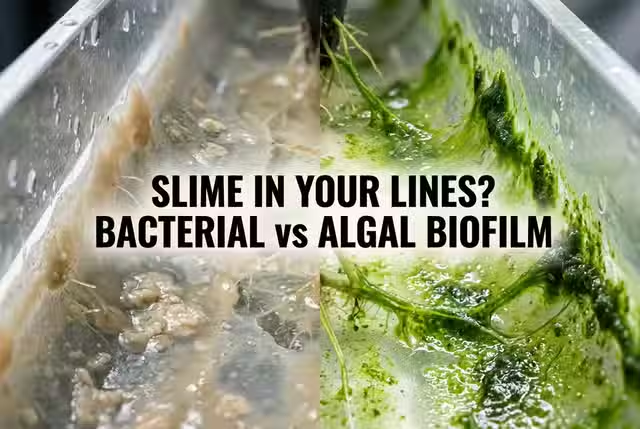
Algal biofilm needs light and only forms where light reaches standing water; bacterial biofilm needs neither light nor visible organic mess and forms just as readily inside fully dark tubing, pump housings, and emitter bodies.
Biofilm is the most common hidden cause of gradual emitter clogging and flow-rate drift in drip systems, since the slime layer narrows internal tubing diameter long before any visible blockage appears.
Mature biofilm physically shelters opportunistic pathogens such as Pythium and Phytophthora from contact sanitizers, a protective effect documented in soilless-culture microbiology research (Vallance et al., 2011, Agronomy for Sustainable Development).
Flushing with plain water removes loose debris but rarely strips attached biofilm; effective removal needs a chemical flush (hydrogen peroxide or chlorine-based) combined with physical agitation of the line or channel surface.
Recirculating NFT and drip systems amplify biofilm risk compared to run-to-waste setups, because the same water — and any biofilm fragments that slough off — repeatedly contacts every plant and emitter in the loop.
The Clog That Was Not Grit
A grower running a drip-fed lettuce rack notices three plants in a row wilting slightly even though EC and pH readings are normal and nothing else on the rack looks stressed. He pulls the emitter feeding the worst plant expecting a grain of perlite or root hair stuck in the orifice. Instead, a stringy gray-brown rope of slime comes out attached to the emitter barb, and the inside of the feed line feels slick when he runs a finger along it.
He had assumed it was a one-off mechanical clog from grit in the line, but what he pulled out was a fully established bacterial biofilm that had been narrowing that line for weeks — invisible from the outside the entire time.
How Bacterial Biofilm Actually Forms Inside Tubing and Channels
Biofilm formation follows a predictable sequence: free-floating bacteria first attach loosely to a wetted surface, then begin secreting extracellular polymeric substances (EPS) that anchor them permanently and trap nutrients, minerals, and other microbes passing in the flow. As the colony matures, it builds a three-dimensional slime layer thick enough to create internal channels and low-oxygen pockets, and eventually sheds fragments downstream to seed new surfaces. Calvo-Bado et al. (2003, Applied and Environmental Microbiology) documented this same attachment-to-maturation process inside horticultural irrigation filtration systems, showing biofilm communities establish and stabilize within roughly one to two weeks of continuous water flow.
Inside a drip emitter, the bore is often under a millimeter wide, so even a thin, even biofilm layer is enough to measurably reduce flow rate well before a grower would call the emitter clogged.
In a closed recirculating loop, biofilm fragments that slough off one emitter or channel joint do not get flushed away from the system — they travel downstream and can re-seed a clean section of channel or a different plant's emitter within a single irrigation cycle.
Bacterial Slime vs. Algal Biofilm vs. Pythium Mat — Telling Them Apart
Bacterial biofilm
Gray, tan, or colorless slime; forms anywhere there is moisture and organic nutrients, including fully dark tubing, pump housings, and emitter interiors; often stringy or rope-like when pulled, with a flat, stagnant odor.
Treat as a whole-plumbing sanitation issue — check dark, hidden sections (pump intakes, header lines, emitter bodies), not just visible channel surfaces.
Algal biofilm
Bright green to blue-green, slick, restricted strictly to surfaces that receive light, such as reservoir interiors, channel lids, and sight glasses; rubs off as a smooth paste rather than a rope.
Treat as a light-exclusion problem first; sealing light leaks stops new growth even before any cleaning is done.
Pythium root-rot mat
Brown to tan slime that forms specifically on root tissue rather than hard plumbing surfaces, with the outer root cortex sliding off when touched and a musty or sour smell.
Treat as an active pathogen event on the crop itself — isolate the tray and address root-zone oxygen and temperature, not just channel cleaning.
Myth: No Green Slime Means No Biofilm Problem
If the inside of my drip lines and channels does not look green or visibly dirty, there is no biofilm to worry about.
Bacterial biofilm is frequently colorless, gray, or tan and forms just as readily inside fully dark, light-excluded tubing as it does in any other wetted surface, since bacteria do not need light the way algae do. Soilless-culture microbiology research has documented bacterial biofilm communities establishing inside irrigation lines and filtration systems with no visible discoloration at all, detectable only through flow-rate decline or direct swabbing.
Calvo-Bado et al. (2003, Applied and Environmental Microbiology); Vallance et al. (2011, Agronomy for Sustainable Development).
Where Biofilm Builds Fastest in Indoor Hydroponic Loops
Channel and line sections downstream of pump cycling (rather than continuous flow) sections that sit static between irrigation pulses
Intermittent-flow setups consistently show heavier slime buildup at low-flow dead zones — channel joints, T-fittings, and the last few centimeters before a closed valve — than continuously irrigated sections do.
Prioritize dead zones and fitting joints, not just open channel runs, when inspecting or swabbing a system for biofilm.
Reservoir return lines that sit warm near pump housings versus chilled feed lines
Warmer, slower-moving return-line sections develop visible slime noticeably sooner than cooler, faster-moving feed-line sections in the same system.
Treat return lines and pump housings as a priority cleaning zone rather than assuming feed lines closest to the crop are the highest-risk spot.
Plant Mood grow log data
What Growers Are Actually Reporting
My drip emitters keep slowing down even though I just back-flushed the lines.
Plain water flushing dislodges loose debris but does not strip the attached EPS slime layer, so flow rate creeps back down within days as the remaining biofilm regrows.
Some plants on the same line as others are stressed even though the dosing and EC are identical.
Partial biofilm occlusion in that specific emitter or channel section is reducing delivered flow to that plant, even though the nutrient solution itself is correctly mixed.
I cleaned the visible channel surfaces and the slime came back within a week.
Biofilm fragments living inside fittings, pump housings, or sections of tubing that were not disassembled and cleaned reseed the freshly cleaned surfaces almost immediately.
There is a flat, stagnant smell from the reservoir but no visible algae anywhere.
Bacterial biofilm does not need to be visibly green or obvious to produce odor; it can be established and active in dark plumbing sections that are never directly seen.
I added a UV sterilizer in-line and I still get clogged emitters.
In-line UV treats microbes suspended in the water passing through the unit but has no effect on biofilm already attached to channel walls, tubing interiors, or emitter bodies, which still requires physical and chemical removal.
Cleaning Protocol for Established Biofilm in Channels and Drip Lines
Disassemble removable fittings, emitters, and any low-flow dead zones (T-joints, valve ends, channel joints) rather than only flushing assembled lines.
Direct visual and physical access to the sections most likely to harbor mature biofilm.
Most biofilm that survives routine flushing is sitting in exactly these hard-to-reach junctions, not in the open, easily flushed channel runs.
Physically swab or brush accessible interior surfaces to mechanically break up the EPS slime layer before applying any chemical treatment.
Loosened biofilm ready for chemical and water removal.
Chemical sanitizers penetrate a disrupted slime layer far more effectively than an intact, undisturbed one.
Circulate a diluted hydrogen peroxide or chlorine-based sanitizing solution through the full line and channel system per labeled dilution guidance, allowing adequate contact time before draining.
Chemically oxidized and disinfected internal surfaces throughout the plumbing run, not just the visible channel.
Contact time and full-loop circulation ensure the sanitizer reaches dark, hidden sections like pump housings and emitter bodies, not just the parts a grower can see.
Flush thoroughly with clean water until no sanitizer residue or odor remains before reconnecting to live nutrient solution.
A sanitized system safe to return to active crop irrigation.
Residual sanitizer left in the loop can stress or damage roots once nutrient solution resumes circulating.
Reassemble and monitor flow rate at several points in the system weekly for the first month after cleaning.
Early detection of any flow-rate decline indicating biofilm regrowth.
Flow-rate drift is typically the earliest measurable sign of biofilm returning, well before any visible slime reappears.
This week: pull at least one emitter and one low-flow joint or dead-zone fitting from your system and check them directly, rather than judging biofilm risk by what the open channel surfaces look like. If you find slime, disassemble what you can, mechanically scrub it, then run a full chemical flush with adequate contact time through the entire loop — not just the visible sections — and track flow rate at a few points weekly afterward so you catch regrowth before it starts stressing plants again.
FAQ
What is biofilm in a hydroponic NFT channel or drip line?
Biofilm is a mixed community of bacteria, algae, and trapped organic debris held together by a self-produced slime matrix called EPS, and it can establish on a wetted surface within about one to two weeks. It forms on channel walls, tubing interiors, pump housings, and emitter bodies, including sections that never receive light. Treat any slick or stringy interior coating as biofilm until proven otherwise, not just leftover dirt.
How do I tell bacterial biofilm apart from algae in my hydroponic system?
Algal biofilm is bright green to blue-green and only forms where light reaches standing water, such as reservoirs and channel lids. Bacterial biofilm is gray, tan, or colorless, often stringy or rope-like, and forms just as easily inside fully dark tubing and emitter bodies. If you find slime in plumbing that never sees light, it is bacterial, not algal.
Why do my drip emitters keep clogging even after I flush the lines?
Plain water flushing removes loose debris but does not strip an attached biofilm layer, so flow rate gradually drops again as the remaining slime regrows. Effective removal needs physical scrubbing or disassembly combined with a chemical sanitizer flush with adequate contact time. Track flow rate weekly after cleaning to confirm the fix is holding rather than assuming one flush solved it permanently.
Is biofilm in my hydroponic system dangerous to eat?
Biofilm itself is mainly an operational and clogging problem rather than a direct food-safety toxin, but mature biofilm can physically shelter opportunistic pathogens like Pythium and Phytophthora from sanitizers. Any tray near heavy biofilm buildup should have its root zone checked separately for rot symptoms. Biofilm and pathogen risk should be assessed as related but distinct issues.
Does a UV sterilizer remove biofilm from drip lines or NFT channels?
An in-line UV sterilizer kills microbes suspended in water as it passes through the unit, which helps prevent new colonization downstream. It has no effect on biofilm already attached to channel walls, tubing interiors, or emitter bodies, since that material never passes through the UV chamber. UV should be paired with physical cleaning and chemical flushing, not used as a standalone fix.
What actually removes established biofilm from hydroponic plumbing?
Mechanical agitation — brushing or disassembling fittings — to break up the slime layer, followed by a hydrogen peroxide or chlorine-based sanitizing flush with sufficient contact time, removes established biofilm far more reliably than water flushing alone. The system should then be flushed clean of sanitizer residue before nutrient solution returns. Skipping the mechanical step and relying on chemicals alone tends to leave the slime layer largely intact.
Why does biofilm keep coming back after I clean the visible channel surfaces?
Biofilm fragments living inside fittings, pump housings, or unseen tubing sections that were not disassembled and cleaned can reseed freshly cleaned visible surfaces within days. A thorough protocol needs to include hidden dead zones like channel joints and valve ends, not just open channel runs. This is the most common reason growers see slime return shortly after a visible clean.
Where does biofilm build up fastest in a recirculating hydroponic system?
Low-flow dead zones such as channel joints, T-fittings, and sections near closed valves accumulate slime noticeably faster than continuously irrigated open channel runs. Warmer return-line sections near pump housings also tend to develop visible biofilm sooner than cooler feed lines. Prioritize inspecting these specific spots rather than judging the whole system by its most visible surfaces.