Key takeaways
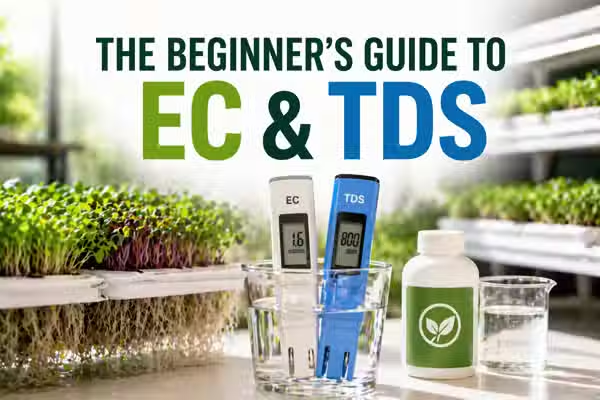
EC measures the electrical conductivity of a solution in millisiemens per centimetre (mS/cm) and is a direct physical measurement; TDS is a calculated estimate of dissolved solids in parts per million (ppm) derived from EC using a conversion factor that varies by meter brand and is never printed on the packaging.
The two most common TDS conversion factors are 0.5 (the NaCl scale, used by Hanna and most budget meters) and 0.7 (the KCl scale, used by Bluelab and some European brands) -- a reading of 1.0 mS/cm EC will display as either 500 ppm or 700 ppm depending on which scale your meter uses, and both readings are correct for their respective scales.
Bangkok tap water EC runs between 0.3 and 0.6 mS/cm depending on district and season, which means your baseline before adding any nutrients is already 150 to 420 ppm on a 0.7 scale -- a number that will push a beginner to underfeed if they target total TDS without subtracting the tap water baseline.
EC is the more reliable measurement for hydroponic management because it is scale-independent -- 1.4 mS/cm means the same thing on every meter, whereas 980 ppm means something different depending on which conversion factor your meter uses.
A TDS or EC reading tells you the total concentration of dissolved ions but cannot tell you the ratio between them -- a solution at EC 2.0 could be correctly balanced or dangerously skewed toward one element, and the meter reading is identical in both cases.
For leafy greens and herbs in a Bangkok tower or NFT system, an EC target of 1.2 to 1.8 mS/cm produces consistent results across our cycles; pushing above 2.0 mS/cm in reservoir temperatures above 30 degrees Celsius accelerates tip burn and osmotic stress before yield benefits appear (Plant Mood grow log data, 2024).
TL;DR
EC and TDS are not the same measurement with different units. EC is what the meter physically detects. TDS is a number the meter calculates from EC using a conversion factor that varies by brand and is almost never disclosed in the product listing. In Bangkok, where tap water already carries a measurable dissolved solid load and reservoir temperature pushes the solution chemistry in ways temperate guides do not account for, working in EC rather than TDS removes a layer of ambiguity that causes real mistakes. Learn one number, use it consistently, and stop converting.
The nutrient solution that was simultaneously too strong and too weak
A grower running a small Bangkok tower setup, two months in, messaging to say their lettuce was showing tip burn and stunted new growth simultaneously. They had been targeting 800 ppm because that was the number in the beginner guide they had been following. Their meter read 810 ppm. Everything looked right on paper. What they had not been told was that their meter used a 0.7 conversion factor, which meant 810 ppm was actually 1.16 mS/cm EC. The guide they were following used a 0.5 conversion factor, meaning its 800 ppm target was 1.6 mS/cm. Their solution was 28 percent weaker than the guide intended. The tip burn was not from overfeeding. It was from a calcium deficiency caused by a solution too dilute to deliver adequate calcium at the root uptake rate their reservoir temperature demanded.
The meter was accurate. The ppm number was correct for its scale. The guide's ppm number was correct for its scale. The two numbers were not comparable because they were calculated from EC using different conversion factors, and neither the guide nor the meter packaging mentioned which scale they used. Switching both the grower and the guide reference to EC eliminated the ambiguity in one step. The solution was remixed at 1.6 mS/cm, the calcium deficiency resolved within 10 days, and the tip burn cleared on new growth. Nothing about the growing changed except the unit of measurement used to calibrate the solution.
What EC actually measures and how TDS is derived from it
Electrical conductivity measures how readily a solution carries an electrical current between two probes. Pure water conducts almost no current. As dissolved ions accumulate -- from nutrient salts, minerals in tap water, or anything else that dissociates into charged particles in solution -- the conductivity increases. The meter applies a small voltage across the probes and measures the resistance, then converts resistance to conductivity expressed in millisiemens per centimetre. This is a direct physical measurement. The meter is detecting actual ion activity in the solution at the moment of measurement, corrected for temperature because conductivity changes approximately 2 percent per degree Celsius. TDS is not measured. It is estimated. Once the meter has a conductivity reading, it multiplies it by a conversion factor to produce a parts-per-million figure that approximates the mass of dissolved solids per litre of solution. The conversion factor used is based on a reference salt -- either sodium chloride or potassium chloride -- because these salts have known conductivity-to-mass relationships. Nutrient solutions are not sodium chloride or potassium chloride. They are complex mixtures of multiple salts with different molecular weights and different conductivity contributions per gram. The TDS figure is therefore an approximation with a built-in error that varies depending on the actual composition of the solution being measured.
A solution of calcium nitrate at a given mass per litre will produce a different conductivity reading than the same mass per litre of potassium sulphate, because the two compounds have different ion mobilities and different degrees of dissociation. The EC meter detects this difference accurately. The TDS calculation then applies a fixed conversion factor that was calibrated on a different salt entirely, producing a TDS figure that does not correspond directly to the actual dissolved solid mass in either case. For hydroponic management purposes this imprecision is acceptable -- the EC reading that underlies the TDS figure is valid regardless. The problem arises only when growers compare TDS numbers across meters or guides without knowing which conversion factor each is using.
Temperature compensation in EC meters works by referencing all readings to a standard temperature, typically 25 degrees Celsius. A solution measured at 32 degrees Celsius in a Bangkok reservoir will have a higher raw conductivity than the same solution at 25 degrees Celsius because ion mobility increases with temperature. The meter compensates for this automatically and reports the 25-degree-equivalent value. This means EC readings are comparable across different water temperatures as long as automatic temperature compensation (ATC) is active -- a setting that should be confirmed on any meter used in Bangkok conditions where reservoir temperature varies significantly across the day.
A higher EC reading does not always mean more nutrients available to the plant
EC measures total ion concentration but is blind to ion ratios. A solution at EC 1.8 mS/cm could contain a correctly proportioned mix of nitrogen, phosphorus, potassium, calcium, magnesium, and micronutrients in the ratios a crop needs. It could also contain the same total ion load with a severely skewed ratio -- excess sodium from low-quality tap water, excess sulphate from a single-salt top-up, or depleted calcium because the crop has been selectively absorbing it faster than other elements. The meter reports the same EC in all three cases. The crop experiences them very differently. In Bangkok tap water, the baseline dissolved solid load includes calcium, magnesium, and sodium at varying concentrations depending on the treatment source. These ions contribute to the EC reading before a single nutrient is added. A grower targeting EC 1.4 mS/cm who starts from Bangkok tap water at EC 0.45 mS/cm and adds nutrients to reach 1.4 mS/cm has a solution with a different ion ratio than a grower using RO water at EC 0.02 mS/cm who adds the same nutrient formula to the same target. The number is identical. The chemistry is not.
We ran a comparison across four cycles using Bangkok tap water baseline versus filtered water baseline, both targeting EC 1.4 mS/cm with the same nutrient formula. The tap water cycles consistently showed faster calcium and magnesium accumulation in older leaves -- visible as marginal chlorosis at week 3 -- that the filtered water cycles did not show at the same EC target. The tap water was not harming the crop through toxicity; it was skewing the ion ratio enough that the nutrient formula was delivering excess calcium relative to potassium in a way the EC reading gave no indication of. The fix was reducing the calcium-heavy component of the nutrient formula when using tap water, not adjusting the EC target.
EC is a proxy for nutrient concentration. Higher EC means more dissolved nutrients in the solution, which means more available to the plant. Beginners follow this logic to its natural conclusion: if the crop looks deficient, raise the EC. If tip burn appears, lower it. The EC number is treated as a direct dial for how much nutrition the plant is receiving.
What our EC and TDS observations showed across Bangkok grow cycles
Across measurements taken at our grow location in Bangkok over 12 months, tap water EC ranged from 0.28 mS/cm in the rainy season to 0.54 mS/cm in the dry season hot months. The seasonal variation was consistent enough to be predictable -- dry season tap water was reliably higher in dissolved solids than rainy season water, likely reflecting reduced dilution in the municipal supply source. On a 0.7 TDS scale, this represents a baseline range of 196 to 378 ppm before any nutrient addition. A beginner targeting 700 ppm total with a 0.7-scale meter is adding very different amounts of actual nutrient depending on the season, and the variation is large enough to produce visible growth differences across crop cycles that look like inconsistent growing practice but are actually inconsistent tap water baseline.
Bangkok tap water EC varied by district and season enough to matter for target calibration
Measuring and logging tap water EC before mixing each reservoir is not optional in Bangkok. It takes 10 seconds and it is the only way to know how much nutrient you are actually adding as opposed to how much total EC you are targeting. Growers who mix to a total EC target without subtracting the tap water baseline are adding a seasonal variable to every reservoir mix without knowing it.
In cycles where we managed the reservoir using a TDS meter on a 0.5 scale, our top-up decisions lagged behind actual EC changes because the lower conversion factor compressed the apparent range of variation. A drift from EC 1.4 to EC 1.65 mS/cm -- a 0.25 mS/cm change that we treat as a significant drift requiring a partial reservoir change -- reads as a change from 700 ppm to 825 ppm on a 0.5-scale meter. The 125 ppm shift looked minor. The same drift on an EC meter registered immediately as outside the target band. We made more timely corrections when managing in EC than in TDS across the same crop cycles, and the cycles managed in EC showed more consistent growth rates week over week.
EC drift rate in our tower reservoir was faster than TDS-based management caught
Managing in TDS compresses the apparent variation in your reservoir and delays corrections relative to managing in EC. This is not a meter quality problem -- it is a unit problem. EC has a tighter apparent range than TDS and makes drift more visible in the numbers. For a grower checking their reservoir once daily, that visibility difference matters.
In four cycles where we pushed EC above 2.0 mS/cm targeting faster growth in lettuce and pak choi, tip burn appeared by week 2 in all four cycles. The reservoir temperature in each case was running above 30 degrees Celsius at peak daily ambient. At elevated water temperatures, the osmotic gradient between root cell and solution increases -- the solution is more concentrated relative to the root cell interior, making water uptake harder for the plant. Tip burn in leafy greens at high EC is a calcium transport failure: the plant cannot move water fast enough through the transpiration stream to deliver calcium to the leaf margins. Lowering EC to 1.6 mS/cm in the same temperature conditions resolved tip burn on new growth within 8 days across three subsequent cycles.
EC above 2.0 mS/cm in Bangkok hot season produced tip burn before yield benefits in leafy greens
The EC target range published in temperate hydroponic guides is not the correct target range for Bangkok conditions at water temperatures above 28 degrees Celsius. The upper end of the acceptable range compresses in heat because the osmotic and calcium transport effects of concentrated solution are amplified by temperature. Managing to the lower half of the recommended range in Bangkok hot season is not underfeeding -- it is temperature-appropriate calibration.
Plant Mood grow log data, 2024
What EC and TDS readings do not tell you and where growers rely on them too heavily
As a crop grows, it does not consume all nutrients equally. Leafy greens pull nitrogen and calcium heavily in vegetative growth while consuming potassium and phosphorus at different rates. Over a reservoir cycle of 10 to 14 days without a full change, the ratio of available ions shifts even as the total EC stays within target range. A reservoir that started at a correct ratio at EC 1.4 mS/cm may be calcium-depleted and nitrogen-skewed by day 10 at the same EC reading. The meter cannot detect this. The crop can -- through slowed growth, interveinal chlorosis, or tip burn -- but by the time these symptoms appear the imbalance has been developing for days. Full reservoir changes on a fixed cycle, rather than top-up management indefinitely, exist to reset the ion ratio that EC cannot track.
Ion ratio depletion over a long reservoir cycle
Rockwool, coco coir, and clay pebbles all leach ions into the solution at different rates, particularly when new. Fresh rockwool is alkaline and releases calcium and magnesium. Fresh coco coir releases potassium and can sequester calcium, temporarily pulling it out of solution. Clay pebbles are relatively inert after washing but can carry dust that dissolves and affects early readings. A beginner who mixes their first reservoir, measures EC, and targets a specific number without accounting for the medium contribution is measuring a composite of nutrient solution and leachate that changes across the first several days as the medium stabilises. Measuring EC in the runoff or reservoir after the first 24 hours of a new system rather than immediately after mixing gives a more accurate picture of what the roots are actually experiencing.
The contribution of growing medium to EC readings
EC probe accuracy depends on clean electrode surfaces. In Bangkok ambient humidity of 70 to 85 percent, a probe stored without rinsing after use will accumulate mineral deposits from evaporated solution on the electrode surface faster than in a dry climate. A fouled probe reads low -- the deposits insulate the electrodes and reduce the detected conductivity. A grower using a fouled probe in a declining reservoir will see EC readings that suggest the solution is within range when it has drifted above target. Rinsing with distilled or RO water after every use and calibrating monthly is the maintenance standard. Most beginners calibrate once at purchase and do not repeat it until the meter gives an obviously wrong reading.
EC meter probe fouling in Bangkok humidity
Automatic temperature compensation on budget EC and TDS meters is calibrated for a reference temperature range that typically centres on 25 degrees Celsius. At Bangkok reservoir temperatures of 30 to 33 degrees Celsius, the compensation algorithm in some budget meters underperforms -- the correction applied is less accurate at the extreme end of the sensor's operating range than at the centre of it. This produces readings that are directionally correct but carry a larger error margin than the meter specification implies. It is not a reason to avoid budget meters -- they are adequate for small-scale hydroponic management -- but it is a reason to take readings at a consistent time of day when reservoir temperature is most stable, rather than treating any-time readings as equally reliable.
Temperature compensation assumptions in budget meters
Where EC and TDS management practice is heading for small Bangkok growers
Within two years, continuous EC logging via low-cost IoT sensors will become standard practice for small Bangkok hydroponic operations, replacing once-daily manual checks and eliminating the drift management errors that currently cause the majority of preventable crop quality failures
The hardware cost for continuous EC logging has dropped to the point where a calibrated Atlas Scientific or Chinese-equivalent EC probe connected to an ESP32 microcontroller represents a one-time investment under 1,500 baht that logs readings every few minutes indefinitely. The barrier is no longer cost -- it is awareness and setup complexity. As more small growers in Bangkok share continuous log data through growing communities and the patterns become visible, manual spot-checking will look as inadequate as it actually is. The growers who log continuously already manage their reservoirs differently from those who check once daily because they can see drift developing over hours rather than discovering it after the damage is done.
A survey of Bangkok small-scale hydroponic growers in 2027 shows fewer than 20 percent using continuous EC monitoring. If manual daily checking remains the dominant practice, the prediction is wrong.
The ppm-versus-EC confusion will produce a visible wave of misdiagnosed nutrient deficiencies in Bangkok's growing urban farming community over the next 12 to 18 months as more beginners enter hydroponic growing following social media content that mixes conversion scales without disclosure
Thai-language and English-language hydroponic content on Instagram and TikTok aimed at Bangkok beginners consistently uses ppm as the primary unit without disclosing the conversion scale. As the beginner grower population grows and more people source meters from Lazada and Shopee -- where the scale used by the meter is rarely in the product description -- the gap between guide targets and actual solution strength will generate a predictable cluster of misdiagnosis events. Growers will add nutrients to a solution that is already adequate on one scale but reads low on another, producing toxicity symptoms they interpret as deficiency.
Bangkok hydroponic growing communities on Facebook and Line show no increase in posts about unresolved nutrient deficiency or tip burn over the 2025 to 2026 period compared to 2024 baseline. If the confusion rate stays flat despite growing community size, the prediction is wrong.
A Bangkok-specific EC target range for leafy greens in tropical apartment conditions -- lower than the international standard range -- will be formally documented and shared within growing communities within 24 months as growers accumulate enough logged cycle data to make the pattern undeniable
The international EC target ranges published in hydroponic guides are derived from temperate grow room research at controlled water temperatures. The compounding effect of Bangkok reservoir temperatures on osmotic stress and calcium transport means the effective upper limit for leafy greens in uncontrolled Bangkok conditions is lower than published ranges suggest. Individual growers are already discovering this in their own cycles. Once enough logged data from Bangkok-specific operations is shared in one place, the pattern will be clear enough to constitute a documented local standard rather than individual anecdote.
No Bangkok-specific EC target documentation appears in Thai hydroponic growing communities or published urban farming resources by end of 2027. If the international ranges continue to be applied without tropical adaptation, the prediction is wrong.
What growers say is confusing about EC and TDS, and what is actually going on
My meter says 700 ppm but the guide says target 700 ppm and my plants still look deficient
The guide and the meter are almost certainly using different conversion factors. If the guide was written using a 0.5-scale meter and your meter uses a 0.7 scale, the guide's 700 ppm target is 1.4 mS/cm EC and your meter's 700 ppm reading is 1.0 mS/cm EC. Your solution is 30 percent more dilute than the guide intends. The deficiency is real. The meter reading is accurate. The two numbers are simply not comparable because they use different math. Convert both to EC -- which requires knowing which scale each is using -- and the comparison becomes valid. If the guide does not specify its conversion scale, assume 0.5 and convert accordingly.
I changed nothing about my nutrient mixing and my EC readings are higher than last month
In Bangkok, this is almost always a tap water baseline shift driven by seasonal variation in municipal supply. Dry season tap water carries more dissolved solids than rainy season water -- the difference across a year at our grow location was 0.26 mS/cm, which is large enough to push a correctly mixed solution above its target EC band without any change in the nutrient formula. Measure your tap water EC before mixing and subtract it from your target to determine how much nutrient to add rather than mixing to a total EC target without accounting for the baseline. The solution is correct formulation, not a fixed recipe applied regardless of what the tap water is contributing.
I hit my EC target but still get tip burn on my lettuce
In Bangkok reservoir temperatures above 30 degrees Celsius, the published EC target range for lettuce does not account for the osmotic effect of heat on calcium transport. The upper end of the acceptable EC range in temperate conditions -- typically around 1.8 to 2.2 mS/cm for lettuce -- causes tip burn at Bangkok water temperatures because the plant cannot move water and calcium to leaf margins fast enough against the osmotic gradient created by a warm, concentrated solution. The EC target is correct for the climate it was developed in. It is not correct for an uncontrolled Bangkok apartment in April. Reduce EC to the lower half of the published range -- 1.2 to 1.5 mS/cm -- in hot season and tip burn on new growth resolves within 7 to 10 days.
My two meters give different readings on the same water
If both meters are EC meters, the difference is either calibration drift or temperature compensation variance -- both fixable with recalibration using a reference solution. If one is an EC meter and one is a TDS meter, the difference is the conversion factor and both readings are correct for their respective scales. The only way to know which scenario applies is to check whether the meter units are the same (mS/cm versus mS/cm, or ppm-500 versus ppm-700) and when each was last calibrated. A budget EC probe that has not been recalibrated in 6 months in Bangkok humidity will read low due to electrode fouling. Recalibrate both meters against a known reference solution, confirm they are using the same scale, and the divergence will either resolve or reveal a faulty probe.
How to manage EC and TDS without creating problems the measurement was meant to prevent
Grower at any stage, immediately
Find out which conversion scale your meter uses. Look for '500 scale', 'NaCl', '0.5 factor', '700 scale', 'KCl', or '0.7 factor' in the manual, on the packaging, or in the product listing. If you cannot find it, email the manufacturer or search the model number with 'conversion factor'. Write it on the meter with a marker. Every nutrient guide you use, every target range you follow, and every reading you compare with another grower needs to be on the same scale or converted to EC first.
Every ppm reading you take is now interpretable and comparable. The single most common source of EC and TDS confusion for Bangkok beginners is eliminated.
Grower at reservoir mixing
Measure tap water EC before mixing every reservoir, not just the first one. Log it with the date. In Bangkok, this number varies enough across seasons to affect your nutrient addition if you are mixing to a total EC target. Subtract the tap water EC from your target EC to determine how much nutrient to add. If your target is 1.4 mS/cm and your tap water reads 0.45 mS/cm, you are adding nutrients to reach a delta of 0.95 mS/cm, not 1.4 mS/cm total.
Reservoir EC at mix time hits the actual target rather than a number that includes an unaccounted seasonal tap water variable. Solution strength is consistent across months rather than varying with municipal water treatment cycles.
Grower managing an active reservoir
Check EC at a consistent time of day -- the same time every check. In Bangkok, reservoir temperature peaks in the afternoon and budget meter temperature compensation is least accurate at temperature extremes. A morning reading at the cooler part of the day is more consistent across days than an afternoon reading taken at varying times. Log the reading, the time, and the reservoir temperature alongside it. Three numbers, 30 seconds.
Readings are comparable across days because they are taken under consistent conditions. Temperature compensation errors from budget meters are minimised by taking readings when reservoir temperature is most stable.
Grower at top-up time
Top up with plain water when EC is at or above target -- evaporation in Bangkok raises EC by concentrating the existing solution, and adding nutrient solution to an already-at-target reservoir compounds the problem. Top up with dilute nutrient solution only when EC has dropped below target, which in Bangkok hot season happens less often than beginners expect. When in doubt, measure before adding anything.
EC stays within the target band without accumulation events. Reservoir life extends and full flushes are needed on a predictable schedule rather than as emergency corrections.
Grower on a maintenance schedule
Calibrate your EC or TDS meter monthly using a reference calibration solution at the concentration specified for your meter. In Bangkok humidity, probe fouling from mineral deposits accumulates faster than in dry climates. A meter calibrated at purchase and never recalibrated will read progressively lower as the electrode surface fouls, making a rising EC problem look stable until the crop shows symptoms. Calibration solution is inexpensive and a monthly recalibration takes under 5 minutes.
Meter readings remain accurate over time. EC drift events are caught by the meter rather than first appearing as crop symptoms.
Measuring tap water EC before mixing. Most beginners measure it once when they set up the system, note it as a baseline, and then mix every subsequent reservoir to a total EC target without re-measuring. In Bangkok, tap water EC shifts enough across the dry and rainy seasons to introduce a 0.2 to 0.3 mS/cm variation into every reservoir mix. That variation is invisible to the grower who stopped measuring tap water EC after the first week -- and it is large enough to explain the inconsistent growth across cycles that gets attributed to technique, seeding density, or lighting instead.
FAQ
What is the difference between EC and TDS in hydroponics?
EC (electrical conductivity) is a direct physical measurement of how well a solution conducts electricity, expressed in millisiemens per centimetre (mS/cm). TDS (total dissolved solids) is a calculated estimate expressed in parts per million (ppm), derived from EC by multiplying it with a conversion factor. The conversion factor varies by meter brand -- commonly 0.5 (NaCl scale) or 0.7 (KCl scale) -- which means 1.0 mS/cm EC displays as either 500 ppm or 700 ppm depending on which meter you use. EC is the more reliable unit for hydroponic management because it is scale-independent.
Why do my two TDS meters give different readings on the same water?
If both meters are TDS meters, they are almost certainly using different conversion factors -- the 0.5 NaCl scale or the 0.7 KCl scale. A solution at 1.0 mS/cm EC will read 500 ppm on a 0.5-scale meter and 700 ppm on a 0.7-scale meter. Both readings are correct for their respective scales. Check the manual or product listing of each meter for '500 scale', 'NaCl', '700 scale', or 'KCl' to identify which each uses, then convert both to EC for a valid comparison. If both meters claim to use the same scale but still diverge, one or both probes may need recalibration.
What EC should I target for leafy greens in a Bangkok hydroponic system?
For leafy greens and herbs in a Bangkok tower or NFT system, an EC target of 1.2 to 1.8 mS/cm produces consistent results. Pushing above 2.0 mS/cm in reservoir temperatures above 30 degrees Celsius accelerates tip burn and osmotic stress before yield benefits appear, because heat amplifies the osmotic gradient between root cell and solution and impairs calcium transport to leaf margins. The published temperate guide range of 1.8 to 2.2 mS/cm for lettuce is not appropriate for uncontrolled Bangkok apartment conditions in hot season. Managing to the lower half of the published range in Bangkok heat is temperature-appropriate calibration, not underfeeding (Plant Mood grow log data, 2024).
Why does my EC keep rising even though I haven't added any nutrients?
In Bangkok ambient temperatures above 30 degrees Celsius, evaporation removes water from the reservoir faster than the crop removes dissolved ions. The same total dissolved solids in a shrinking water volume produces a rising EC reading. This is concentration through evaporation, not nutrient accumulation. The correct response is to top up with plain water to restore volume and bring EC back to target. Adding nutrient solution to a rising EC reservoir compounds the problem. In our Bangkok tower, EC drifted 0.15 to 0.25 mS/cm upward per 24 hours during hot season without top-up (Plant Mood sensor log data, 2024).
Does Bangkok tap water affect my hydroponic nutrient solution EC?
Yes, significantly. Bangkok tap water EC ranges from 0.28 mS/cm in the rainy season to 0.54 mS/cm in the dry season at our grow location -- a seasonal variation of 0.26 mS/cm. On a 0.7 TDS scale this represents a baseline range of 196 to 378 ppm before any nutrient addition. A grower mixing to a total EC target of 1.4 mS/cm without measuring tap water EC is adding different amounts of actual nutrient depending on the season. Measure tap water EC before every reservoir mix and subtract it from your target EC to determine the nutrient addition delta rather than mixing blindly to a total target.
How often should I calibrate my EC or TDS meter in Bangkok?
Monthly calibration with a reference solution is the correct interval for Bangkok conditions. Bangkok's ambient humidity of 70 to 85 percent accelerates mineral deposit accumulation on EC probe electrodes, which insulates the surface and causes the meter to read progressively lower over time. A fouled probe makes a rising EC problem look stable until the crop shows symptoms. Monthly recalibration catches drift before it causes management errors. Most beginners calibrate at purchase and do not repeat it -- in Bangkok humidity, that approach means the meter is unreliable within 2 to 3 months of first use.
Why do I have tip burn even though my EC is within the target range?
In Bangkok reservoir temperatures above 30 degrees Celsius, the published EC target range for lettuce and leafy greens does not account for the osmotic effect of heat on calcium transport. At warm water temperatures, the plant cannot move water and calcium to leaf margins fast enough against the osmotic gradient created by a concentrated solution, even at concentrations that would be safe at 20 degrees Celsius. The EC target is within the range written for temperate conditions. It is above the effective safe ceiling for an uncontrolled Bangkok apartment in hot season. Reducing EC to 1.2 to 1.5 mS/cm resolves tip burn on new growth within 7 to 10 days without changing any other variable (Plant Mood grow log data, 2024).