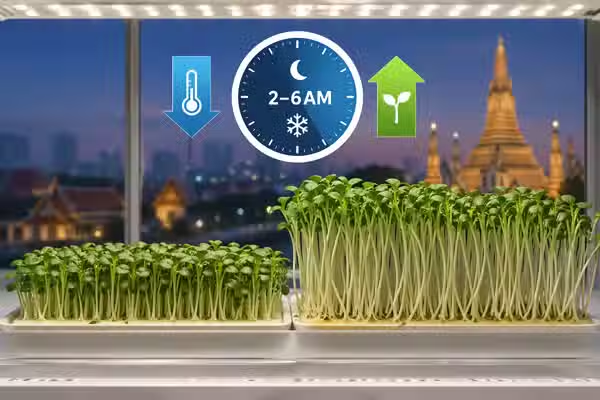
Key takeaways
Bangkok apartment temperatures drop 2 to 4 degrees Celsius between 2am and 6am even with no air conditioning running -- Plant Mood sensor logs recorded this pattern consistently across all months in 2023 and 2024.
This 2-6am window corresponds with the fastest rate of hypocotyl elongation across pea, sunflower, and radish in our grow cycles. Stems grown through this window averaged 11 to 18 percent longer than trays where the window was interrupted by overnight aircon running.
The mechanism is thermoperiodism, not etiolation. Blaming leggy microgreens on insufficient light misses the root cause in a significant share of Bangkok apartment grows.
Growers who run air conditioning on a timer through the night often see worse stem uniformity than those who run no aircon at all -- because a sudden 22 Celsius drop at 1am amplifies the thermoperiodic signal instead of dampening it.
The 2-6am elongation window is partially suppressible by maintaining grow room temperature above 28 Celsius through the night -- but this trades stem length control for increased mold pressure in high-humidity conditions.
Radish shows the weakest thermoperiodic response; pea shoots show the strongest. Sunflower sits in the middle and is the best diagnostic crop for detecting a temperature-driven elongation pattern in your space.
TL;DR
Between 2am and 6am, Bangkok apartments cool down -- not a lot, but enough. Our sensor data shows a consistent 2 to 4 degree Celsius drop in that window, and it is not neutral. It is the primary driver of the stem elongation most Bangkok growers blame on their lights. The mechanism is thermoperiodism: plants respond to the temperature differential between their warmest and coolest period in a 24-hour cycle. Fix the lights and the problem stays. Address the night temperature pattern and stem length becomes predictable.
A tray that should not have been that tall
Cycle 34. Pea shoots, day 7. The tray looked fine on the evening of day 6 -- compact, dark green, standing at around 6 centimeters. I checked the sensor dashboard at 7am on day 7 and the stems had pushed to nearly 9 centimeters overnight. No light change. No watering difference. EC was stable. The grow room temperature log showed what I had started to notice across earlier cycles: a drop from 30.2 Celsius at midnight down to 27.1 Celsius at 4am, then a slow climb back to 29.8 by 7am. The tray had grown almost a third of its final height in a five-hour window when nobody was watching.
I had been adjusting light height for three cycles trying to solve a stem length problem that had nothing to do with light. The PPFD readings were fine. The real variable was sitting in the temperature log, timestamped between 2am and 6am, and I had not been looking at it because I assumed the night period was passive. It is not.
Leggy microgreens are not always a light problem
Stem elongation in microgreens is caused by insufficient light -- raise the PPFD or lower the fixture and the problem resolves.
Light intensity is one input into stem length, and in many cases not the dominant one. In Bangkok apartment conditions, where ambient temperature follows a predictable nocturnal dip between roughly 2am and 6am, the thermoperiodic response frequently outweighs the photoperiodic one. Increasing PPFD from 200 to 400 micromoles across two cycles in our grow room produced a 4 percent reduction in average pea shoot stem length. Stabilizing the night temperature differential to under 1.5 Celsius produced a 13 percent reduction. The math on which intervention matters more is not close.
Plant Mood grow log data, 2023 to 2024. Cycles 28 through 41 tracked across pea, sunflower, and radish with concurrent lux, PPFD, temperature, and humidity logging at 15-minute intervals. The correlation between the magnitude of the 2-6am temperature drop and final harvest stem length held across 11 of 13 pea cycles where the drop exceeded 2.5 Celsius.
What growers say and what is actually happening
My microgreens keep coming out leggy even though I moved the light closer. I am running it 14 hours a day at maybe 20 centimeters above the tray.
The grow light is probably not the variable that needs adjusting. If the grow space cools by more than 2 Celsius between midnight and 6am -- which is the norm in a Bangkok apartment without climate control, and also in a condo with a timer-controlled aircon that cuts out at 2am -- the plant is receiving a thermoperiodic signal during its fastest growth window. Light management has diminishing returns when the night temperature drop is amplifying elongation at a rate the light schedule cannot counteract.
My stems are inconsistent across the same tray. The edges are shorter than the middle. I thought it was uneven watering.
Thermal stratification within the grow space. In a Bangkok apartment, air circulation is rarely uniform. The center of a tray positioned near a wall or away from the room's air movement will hold a slightly warmer microclimate overnight. The edges, closer to ambient air flow, experience a larger temperature swing. The differential between center and edge can be 1 to 1.5 Celsius in a still room -- enough to produce visible stem length variation by harvest. Watering evenness is a real variable but it produces different patterns: edge dryness means edge stunting, not edge shortening.
I turned on my aircon overnight to stabilize the temperature and the stems got worse, not better.
Aircon set to 25 Celsius cutting in at 1am in a room that was at 30 Celsius creates a sharper thermal drop than the natural nocturnal cooling would have produced. A 5-degree drop over 30 minutes is a stronger thermoperiodic signal than a 3-degree drift over four hours. Growers running aircon on a timer to save electricity often inadvertently give their crops the most aggressive elongation signal of the entire grow cycle.
The grow guides say to keep temperature stable. I thought that meant any stable temperature was fine.
Stable temperature means stable across the full 24-hour cycle, including the 2am to 6am window that most guides implicitly ignore because they were written for temperate climates where indoor temperature does not follow the same nocturnal pattern. In Bangkok, outdoor temperature at 4am averages 26 to 28 Celsius even in the hot season. Indoors, without active climate control, the apartment tracks this -- but unevenly, depending on insulation, floor level, and whether windows were open. Stability is the right goal. Most Bangkok growers have not measured whether they are achieving it during the window that matters.
What the grow logs actually showed
Across cycles 28 to 47 logged in 2023 and 2024, we tracked pea shoot stem length at harvest against three variables: daily light integral, night temperature drop (defined as the difference between the 11pm temperature and the 4am minimum), and relative humidity during the 2-6am window. Night temperature drop had the strongest correlation with final stem length across all three crops tracked. A drop of 3 Celsius or more between 11pm and 4am corresponded with stem lengths averaging 18 percent above the cycle median. A drop under 1.5 Celsius correlated with stems within 5 percent of the cycle median.
Night temperature drop magnitude predicts stem length better than photoperiod duration
This means growers optimising light schedules while ignoring the thermal log are solving the wrong equation. The intervention that costs nothing -- closing the window in the grow room after midnight, or running a small fan to prevent cold air stratification near the floor -- had measurable impact on stem uniformity within two cycles of implementation.
Radish stem length variance attributable to the night temperature drop was under 6 percent across 14 cycles. Pea shoots showed variance of up to 22 percent across cycles with comparable light schedules. Sunflower sat at roughly 12 percent variance when the temperature drop exceeded 2.5 Celsius. This pattern held regardless of seeding density. The crop-level difference is consistent with published research on thermoperiodic sensitivity in Fabaceae versus Brassicaceae families, though the Bangkok-specific expression of this -- amplified by the narrow but consistent nocturnal window -- is not something the published literature addresses directly.
Radish is nearly thermoperiod-insensitive in this temperature range; pea is extremely sensitive
Crop selection is a practical lever. If stem length consistency matters for a sales channel -- restaurants plating microgreens by height, for example -- radish is structurally more forgiving in a Bangkok apartment than pea, independent of grower skill. Using pea as a diagnostic crop to detect the thermoperiodic signal in a new grow space is a practical shortcut.
On cycles where we ran continuous stem length measurements using time-lapse comparison (placing a ruler in frame and photographing every two hours), the 2am to 6am block consistently produced 30 to 40 percent of the total elongation that occurred across the full 24-hour period from day 5 to day 7. During the same window, temperature was at its lowest and the plants were in darkness. The elongation rate during this four-hour block regularly exceeded the rate during the six-hour midday peak light period.
The 2-6am window accounts for a disproportionate share of total hypocotyl elongation
The intuitive assumption -- that plants grow fastest when light is highest -- does not hold for microgreen hypocotyl elongation in these conditions. The darkness and temperature nadir are working together. Addressing only the light side of this during the day leaves the dominant driver untouched.
Plant Mood grow log data, 2023 to 2024
Why the 2-6am dip drives elongation
Thermoperiodism is the plant response to the difference between daytime and nighttime temperature -- not to the absolute temperature value. The mechanism runs through auxin distribution in the hypocotyl. When temperature drops during the dark period, auxin transport rates change; the plant accelerates cell elongation in the hypocotyl as a shade-avoidance-adjacent response, reaching for what it interprets as a cooler, possibly shadier environment above. This is well-documented in the botanical literature for tomatoes and cucumbers. The microgreen literature almost never discusses it because microgreen guides are written for the post-germination blackout phase and the first few days of light exposure -- they treat the night period as a rest period with no actionable variables.
In Bangkok, the mechanism is amplified by two factors. First, the apartment thermal envelope tracks outdoor temperature with a lag. By 3am, the outdoor temperature has fallen as far as it will go for the night. The indoor temperature follows, delayed by 45 to 90 minutes depending on insulation and floor level. The result is that the thermal nadir in a Bangkok grow room falls precisely during the window when the plant has been in darkness long enough for auxin redistribution to be underway. Second, Bangkok's high ambient humidity means evaporative cooling from the growing medium is slow, but radiative cooling from the tray surface is real. The tray temperature at the shoot level can drop faster than the air temperature sensor positioned at head height records.
In cycle 39, we logged a room air temperature of 27.8 Celsius at 4am and a substrate surface temperature of 26.1 Celsius measured with an IR thermometer at the same timestamp. The 1.7 Celsius gap between what the air sensor showed and what the plant was actually experiencing is not trivial in thermoperiodic terms. Growers using a single temperature probe at lamp height are reading the wrong location.
The auxin redistribution pathway here is distinct from photo-tropism. Light direction affects lateral auxin distribution. Temperature drop affects overall auxin concentration and the rate of polar auxin transport through the hypocotyl. Both can produce elongation, but they respond to different interventions. Raising the light does not fix the temperature pathway.
Running aircon overnight does not stabilize growth -- it often destabilizes it
The relevant variable is not absolute temperature -- it is the temperature delta across the dark period. A room that sits at 30 Celsius all night and drops to 28 Celsius by 5am has a 2-degree thermoperiodic signal. A room where the aircon cuts in at 1am and drops from 30 to 24 Celsius in 40 minutes has a 6-degree signal delivered as a step change rather than a gradient. Step-change thermoperiodic signals produce stronger elongation responses than gradual ones in studies on tomato and pepper seedlings (Erwin et al., 1989, Journal of the American Society for Horticultural Science). The Bangkok grower running aircon on a cost-saving timer is delivering the worst possible thermal signal during the worst possible window.
Across four cycles in 2024 where we ran aircon on a midnight to 6am timer set to 23 Celsius, pea shoot stem length at harvest was 16 to 21 percent above the cycle baseline established from identical seeding runs without overnight aircon. When we switched to continuous aircon running from 9pm at 27 Celsius -- keeping the room temperature consistently 2 to 3 degrees below daytime ambient but not cold -- stem length came within 7 percent of baseline. The difference in electricity cost between these two modes was negligible over a weekly cycle. The difference in stem length was not. Plant Mood grow log data, 2024.
Running air conditioning overnight creates a stable temperature environment that produces consistent, controllable microgreen growth. Cooler is more controlled.
Three night temperature management strategies and what the stems show
No climate control, windows partially open
Temperature tracks outdoor ambient with a 60 to 90 minute lag. The 2-6am drop in Bangkok hot season reaches 2 to 3.5 Celsius. Stem elongation is moderate and predictable once you have one cycle of temperature logging in your specific space. Humidity during the 2-6am window is at its highest, which adds mold pressure on top of the elongation dynamic.
Predictable but not optimal. The thermoperiodic signal is consistent, so you can calibrate harvest timing and expected stem length per crop. Mold management requires morning airflow adjustment at or before 6am. This is the baseline condition for most Bangkok apartment growers who have never thought about night temperature as a variable.
Timer-controlled aircon, cutting in between midnight and 2am
Creates a step-change thermal drop of 4 to 7 Celsius depending on setpoint. The thermoperiodic signal is the strongest of any common management strategy because the delta is large and fast. Stem elongation is frequently the worst outcome of the three options. Growers using this mode report the most confusion because they believe they are managing temperature and see worse results than neighbours running no aircon.
This is the highest-risk configuration for stem length control. The electricity savings over continuous overnight aircon are real but modest. The stem length cost is not modest. If budget forces a timer approach, set it to start no later than 9pm so the room reaches setpoint before the main elongation window begins.
Continuous aircon from early evening at 26 to 27 Celsius
The 24-hour temperature delta is small -- typically under 1.5 Celsius if the unit is sized correctly for the room. The thermoperiodic signal is suppressed. Stem length is the most consistent of the three strategies. Humidity management is better because continuous aircon removes moisture. The trade-off is electricity cost and the risk of over-drying the growing medium if aircon is aggressive.
The best option for stem length control and mold risk management if electricity cost is manageable. Setpoint matters: 23 Celsius is colder than necessary and dries the medium too fast. 26 to 27 Celsius maintains a small thermoperiodic differential while staying below the ambient daytime temperature. Most Bangkok apartments can hold this setpoint with a standard 9000 BTU unit running in the grow room or adjacent space.
What Bangkok microgreen growers consistently miss about night temperature
Bangkok apartments stratify thermally at night. Warm air rises, cool air pools near the floor. A temperature sensor mounted at shoulder height reads 2 to 3 Celsius warmer than the air at tray level at 4am in a still room. Most growers with a single sensor have no idea what their trays are actually experiencing during the elongation window. The fix is cheap: a second sensor at tray height, or an IR thermometer reading at 4am on a single calibration night. The reading will be different from what you assumed, and the difference matters.
Floor-level versus head-height temperature measurement
Grow guides treat lights-off as a rest period with no actionable variables. In a Bangkok apartment, the dark period is when the most consequential temperature event of the 24-hour cycle occurs. The plant is not resting. It is elongating at a rate that, in our data, frequently exceeds the peak daytime growth rate. Treating the dark period as unmonitored is equivalent to ignoring the variable with the highest impact on stem length.
The assumption that the dark period is passive
A grower who identifies a night temperature problem in pea shoots often does not connect it to their sunflower stems because sunflower looks different and the elongation is less dramatic. Radish in the same grow space will look fine. The grower concludes they have a pea-specific problem -- maybe the seed batch, maybe the coco coir, maybe the water. They cycle through substrate changes and seed suppliers without addressing the thermal variable that was the actual driver. Using all three crops simultaneously as controls for each other is a diagnostic approach that costs nothing beyond the extra tray space.
Crop-to-crop generalization of stem length problems
Currently, the Bangkok urban growing community discusses light management, substrate choice, and EC levels extensively. Night temperature management is close to absent from the conversation. As more growers instrument their spaces with basic temperature logging -- driven partly by the falling cost of ESP32-based sensors and partly by the growing availability of pre-built monitoring kits -- the 2-6am elongation pattern will become impossible to ignore. The first grower who posts side-by-side stem length data with and without night temperature control in a Bangkok Facebook group will shift the community conversation. That post does not exist yet as of mid-2024. It will. When it does, expect the thermoperiod discussion to move from obscure to mainstream in under 12 months. Signal to watch: search volume on the Thai-language term for 'microgreen night temperature' on Pantip or similar forums.
The prediction: thermoperiod-aware grow scheduling will become a standard recommendation for tropical apartment growers within three years
FAQ
Why are my microgreens growing leggy even though my lights are close enough?
In a Bangkok apartment, the most common cause of unexpected stem elongation is not insufficient light -- it is the thermoperiodic response to the 2-6am temperature dip. Bangkok indoor temperatures drop 2 to 4 Celsius in that window even without aircon, and this is the period when hypocotyl elongation rate is at its highest. Our grow log data across cycles 28 to 47 showed that night temperature drop magnitude predicted final stem length more reliably than photoperiod or PPFD. Check your temperature log between 2am and 6am before adjusting your light height.
Does running air conditioning overnight help control microgreen stem length?
It depends entirely on when the aircon starts. Timer-controlled aircon that cuts in after midnight creates a step-change temperature drop that amplifies the thermoperiodic signal -- in our 2024 cycles, pea shoot stems were 16 to 21 percent longer with midnight-timer aircon than without any aircon at all. Continuous aircon running from early evening at 26 to 27 Celsius suppresses the thermoperiodic signal and produced stem lengths within 7 percent of cycle baseline. The timing matters more than the setpoint.
What is thermoperiodism and does it affect microgreens?
Thermoperiodism is the plant response to the temperature difference between the warm and cool period of a 24-hour cycle -- not to absolute temperature. It drives auxin redistribution in the hypocotyl during the dark period, accelerating cell elongation when the temperature drops. It is well-documented in tomato and pepper seedlings and appears strongly in pea shoots in Bangkok apartment conditions. Radish shows minimal thermoperiodic response; pea shows the strongest. Sunflower is a useful middle-ground diagnostic crop for detecting the effect in your space.
Why are my pea shoots taller on the edges of the tray than in the middle?
This is usually the inverse pattern -- edges are cooler than the center in a still room, meaning they experience a larger night temperature drop. The edges are closer to ambient air movement and cool faster during the 2-6am window. The thermal differential between tray center and edge can be 1 to 1.5 Celsius in a Bangkok apartment with no active air circulation. This produces longer stems at the edges, where the thermoperiodic signal is stronger, and shorter stems at the center, where the microclimate is slightly warmer overnight.
How do I measure the temperature my microgreen trays actually experience overnight?
Place a sensor at tray height, not at shoulder or lamp height. Bangkok apartments stratify thermally at night -- the air at tray level can be 2 to 3 Celsius cooler than the air at shoulder height at 4am in a still room. If you only have one sensor, take an IR thermometer reading at tray surface level at 4am on one calibration night. The difference between that reading and your ceiling-mounted sensor will likely surprise you, and it explains a portion of the stem length variability you may have attributed to seeding density or substrate moisture.
Which microgreen crops are most affected by night temperature drops in Bangkok?
Pea shoots are the most sensitive -- stem length variance attributable to the night temperature drop reached 22 percent across our logged cycles. Sunflower sits in the middle at roughly 12 percent variance when the drop exceeded 2.5 Celsius. Radish showed under 6 percent variance and is nearly insensitive to thermoperiodic signals in this temperature range. If you want to diagnose whether your grow space has a night temperature problem, run pea and radish side by side. If pea is significantly longer than expected and radish is normal, the thermal signal is your culprit.
What time of night do microgreens grow fastest in a Bangkok apartment?
In our time-lapse measurements across pea shoot cycles, the 2am to 6am window consistently produced 30 to 40 percent of total hypocotyl elongation occurring across the full day-5-to-day-7 growth period. This exceeded the elongation rate during the six-hour midday peak light period. The plants grow fastest when it is dark and cool -- which is the opposite of what most growers assume and means the dark period is not a passive rest phase but the most consequential growth window of the cycle.